Pređi na štampu
 Pročitaj više







































 Za umetnička dela ili reprodukcije čija je bilo koja strana veća od 105 cm (približno 41 inč), okvir će biti isporučen u obliku rastavljenog seta za sklapanje. Ovaj metod osigurava bezbednu dostavu i sprečava oštećenja tokom transporta.


The Essence of Modern Life: An Analysis of Edgar Degas’ “The Absinthe Drinker”
Edgar Degas stands apart from his Impressionist contemporaries, not merely in stylistic preference but in a fundamental commitment to portraying the world with unflinching honesty. His gaze was fixed on the urban landscape—the bustling cafes and theaters of Paris—and he sought to capture its essence not through idealized beauty but through meticulous observation and nuanced technique.
- Subject Matter: The painting depicts a Parisian café scene, specifically “La Nouvelle Athènes,” frequented by artists and intellectuals. At its center are two figures – Ellen André, an actress, and Marcellin Desboutin, an engraver—seated together yet profoundly isolated.
- Style: Degas’s style defies easy categorization. While influenced by Impressionism's emphasis on light and atmosphere, he rejected the label, prioritizing realism alongside expressive brushwork. This duality is evident in his masterful blending of observation with artistic license.
- Technique: Degas employed a distinctive technique characterized by loose, visible brushstrokes—a hallmark of Impressionism—to create a textured surface that conveys immediacy and dynamism. The muted color palette contributes to the melancholic mood, while subtle shading defines the forms of the figures and furniture.
- Historical Context: Painted in 1876 during the height of the Impressionist movement, “The Absinthe Drinker” reflects the anxieties surrounding modernity—the alienation and moral decay associated with urban life. The inclusion of absinthe serves as a potent symbol of decadence and societal decline.
- Symbolism: Beyond its depiction of everyday life, the painting explores themes of solitude, introspection, and disillusionment. The empty gaze of the figures and the off-center framing contribute to this emotional resonance, inviting viewers to contemplate the human condition.
The composition itself is deceptively simple—a snapshot captured from a nearby table—yet Degas meticulously crafted every element to convey a profound sense of melancholy. The artist skillfully utilized Japanese print influences, employing asymmetrical framing and silhouettes to heighten the dramatic impact.
“The Absinthe Drinker” transcends mere representation; it embodies the spirit of its time and speaks to universal concerns about human experience. Its enduring appeal lies in its ability to evoke emotion and stimulate contemplation—a testament to Degas’s genius as a painter and his unwavering dedication to capturing the complexities of modern life.
Why Collect or Reproduce This Artwork? For art lovers, collectors, and interior designers alike, “The Absinthe Drinker” offers an unparalleled opportunity to infuse any space with artistic inspiration. Its rich history, masterful technique, and evocative symbolism solidify its place as a cornerstone of Impressionist art.
- Dimensions: 92 x 68 cm
- Date: 1876
Artist Information: Edgar Degas – A Pioneer of Modern Art
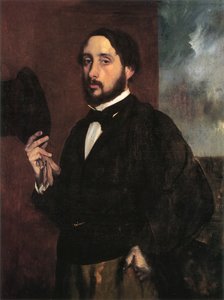
Hilaire-Germain-Edgar De Gas (1834–1917) was a French artist whose groundbreaking approach to painting challenged conventional artistic norms. Initially drawn to classical art through meticulous copying in the Louvre, Degas swiftly embraced Impressionism’s revolutionary techniques—abandoning academic conventions for spontaneous brushstrokes and capturing fleeting moments of light and atmosphere.
His early life provided him with considerable privilege – his father was a banker, affording him access to education and artistic training. However, Degas possessed an innate restlessness that propelled him beyond formal instruction, fostering a lifelong fascination with observation and experimentation.
Pitanja i odgovori
Gde se danas može videti delo „Упитник абсента”, autor Хилари Жермен Едгар Дегас?
Delo „Упитник абсента”, autor Хилари Жермен Едгар Дегас je izloženo u muzeju Muzej d'Orsej, Paris, France. Navod o muzeju odnosi se na originalno delo, a ne na reprodukcije.
Koliko je popularno delo "Упитник абсента" unutar pokreta impressionist realism?
„Упитник абсента”, autor Хилари Жермен Едгар Дегас se klasifikuje kao kultne i pripada pokretu impressionist realism.
Šta objašnjava status autorskih prava za „Упитник абсента”, autor Хилари Жермен Едгар Дегас?
"Упитник абсента" autora Хилари Жермен Едгар Дегас je u u javnom vlasništvu – autorska prava su istekla. Autorska prava se računaju od godine smrti umetnika, a Хилари Жермен Едгар Дегас je preminuo/la 1917.
 Pregledaj u prostoru
 Pošalji
 Podeli
 Detalji o delu
 Vodič
Vodič

 Preuzmi
 Slični predmeti
 Rendgenski snimak
 Automatska prezentacija
 Pitanja i odgovori
 Statistika