Pregledaj u prostoru
 Pošalji
 Podeli
 Detalji o delu
 Vodič
Vodič

 Preuzmi
 Slični predmeti
 Rendgenski snimak
 Automatska prezentacija
 Pitanja i odgovori
 Statistika
Карнавал вечера

- 117.0 x 90.0 cm


 Pročitaj više
Giclee štampa / Umetnički otisak
Giclée štampa ili print na platnu muzejskog kvaliteta uz brzu izradu i raznovrsne opcije završne obrade. ( Kupite ručno oslikano delo Pređi na digitalnu sliku)




P118B дин10

P118H дин10

P118W дин10

P438Z дин10

P508JH дин12

P508YH дин12

P805H дин10

P805Z дин10

P919BZ дин10

P919G дин10

P919XJ дин10

P959ZH дин10

P968JZ дин12

W106C дин8

W218G дин10

W218JH дин8

W218Y дин10

W307PJ дин10

W316G дин10

W316PJ дин8

W316Y дин10

W398PJ дин8

W4111J дин10

W500HY дин15

W500JH дин15

W692G дин12

W849H дин8

W940BG дин15

W953PJ дин8




Izaberite jednu od naših unapred definisanih veličina koje odgovaraju originalnim proporcijama umetničkog dela.

Unesite željenu širinu i visinu kako bi se štampa uklopila u vaš ram ili zid. Štampu je moguće samo iseći, ali nikada povećati iznad dimenzija originalne slike, stoga format sa drugačijim proporcijama uzrokuje gubitak dela slike. Pre početka štampe, poslaćemo vam digitalni prikaz radi potvrde. Slika prikazana na ovoj stranici ne predstavlja stvarni isrez — to pokazuje samo digitalni prikaz.
Dostava širom sveta () za 2 nedelje umesto uobičajenih 4/5 nedelja. (8 новембар)

Besplatna ekspresna dostava širom sveta

Visokokvalitetno laneno platno

Potpuno osiguranje transporta

Garancija povraćaja carine i uvoznih dažbina

Garancija vernosti boja

Politika povraćaja u roku od 100 dana (samo u slučaju nedostataka)

Garancija povrata 100% novca

Popust na više proizvoda
 Opcija sa staklom dostupna je samo za dimenzije manje od 110 cm

Карнавал вечера
Giclee štampa / Umetnički otisak
Dimenzije reprodukcije
-


Ukupna cena
дин 8485
Henri Rousseau: A Vision of Untouched Paradise
Henri Emile Rousseau (1875 – 1933) stands as one of the most singular figures in French Impressionism and Post-Impressionism—a painter who resolutely rejected prevailing artistic trends to forge his own distinctive path, characterized by uncompromising devotion to Naïve Art. His canvases depict fantastical landscapes populated by animals and humans rendered with childlike simplicity and vibrant color palettes, transporting viewers into dreamlike realms brimming with symbolic resonance. Rousseau’s upbringing in a working-class family instilled in him a deep appreciation for the natural world and folklore—influences that would profoundly shape his artistic vision. Despite facing considerable skepticism from critics of his time—who dismissed his style as amateurish—Rousseau persevered, establishing himself as one of France's most distinctive painters and securing a place among the pioneers of Modern Art.Early Life & Artistic Beginnings: The Seeds of Rebellion
Rousseau’s formal artistic training was minimal; he eschewed the rigorous academic curriculum championed by the Académie des Beaux-Arts, opting instead for self-education fueled by an ardent fascination with primitive art and mythology. This deliberate rejection of convention wasn't a lack of skill—but rather a conscious decision—a profound affirmation of personal vision. His early artistic explorations centered on sketching botanical specimens and animal studies—exercises that honed his observational abilities and cultivated a meticulous attention to detail, qualities he would later translate into breathtaking depictions of the jungle environment. These formative experiences instilled in him an unwavering belief in the expressive power of unfiltered observation—a conviction that would underpin his entire oeuvre.A Carnival Evening: Decoding Rousseau’s Surreal Landscape
“A Carnival Evening,” completed in 1886, exemplifies Rousseau's unparalleled mastery of Naïve Art—specifically Primitivism. This monumental canvas, currently housed at the Philadelphia Museum of Art, transcends mere representation; it invites contemplation on themes of desire, escape, and the complexities of human experience. The scene unfolds beneath a colossal moon casting an ethereal glow upon a desolate forest landscape—a composition dominated by vertical lines created by towering trees that contrast sharply with the horizontal expanse of the sky. Rousseau’s meticulous rendering of foliage and fabric is striking—creating a captivating tension against the painting's surreal elements. At first glance, we observe a formally dressed couple strolling along a path—yet beneath this seemingly straightforward depiction lies a rich tapestry of symbolism. The brightly illuminated hot air balloon, populated with shadowy figures, floats ethereally above—a potent emblem of aspiration, escape from earthly constraints, or perhaps a detachment from reality itself. Conversely, the dark and imposing forest represents the unknown, the subconscious, and potentially, isolation. Rousseau’s masterful use of color—primarily muted blues and browns—further amplifies the painting's melancholic atmosphere.Symbolism & Emotional Resonance: Beyond Literal Illusion
Rousseau’s artistic vision wasn’t concerned with achieving photographic accuracy—but rather with conveying emotion through stylized forms and evocative imagery. He deliberately flattened perspective, eliminating depth cues to heighten the painting’s dreamlike quality—a technique characteristic of Primitivist art that prioritizes psychological impact over visual realism. The inclusion of a ghostly figure hovering above the couple underscores Rousseau's preoccupation with spiritual themes—suggesting an awareness of forces beyond human comprehension. Furthermore, the luminous moon serves as a timeless emblem of mystery, intuition, and feminine grace—illuminating the scene with a gentle radiance that imbues it with profound emotional resonance. “A Carnival Evening” remains a testament to Rousseau’s unwavering belief in the transformative power of art—a masterpiece that continues to captivate audiences worldwide with its haunting beauty and enduring symbolic depth.- Artist: Henri Emile Rousseau
- Born Year: 1875
- Death Year: 1933
- Birth City: None
- Birth Country: None
- Useful Links: Explore the captivating world of Henri Rousseau, the celebrated Naïve artist who challenged academic traditions with his unique jungle scenes & dreamlike symbolism. Discover his lasting influence on modern art and collecting today.Explore Henri Rousseau
- Useful Links: Explore Henri Rousseau (Le Douanier), the celebrated French Post-Impressionist & Naïve artist. Discover his unique jungle scenes, dreamlike symbolism, and lasting influence on modern art.Explore Henri Rousseau
- Useful Links: Find more prominent pieces of genre painting at Wikiart.org.WikiArt.org
Pitanja i odgovori
Kakvu atmosferu odiše "Карнавал вечера"?
„Карнавал вечера”, autor Henri Emilien Rousseau se opisuje kao delo Mistična raspoloženja. Ovakva klasifikacija može pomoći u uklapanju dela u određeni ambijent.
Od čega je izrađeno "Карнавал вечера" i u kom stilu?
„Карнавал вечера”, autor Henri Emilien Rousseau spaja tehniku Ulje na platnu sa stilom Naive Surrealism. Tehnika i pravac opisuju način izrade i stil dela.
Koji je tehnički postupak korišćen za delo "Карнавал вечера" i kolikih je dimenzija?
Originalno delo „Карнавал вечера”, autor Henri Emilien Rousseau je rad u tehnici Ulje na platnu dimenzija 117 x 90 cm. Tehnika i dimenzije se odnose na originalni predmet.
Biografija umetnika
Henri Emile Rousseau (1875 – 1933): The Enchanted Vision of Primitive Beauty
Henri Emile Rousseau, born in Lyon, France, in 1875, defied the conventions of Impressionism and Post-Impressionism to forge a singular artistic path—one characterized by an uncompromising embrace of Naïve Art. His canvases depict fantastical landscapes populated by animals and humans rendered with childlike simplicity and vibrant color palettes, transporting viewers into dreamlike realms brimming with symbolic resonance. Rousseau’s upbringing in a working-class family instilled in him a deep appreciation for the natural world and folklore, influences that would profoundly shape his artistic vision. Despite facing considerable skepticism from critics of his time—who dismissed his style as amateurish—Rousseau persevered, establishing himself as one of France's most distinctive painters and securing a place among the pioneers of Modern Art.- Early Life & Artistic Beginnings: Rousseau’s formal artistic training was minimal; he largely self-taught, honing his skills through sketching outdoors and studying prints. He initially pursued commercial illustration work to support himself, but his passion for painting remained unwavering.
- The Influence of Primitive Art: Rousseau's fascination with African masks and tribal art—particularly those collected by Alexandre Cabanel—served as a catalyst for his stylistic evolution. These artworks captivated him with their bold colors, stylized forms, and rejection of academic realism, inspiring him to abandon traditional techniques in favor of a more direct and expressive approach.
- Key Paintings & Artistic Style: Rousseau’s oeuvre is dominated by monumental landscapes infused with mythological elements and populated by animals imbued with spiritual significance. Notable works include “The Sleeping Venus” (1890), “The Promised Land” (1893), “The Concert” (1897), and “The Shepherdess,” which exemplifies his signature style—characterized by flattened perspectives, luminous colors, and a deliberate blurring of outlines.
- Recognition & Legacy: Despite initial rejection by the Parisian avant-garde, Rousseau gained recognition in 1905 thanks to the patronage of Ambroise Vollard, who championed his work and secured exhibitions at Galerie Bernheim-Jeune. His paintings gradually attracted admirers among artists like Picasso and Matisse, cementing his reputation as a visionary artist whose uncompromising vision anticipated Surrealism.
- Death & Enduring Influence: Rousseau died in Étampes in 1933, leaving behind a legacy of approximately 800 paintings—a remarkable achievement considering his unconventional methods. His distinctive Naïve Art style continues to inspire artists today, demonstrating the enduring power of imagination and the beauty found in unfiltered observation.
Exploring Rousseau’s Palette & Technique
Rousseau's artistic technique was remarkably simple yet profoundly effective. He eschewed meticulous detail, opting instead for bold brushstrokes and vibrant hues—often achieved through layering thin glazes of color onto a toned ground. This method allowed him to capture the essence of his subjects with remarkable immediacy and luminosity, conveying emotion and atmosphere as much as visual representation. His use of complementary colors—such as reds and greens—created striking contrasts that heightened the dramatic impact of his compositions. Furthermore, Rousseau’s deliberate flattening of perspective—a technique borrowed from African art—reinforced the dreamlike quality of his landscapes and contributed to their captivating allure.
Henri Emilien Rousseau
1875 - 1933
Osnovne informacije
- Full Name: Henri Émile Rousseau
- Nationality: French
- Date Of Birth: 1875
- Date Of Death: 1933
- Place Of Birth: Nancy, France
- Notable Artworks:
- A Carnival Evening
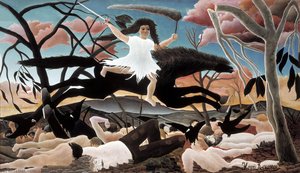
- War or The Ride of Discord
- Fantasia de mariage
- Artistic Movement Or Style: Naive Art
- Artists Who Influenced This Artist:
- Gustave Moreau
- Pierre Puvis de Chavannes
- Artists Or Movements Influenced By This Artist: ['Symbolism']
Povezani članci

Naive Art Unveiled: The Charming Beauty of Simple Masterpieces
Discover the enchanting world of Naive Art. Explore the profound beauty of self-taught masters like Henri Rousseau through an art-history lens, uncovering how simple forms and vibrant colors create timeless, soulful masterpieces for the discerning collector.
Henri Rousseau: Primitivism, Paradox & Subversion of Academic Tradition
Explore the captivating world of Henri Rousseau, the celebrated Naïve artist who challenged academic traditions with his unique jungle scenes & dreamlike symbolism. Discover his lasting influence on modern art and collecting today.

The Untamed Vision: Exploring Naïve Art & Primitivism's Rejection of Convention
Explore the revolutionary world of Naïve Art & Primitivism! Discover how artists challenged academic traditions with raw emotion & unique styles. Learn about Picasso, Rousseau & more at OriginalUniqueArt.
Fauvism's Boldest Visions: 10 Masterpieces That Revolutionized Modern Art | OriginalUniqueArt
Explore 10 Fauvist masterpieces by Matisse, Derain & Vlaminck that ignited Modern Art! Discover bold colors, expressionist landscapes & the history of this revolutionary movement. Find museum-quality prints at OriginalUniqueArt.com.

Henri Matisse: 25 Remek-dela koji definišu boju i modernu umetnost | OriginalUniqueArt
Uronite u svet Henri Matissea! Istražite 25 remek-dela Fauvizma i moderne umetnosti. Otkrijte priče iza slika, tehnike i inspiraciju slavnog francuskog slikara. Reprodukcije vrhunskog kvaliteta dostupne na OriginalUniqueArt.com.