
 Kupi štampu Naručite reprodukciju
 Pošalji
 Podeli
 Detalji o delu
 Dodaj u omiljene

 Преузми
 Slični predmeti
 Rendgenski snimak
 Slajdovi
Strip
 Acrylic On Paper
- Other
- Op Art
 2013
2013- Contemporary
 200.0 x 1000.0 cm
 Pročitaj više
Kupite digitalnu sliku visoke rezolucije i poboljšanog kvaliteta, koja je znatno superiornija od onoga što vidite u online prikazu.
Svaka datoteka je pedantno pripremljena od strane naših stručnjaka koristeći napredne alate i profesionalnu ručnu retušu. Osiguravamo da svaka slika ima izuzetnu oštrinu, preciznu reprodukciju boja i fine detalje.
Konačna datoteka se dostavlja putem e-pošte u roku od 72 sata, optimizovana za neposrednu upotrebu u profesionalnim, izdavačkim i štamparskim okruženjima. To je isti kvalitet kojem veruju vrhunski studiji dizajna, izdavači i galerije.
Digitalna slika
Preuzmite datoteku visoke rezolucije za ličnu upotrebu, štampanje i kreativne projekte.
Uključeno uz svaku porudžbinu digitalne slike
Profesionalna digitalna isporuka, zagarantovana
Kada odaberete OriginalUniqueArt.com, ne dobijate samo sliku – vi primate profesionalno unapređeno digitalno umetničko delo, izrađeno sa najvećom preciznošću i uz garanciju zadovoljstva. Evo svega što automatski dolazi uz vašu porudžbinu:

Brza dostava putem e-pošte
Vaša digitalna slika visoke rezolucije biće vam poslata putem e-pošte u roku od 72 sata od poručivanja – spremna za trenutnu upotrebu.

Digitalna datoteka unapređena veštačkom inteligencijom
Vaše umetničko delo je profesionalno optimizovano korišćenjem naprednih AI alata i ručne obrade, čime se osiguravaju maksimalni detalji, oštrina i preciznost boja.

Besplatna ponovna isporuka doživotno
Slučajno ste obrisali ili izgubili svoju datoteku? Ne brinite – poslaćemo vam je ponovo u bilo kom trenutku, potpuno besplatno.

Bez troškova uvoza – zauvek
Uživajte u svojim umetničkim delima trenutno, bez carine, dažbina ili troškova dostave – digitalni download je uvek bez poreza.

Garancija vernosti boja
Uz pomoć profesionalnih alata i upravljanja bojama, osiguravamo da vaša digitalna slika što vernije odražava originalne boje.

Garancija zadovoljstva u roku od 60 dana
Ako niste zadovoljni svojom digitalnom slikom, revidirat ćemo je ili vratiti 100% novca u roku od 60 dana – bez ikakvih pitanja.

100% garancija povrata novca
Niste zadovoljni? Obezbedite pun povrat novca u roku od 60 dana od trenutka kada ste primili svoju digitalnu datoteku – bez suvišnih pitanja.

Popusti na velike porudžbine
Kupite 3 slike, uštedite 10% - Kupite 5 slika, uštedite 15% - Kupite 10+ slika, uštedite 20%. Odlično za kreativne projekte, galerije i agencije.
Opis kolekcionarskog dela
The Enigmatic Strip: A Window into Richter’s World
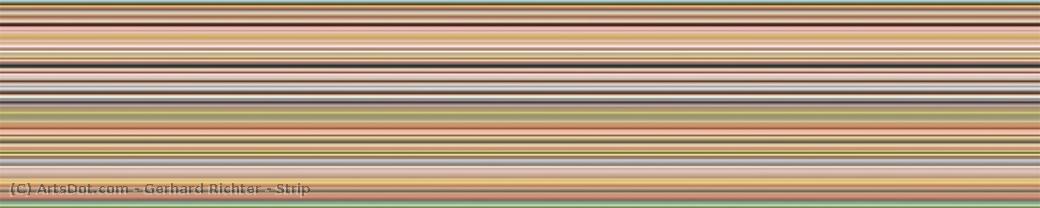
Gerhard Richter's "Strip," a monumental work from 2013, isn’t merely a painting; it’s an invitation to contemplate the very nature of perception and representation. Measuring a substantial 200 x 1000 cm, this acrylic on paper piece immediately commands attention with its bold, almost aggressively simple composition – a series of horizontal bands in varying shades of brown and orange. Yet, beneath this apparent austerity lies a complex interplay of color, texture, and the subtle suggestion of depth that speaks volumes about Richter’s signature style and his ongoing exploration of photographic source material.
The painting firmly places itself within the realm of Op Art, though Richter's approach transcends mere visual stimulation. The stripes aren’t static; they subtly shift and morph depending on the viewer’s perspective, creating a dynamic illusion that plays with our sense of space and form. This effect is achieved through careful manipulation of color intensity and value – a technique rooted in Richter’s decades-long fascination with photography and his method of layering multiple photographic sources to create abstract compositions.
A Legacy Forged in Division
Understanding "Strip" requires acknowledging the profound context of Gerhard Richter's life and career. Born in Dresden, Germany, in 1932, Richter’s early years were profoundly shaped by the political upheavals of post-war Europe. His childhood was marked by displacement and uncertainty, experiences that undoubtedly informed his artistic sensibility – a willingness to question, to deconstruct, and to embrace ambiguity. This formative period instilled within him a deep sense of questioning and a constant negotiation with the fragmented realities of his time.
Richter’s work is inextricably linked to this history of division. His exploration of memory, representation, and the photographic image can be seen as an attempt to grapple with the complexities of German identity in the aftermath of World War II and the subsequent decades of political and social transformation. The painting's restrained palette and deliberate abstraction mirror a certain emotional distance, reflecting Richter’s characteristic refusal to offer easy answers or definitive interpretations.
Decoding the Technique: Layers of Illusion
The seemingly effortless execution of "Strip" belies a meticulous process. Richter typically works with multiple photographic sources, creating composite images that are then translated into abstract paintings. In this instance, he likely employed a technique of layering and blending acrylics to achieve the subtle shifts in color and value that define the work’s visual dynamism. The textured surface – a result of these layered applications – adds another layer of complexity, inviting close inspection and encouraging viewers to lose themselves within its intricate details.
The choice of brown and orange is particularly significant. These earthy tones evoke a sense of warmth and grounding, yet their juxtaposition creates an underlying tension—a subtle discordance that mirrors the complexities of the historical context in which Richter operates. The stripes themselves act as visual anchors, guiding the eye across the canvas and creating a rhythmic pattern that simultaneously draws us in and keeps us at arm’s length.
A Reflection on Perception and Memory
Ultimately, "Strip" is more than just a visually striking composition; it's an invitation to contemplate the nature of perception and memory. Richter’s work consistently challenges our assumptions about representation, forcing us to question how we see and interpret the world around us. The painting’s ambiguous forms and shifting colors create a sense of unease—a feeling that something is just beyond our grasp. It's a testament to Richter's skill as an artist: he doesn’t offer solutions but rather presents us with questions, inviting us to engage in a dialogue with his work and with ourselves.
Biografija umetnika
A Life Shaped by Division: The Early Years and Artistic Formation of Gerhard Richter
Gerhard Richter’s artistic journey began in Dresden, Germany, amidst the turbulent backdrop of postwar Europe and the looming shadow of Soviet influence. Born on February 9, 1932, his childhood was profoundly impacted by displacement – his family repeatedly relocated during the Nazi era and subsequently under communist rule—experiences that instilled within him a fundamental preoccupation with uncertainty and questioning. The idyllic landscapes of Reichenau and Waltersdorf, initially formative environments for his artistic sensibilities, dissolved into conflict as Dresden endured siege during World War II, leaving indelible scars on his psyche. His father, Wilhelm Richter, was a schoolteacher who navigated the complexities of life under authoritarian pressure, while his mother, Elise Richter-Schröder, nurtured a love for literature and music within their household—a duality that would become a defining characteristic of Richter’s own artistic approach. Early Artistic Training: Socialist Realism's Constraints Richter commenced formal training at Dresden Academy of Fine Arts in 1951, initially immersed in the dominant stylistic conventions of socialist realism – a mandated aesthetic aimed at glorifying communist ideology and portraying idealized depictions of Soviet life. Despite this imposed framework, Richter harbored an innate desire for artistic freedom—a yearning to transcend ideological boundaries and explore more expansive creative horizons. He recognized that true expression demanded resistance to dogma, prompting him to actively seek alternative paths beyond the prescribed norms. This awareness fueled his determination to develop a distinctive visual language, one rooted in observation and experimentation rather than adherence to predetermined formulas. The Düsseldorf Breakthrough: Embracing Experimentation and Dissidence A pivotal moment arrived in 1961 when Richter, alongside Marianne Eufinger, courageously defied communist restrictions and fled East Germany for Düsseldorf—a city brimming with artistic dynamism and intellectual ferment. This relocation represented a radical transformation of his artistic trajectory, liberating him from the constraints of socialist realism and immersing him in an environment where innovation was not merely tolerated but actively championed. Düsseldorf became Richter’s crucible—a space where he dismantled conventional stylistic conventions and embarked on a period of intense exploration that would solidify his early mature work. He swiftly rejected the rigid aesthetic dictates of socialist realism, embracing instead a multifaceted approach encompassing photorealism, abstraction, and chance operations—techniques that challenged established artistic paradigms and interrogated the very nature of representation. Photorealism's Paradox: Replication and Reflection Richter’s fascination with photorealism stemmed from his conviction that meticulous reproduction could illuminate deeper truths about reality—a paradoxical assertion given the inherent limitations of photographic illusion. He painstakingly recreated images sourced from family photographs or newspaper clippings, employing techniques honed to an astonishing degree of precision—capturing minute details with unwavering accuracy. However, Richter’s photorealistic paintings transcended mere imitation; they functioned as meditations on perception and memory—inviting viewers to contemplate the subjective experience of seeing and remembering. By confronting photographic illusion head-on, he exposed its inherent ambiguities and questioned its ability to convey complete objectivity—a stance that resonated powerfully with fellow artists grappling with similar dilemmas. Abstraction's Embrace: Chance and Gestural Freedom Alongside photorealism, Richter pursued abstraction—creating canvases layered with vibrant colors and dynamic brushstrokes—techniques that prioritized gestural freedom over precise control. He recognized that artistic expression could flourish beyond the confines of representational accuracy—embracing spontaneity and unpredictability as fundamental principles. His pioneering use of squeegees—tools typically employed for cleaning windows—added another dimension to his artistic practice—manipulating paint in ways that defied conventional expectations and yielding unexpected textural effects. This embrace of chance—a deliberate relinquishment of control—served as a catalyst for innovation, propelling Richter’s work into uncharted territories of visual language. Legacy and Influence: Shaping Contemporary Art's Landscape Gerhard Richter’s enduring legacy extends far beyond the realm of artistic achievement—he fundamentally reshaped the landscape of contemporary art by challenging established conventions and redefining notions of stylistic coherence. His unwavering commitment to experimentation—coupled with his profound engagement with historical and political themes—established him as one of the most influential artists of our time. He resisted categorization—rejecting attempts to confine his work within a single stylistic framework—a stance that underscored his conviction that artistic exploration demanded boundless curiosity and intellectual rigor. Richter’s influence can be seen in countless artworks produced by subsequent generations of artists—drawn to his innovative techniques and his fearless interrogation of artistic norms—demonstrating the enduring power of his vision. He remains a beacon of creativity—inspiring audiences worldwide with his challenging and deeply resonant oeuvre—a testament to his transformative contribution to art history.
Георг Рихтер
1932 - , Германија
Kratke činjenice
- Artistic Movement Or Style:
- Фотореализам
- Абстракција
- Artists Who Influenced This Artist:
- Жан Арп
- Пабло Пикассо
- Date Of Birth: 9 фебруара 1932.
- Full Name: Gerhard Richter
- Nationality: Германија
- Notable Artworks:
- Абстрактно сликарство 610-1
- Gilbert
- С. са дететом
- Place Of Birth: Дрезден, Германија

