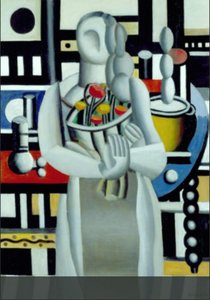
Ulje na platnu
 Sve o delu The dance







































 Za umetnička dela ili reprodukcije čija je bilo koja strana veća od 105 cm (približno 41 inč), okvir će biti isporučen u obliku rastavljenog seta za sklapanje. Ovaj metod osigurava bezbednu dostavu i sprečava oštećenja tokom transporta.


A Rhythmic Convergence of Form and Motion
Fernand Léger’s 1932 masterpiece, The Dance, serves as a breathtaking window into the heart of the modern era. At first glance, the viewer is swept up in a whirlwind of activity, where figures are caught in various states of repose and exuberant movement. It is not merely a depiction of a gathering; it is a carefully orchestrated symphony of geometric shapes. Léger, often celebrated as a Geometric Surrealist, eschews traditional anatomical precision in favor of cylinders, cubes, and bold lines. This reduction of the human form into architectural elements creates a mesmerizing rhythm that mirrors the very pulse of life itself. The composition vibrates with an energy that feels both primal and profoundly modern, inviting the observer to lose themselves in the swirling patterns of the dancers.The Tactile Brilliance of Faceted Painting
Beyond the striking composition lies a technical mastery that demands close inspection. Léger utilized a technique known as faceted painting, applying thick, deliberate layers of pigment to create a surface that possesses its own physical presence. The palette is unapologetically bold, dominated by primary reds, yellows, and blues that clash and harmonize with startling intensity. These vibrant hues are set against cooler, more muted backgrounds, creating a sense of depth despite the intentional flattening of perspective. For the collector or interior designer, this texture offers a captivating sensory experience; when captured in a high-quality reproduction, the interplay of light across these simulated thick strokes brings a dynamic, sculptural quality to any wall, making it a centerpiece of modern decor.Echoes of the Machine Age
To understand The Dance is to understand the tension of the early twentieth century. Amidst the swirling figures, Léger integrates objects that speak to the burgeoning industrial landscape—clocks, sports equipment, and mechanical shapes that suggest a world increasingly defined by technology. This juxtaposition of organic human movement with rigid, man-made objects reflects the artist's fascination with the Machine Age. There is a profound symbolism in how the figures seem both part of and distinct from their mechanical surroundings, capturing the era's struggle to find humanity within an increasingly automated reality. It is this complex emotional layer—the balance between chaos and order, nature and industry—that gives the painting its enduring power, making it an essential piece for those who appreciate art that challenges the intellect while stirring the soul.Pitanja i odgovori
Da li je The dance ručno oslikano ili odštampano?
Ručno oslikano: profesionalni umetnik kopira The dance uljanim bojama na platnu od lana.
Koju veličinu treba da odaberem za The dance?
Dimenzije se kreću od 34.8 x 28.7 cm (дин20925) do 242.0 x 199.7 cm (дин185393); tabela na ovoj stranici navodi glavne korake i njihove cene.
Koliko dugo traje dostava?
Isporuka traje od 4 do 5 nedelja, uz besplatnu ekspresnu dostavu širom sveta; na ovoj stranici je ponuđena opcija hitne proizvodnje. Možete ga vratiti u roku od 100 dana uz pun povraćaj sredstava, bez ikakvih uslova.
Koji je medij koristio/la Fernan Leže za delo The dance?
Oil On Canvas
 Pregledaj u prostoru

 Pošalji
 Podeli
 Detalji o delu
 Informativni list


 Preuzmi
 Slični predmeti
 Rendgenski snimak
 Automatska prezentacija
 Pitanja i odgovori

 Statistika