Pređi na štampu
 Pročitaj više







































 Za umetnička dela ili reprodukcije čija je bilo koja strana veća od 105 cm (približno 41 inč), okvir će biti isporučen u obliku rastavljenog seta za sklapanje. Ovaj metod osigurava bezbednu dostavu i sprečava oštećenja tokom transporta.


Belle-Alliance Platz, Berlin: A Dynamic Expressionist Vision
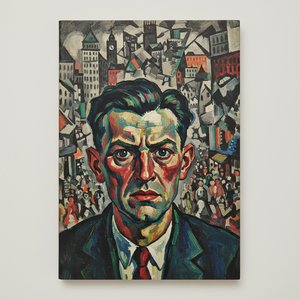
Belle-Alliance Platz, Berlin – more commonly known as Bebelplatz – stands as a poignant emblem of German Expressionism’s preoccupation with the anxieties and uncertainties of modernity. Painted by Ernst Ludwig Kirchner in an unknown date, this monumental canvas transcends mere depiction; it strives to convey a visceral experience of urban life, capturing its unsettling dynamism and psychological resonance. Kirchner's masterful manipulation of color and form embodies the core tenets of the movement, rejecting academic realism for a subjective portrayal rooted in emotion.The Expressionist Technique: Thick Brushstrokes and Bold Color
Kirchner’s artistic approach is immediately identifiable as deeply embedded within Expressionism. He eschews meticulous detail, prioritizing expressive lines that pulsate with energy and tension. The thick impasto technique—characterized by heavily textured paint application—dominates the surface of the canvas, creating a palpable sense of physicality and immediacy. This deliberate disregard for conventional representation serves not to diminish skill but rather to amplify the emotional impact of the scene. As seen in the photograph accompanying this description, Kirchner’s brushstrokes are visible, conveying an artist's hand and underlining the artwork's raw emotive power. The color palette—primarily yellows, greens, and blues punctuated by grey and brown—is deliberately jarring, diverging sharply from naturalistic hues. Yellows illuminate the foreground, symbolizing warmth and optimism amidst the pervasive gloom of the cityscape, while greens dominate architectural elements and foliage, representing vitality struggling against decay. Blues permeate the sky and building facades, reflecting a melancholic contemplation of the urban environment’s vastness and indifference.A Fragmented Landscape: Composition and Perspective Distortion
The composition itself contributes significantly to the artwork's expressive character. Kirchner employs a layered approach, positioning buildings receding into the background against which figures inhabit the midground and foreground. A towering monument—likely referencing historical significance—occupies the central space, acting as a focal point that draws the viewer’s gaze upwards. Architectural elements like arches frame the lower portion of the image, guiding the eye and enhancing depth perception. However, Kirchner deliberately disrupts linear perspective, tilting buildings and skewing architectural lines to create a disconcerting effect mirroring the psychological disorientation experienced in modern urban spaces. This stylistic choice underscores Expressionism's preoccupation with conveying emotional truth rather than objective visual accuracy.Symbolic Resonance: Anxiety and Alienation
Beyond its formal qualities, “Belle-Alliance Platz” resonates with profound symbolic meaning. The densely populated square embodies the impersonal nature of urban life—a realm where individuals exist alongside each other yet remain fundamentally isolated. Kirchner’s distorted forms and unsettling color palette evoke feelings of anxiety, tension, and alienation – emotions prevalent in the artistic milieu of Weimar Germany during Kirchner's time. The monument itself serves as a reminder of history’s burdens and complexities, prompting contemplation on themes of memory and trauma. Ultimately, Kirchner’s masterpiece invites viewers to confront not just what they see but also what they feel—a testament to Expressionism’s enduring power to communicate profound psychological states.Pitanja i odgovori
U kom delu doma bi se reprodukcija dela "Belle-Alliance Platz, Berlin" lepo uklopila?
Reprodukcija dela "Belle-Alliance Platz, Berlin" odlično se uklapa u Dnevna soba.
Kakvo je opšte raspoloženje dela „Belle-Alliance Platz, Berlin”, autor Ерnst Лудвиг Киршнер?
„Belle-Alliance Platz, Berlin“ odiše Dramatično atmosferom.
Koliko ljudi posmatra "Belle-Alliance Platz, Berlin"?
Stranica Statistika za delo „Belle-Alliance Platz, Berlin”, autor Ерnst Лудвиг Киршнер prikazuje statistiku javnih poseta: mesečni broj poseta ovom umetničkom delu, poređenje sa najgledanijim radovima ovog umetnika i poreklom posetilaca.
 Pregledaj u prostoru
 Pošalji
 Podeli
 Detalji o delu
 Vodič
Vodič

 Preuzmi
 Slični predmeti
 Rendgenski snimak
 Automatska prezentacija
 Q&A
Q&A Statistika