Pređi na štampu
 Pročitaj više







































 Za umetnička dela ili reprodukcije čija je bilo koja strana veća od 105 cm (približno 41 inč), okvir će biti isporučen u obliku rastavljenog seta za sklapanje. Ovaj metod osigurava bezbednu dostavu i sprečava oštećenja tokom transporta.


Diego Rodríguez de Silva y Velázquez’s Democritus: A Portrait of Philosophical Contemplation
Diego Rodríguez de Silva y Velázquez, hailed as “The Master of Light and Shadow,” stands apart in the annals of Spanish art—not merely for his prolific output but for a revolutionary approach to portraiture that profoundly influenced generations of painters. Born in Seville in 1599, Velázquez’s artistic journey coincided with Spain's Golden Age, an era characterized by imperial grandeur and unparalleled cultural dynamism, inextricably linking his oeuvre to the opulent atmosphere of the Habsburg court.
From humble beginnings as a royal painter’s apprentice, Velázquez ascended to become more than just a craftsman; he became a visual storyteller, meticulously documenting the lives of monarchs, courtiers, and ordinary citizens with an astonishing degree of realism and psychological acuity. His formative years under Francisco de Herrera el Viejo and, crucially, with Francisco Pacheco instilled in him a bedrock of classical learning and technical mastery—a foundation that would underpin his groundbreaking innovations.
A Study in Baroque Realism
Velázquez’s distinctive style is instantly recognizable: an unwavering commitment to capturing the nuances of human emotion and physicality through masterful observation. Unlike many contemporaries who relied on idealized representations, Velázquez prioritized accuracy, employing subtle gradations of light and color—a technique he termed “sfumato”—to create atmospheric depth and imbue his subjects with palpable presence. This approach was particularly evident in ‘Las Meninas,’ arguably his most celebrated masterpiece, where he achieved an unprecedented level of illusionistic realism.
The Portrait of Democritus: Symbolism and Context
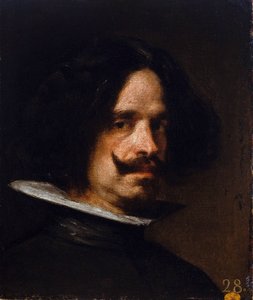
'Democritus,' painted around 1629, exemplifies Velázquez’s artistic vision. The portrait depicts the Greek philosopher Democritus, known for his atomic theory—the radical notion that matter is composed of indivisible particles—a concept that challenged prevailing philosophical dogma of the time. Velázquez portrays Democritus with a serene smile, gazing directly at the viewer, conveying an aura of quiet contemplation and intellectual curiosity.
The composition itself speaks volumes about Velázquez’s artistic sensibilities. Set against a muted wall adorned with a clock—a symbol of time and mortality—the portrait emphasizes the philosopher's inner life amidst the external pressures of courtly society. The inclusion of a globe subtly underscores Democritus’s interest in cosmology and his pursuit of knowledge beyond earthly concerns.
Emotional Resonance and Artistic Legacy
More than just a likeness, ‘Democritus’ captures something deeper—the essence of philosophical thought itself. Velázquez's masterful handling of light and shadow creates an atmosphere of intimacy and invites viewers to contemplate the subject’s inner world. This painting stands as a testament to Velázquez’s unparalleled ability to convey emotion through visual means, securing his place among the titans of Baroque art and influencing countless artists who followed.
Resources for Further Exploration
- Diego Rodríguez de Silva y Velázquez: https://www.wga.hu/html_m/v/velazque/02/0208vela.html
- João Joaquim Marques da Silva Oliveira: https://www.wga.hu/html_m/j/oliveira/02/0213oliva.html
- Musée des Beaux-Arts: https://www.wga.hu/html_m/m/musee-beau/02/0214museeau.html
- Musée des Beaux-Arts et de la Céramique: https://www.wga.hu/html_m/m/museeaucera/02/0215museeaucera.html
- Democritus by VELÁZQUEZ, Diego Rodriguez de Silva y: https://www.wga.hu/html_m/v/velazque/02/0208vela.html
Pitanja i odgovori
Šta predstavlja delo "Democritus"?
Teme prisutne u delu „Democritus”, autor Diego Velázquez obuhvataju portraiture, philosopher, greek mythology, baroque art, velázquez mastery, classical symbolism, intellectual portrait, što zajedno sažima suštinu ovog umetničkog dela.
Da li je zakonski dozvoljeno reprodukovati delo „Democritus”, autor Diego Velázquez koje se nalazi u muzeju Grand Palais?
Status autorskih prava za delo „Democritus”, autor Diego Velázquez je jasan: rad pripada u javnom vlasništvu – autorska prava su istekla. Njegovo prisustvo u muzeju Grand Palais ne menja taj status.
Koja veličina se preporučuje za "Democritus" u prostoriji tipa Living Room?
Za prostoriju kao što je Living Room, za delo "Democritus" preporučujemo štampu u veličini od Large.
 Pregledaj u prostoru
 Pošalji
 Podeli
 Detalji o delu
 Vodič
Vodič

 Preuzmi
 Slični predmeti
 Rendgenski snimak
 Automatska prezentacija
 Q&A
Q&A Statistika