Portret Питер Де Хох

100 najpoznatijih slika umetnika Питер Де Хох, izbor iz galerije

Ažurirano: октобар 2026 · rangirano prema našem koeficijentu popularnosti (pretrage, posete i porudžbine za svako delo) · 253 dela Питер Де Хох u našem katalogu

Ukratko

Od svih originala koje je Питер Де Хох ostavio, najpoznatiji je Žena Čitajući Pismo (1664), koji se nalazi u kolekciji Szépművészeti Múzeum, Budimpešta. Odmah za njima slede A Woman Peeling Apples (1663) i The Courtyard of a House in Delft (1658). Naš katalog sadrži 253 dela umetnika Питер Де Хох; galerija je čuvala 100 dela koja svet najviše admira, od kojih je svako prikazano sa svojim datumom, muzejom i pričom.

1629 – 1684, Ротердам Dutch golden age Najviše dela: Luvr

Top 10 slika umetnika Питер Де Хох: izbor galerije

1
Žena Čitajući Pismo (1664) čiji je Питер Де Хох

Žena Čitajući Pismo

1664 · Ulje na platnu · Szépművészeti Múzeum, Budimpešta

„Žena čitajući pismo“ Pietera de Hoocha, naslikana 1664. godine, predstavlja mnogo više od običnog prikaza domaćinstva; to je poziv u svet tihe kontemplacije i suptilne emocionalne rezonance. Ovo delo sažima samu suštinu holandskog zlatnog doba – perioda koji je slavljen zbog svog majstorstva u realizmu, pedantne pažnje posvećene detaljima i dubokog razumevanja svetlosti i senke. De Hooch nam ne prikazuje samo ženu koja čita; on nam omogućava da delimo njen…

2
A Woman Peeling Apples (1663) čiji je Питер Де Хох

A Woman Peeling Apples

1663 · Oil On Canvas · Wallace Collection, London

In the soft, diffused light of a Dutch interior, time seems to slow to a rhythmic, peaceful crawl. Pieter de Hooch’s “A Woman Peeling Apples,” completed around 1663, is far more than a mere depiction of household chores; it is a masterclass in the art of finding the extraordinary within the ordinary. The scene captures a tender, fleeting moment of domestic tranquility: a woman sits by the hearth, her focus…

3
The Courtyard of a House in Delft (1658) čiji je Питер Де Хох

The Courtyard of a House in Delft

1658 · Oil · National Gallery, London

In the quiet corners of seventeenth-century Delft, where the light of the Netherlands dances through narrow streets and over brickwork, Pieter de Hooch captured a world of profound domestic serenity. His 1658 masterpiece, The Courtyard of a House in Delft, serves as more than a mere depiction of architecture; it is an invitation into a sanctuary of peace. As one gazes upon this canvas, the bustle of the outside world…

4
A Woman Reading a Letter by a Window (1664) čiji je Питер Де Хох

A Woman Reading a Letter by a Window

1664 · Oil · Szépművészeti Múzeum, Budimpešta

A Moment Frozen in Time: Pieter de Hooch’s “Woman Reading a Letter” Pieter de Hooch's "Woman Reading a Letter by a Window," painted in 1664, isn’t merely a portrait; it’s a meticulously crafted tableau of domestic tranquility and quiet contemplation – a quintessential example of the Dutch Golden Age’s fascination with capturing fleeting moments of everyday life. The painting immediately draws the viewer into a softly lit interior, dominated by…

5
The Visit (detail) (1657) čiji je Питер Де Хох

The Visit (detail)

1657 · Oil On Panel · Metropoliten музеј у Њујорку, Њујорк

The air inside this room feels still, held in a quiet suspension as sunlight filters through window shutters to dance across the floor. In this corner of seventeenth-century Delft, a soft glow illuminates a scene of domestic intimacy. A woman sits at a table, her form bathed in a gentle radiance that catches the edge of her clothing and the subtle movement of her hands. Nearby, others linger in the…

6
Portrait of a Family in a Courrtyard in Delft (detail) (1658) čiji je Питер Де Хох

Portrait of a Family in a Courrtyard in Delft (detail)

1658 · Oil On Canvas · Academy of Fine Arts Vienna, Beč

In the quiet corners of the Dutch Golden Age, few artists possessed the ability to transform a mundane afternoon into a timeless meditation on domestic grace quite like Pieter de Hooch. His masterpiece, Portrait of a Family in a Courtyard in Delft, serves as more than just a window into a bygone era; it is an invitation to witness the profound beauty found within the ordinary. Painted around 1658, this…

7
In the Bedroom (1660) čiji je Питер Де Хох

In the Bedroom

1660 · Oil On Canvas · Staatliche Kunsthalle Karlsruhe, Karlsrue

Pieter de Hooch’s “In the Bedroom,” painted around 1660, isn’t merely a depiction of an interior; it’s a carefully constructed tableau of Dutch Golden Age life – a quiet meditation on motherhood, domesticity, and the subtle interplay of light and shadow. Within the confines of this modestly furnished room in Delft, De Hooch masterfully captures a fleeting moment of serene intimacy, inviting us to step into a world of understated…

8
Les joueurs de cartes čiji je Питер Де Хох

Les joueurs de cartes

Oil On Canvas · Luvr, Pariz

In the quiet corners of the seventeenth century, amidst the burgeoning prosperity of the Netherlands, Pieter de Hooch captured moments that felt both monumental and profoundly intimate. His masterpiece, Les joueurs de cartes (The Card Players), completed between 1663 and 1665, serves as a breathtaking window into the heart of the Dutch Golden Age. This is not merely a depiction of a casual pastime; it is an evocative study of…

9
A Dutch Courtyard (detail) (1659) čiji je Питер Де Хох

A Dutch Courtyard (detail)

1659 · Oil On Canvas · National Gallery of Art, Washington

In this oil on canvas, A Dutch Courtyard (detail) presents a quiet moment of domestic life and leisure. The work was painted by Pieter de Hooch in 1659. It offers a glimpse into the structured, everyday rhythms of the seventeenth century, focusing on the subtle interactions within a private space.

10
Company in an interior eating oysters (1681) čiji je Питер Де Хох

Company in an interior eating oysters

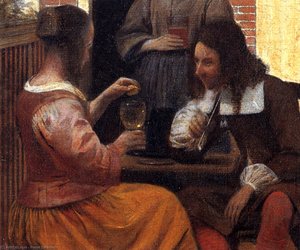
1681 · Oil On Canvas · Музеј Тисен-Борнемиза, Madrid

In this 1681 oil on canvas, we encounter Company in an interior eating oysters, a work by the Dutch artist Pieter de Hooch. The scene captures a moment of refined leisure within a luxuriously subdued interior. It is an example of the artist's late manner, characterized by a more restrained and angular gesture in the figures and a preference for a darker, more sophisticated tonality.

Izbor umetnika Питер Де Хох se nastavlja, od 11 do 100

11Village House (detail) (1665) čiji je Питер Де ХохVillage House (detail)1665 · Rijksmuseum 12Two women with a child in court (1657) čiji je Питер Де ХохTwo women with a child in court1657 · Toledo Museum of Art 13The bedroom, detalj 5, ngw (1660) čiji je Питер Де ХохThe bedroom, detalj 5, ngw1660 14Woman Peeling Vegetables in the Back Room of a Dutch House (1657) čiji je Питер Де ХохWoman Peeling Vegetables in the Back Room of a Dutch House1657 · Luvr 15Cardplayers in a Sunlit Room (1658) čiji je Питер Де ХохCardplayers in a Sunlit Room1658 · Royal Collection 16A soldier smoking a pipe (1650) čiji je Питер Де ХохA soldier smoking a pipe1650 · Philadelphia Museum of Art 17Woman reading a letter and a man at a window (1669) čiji je Питер Де ХохWoman reading a letter and a man at a window1669 · Nationalmuseum 18Man Offering a Glass of Wine to a Woman (1653) čiji je Питер Де ХохMan Offering a Glass of Wine to a Woman1653 · Ermitaž 19Young Woman Drinking (1658) čiji je Питер Де ХохYoung Woman Drinking1658 · Luvr 20The Mother (1660) čiji je Питер Де ХохThe Mother1660 · Rijksmuseum 21Woman and Child in a Courtyard (1660) čiji je Питер Де ХохWoman and Child in a Courtyard1660 · National Gallery of Art 22Portrait of a family of musicians (1663) čiji je Питер Де ХохPortrait of a family of musicians1663 23Elegant company playing cards (1660) čiji je Питер Де ХохElegant company playing cards1660 24Portrait of a Family (1656) čiji je Питер Де ХохPortrait of a Family1656 · Szépművészeti Múzeum 25Woman and Child in a Street (1658) čiji je Питер Де ХохWoman and Child in a Street1658 26Interior with a woman and a child; outside a maid is sweeping the yard (1655) čiji je Питер Де ХохInterior with a woman and a child; outside a maid is sweeping the yard1655 27Interior with 5 soldiers and armor on the wall (1658) čiji je Питер Де ХохInterior with 5 soldiers and armor on the wall1658 28A man and a serving woman behind a screen, with card players beyond (1660) čiji je Питер Де ХохA man and a serving woman behind a screen, with card players beyond1660 29Woman and child by a window, with a maid sweeping (1656) čiji je Питер Де ХохWoman and child by a window, with a maid sweeping1656 30Two soldiers with a serving woman and a boy in a tavern (1653) čiji je Питер Де ХохTwo soldiers with a serving woman and a boy in a tavern1653 31Woman with a glass of wine and a child in a garden (1659) čiji je Питер Де ХохWoman with a glass of wine and a child in a garden1659 32Soldiers with a Serving Maid in a Barn (1652) čiji je Питер Де ХохSoldiers with a Serving Maid in a Barn1652 · Philadelphia Museum of Art 33Soldiers with a serving woman and a flute player (1653) čiji je Питер Де ХохSoldiers with a serving woman and a flute player1653 · Galleria Borghese 34Interior with mother and child and a maid sweeping (1656) čiji je Питер Де ХохInterior with mother and child and a maid sweeping1656 35Two soldiers drinking with a serving woman (1650) čiji je Питер Де ХохTwo soldiers drinking with a serving woman1650 36Tavern interior with a seated soldier, seen from behind, with a serving woman, figures playing cards in the background (1652) čiji je Питер Де ХохTavern interior with a seated soldier, seen from behind, with a serving woman, figures playing cards in the background1652 37Courtyard with a Woman Spinning (1656) čiji je Питер Де ХохCourtyard with a Woman Spinning1656 · Royal Collection 38Bringer of Bad News (1655) čiji je Питер Де ХохBringer of Bad News1655 · Museu Nacional d'Art de Catalunya 39Liberation of St. Peter from prison (1650) čiji je Питер Де ХохLiberation of St. Peter from prison1650 40Soldier with maid and cardplayers in a tavern (1655) čiji je Питер Де ХохSoldier with maid and cardplayers in a tavern1655 · Wallraf-Richartz-Museum 41Maid with a Bucket and Broom in a Courtyard (1660) čiji je Питер Де ХохMaid with a Bucket and Broom in a Courtyard1660 · Staatliche Kunsthalle Karlsruhe 42The morning toilet of a young man (1656) čiji je Питер Де ХохThe morning toilet of a young man1656 43A Merry Company with a Trumpeter (1674) čiji je Питер Де ХохA Merry Company with a Trumpeter1674 · Gemäldegalerie 44A Woman and Child with a Serving Woman with Asparagus (1672) čiji je Питер Де ХохA Woman and Child with a Serving Woman with Asparagus1672 45Mother and Child with a Boy descending a Stair (1668) čiji je Питер Де ХохMother and Child with a Boy descending a Stair1668 · Kunsthalle Bremen 46A Wounded Man being Treated in a Stable (1667) čiji je Питер Де ХохA Wounded Man being Treated in a Stable1667 47A Woman Placing a Child in a Cradle (1665) čiji je Питер Де ХохA Woman Placing a Child in a Cradle1665 48A Woman with a Duck and a Woman with a Cabbage (1670) čiji je Питер Де ХохA Woman with a Duck and a Woman with a Cabbage1670 49An Elegant Company Making Music in a Vestibule, with a View of a City (1670) čiji je Питер Де ХохAn Elegant Company Making Music in a Vestibule, with a View of a City1670 50Musical Company on a Terrace with a View of the Amsterdam Town Hall (1667) čiji je Питер Де ХохMusical Company on a Terrace with a View of the Amsterdam Town Hall1667 51A Woman Receiving a Man in the Doorway (1669) čiji je Питер Де ХохA Woman Receiving a Man in the Doorway1669 · Hamburger Kunsthalle 52Interior with two women, two children and a parrot (1673) čiji je Питер Де ХохInterior with two women, two children and a parrot1673 53Man playing a lute and woman singing in an interior (1670) čiji je Питер Де ХохMan playing a lute and woman singing in an interior1670 54Man with a glass and a woman with a jug in an interior (1669) čiji je Питер Де ХохMan with a glass and a woman with a jug in an interior1669 · Bavarske državne slikopisne kolekcije 55Man with a glass and a jug and a woman lacing her bodice (1665) čiji je Питер Де ХохMan with a glass and a jug and a woman lacing her bodice1665 56Musical company with a dog in an interior (1674) čiji je Питер Де ХохMusical company with a dog in an interior1674 57Woman busy sewing in an interior (1665) čiji je Питер Де ХохWoman busy sewing in an interior1665 · Niedersächsisches Landesmuseum 58Portrait of a family on a terrace (1667) čiji je Питер Де ХохPortrait of a family on a terrace1667 59Man smoking and a young woman by a hearth (1662) čiji je Питер Де ХохMan smoking and a young woman by a hearth1662 60Young woman feeding a parrot, with a man and a serving woman (1669) čiji je Питер Де ХохYoung woman feeding a parrot, with a man and a serving woman1669 61Music making company with a monkey on a terrace (1669) čiji je Питер Де ХохMusic making company with a monkey on a terrace1669 62Merry Company in a Hall (1665) čiji je Питер Де ХохMerry Company in a Hall1665 · Statens Museum For Kunst 63Merry company with trumpeter in a distinguished interior (1670) čiji je Питер Де ХохMerry company with trumpeter in a distinguished interior1670 · Kraljevski muzeji fine umetnosti Belgije 64Two men and a young woman in a distinguished interior (1662) čiji je Питер Де ХохTwo men and a young woman in a distinguished interior1662 · Germanisches Nationalmuseum 65Interior with two embracing couples (1674) čiji je Питер Де ХохInterior with two embracing couples1674 66Interior with a woman reading and a child with a hoop (1664) čiji je Питер Де ХохInterior with a woman reading and a child with a hoop1664 67Interior with a woman knitting and a maid with a girl (1673) čiji je Питер Де ХохInterior with a woman knitting and a maid with a girl1673 · Guildhall Art Gallery 68Interior with a Woman sewing and a Child (1668) čiji je Питер Де ХохInterior with a Woman sewing and a Child1668 · Музеј Тисен-Борнемиза 69Game of Skittles (1666) čiji je Питер Де ХохGame of Skittles1666 · Cincinnati Art Museum 70Game of Skittles in a Garden (1666) čiji je Питер Де ХохGame of Skittles in a Garden1666 · Saint Louis Art Museum 71A Musical party (1667) čiji je Питер Де ХохA Musical party1667 · Hampton Court Palace 72A Sick Child (1670) čiji je Питер Де ХохA Sick Child1670 · Pushkin State Museum 73Two women and a child,  'A Mother's Care' (1673) čiji je Питер Де ХохTwo women and a child, 'A Mother's Care'1673 · Pushkin State Museum 74A woman and a maid in an interior (1670) čiji je Питер Де ХохA woman and a maid in an interior1670 · Museum Boijmans Van Beuningen 75Family Jacott-Hoppesack (1670) čiji je Питер Де ХохFamily Jacott-Hoppesack1670 · Amsterdam Museum 76A Musical Company of Four Figures (1682) čiji je Питер Де ХохA Musical Company of Four Figures1682 77Two Women and a Man in Bed (1682) čiji je Питер Де ХохTwo Women and a Man in Bed1682 78A Musical Company of Four Figures with a Small Boy Dancing (1682) čiji je Питер Де ХохA Musical Company of Four Figures with a Small Boy Dancing1682 · Berkshire Museum 79A Woman kneeling by a Fire with a Musical Company (1682) čiji je Питер Де ХохA Woman kneeling by a Fire with a Musical Company1682 80A Woman kneeling by a Fire with Figures at a Table (1682) čiji je Питер Де ХохA Woman kneeling by a Fire with Figures at a Table1682 81A Woman Sewing with a Serving Girl and a Child (1680) čiji je Питер Де ХохA Woman Sewing with a Serving Girl and a Child1680 82A Woman Taking Butter from a Plate Held by a Little Girl (1682) čiji je Питер Де ХохA Woman Taking Butter from a Plate Held by a Little Girl1682 83A Woman Playing a Lute with other Figures (1677) čiji je Питер Де ХохA Woman Playing a Lute with other Figures1677 84A Woman with a Lute and a Man with a Violin (1678) čiji je Питер Де ХохA Woman with a Lute and a Man with a Violin1678 85A Musical Party with Three Figures and  Serving Woman (1678) čiji je Питер Де ХохA Musical Party with Three Figures and Serving Woman1678 86A Doctor and a Sick Woman (1677) čiji je Питер Де ХохA Doctor and a Sick Woman1677 87A Woman Holding a Wineglass in a Doorway (1677) čiji je Питер Де ХохA Woman Holding a Wineglass in a Doorway1677 88A Woman Paying a Girl and a Woman Sweeping (1677) čiji je Питер Де ХохA Woman Paying a Girl and a Woman Sweeping1677 89A Man with a Book and Two Women (1676) čiji je Питер Де ХохA Man with a Book and Two Women1676 · Gemäldegalerie 90Tavern Scene with a Smoker (1677) čiji je Питер Де ХохTavern Scene with a Smoker1677 · Nationalmuseum 91A Musical Company of Three Figures (1684) čiji je Питер Де ХохA Musical Company of Three Figures1684 92A Musical Trio in an interior (1680) čiji je Питер Де ХохA Musical Trio in an interior1680 93A Woman Seated at a Window and a Child in a Doorway (1680) čiji je Питер Де ХохA Woman Seated at a Window and a Child in a Doorway1680 94A woman with a baby on her lap and a maid seen from the back (1677) čiji je Питер Де ХохA woman with a baby on her lap and a maid seen from the back1677 95A Woman Standing before a Man Seated at a Table (1683) čiji je Питер Де ХохA Woman Standing before a Man Seated at a Table1683 96Standing woman with a woman playing the cello (1675) čiji je Питер Де ХохStanding woman with a woman playing the cello1675 97Woman playing the virginal with a man and two dancing dogs (1681) čiji je Питер Де ХохWoman playing the virginal with a man and two dancing dogs1681 98Portrait of an unknown man and woman (1684) čiji je Питер Де ХохPortrait of an unknown man and woman1684 99Elegant company with a woman at the virginal (1677) čiji je Питер Де ХохElegant company with a woman at the virginal1677 100Man with a letter and a woman feeding a bird (1682) čiji je Питер Де ХохMan with a letter and a woman feeding a bird1682

Čuvena dela Питер Де Хох po periodima

Motivi koji su privlačili pažnju Питер Де Хох

Četiri teme koje se najčešće ponavljaju u ovim originalima, svaka sa svojim vrhunskim primerom.

Muzeji u kojima se čuvaju originalna dela umetnika Питер Де Хох

8 muzeja u kojima se nalazi najviše slika sa ove stranice.

Muzej Grad Radovi umetnika Питер Де Хох Slike iz ovog spiska
Luvr, ParizLuvr Pariz 5 Les joueurs de cartes, Woman Peeling Vegetables in the Back Room of a Dutch House, Young Woman Drinking
Szépművészeti Múzeum, BudimpeštaSzépművészeti Múzeum Budimpešta 3 Žena Čitajući Pismo, A Woman Reading a Letter by a Window, Portrait of a Family
Rijksmuseum, AmsterdamRijksmuseum Amsterdam 9 Village House (detail), The Mother
National Gallery of Art, WashingtonNational Gallery of Art Washington 6 A Dutch Courtyard (detail), Woman and Child in a Courtyard
Philadelphia Museum of Art, FiladelfijaPhiladelphia Museum of Art Filadelfija 4 A soldier smoking a pipe, Soldiers with a Serving Maid in a Barn
Gemäldegalerie, BerlinGemäldegalerie Berlin 4 A Merry Company with a Trumpeter, A Man with a Book and Two Women
Nationalmuseum, СтокхолмNationalmuseum Стокхолм 3 Woman reading a letter and a man at a window, Tavern Scene with a Smoker
Pushkin State Museum, MoskvaPushkin State Museum Moskva 3 A Sick Child, Two women and a child, 'A Mother's Care'

Питер Де Хох deceniju po deceniju: original koji definiše svaku od njih

Radovi po decenijama

Izaberite deceniju da biste videli original koji je definiše.

Pitanja kolekcionara o slikama umetnika Питер Де Хох

Po kojem delu je Питер Де Хох najpoznatiji/a?Otkrij odgovor

Žena Čitajući Pismo (1664), Szépművészeti Múzeum, Budimpešta. Slede A Woman Peeling Apples (1663) i The Courtyard of a House in Delft (1658).

Koliko je godina imao/la Питер Де Хох kada je nastalo delo Žena Čitajući Pismo?Otkrij odgovor

35 godina: Žena Čitajući Pismo datira iz 1664, a Питер Де Хох je rođen/a 1629.

Koja su deset najpoznatijih slika umetnika Питер Де Хох?Otkrij odgovor

Žena Čitajući Pismo, A Woman Peeling Apples, The Courtyard of a House in Delft, A Woman Reading a Letter by a Window, The Visit (detail), Portrait of a Family in a Courrtyard in Delft (detail), In the Bedroom, Les joueurs de cartes, A Dutch Courtyard (detail) i Company in an interior eating oysters. Gornji rang pokazuje godinu i muzej za svako od njih.

Koliko je slika ostavio Питер Де Хох?Otkrij odgovor

Naš katalog sadrži 253 dela umetnika Питер Де Хох, datiranih od 1650 do 1684.

U kojim muzejima se nalaze remek-dela umetnika Питер Де Хох?Otkrij odgovor

Većinom u Luvr (Pariz), Szépművészeti Múzeum (Budimpešta) i Rijksmuseum (Amsterdam). Tabela muzeja iznad sadrži njih sve.

U kojim godinama je Питер Де Хох naslikao svoja najpoznatija dela?Otkrij odgovor

U 1660s: 32 od 100 dela na ovoj stranici nastalo je tada, od čega je Žena Čitajući Pismo.

Koja su prva i poslednja čuvena originalna dela umetnika Питер Де Хох?Otkrij odgovor

Na ovoj stranici, najstarije delo je iz A soldier smoking a pipe (1650), a najnovije iz A Musical Company of Three Figures (1684).

Koje je motive Питер Де Хох najčešće birao/la?Otkrij odgovor

Woman (72), Interior (40) i Man (36), kroz svih 100 dela na ovoj stranici.

Koju je tehniku najčešće koristio/la Питер Де Хох?Otkrij odgovor

Oil On Canvas, za 80 od 100 dela na ovoj stranici.

Kojem umetničkom pravcu pripada Питер Де Хох?Otkrij odgovor

Dutch golden age, sudeći po originalima na ovoj stranici.

Čija se dela umetnika Питер Де Хох nalaze u Luvr?Otkrij odgovor

Les joueurs de cartes, Woman Peeling Vegetables in the Back Room of a Dutch House i Young Woman Drinking: Luvr, Pariz čuva 3 dela sa ove stranice.

Питер Де Хох: život i delo

Early Life, Family and Artistic Training

Pieter de Hooch was born on December 20, 1629, in Rotterdam, Netherlands. He was the eldest of five children born to Hendrick Hendricksz de Hooch, a master bricklayer, and Annetge Pieters, a midwife. This upbringing in a family of skilled artisans likely provided an early understanding of structure and the meticulous nature of craft. While the specific details of his childhood remain somewhat elusive, his roots in a working-class household in a bustling port city shaped the foundation of his later life.

His formal artistic education took place in Haarlem, where he moved away from the domestic sphere of his youth to pursue the technical demands of painting. He studied under the landscape painter Nicolaes Berchem, a period that coincided with the training of other contemporary artists like Jacob Ochtervelt. This instruction in Haarlem provided the essential grounding for his development, introducing him to the disciplined observation required to render the world with precision.

During these formative years, de Hooch was a pupil of Claes Berchem. This training helped cultivate the eye for detail and the sense of spatial order that would eventually define his professional output. He moved through these early stages of learning with a focus on the naturalism that characterized the era, preparing him for a career spent observing the quiet rhythms of everyday existence.

Activity in Rotterdam, Delft and Amsterdam

The artist's professional path moved through the major urban centers of the Netherlands, tracing a trajectory from his origins to his later years. His early career involved work in Rotterdam, where he began his professional life, before his presence was first officially recorded in Delft on 5 August 1652. During this period in Delft, he resided at Oude Delft 161, a location that placed him in the heart of a flourishing artistic community. His formal standing in the city was solidified when he became a member of the Delft Guild of Saint Luke, a membership he held from 1654 to 1657.

As his career progressed, the geography of his life shifted once more. By 1661, he had moved to Amsterdam, marking a transition into a different social and artistic environment. This movement between cities reflected the shifting centers of commerce and culture during the Dutch Golden Age. His work during these years captured the quietude of domestic life and the structured geometry of interior spaces, often utilizing the doorkijkje, or see-through-doorway, technique to connect private rooms with the world outside.

Patrons, Workshop and Commissions

The trajectory of de Hooch's career was closely tied to the patronage of the merchant class, a relationship that often blurred the lines between professional artistry and domestic service. In Rotterdam, he found employment not merely as a painter, but as a servant to Justus de la Grange, a linen-merchant and art collector. This arrangement was a common necessity for many artists of the era, providing a steady livelihood in exchange for labor and loyalty. By 1653, his service to de la Grange had become a defining feature of his professional life, requiring him to accompany the merchant on travels through The Hague, Leiden, and Delft.

This period of service likely dictated much of his movement and the subjects available to him. It is probable that the artist handed over a significant portion of his output to de la Grange in exchange for board and other essential benefits. Such arrangements meant that much of his work was absorbed into private collections early on, often before it could reach a wider public. His presence in the merchant's household provided a stable environment, yet it also tied his creative output to the specific needs and tastes of a single, influential collector.

Technique and Artistic Style

De Hooch possessed a singular ability to organize the quietude of a room. His compositions often relied on a sophisticated spatial arrangement, frequently employing his signature doorkijkje, or "see-through-doorway" technique. By framing a secondary room or a distant courtyard through an open doorway, he brought a sense of depth and continuity to the domestic interior. This method allowed him to connect the private sanctuary of the home with the world beyond, creating a layered perspective that guided the eye through the architecture of everyday life.

His handling of light was both precise and atmospheric. Through the meticulous use of chiaroscuro, he allowed sunlight to stream through windows, carving out the textures of worn wood, smooth fabric, and cold floor tiles. This light did not merely illuminate; it defined the very air within the scene. He favored a palette of earthy tones, muted creams, and deep shadows, which lent a sense of naturalism to his subjects. These depictions of mundane activities—a woman peeling vegetables or a mother tending to a child—reflected the values of an emerging middle class that found dignity in domestic order and quiet refinement.

While his technical precision was high, there was a certain unpretentious charm in his figures. They were often rendered with a focus on the tactile reality of their surroundings, from the heavy weave of a garment to the polished surface of a table. This attention to detail ensured that even the most simple household ritual felt grounded in a tangible, lived-in reality.

Key Works and Notable Masterpieces

De Hooch’s ability to organize domestic space is perhaps most evident in The Courtyard of a House in Delft. This work exemplifies his signature approach to light and architectural depth. In similar vein, A Woman and Her Maid in a Court, painted in 1658, demonstrates his skill in capturing the quietude of outdoor-indoor transitions. These compositions often rely on a strict geometry to guide the viewer through the scene.

His later years saw a continued focus on the intimacy of the home. In 1664, he produced Woman Reading a Letter, a work that utilizes light to define the textures of wood and fabric. Even in his final years, the artist maintained this precision; Concert, dated 1680, remains a significant example of his late-period output. His earlier explorations into tavern life are seen in The Empty Glass, where he applied his developing sense of perspective to more social, boisterous settings.

The Rijksmuseum holds A Mother Delousing her Child, a painting that captures a tender, unvarnished fragment of daily life. Through such works, he transformed the mundane rituals of the seventeenth century into moments of profound stillness. His oeuvre is defined by this ability to find order within the domestic sphere.

Legacy and Influence on Art

Pieter de Hooch remains a cornerstone of the Dutch Golden Age, a period defined by its intense artistic flourishing. His command over the interplay of light and shadow provided a foundation for the development of Baroque painting. By capturing the way light filters through a doorway or settles upon a tiled floor, he moved beyond mere representation to explore the atmospheric qualities of a room. His compositions often shared thematic ground and structural similarities with the works of Emanuel de Witte, particularly in their approach to interior spaces.

The reach of his influence extends into much later movements, leaving a mark on both Realism and Impressionism. His ability to find dignity in the mundane allowed later artists to look toward the domestic sphere as a subject worthy of serious study. He transformed the quietude of a household into a structured, geometric reality, emphasizing the order and stability of the emerging middle class. This focus on the textures of everyday life—the grain of wood, the weave of fabric, and the soft glow of a window—helped shape the visual language of subsequent generations.