Portret Rogier Van Der Weyden

100 najbolj znanih slik umetnika Rogier Van Der Weyden, vsaka popolnoma edinstvena

Posodobljeno november 2026 · uvrščeno glede na naš skoraj priljubljenosti (iskanja, obiske in naročila za vsako delo) · 314 del v našem katalogu avtorja Rogier Van Der Weyden

Kratek opis

Spust z križa (1435) je slika avtorja Rogier Van Der Weyden, ki pritegne največ pogledov; original se nahaja v muzeju Muzej Prado, Madrid. Nato se pogled smeri k Portret dam (1455) in Poslednji sodob. Med 314 dela umetnika Rogier Van Der Weyden v našem katalogu so ta 100 najbolj znana; vsako je edinstven original, predstavljen z letnico nastanka, muzejem in razlogom za njegovo nečasenost.

1400 – 1464, Tournai Zgodnje nizozemsko slikarstvo Največ del: Staatliche Museen zu Berlin

10 najboljjših slik umetnika Rogier Van Der Weyden skozi oči galerije

1
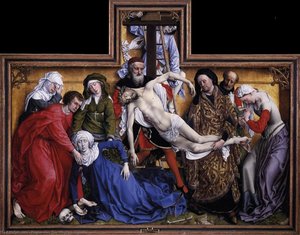
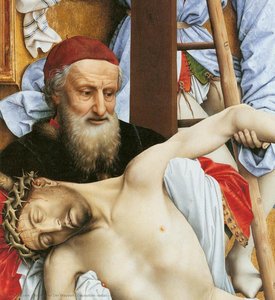
Spust z križa (1435) avtorja Rogier Van Der Weyden

Spust z križa

1435 · Olje na leseni podlagi · Muzej Prado, Madrid

Rogier van der Weyden's “Deposition,” ali bolj znana kot “Spust z križa,” ni le prikaz biblijskega dogodka; je izjemno zastavljena slika globoke žalosti in duhovne pomembnosti. To oljno slikarstvo na leseni podlagi, dokončano leta 1435 in trenutno shranjeno v svetinjah muzeja Museo del Prado v Madridu, presega svoj zgodovinski kontekst, da neposredno nagovarja čustva gledalca. Van der Weyden, ključna figura v razvijajoči se zgodnji nizozemski šoli, mojstrsko uporablja zmerno paleto…

2
Portret dam (1455) avtorja Rogier Van Der Weyden

Portret dam

1455 · Olje na leseni podlagi · National Gallery of Art, Washington

Stati pred tem delom pomeni srečati globok občutek miru. Okrog leta 1455 ustaljen ta portret na leseni plati predstavlja ženo, katere identiteta je izslipala skozi razpoko zgodovine, nam pa je pustila le vtis njenega značaja. Utrtega je v trenutku intenzivne mentalne koncentracije, z pogledom usmerjenim navzdol in nekoliko v levo. V njenih tesno stisnjenih prstih in čvrstem položaju ustih čutimo določeno napetost, ki nakazuje na um obrnjen navznoter. Kompozicija se…

3
Poslednji sodob avtorja Rogier Van Der Weyden

Poslednji sodob

Olje na leseni podlagi

Rogier van der Weyden's "The Last Judgment," painted around 1430-1435, isn’t merely a depiction of biblical narrative; it’s a visceral exploration of human mortality and the agonizing weight of divine judgment. This monumental work, likely intended for a private chapel or a significant civic commission, transcends simple religious illustration to become a profoundly moving meditation on sin, redemption, and the inescapable consequences of earthly actions. Van der Weyden, already recognized…

4
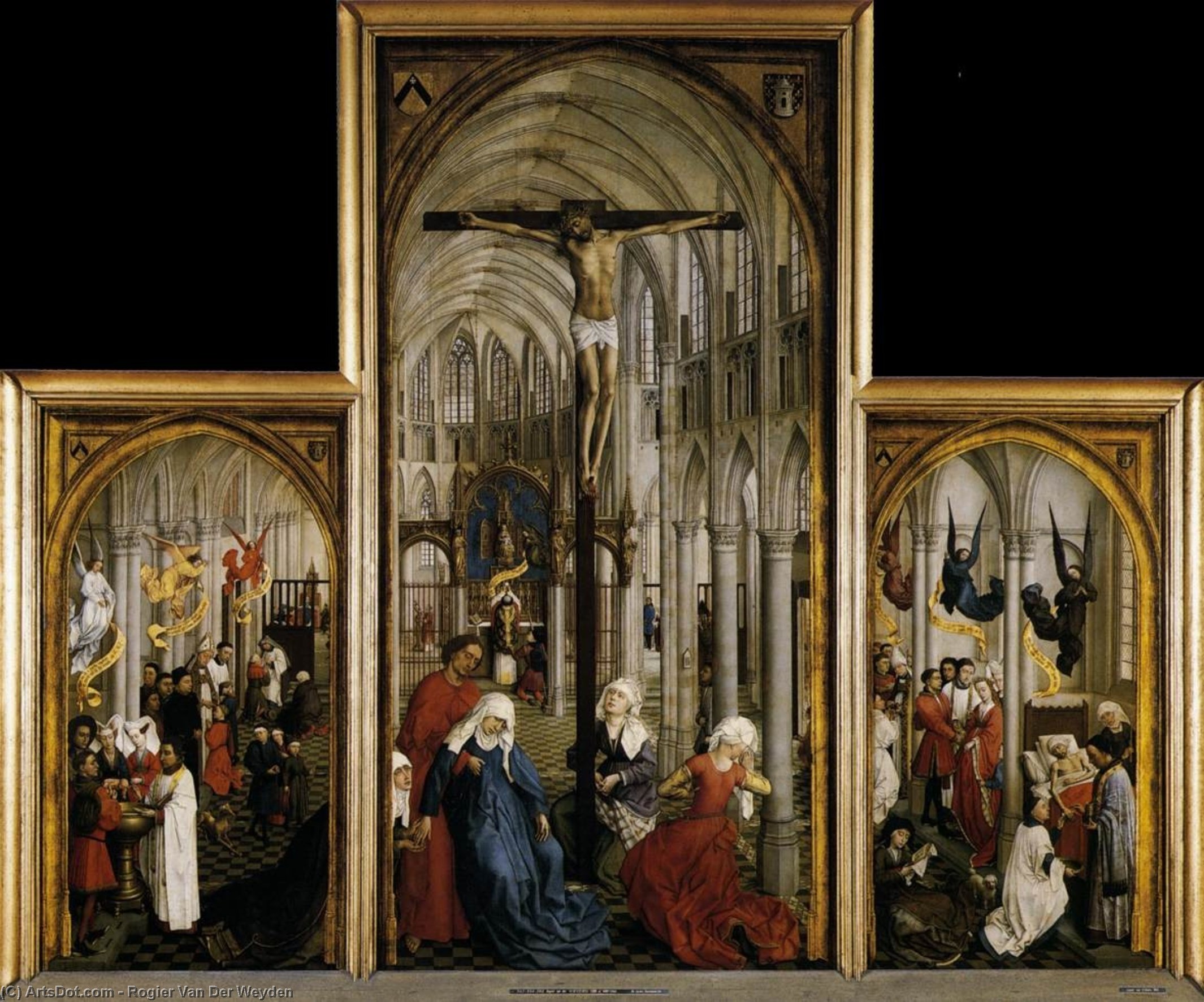
Oltar s sedem sakramenti (1445) avtorja Rogier Van Der Weyden

Oltar s sedem sakramenti

1445 · Olje na leseni podlagi · Koninklijk Museum voor Schone Kunsten, Antverp

Okno v srednjevečno vero: Rogier van der Weydenovo oltarno znamenje sedmih sakramentov Rogier van der Weydenovo Oltarno znamenje sedmih sakramentov, dokončano leta 1445, stoji kot ključno del obdobja zgodnje nizozemske slikarstva. To velikoplansko oljno delo na leseni podlagi (200 x 97 cm), ki se nahaja v Koninklijk Museum voor Schone Kunsten v Antwerpu v Belgiji, ni le slika; je teološki traktat, izrazjen z zaprepaščajočo umetniško izvedbo in globoko čustveno globino.…

5
Stolpica sv. Kolombe (1455) avtorja Rogier Van Der Weyden

Stolpica sv. Kolombe

1455 · Olje na leseni podlagi · Alte Pinakothek, München

In the quiet corridors of the Alte Pinakothek in Munich, there exists a masterpiece that transcends the boundaries of mere paint and wood, inviting the viewer into a sacred, breathing reality. The St Columba Altarpiece, completed around 1455 by the Flemish virtuoso Rogier van der Weyden, is not simply an object of devotion but a profound psychological landscape. At its heart, the work captures the intersection of the earthly and…

6
Odložišče (1435) avtorja Rogier Van Der Weyden

Odložišče

1435 · Olje na leseni podlagi · Muzej Prado, Madrid

Rogier van der Weydenova ‘Depozicija’ ni le slika; to je izjemen trenutek, zazet s prefinjeno občutljivostjo in globokim razumevanjem človeške trpljenja. Ustvarjena okoli leta 1435, ta del umetnosti iz obdobja severne renesanse, ki jo danes lahko občudujemo v Pradovem muzeju v Madridu, je dokaz van der Weydenovega talenta in njegovega pomembnega vpliva na umetnost te dobe. Van der Weyden se ni zanašal le na tradicionalne metode; s svojimi inovativnimi tehnikami…

7
Spust z križa (1449) avtorja Rogier Van Der Weyden

Spust z križa

1449 · Olje na leseni podlagi · Detroit Institute of Arts, Detroit

The air feels heavy, thick with the scent of damp wood and the weight of an unbearable loss. Within this shallow, compressed space, the limp, pale body of Christ begins its slow descent from the cross. Every muscle in his torso reflects a profound exhaustion, a physical surrender to death that pulls at the hearts of those gathered around him. The light catches the sickly, translucent flesh of his skin,…

8
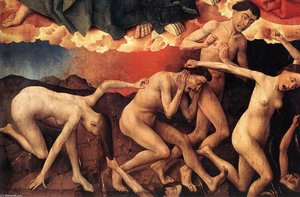
Zadnji sod |detajl| (42) (1446) avtorja Rogier Van Der Weyden

Zadnji sod |detajl| (42)

1446 · Olje na leseni podlagi · Musée de l'Hôtel Dieu, Bourg-en-Bresse

A Vision of Divine Justice: Rogier van der Weyden’s ‘The Last Judgment’ (Detail) This compelling detail originates from Rogier van der Weyden's monumental *Last Judgment* polyptych, a masterpiece of Early Netherlandish painting. While the complete work was originally designed for the altar of Saint James in Lübeck Cathedral, this fragment offers an intensely focused glimpse into the artist’s profound exploration of faith, sin, and salvation. Van der Weyden (c. 1400-1464)…

9
Pieta (1450) avtorja Rogier Van Der Weyden

Pieta

1450 · Olje na leseni podlagi · Muzej Prado, Madrid

In the quiet stillness of the mid-15th century, a profound transformation occurred in the landscape of Northern European art, moving away from stylized icons toward a visceral, breathing reality. At the heart of this movement stands Rogier van der<|image>Weyden’s Pietà, a masterpiece that does not merely depict a biblical event but invites the viewer into a sacred space of shared mourning. Completed around 1450, this oil on oak panel serves…

10
Dama z gazastim okrasjem na glavi (1445) avtorja Rogier Van Der Weyden

Dama z gazastim okrasjem na glavi

1445 · Olje na leseni podlagi · Staatliche Museen zu Berlin, Berlin

V tihih hodnikih Gemäldegalerie v Berlinu obstaja oknon v sredino 15. stoletja, ki presega preprosto pretok časa. Rogier van der Weydenovo del “Dama z gazno vrečico na glavi,” naslikano okoli leta 1445, je veliko več kot le statičen portret; je globok stik z živo dušo. Motiv, ženska plemenite drže, je zajet v trenutku globoke, introspektivne tišine. Njen pogled, nežno usmerjen navzdol, gledalca povabi v njen zasebni svet kontemplacije. Od platelja…

Slavna platna umetnika Rogier Van Der Weyden, od številk 11 do 100

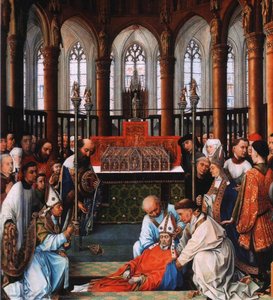
11Ekshumacija sv. Huberta (1437) avtorja Rogier Van Der WeydenEkshumacija sv. Huberta1437 · National Gallery 12Sveti Luka slika portret Madone (1435) avtorja Rogier Van Der WeydenSveti Luka slika portret Madone1435 · Muzej fine arts 13Magdalena bere (detajl) (1445) avtorja Rogier Van Der WeydenMagdalena bere (detajl)1445 · National Gallery 14Bladelin Triptih (1445) avtorja Rogier Van Der WeydenBladelin Triptih1445 · Staatliche Museen zu Berlin 15Oltar St Columba (desni panel) (1455) avtorja Rogier Van Der WeydenOltar St Columba (desni panel)1455 · Alte Pinakothek 16Bladelin triptih (desni krilo) (1445) avtorja Rogier Van Der WeydenBladelin triptih (desni krilo)1445 · Staatliche Museen zu Berlin 17The Holy Trinity (1430) avtorja Rogier Van Der WeydenThe Holy Trinity1430 18Bladelin triptik (levo krilo) (1445) avtorja Rogier Van Der WeydenBladelin triptik (levo krilo)1445 · Staatliche Museen zu Berlin 19Triptik Pierre Bladelin (detajl) (1445) avtorja Rogier Van Der WeydenTriptik Pierre Bladelin (detajl)1445 · Staatliche Museen zu Berlin 20Diptih o razp 곳u (desna stran) (1460) avtorja Rogier Van Der WeydenDiptih o razp 곳u (desna stran)1460 · Philadelphia Museum of Art 21The Last Judgment (detail) (21) (1446) avtorja Rogier Van Der WeydenThe Last Judgment (detail) (21)1446 · Musée de l'Hôtel Dieu 22Spust z križa (podrobnost) (1435) avtorja Rogier Van Der WeydenSpust z križa (podrobnost)1435 · Muzej Prado 23Objavitev (detajl) (1440) avtorja Rogier Van Der WeydenObjavitev (detajl)1440 · Louvre 24Oltar svetnika Janeza (detajl) (1455) avtorja Rogier Van Der WeydenOltar svetnika Janeza (detajl)1455 · Staatliche Museen zu Berlin 25Devica in otrok (Duránova Madonna) (1440) avtorja Rogier Van Der WeydenDevica in otrok (Duránova Madonna)1440 · Muzej Prado 26Sveti Jožef (1445) avtorja Rogier Van Der WeydenSveti Jožef1445 · Calouste Gulbenkian Foundation 27Deposition (detail) (1435) avtorja Rogier Van Der WeydenDeposition (detail)1435 · Muzej Prado 28Triptih Pierre Bladelin (detajl) (1445) avtorja Rogier Van Der WeydenTriptih Pierre Bladelin (detajl)1445 · Staatliche Museen zu Berlin 29Spomin (1435) avtorja Rogier Van Der WeydenSpomin1435 · Muzej Prado 30Poslednji sodba (detajl) (1446) avtorja Rogier Van Der WeydenPoslednji sodba (detajl)1446 · Musée de l'Hôtel Dieu 31Sveti Luka slika portret Madone avtorja Rogier Van Der WeydenSveti Luka slika portret MadoneGroeninge muzej 32Saint Luke Portraying the Virgin (1431) avtorja Rogier Van Der WeydenSaint Luke Portraying the Virgin1431 · National Gallery of Ireland 33Madonna and Child in a Landscape (1460) avtorja Rogier Van Der WeydenMadonna and Child in a Landscape1460 34Triptih Razpote (1445) avtorja Rogier Van Der WeydenTriptih Razpote1445 · Kunsthistorisches Museum 35Crucifixion Triptych (right wing) (1445) avtorja Rogier Van Der WeydenCrucifixion Triptych (right wing)1445 · Kunsthistorisches Museum 36Spust z križa (podrobnost) (1435) avtorja Rogier Van Der WeydenSpust z križa (podrobnost)1435 · Muzej Prado 37Spuščanje (detajl) (9) (1435) avtorja Rogier Van Der WeydenSpuščanje (detajl) (9)1435 · Muzej Prado 38Mirafloresovo oltarje (osrednji panel) (1440) avtorja Rogier Van Der WeydenMirafloresovo oltarje (osrednji panel)1440 · Staatliche Museen zu Berlin 39San papija Sergija (1437) avtorja Rogier Van Der WeydenSan papija Sergija1437 · J. Paul Getty Museum 40Portret moškega (Guillaume Fillastre.) (1440) avtorja Rogier Van Der WeydenPortret moškega (Guillaume Fillastre.)1440 · Courtauld Gallery 41Portret moža (1450) avtorja Rogier Van Der WeydenPortret moža1450 · Koninklijk Museum voor Schone Kunsten 42Deposition (detail) (1435) avtorja Rogier Van Der WeydenDeposition (detail)1435 · Muzej Prado 43Sveti Luka slika portret Madone (1450) avtorja Rogier Van Der WeydenSveti Luka slika portret Madone1450 · Alte Pinakothek 44Diptych (1440) avtorja Rogier Van Der WeydenDiptych1440 · Kunsthistorisches Museum 45Objavitev (detajl) (8) (1440) avtorja Rogier Van Der WeydenObjavitev (detajl) (8)1440 · Louvre 46Sveti Luka slika portret Madone avtorja Rogier Van Der WeydenSveti Luka slika portret MadoneErmitaž 47Braque Family Triptych (1450) avtorja Rogier Van Der WeydenBraque Family Triptych1450 · Louvre 48Oltar svetega Janeza (podrobnost) (1455) avtorja Rogier Van Der WeydenOltar svetega Janeza (podrobnost)1455 · Staatliche Museen zu Berlin 49The Last Judgment (detail) (13) (1446) avtorja Rogier Van Der WeydenThe Last Judgment (detail) (13)1446 · Musée de l'Hôtel Dieu 50Magdalena bere (1445) avtorja Rogier Van Der WeydenMagdalena bere1445 · National Gallery 51Portrait of Jean le Belliqueux (1451) avtorja Rogier Van Der WeydenPortrait of Jean le Belliqueux1451 52Oltar sv. Janeza (osrednji panel) (1455) avtorja Rogier Van Der WeydenOltar sv. Janeza (osrednji panel)1455 · Staatliche Museen zu Berlin 53Objavljenje avtorja Rogier Van Der WeydenObjavljenjeAlte Pinakothek 54The Middelburg Altar (1450) avtorja Rogier Van Der WeydenThe Middelburg Altar1450 · Gemäldegalerie 55Bladelin Triptych (exterior) (1480) avtorja Rogier Van Der WeydenBladelin Triptych (exterior)1480 · Staatliche Museen zu Berlin 56Spuščanje (detajl) (8) (1435) avtorja Rogier Van Der WeydenSpuščanje (detajl) (8)1435 · Muzej Prado 57Spust z križa (podrobnost) (1435) avtorja Rogier Van Der WeydenSpust z križa (podrobnost)1435 · Muzej Prado 58Crucifixion Triptych (central panel) (1445) avtorja Rogier Van Der WeydenCrucifixion Triptych (central panel)1445 · Kunsthistorisches Museum 59Mary Altarpiece (1445) avtorja Rogier Van Der WeydenMary Altarpiece1445 · Gemäldegalerie 60Braque Family Triptych (1450) avtorja Rogier Van Der WeydenBraque Family Triptych1450 61St John Altarpiece (1455) avtorja Rogier Van Der WeydenSt John Altarpiece1455 · Staatliche Museen zu Berlin 62Seven Sacraments Altarpiece (detail) (10) (1445) avtorja Rogier Van Der WeydenSeven Sacraments Altarpiece (detail) (10)1445 · Koninklijk Museum voor Schone Kunsten 63Triptih družine Braque (desni krilo) (1450) avtorja Rogier Van Der WeydenTriptih družine Braque (desni krilo)1450 · Louvre 64Miraflores oltar (podrobnost) (1440) avtorja Rogier Van Der WeydenMiraflores oltar (podrobnost)1440 · Staatliche Museen zu Berlin 65Exhumation of Saint Hubert (1440) avtorja Rogier Van Der WeydenExhumation of Saint Hubert1440 · National Gallery 66Madonna and Child avtorja Rogier Van Der WeydenMadonna and Child 67Podrobnost oltarnega dela sveti Kolumba (1455) avtorja Rogier Van Der WeydenPodrobnost oltarnega dela sveti Kolumba1455 · Alte Pinakothek 68Objavljenje (1440) avtorja Rogier Van Der WeydenObjavljenje1440 · Louvre 69Oltar St. Columba (detajl) (1455) avtorja Rogier Van Der WeydenOltar St. Columba (detajl)1455 · Alte Pinakothek 70Christ appears to Mary (1430) avtorja Rogier Van Der WeydenChrist appears to Mary1430 71Three Kings Altar (Columba Altar) (1455) avtorja Rogier Van Der WeydenThree Kings Altar (Columba Altar)1455 72The Last Judgment (detail) (38) (1446) avtorja Rogier Van Der WeydenThe Last Judgment (detail) (38)1446 · Musée de l'Hôtel Dieu 73Portret Antona Burgundskega (1461) avtorja Rogier Van Der WeydenPortret Antona Burgundskega1461 · Musées Royaux des Beaux-Arts 74The Last Judgment (detail) (8) (1446) avtorja Rogier Van Der WeydenThe Last Judgment (detail) (8)1446 · Musée de l'Hôtel Dieu 75Sforza Triptych (exterior) (1460) avtorja Rogier Van Der WeydenSforza Triptych (exterior)1460 · Musées Royaux des Beaux-Arts 76Seven Sacraments (central panel) (1445) avtorja Rogier Van Der WeydenSeven Sacraments (central panel)1445 · Koninklijk Museum voor Schone Kunsten 77Miraflores Altarpiece (right panel) (1440) avtorja Rogier Van Der WeydenMiraflores Altarpiece (right panel)1440 · Staatliche Museen zu Berlin 78Sforza Triptych (1460) avtorja Rogier Van Der WeydenSforza Triptych1460 · Musées Royaux des Beaux-Arts 79Crucifixion Diptych (detail of the left panel) (1460) avtorja Rogier Van Der WeydenCrucifixion Diptych (detail of the left panel)1460 · Philadelphia Museum of Art 80Virgin with the Blessing Child (1450) avtorja Rogier Van Der WeydenVirgin with the Blessing Child1450 · Museum Boijmans Van Beuningen 81Portretni diptih Laurenta Froimonta (levo krilo) (1460) avtorja Rogier Van Der WeydenPortretni diptih Laurenta Froimonta (levo krilo)1460 · Musée des Beaux-Arts 82Portrait Diptych of Philippe de Croy (left wing) (1460) avtorja Rogier Van Der WeydenPortrait Diptych of Philippe de Croy (left wing)1460 · Henry E. Huntington Library 83The Last Judgment (detail) (18) (1446) avtorja Rogier Van Der WeydenThe Last Judgment (detail) (18)1446 · Musée de l'Hôtel Dieu 84Oltar svetega Columbe (detajl) (1455) avtorja Rogier Van Der WeydenOltar svetega Columbe (detajl)1455 · Alte Pinakothek 85Virgin and Child avtorja Rogier Van Der WeydenVirgin and ChildMuseum of Fine Arts 86The Last Judgment (detail) (23) (1446) avtorja Rogier Van Der WeydenThe Last Judgment (detail) (23)1446 · Musée de l'Hôtel Dieu 87St John Altarpiece (right panel) (1455) avtorja Rogier Van Der WeydenSt John Altarpiece (right panel)1455 · Staatliche Museen zu Berlin 88Mary Altarpiece (Miraflores Altarpiece) (1440) avtorja Rogier Van Der WeydenMary Altarpiece (Miraflores Altarpiece)1440 · Staatliche Museen zu Berlin 89Crucifixion (1445) avtorja Rogier Van Der WeydenCrucifixion1445 90The Altar of St. John (1455) avtorja Rogier Van Der WeydenThe Altar of St. John1455 · Slovenska narodna galerija 91Crucifixion Diptych (1460) avtorja Rogier Van Der WeydenCrucifixion Diptych1460 92Spust z križa (podrobnost) (1435) avtorja Rogier Van Der WeydenSpust z križa (podrobnost)1435 · Muzej Prado 93The Altar of Our Lady (Miraflores Altar) (1440) avtorja Rogier Van Der WeydenThe Altar of Our Lady (Miraflores Altar)1440 94Sveti Ivo (1450) avtorja Rogier Van Der WeydenSveti Ivo1450 · National Gallery 95The Last Judgment (detail) (9) (1446) avtorja Rogier Van Der WeydenThe Last Judgment (detail) (9)1446 · Musée de l'Hôtel Dieu 96Seven Sacraments Altarpiece (detail) (8) (1445) avtorja Rogier Van Der WeydenSeven Sacraments Altarpiece (detail) (8)1445 · Koninklijk Museum voor Schone Kunsten 97The Last Judgment (detail) (1446) avtorja Rogier Van Der WeydenThe Last Judgment (detail)1446 · Musée de l'Hôtel Dieu 98Diptih Križanjanja (1460) avtorja Rogier Van Der WeydenDiptih Križanjanja1460 · Philadelphia Museum of Art 99The Last Judgment (detail) (17) (1446) avtorja Rogier Van Der WeydenThe Last Judgment (detail) (17)1446 · Musée de l'Hôtel Dieu 100Seven Sacraments (left wing) (1445) avtorja Rogier Van Der WeydenSeven Sacraments (left wing)1445 · Koninklijk Museum voor Schone Kunsten

Slavna platna umetnika Rogier Van Der Weyden, razdeljena po obdobjih

Motivi, ki so očarali Rogier Van Der Weyden

Četiri teme, ki se v teh originalih najpogosteje ponavljajo, vsaka z svojim vrhunskim primerom.

Muzeji, ki hranijo originala umetnika Rogier Van Der Weyden

8 muzejev, ki vsebujo največ slik na tej strani.

Muzej Mesto Sloga Rogier Van Der Weyden Slike iz tega seznama
Staatliche Museen zu Berlin, BerlinStaatliche Museen zu Berlin Berlin 21 Dama z gazastim okrasjem na glavi, Bladelin Triptih, Bladelin triptih (desni krilo)
Muzej Prado, MadridMuzej Prado Madrid 15 Spust z križa, Odložišče, Pieta
Musée de l'Hôtel Dieu, Bourg-en-BresseMusée de l'Hôtel Dieu Bourg-en-Bresse 24 Zadnji sod |detajl| (42), The Last Judgment (detail) (21), Poslednji sodba (detajl)
Alte Pinakothek, MünchenAlte Pinakothek München 12 Stolpica sv. Kolombe, Oltar St Columba (desni panel), Sveti Luka slika portret Madone
Koninklijk Museum voor Schone Kunsten, AntverpKoninklijk Museum voor Schone Kunsten Antverp 12 Oltar s sedem sakramenti, Portret moža, Seven Sacraments Altarpiece (detail) (10)
Louvre, ParizLouvre Pariz 9 Objavitev (detajl), Objavitev (detajl) (8), Braque Family Triptych
National Gallery, LondonNational Gallery London 8 Ekshumacija sv. Huberta, Magdalena bere (detajl), Magdalena bere
Kunsthistorisches Museum, DunajKunsthistorisches Museum Dunaj 8 Triptih Razpote, Crucifixion Triptych (right wing), Diptych

Rogier Van Der Weyden skozi desetetja: vsak unikatni original za vsako obdobje

Delo po desetletjih

Izberite desetletje, da si ogledate original, ki ga opredeljuje.

Slike umetnika Rogier Van Der Weyden: vprašanja za galerijo

Katero je najbolj znano delo umetnika Rogier Van Der Weyden?Razkriti odgovor

Spust z križa (1435), Muzej Prado, Madrid. Zatem sledeta Portret dam (1455) in Poslednji sodob.

Pri kateri dobe je Rogier Van Der Weyden ustvaril Spust z križa?Razkriti odgovor

35 let: delo Spust z križa iz leta 1435, Rogier Van Der Weyden pa je bil/a rojen/a leta 1400.

Katera desetina slik avtorja Rogier Van Der Weyden je najbolj znana?Razkriti odgovor

Spust z križa, Portret dam, Poslednji sodob, Oltar s sedem sakramenti, Stolpica sv. Kolombe, Odložišče, Spust z križa, Zadnji sod |detajl| (42), Pieta in Dama z gazastim okrasjem na glavi. Zgornja lestica prikazuje leto nastanka in muzej za vsako delo.

Koliko je znanih del avtorja Rogier Van Der Weyden?Razkriti odgovor

Naš katalog vsebuje 314 del avtorja Rogier Van Der Weyden, datiranih od 1430 do 1461.

Kje si lahko ogledate najslavnejše originale umetnika Rogier Van Der Weyden?Razkriti odgovor

Večini v Staatliche Museen zu Berlin (Berlin), Muzej Prado (Madrid) in Musée de l'Hôtel Dieu (Bourg-en-Bresse). Zgoraj navedena tabela muzejev vsebuje njihov celoten seznam.

V katerem obdobju je Rogier Van Der Weyden ustvaril svoja najbolj znana dela?Razkriti odgovor

V obdobju 1440s: 43 od 100 del na tej strani je bilo izdelovanih takrat, med njimi pa Oltar s sedem sakramenti.

Katero znano sliko je naslikal Rogier Van Der Weyden najprej in katero najpozdneje?Razkriti odgovor

Na tej strani je najstarejše delo iz The Holy Trinity (1430) in najstarejše iz Portret Antona Burgundskega (1461).

Katere teme je Rogier Van Der Weyden najprej ravnate?Razkriti odgovor

Medieval art (26), Memento mori (16) in Devica marija (14), na 100 delih na tej strani.

S katerimi materiali je Rogier Van Der Weyden najpogosteje slikal?Razkriti odgovor

Olje na leseni podlagi, za 44 od 100 del na tej strani.

Kateri umetniški slog predstavlja delo umetnika Rogier Van Der Weyden?Razkriti odgovor

Zgodnje nizozemsko slikarstvo, glede na originala na tej strani.

Katere originale Rogier Van Der Weyden lahko vidim v muzeju Staatliche Museen zu Berlin?Razkriti odgovor

Dama z gazastim okrasjem na glavi, Bladelin Triptih in Bladelin triptih (desni krilo): v muzeju Staatliche Museen zu Berlin, Berlin se nahaja 16 del z te strani.

Rogier Van Der Weyden: portret umetnika

The Life and Identity of Rogier van der Weyden

The name Rogier van der Weyden emerges from the shifting linguistic landscapes of the fifteenth century. Born in Tournai, a Bishopric that is now part of Belgium, around 1399 or 1400, he moved through a world of evolving identities. He was known as Roger de la Pasture and Rogelet de le Pasture before his name was translated to Dutch as Rogier van der Weyden. This transition reflects the complex social and regional textures of the Burgundian Netherlands during his lifetime.

His existence was defined by the transition from a craftsman to a central figure of Early Netherlandish painting. He navigated the high-stakes circles of the Burgundian court, moving between the urban centers of Tournai and Brussels. His life reached its conclusion on 18 June 1464. He left behind a body of work that redefined the capacity for human emotion in Northern Renaissance art, moving away from rigid iconography toward a more visceral, breathing reality.

Early Life, Family and Training

The foundations of Rogier van der Weyden’s precision lie in the workshop of a cutler. His father, Henri de le Pasture, was a prosperous man who died around 1425-26. Alongside his mother, Agnes de Wattrélos—sometimes called demoiselle Agnès de Waterlos—he was raised in a household defined by craftsmanship. Before the brush became his primary tool, Rogier likely honed his technical sensibilities as a goldsmith. This early immersion in the manipulation of precious metals instilled a discipline for minute detail and a refined sense of texture that would later define his approach to oil painting.

A shift in his professional trajectory occurs in the late 1420s. On 5 March 1427, Rogier entered the workshop of Robert Campin as an apprentice. This period marks his transition from the metalworker's bench to the painter's easel. During these formative years, his personal life also took root. He married Elisabeth Goffaert between 1426 and 1427. The couple would go on to have four children: Cornelius, Margaretha, Pieter, and Jan.

Professional Life in Tournai and Brussels

The professional ascent begins in Tournai. By 1427, he has already ascended to the rank of master within the Guild of Saint Luke. This status provides the legal and social standing necessary to operate a formal workshop. He secures the official title of a Master painter on 1 August 1432. His presence in the city marks him as a significant figure in the local guild structure.

The focus shifts toward Brussels. On 2 March 1436, he holds the prestigious title of painter to the town of Brussels. This appointment anchors his career in the political and administrative heart of the region. He maintains active workshops in both Tournai and Brussels, managing the production of art across two major urban centers. Around 1443, his operations expand within the city; he occupies two adjoining houses in the Golden Street, situated near the Coudenberg Palace and the Town Hall.

Patrons, Workshop and Commissions

Success arrives in 1435. Rogier van der Weyden enters the service of Philip the Good, Duke of Burgundy. This appointment secures his status within the most influential court in Europe. His reputation spreads far beyond the borders of the Low Countries. Foreign aristocrats seek his hand, sending commissions across vast distances to secure his specific style. He is a highly successful artist in his lifetime, commanding a presence that reaches into Italy and Spain.

His workshop functions as a center of technical excellence and instruction. Having been a student of Robert Campin, he carries forward a lineage of precision. He does not merely produce works; he shapes the next generation of painters. Hans Memling enters his orbit, learning the methods that will define the next era of Northern art. The workshop operates with a high degree of professional organization, managing the demands of both civic leaders and private patrons.

Technique and Artistic Style

The brush moves with the precision of a goldsmith. Working from life models, Rogier van der Weyden captures the physical world with a meticulous, detailed realism. He does not merely replicate a face; he sculpts it. While his observations are acute, he often idealises certain facial features, refining the sitter into a version of themselves that possesses a certain Gothic elegance. This tension between the real and the ideal defines his approach to the human form.

Light and shadow act as tools of psychological depth. In his portraiture, he employs dark planes to isolate the subject, forcing the viewer's gaze onto the face and hands. This technique strips away distractions. He builds his images through the careful application of oil paint, layering translucent glazes to achieve luminous effects and a sense of profound depth. His palette is expansive, utilizing an unusually broad range of colours and varied tones to ensure that no two areas of a canvas are identical in hue. This variety creates a sense of living, breathing space.

Emotion is not an afterthought; it is built into the very anatomy of his compositions. He achieves a sense of expressive pathos through subtle gestures and the heavy, sculptural quality of drapery. In scenes of intense sorrow, the grief is palpable in the tilt of a head or the tension in a hand. The technical mastery of his medium allows this emotion to feel visceral rather than merely symbolic.

Key Works and Masterpieces

The emotional weight of his oeuvre often centers on the profound grief of the Passion. In the Lamentation, held at the Musée des Beaux-Arts Tournai, Belgium, sorrow is palpable. This intensity finds a parallel in the Deposition, a panel painting from about 1435. Nearby, the Descent from the Cross in the Museo del Prado, Madrid, captures a similar dramatic tension. These works do not merely depict religious events; they translate human suffering into a visual language of heavy drapery and expressive gestures.

His technical precision extends to the most intimate and the most complex commissions. The Annunciation displays a refined style, while the Bladelin Triptych presents an intricate and detailed composition. In 1445, he completed the Seven Sacraments Altarpiece, a large-scale work that articulates complex theological truths through visual narrative. Even in smaller, more contemplative scenes, the detail remains sharp. The Magdalene Reading, also from 1445, focuses on the quietude of spiritual reflection, while the Virgin and Child in the Museum of Fine Arts, Houston, captures a tender, human moment between mother and child.

Legacy and Influence on Art

Rogier van der Weyden occupies a central position in the history of Northern Renaissance art. He is recognized alongside Jan van Eyck and Robert Campin as one of the three great Early Flemish masters. His reach extends far beyond the borders of the Low Countries; his panels travel across Europe, finding high demand in Italy and Spain. This international presence ensures his stylistic innovations ripple through diverse artistic traditions.

The impact of his work is visible in the evolution of European painting. His technical advancements and specific approach to human emotion influence a lineage of significant artists, including Antonello da Messina, Albrecht Durer, and Martin Schongauer. By moving away from rigid iconography toward a more visceral naturalism, he provides a new visual language for the depiction of the human condition. His methods regarding the use of oil paint and the rendering of psychological depth pave the way for subsequent generations of painters.

Where to See His Works Today

His presence in modern collections spans the major cultural centers of Europe and the Americas. In Madrid, the Museo del Prado holds significant pieces, including the 1435 Deposition. The National Gallery in London preserves his paintings, such as the 1445 The Magdalene Reading. Across the channel, the Musée du Louvre in Paris contains his art, while the Metropolitan Museum of Art in New York maintains a selection of his works. In Brussels, the Royal Museums of Fine Arts houses his paintings, preserving the visual language he helped establish in the Low Countries.

The reach of his influence extends into the great state museums of Germany and Austria. The Staatliche Museen in Berlin holds several works, including details from the 1445 Miraflores Altarpiece. In Vienna, the Kunsthistorisches Museum maintains his paintings, ensuring his technical precision remains accessible to scholars and viewers alike. These institutions act as the primary repositories for his surviving output, where the specific textures of oil glazes and the sculptural quality of his figures remain visible to the modern eye.