

1


Posodobljeno november 2026 · uvrščeno glede na naš skoraj priljubljenosti (iskanja, obiske in naročila za vsako delo) · 36 del v našem katalogu avtorja Nils Blommér
Kratek opis
Za oči galerije je najbolj znano sliko umetnika Nils Blommér delo Johan Knutson (1840), katere original visi v muzeju Finnish National Gallery, Helsinki. Idun and Brage (1846) in Heimdall returns Brisingamen to Freyja (1846) dopolnjujeta trijo, ki jo prepozna vsak pogled. Od 36 del avtorja Nils Blommér v našem katalogu galerija spodaj predstavlja 32 najbolj znanih; vsako je original z letom nastanka, pripadajočim mu muzejem in opisom tistega, kar ga dela edinstavnim.


 A Dutch Harbour1840 · Finnish National Gallery
12
 Moses Defending Reuel's Daughters1845 · Nationalmuseum
13
 Oskar II (1829-1907), king of Sweden and Norway, married to Sofia of Nassau-Weilburg1846 · National Portrait Gallery of Sweden
14
 Asgårdsreia, Sketch1849 · Finnish National Gallery
15
 NymphsFinnish National Gallery
16
 Nils Jakob Olsson Blommér (1816-1853), artist, married to Edla JanssonNationalmuseum
17
 Bearded man, modelsketchFinnish National Gallery
18
 Heimdal and Freja. SketchNationalmuseum
19
 Antonio José da Silva Loureiro (born 1810), Portuguese consul in Stockholm With his daughter: Anna Mathilda Carolina LoureiroNational Portrait Gallery of Sweden
20
 Mother Schweden is peacefully sleeping
21
 Plants, StudyFinnish National Gallery
22
 Study, LeavesFinnish National Gallery
23
 Desert with Figures, Compositional SketchFinnish National Gallery
24
 Leaves, StudyFinnish National Gallery
25
 Flowers and Plants, StudyFinnish National Gallery
26
 Plants, StudyFinnish National Gallery
27
 Landscape StudyFinnish National Gallery
28
 Landscape from Italy, StudyFinnish National Gallery
29
 Landscape from ItalyFinnish National Gallery
30
 Landscape, StudyFinnish National Gallery
31
 Fairies of the Meadow1850 · Nationalmuseum
32
 The Water-Sprite and Ägir's Daughters1850 · Nationalmuseum
3 muzejev, ki vsebujo največ slik na tej strani.
| Muzeji | Mesto | Sloga Nils Blommér | Slike iz tega seznama |
|---|---|---|---|
 Finnish National Gallery |
Helsinki | 17 | Johan Knutson, Mary with Child, St. Stephen, St. Jerome and St. Mauritius, a copy after Titian (Tiziano Vecellio), Portrait of a woman (Edla Blommér?), unfinished |
 National Portrait Gallery of Sweden |
Strängnäs | 6 | August (1831-1873), hereditary prince, prince of Sweden and Norway, duke of Dalarna, married to Teresia of Saxony-Altenburg, Gustav (1827-1852), hereditary prince, prince of Sweden and Norway, duke of Uppland, Axel Georg Bennet, 1803-1869, kammarskrivare |
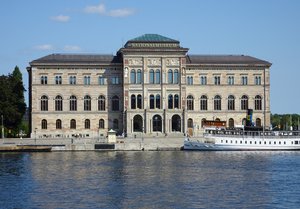 Nationalmuseum |
Stockholm | 6 | Freja Seeking her Husband, Moses Defending Reuel's Daughters, Nils Jakob Olsson Blommér (1816-1853), artist, married to Edla Jansson |
Kariera umetnika Nils Blommér na tej strani obsega 13 let, od 1840 do 1852: vsako leto je tu predstavljeno z njegovimi najbolj znanimi originali.
Izberite leto in oglej originale.

Več od 1846
 #3 Heimdall returns Brisingamen to Freyja
 #4 August (1831-1873), hereditary prince, prince of Sweden and Norway, duke of Dalarna, married to Teresia of Saxony-Altenburg
 #5 Gustav (1827-1852), hereditary prince, prince of Sweden and Norway, duke of Uppland
 #7 Eugenia (1830-1889)
#13 Oskar II (1829-1907), king of Sweden and Norway, married to Sofia of Nassau-Weilburg
Več od 1849

Johan Knutson (1840), Finnish National Gallery, Helsinki. Zatem sledeta Idun and Brage (1846) in Heimdall returns Brisingamen to Freyja (1846).
24 let: delo Johan Knutson iz leta 1840, Nils Blommér pa je bil/a rojen/a leta 1816.
Johan Knutson, Idun and Brage, Heimdall returns Brisingamen to Freyja, August (1831-1873), hereditary prince, prince of Sweden and Norway, duke of Dalarna, married to Teresia of Saxony-Altenburg, Gustav (1827-1852), hereditary prince, prince of Sweden and Norway, duke of Uppland, Axel Georg Bennet, 1803-1869, kammarskrivare, Eugenia (1830-1889), Mary with Child, St. Stephen, St. Jerome and St. Mauritius, a copy after Titian (Tiziano Vecellio), Portrait of a woman (Edla Blommér?), unfinished in Freja Seeking her Husband. Zgornja lestica prikazuje leto nastanka in muzej za vsako delo.
Naš katalog vsebuje 36 del avtorja Nils Blommér, datiranih od 1840 do 1852.
Večini v Finnish National Gallery (Helsinki), National Portrait Gallery of Sweden (Strängnäs) in Nationalmuseum (Stockholm). Zgoraj navedena tabela muzejev vsebuje njihov celoten seznam.
V obdobju 1846: 6 od 32 del na tej strani je bilo izdelovanih takrat, med njimi pa Idun and Brage.
Na tej strani je najstarejše delo iz Johan Knutson (1840) in najstarejše iz Portrait of a woman (Edla Blommér?), unfinished (1852).
Johan Knutson, Mary with Child, St. Stephen, St. Jerome and St. Mauritius, a copy after Titian (Tiziano Vecellio) in Portrait of a woman (Edla Blommér?), unfinished: v muzeju Finnish National Gallery, Helsinki se nahaja 17 del z te strani.
In the brief, luminous span of his thirty-six years, Nils Blommér managed to capture the very soul of Swedish folklore, weaving together the tangible world of nature with the shimmering veil of the supernatural. Born Nils Johan Olsson in 1816 within the quiet village of Blommeröd, his journey from a provincial apprentice in Lund to a celebrated figure in the European art scene is a testament to a profound, innate connection to mythic storytelling. His early training under Magnus Körner provided the technical foundation, but it was his enrollment at the Royal Swedish Academy of Fine Arts that truly ignited his artistic spirit, setting him on a path toward a style that would eventually define a national romantic identity for Sweden.
The trajectory of Blommér’s development took a transformative turn in 1847 when a generous scholarship carried him to the vibrant heart of Paris. It was amidst the cosmopolitan energy of France, studying under the esteemed Léon Cogniet, that he adopted the name "Blommér"—a poetic nod to his birthplace—and refined a technique capable of rendering the delicate textures of the ethereal. During this period, his brushwork began to dance between the academic precision of his training and a newfound, dreamy romanticism. He became deeply enammed with the idea that nature possessed an inherent soul, a belief that would manifest in his ability to personify the wind, the forest, and the water through the figures of folklore.
Blommér’s oeuvre is most profoundly recognized for its devotion to Norse mythology and the rich tapestry of Swedish folk legends. He did not merely illustrate ancient tales; he breathed life into them, treating the gods and spirits as living entities inhabiting a landscape that felt both ancient and immediate. His work was heavily influenced by the neo-romantic movements of his era, drawing inspiration from the poetic sensibilities of figures like Erik Gustaf Geijer and the folkloric motifs found in the works of the Austrian painter Moritz von Scharl. This synthesis of Swedish narrative and Continental romanticism allowed him to create a visual language that felt uniquely national yet universally enchanting.
His canvases are populated by the inhabitants of the North, from the mischievous Älfvor (elves) to the powerful deities of the Aesir. In masterpieces such as Brage och Iduna, one can witness his ability to blend character study with mythological grandeur, portraying the god of poetry and his wife with a tenderness that suggests a timeless intimacy. His depictions of Freja and the various scenes involving the goddess of love often utilize soft, luminous light to evoke a sense of divine presence. Through these works, Blommér sought to bridge the gap between the human experience and the mythic past, using the natural world as a stage for the eternal dramas of the gods.
Though his life was tragically cut short in Rome in 1853, following a bout of pneumonia shortly after his marriage to the talented Finnish painter Edla Gustafva Jansson, Blommér’s impact on Swedish art remains indelible. He was part of a pivotal movement of artists striving to establish a distinct national aesthetic, one that looked inward toward the forests and legends of their own soil rather than solely toward the classical traditions of the South. His ability to imbue landscapes with a sense of enchantment helped shape the visual identity of Swedish Romanticism.
Today, his contributions are preserved in some of the most prestigious institutions, ensuring that his vision of a spirited, living nature continues to inspire. His legacy can be found through:
