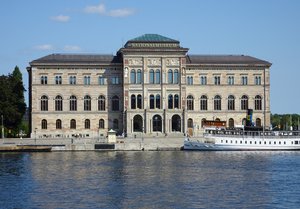
Portret Gustaf Cederström

27 najbolj znanih slik umetnika Gustaf Cederström, galerijska izbira

Posodobljeno november 2026 · uvrščeno glede na naš skoraj priljubljenosti (iskanja, obiske in naročila za vsako delo) · 27 del v našem katalogu avtorja Gustaf Cederström

Kratek opis

Med vsemi originali, ki jih je pustil Gustaf Cederström, je najbolj znan 30th November. Sketch (1896), ki se nahaja v kolekciji Nationalmuseum, Stockholm. Takoj za njima sta Karl XII and Ivan Mazepa after The Poltava Battle 1709 (1709) in Gotthard Werner (1837-1903), artist (1870). Naš katalog vsebuje 27 del umetnika Gustaf Cederström; galerija je ohranila 27 del, ki jih svet najbolj oboževa, odlikovanih z datumom nastanka, pripadajočim muzajem in zgodbojo.

1845 – 1933, Stockholm Največ del: Nationalmuseum

10 najboljših slik umetnika Gustaf Cederström: izbira galerije

2
Karl XII and Ivan Mazepa after The Poltava Battle 1709 (1709) avtorja Gustaf Cederström

Karl XII and Ivan Mazepa after The Poltava Battle 1709

1709 · Oil On Canvas

In this historical oil painting, titled Karl XII and Ivan Mazepa after The Poltava Battle 1709, the artist Gustaf Cederström captures a moment of profound political and personal consequence. The work focuses on the interaction between King Charles XII of Sweden and Ivan Mazepa. This encounter occurs in the immediate aftermath of the Battle of Poltava, a significant conflict that reshaped the landscape of Northern and Eastern Europe.

3
Gotthard Werner (1837-1903), artist (1870) avtorja Gustaf Cederström

Gotthard Werner (1837-1903), artist

1870 · Oil On Canvas · Nationalmuseum, Stockholm

The man faces the right, his profile etched against a pale, nebulous background. He is a figure of quiet dignity, caught in a moment of stillness that feels heavy with thought. A full, textured beard descends from his chin, its coarseness rendered through deliberate, visible brushwork that catches the light. His hair, receding at the temples, flows back in soft, painterly strokes. The light strikes his forehead, the bridge of…

4
Självporträtt (1877) avtorja Gustaf Cederström

Självporträtt

1877 · Oil On Canvas · National Portrait Gallery of Sweden, Strängnäs

A man emerges from a void of deep black. He is caught in a moment of quiet gravity, his gaze fixed on a point just beyond the viewer. The light strikes the ridge of his forehead and the bridge of his nose, carving his features out of the darkness. It is a face of heavy lines and groomed textures. A thick, dark mustache dominates the lower half of his visage,…

5
Amy Jaeder, 1843-1912, gift med friherre Gustav Cederström (1878) avtorja Gustaf Cederström

Amy Jaeder, 1843-1912, gift med friherre Gustav Cederström

1878 · Oil On Canvas · National Portrait Gallery of Sweden, Strängnäs

The canvas holds Amy Jaeder, 1843-1912, gift med friherre Gustav Cederström, captured in a moment of quietude. This portrait was rendered by Gustaf Cederström, a man born in 1845 in Klara Church Parish, Sweden. The subject of this work was the artist's wife. Through his brush, she is fixed in a singular, steady gaze that defies the passing of years. He would live until 1933, leaving this likeness of her…

6
Epilogue (1874) avtorja Gustaf Cederström

Epilogue

1874 · Oil · Nationalmuseum, Stockholm

A heavy, white cloth spills from a dark wooden sideboard like a frozen wave. Beneath its luminous folds, a man lies prone upon the floor, his form partially swallowed by the gloom. The scene is a quiet tragedy of geometry and light. A sharp, directional glow strikes the pale fabric and the man's face, leaving the rest of the room to the deep blacks and muted browns of a somber…

7
The Artist's Wife on the Beach at Noirmoutier (1882) avtorja Gustaf Cederström

The Artist's Wife on the Beach at Noirmoutier

1882 · Oil · Nationalmuseum, Stockholm

In this 1882 oil painting, a woman sits upon a sandy beach near large, dark rock formations. She is positioned slightly to the left of the center, leaning her back against a heavy, muted brown boulder that anchors the composition. Her pale blue dress contrasts with the warm beige and tan tones of the sand. A lace parasol rests near her, its delicate texture rendered through fine, visible brushwork. The…

8
Recruiting Sergeants (1879) avtorja Gustaf Cederström

Recruiting Sergeants

1879 · Oil · Nationalmuseum, Stockholm

Created about 1879, Recruiting Sergeants by Gustaf Cederström captures a moment of profound tension during military recruitment. The scene centers on a pivotal interaction between three figures within a dimly lit, vaulted stone interior. A young man, appearing hesitant or distressed, stands before two older men, anchoring the narrative weight of the composition.

9
A Funeral in Alsike (1883) avtorja Gustaf Cederström

A Funeral in Alsike

1883 · Oil · Nationalmuseum, Stockholm

A freshly dug grave breaks the white skin of the landscape. The earth is dark, churned, and raw against the pale snow. Around this hollow, a group of mourners gathers, their heavy woolen coats absorbing the dim light of an overcast day. They stand in the stillness of a Swedish winter, their forms vertical and somber against the skeletal, reaching branches of a leafless tree. The air feels thick with…

10
Count and general Magnus Stenbock speaks to the people at the city hall of Malmö 1709 (1892) avtorja Gustaf Cederström

Count and general Magnus Stenbock speaks to the people at the city hall of Malmö 1709

1892 · Oil

The painting titled Count and general Magnus Stenbock speaks to the people at the city hall of Malmö 1709 is an oil work by the artist Gustaf Cederström. Created about 1892, the composition focuses on the Swedish field marshal and Royal Councillor, Magnus Stenbock. The scene captures a specific historical moment on 27 September 1709, when Stenbock addressed the citizens of Malmö. This gathering occurred during the Great Northern War,…

Izbor umetnika Gustaf Cederström se nadaljuje, od 11 do 27

Slavna platna umetnika Gustaf Cederström, razdeljena po obdobjih

Motivi, ki so očarali Gustaf Cederström

Četiri teme, ki se v teh originalih najpogosteje ponavljajo, vsaka z svojim vrhunskim primerom.

Muzeji, ki hranijo originala umetnika Gustaf Cederström

4 muzejev, ki vsebujo največ slik na tej strani.

Muzeji Mesto Sloga Gustaf Cederström Slike iz tega seznama
Nationalmuseum, StockholmNationalmuseum Stockholm 14 30th November. Sketch, Gotthard Werner (1837-1903), artist, Epilogue
National Portrait Gallery of Sweden, SträngnäsNational Portrait Gallery of Sweden Strängnäs 3 Självporträtt, Amy Jaeder, 1843-1912, gift med friherre Gustav Cederström, Karl Emanuel Cederström, 1804-1892
Finnish National Gallery, HelsinkiFinnish National Gallery Helsinki 1 Charles XII's Funeral Procession, Sketch
Gothenburg Museum of Art, GöteborgGothenburg Museum of Art Göteborg 1 The Salvation Army. Miss Booth visiting a Paris Tavern.

Gustaf Cederström desetletje za desetletjem: originali, ki definira vsako od njih

Slikorstva po desetletjih

Izberite desetletje, da si ogledate original, ki ga opredeljuje.

Vprašanja zbirateljev o slikah umetnika Gustaf Cederström

Za katero delo je Gustaf Cederström najbolj znan/a?Razkriti odgovor

30th November. Sketch (1896), Nationalmuseum, Stockholm. Zatem sledeta Karl XII and Ivan Mazepa after The Poltava Battle 1709 (1709) in Gotthard Werner (1837-1903), artist (1870).

Koliko je bil Gustaf Cederström let, ko je nastalo delo 30th November. Sketch?Razkriti odgovor

51 let: delo 30th November. Sketch iz leta 1896, Gustaf Cederström pa je bil/a rojen/a leta 1845.

Katera je deset najbolj znanih slik umetnika Gustaf Cederström?Razkriti odgovor

30th November. Sketch, Karl XII and Ivan Mazepa after The Poltava Battle 1709, Gotthard Werner (1837-1903), artist, Självporträtt, Amy Jaeder, 1843-1912, gift med friherre Gustav Cederström, Epilogue, The Artist's Wife on the Beach at Noirmoutier, Recruiting Sergeants, A Funeral in Alsike in Count and general Magnus Stenbock speaks to the people at the city hall of Malmö 1709. Zgornja lestica prikazuje leto nastanka in muzej za vsako delo.

Koliko slik je pustil Gustaf Cederström?Razkriti odgovor

Naš katalog vsebuje 27 del avtorja Gustaf Cederström, datiranih od 1870 do 1933.

V katerih muzejih so razložena remek dela umetnika Gustaf Cederström?Razkriti odgovor

Večini v Nationalmuseum (Stockholm), National Portrait Gallery of Sweden (Strängnäs) in Finnish National Gallery (Helsinki). Zgoraj navedena tabela muzejev vsebuje njihov celoten seznam.

V katerih letih je Gustaf Cederström naslikal svoja najbolj znana dela?Razkriti odgovor

V obdobju 1870s: 9 od 27 del na tej strani je bilo izdelovanih takrat, med njimi pa Gotthard Werner (1837-1903), artist.

Kakšna sta prva in zadnja znana originala umetnika Gustaf Cederström?Razkriti odgovor

Na tej strani je najstarejše delo iz Gotthard Werner (1837-1903), artist (1870) in najstarejše iz Charles XII of Sweden and Ivan Mazepa after The Battle of Poltava (1933).

Katere teme je Gustaf Cederström najpogosteje izbiral?Razkriti odgovor

Man (11), Sky (7) in Soldiers (5), na 27 delih na tej strani.

Katero tehniko je Gustaf Cederström najpogosteje uporabljal?Razkriti odgovor

Oil On Canvas, za 13 od 27 del na tej strani.

Katera dela umetnika Gustaf Cederström so razstavljena v muzeju Nationalmuseum?Razkriti odgovor

30th November. Sketch, Gotthard Werner (1837-1903), artist in Epilogue: v muzeju Nationalmuseum, Stockholm se nahaja 14 del z te strani.

Gustaf Cederström: življenje in delo

Življenje, vrezano v zgodovino: Svet Gustafa Cederströma

Gustaf Olof Cederström, born in Stockholm in 1845, was a painter whose name became synonymous with historical narrative in Swedish art. His life’s work wasn't merely the depiction of past events; it was an immersive journey into them, fueled by a deep-seated fascination with his nation’s legacy and a talent for dramatic composition. Cederström’s lineage itself hinted at the duality that would define his career—his father, Carl Emanuel Cederström, was a naval officer embodying duty and discipline, while his mother, Theresine, nurtured an artistic sensibility within the home. This early exposure to both worlds laid the foundation for a life spent bridging the gap between rigorous historical accuracy and compelling visual storytelling. A pivotal moment in young Gustaf’s imagination occurred with the discovery of an ancestor's participation in the Skirmish at Bender, sparking a lifelong obsession with Swedish history that would permeate his canvases.

Od vojaških aspiracij do umetniškega poklicanja

Na začetku je sledil očetovim korakom in se v letu 1864 pridružil pešeniškemu regimentu v Värmlandu, kjer je začel svojo vojaško pot. Vendar pa je klic umetnosti postal premočen, da bi ga lahko ignoriral. Prisotno vojaško službo je dopolnjeval z umetnostnimi študiji na Kralijski švedski akademiji likovnih umetnosti, saj je v tistem času že vedel, da njegova prava poklicanica ni na bojišču, temveč v svetu ustvarjalne izrazitve. Leto 1870 je prineslo odločilen prelom; odstopil je iz svoje funkcije in se posvetil izključno slikarstvu. Ta predanost ga je popotovala v tujino, najprej v Düsseldorf pod mentorstvo Ferdinand Fagerlina, nato pa v Pariz, kjer je študiral pri Léonu Bonnatu. Prav v Parizu je Gustaf Cederström resnično našel svojo umetniško točko; tam je vdel v svoje delo vplive francoskega akademskega sloga, hkrati pa je razvil edinstveno švedsko perspektivo na zgodovinske teme. Leta 1873 se je dokončno preselil v Pariz in si tam vzpostavil trdno mesto v živahni mednarodni umetniški sceni.

Zmagoslav in priznanje: Pokop kralja Karla XII.

Cederströmov prelomni trenutek se je zgodil na svetovni razstavi Exposition Universelle leta 1878 z njegovo monumentalno sliko, Karl XIIs likfärd (Pokop kralja Karla XII.). To delo, ki prikazuje slovestno procesijo z motri> telesom švedskega kralja, ki ga niesemo dom po njegovi smrti v bitki, je bilo takojšnje sensation. To ni bila le zgodovinska beležnica; bila je močno čustvena predstavitev narodnega žalovanja in heroičnega žrtvovanja. Dramatična svetloba, natančna podrobnost in oprijemljiva čutje žalosti na sliki sta globoko odsegla pri gledalcih, čim avtoru pridobil medaljo in zagotovila nakup rusko velikoduhodu Konstantinju. Po tem se je slika vrnila v Švedsko, kjer zdaj v muzeju Göteborgs konstmuseum stoji kot dokaz njegove izjemne umetniške veščine. Ta uspeh ga je potolil v sam vrh švedske umetnosti, kar je bilo leta 1878 potrdeno z izpostavljanjem v Kralijsko akademijo in utrditvijo njegovega ugleda kot mojstra zgodovinskega slikarstva. Njegov življenjski slog je še dodatno obogotila poroka z Amalijo Katarino Jaeder, njuna hči Carola pa je tudi sama izbrala umetniško pot.

Dediščina, ki presega platno

Vpliv Gustafa Cederströma se je razširjal daleč zdlaj_za njegove slike. Leta 1887 je bil imenovan za profesorja na akademiji, pozneje pa je med leti 1899 in 1911 služil kot njena direktorica, s čimer je oblikoval naslednjo generacijo švedskih umetnikov. Čeprav se je ukvarjal pri projektih, kot so zgodovinske freske za Nationalmuseum—naloga, ki jo je končno odstopil zaradi umetniških nesporazmov z Carlom Larssonom—je bila njegova prava strast vedno usmerjena v velike zgodovinske kompozicije. Skozi celotno svojo kariero je neprestno raziskoval teme švedske identitete in narodnega narativa ter ustvarjal dela, ki so zajela ključne trenutke iz preteklosti naroda. V poznejšem obdobju življenja se je posvetil pisanju, leta 1926 pa je objavil svojo avtobiografijo En gammal konstnärs minnen (Spomine starega umetnika), nato pa leta 1929 delo Gammalt och nytt (Staro in novo). Ta zapisi so ponudili neprecenljive vpoglede v njegovo umetniško filozofijo in zgodovinski kontekst, ki je temeljil na njegovem delu. Gustaf Olof Cederström je umrl leta 1933 in pustil bogato dediščino slik in zapisov, ki še danes navdihujejo in očarjavajo gledalce. Njegova sposobnost, da je v zgodovino vplivnil življenje in dogodke spremenil v vizualna izkušnje, ki globoko resonirajo z čustvi, mu zagotavlja mesto med najpomembnejšimi in najbolj ljubljenimi švedskimi umetniki.