
 Pošlji
 Deli
Deli
 Podrobnosti o delu
 Priročnik

 Prenesi sliko
 Podobni izdelki
 Predvajaj diaporama
 Vprašanja in odgovori
 Statistika
Fancy

- 133.0 x 114.0 cm


 Preberi več
Pridobite datoteko, pripravljeno za tiskanje, ki presega kakovost spletnega predogleda. Vsaka digitalna slika v naši ponudbi izvira iz visoko ločljive izvirne datoteke v naši bazi — običajno široke od 5.000 do 15.000 pikselov — zato lahko z zaupanjem tiskate v večji format, tesno izrezujete ali reproducirate fine podrobnosti.
Nobena datoteka ne zapusti našega studia nedotiknjena. Digitalni strokovnjak preveri barve v primerjavi z izvirno sliko in jih po potrebi popravi, nato pa s profesionalnimi orodji za retuširanje izboljša jasnost in podrobnosti — pri čemer vedno ostaja zvest umetnikovim potezam in slogu. Rezultat je slika, ki izgleda kot samo slikarstvo, ne pa kot le filtriran sken.
Potrditev pred dokončanjem dela: naš strokovnjak vam v roku 72 ur pošlje sliko po e-pošti na pregled. Niste zadovoljni? Zahtevajte izboljšave ali popravke ali prosite za povračilo denarja, če kakovost ni v skladu z pričakovanimi standardi.
To je kakovost, po kateri temeljijo založniki, oblikovalni studii, galerije in tiskarne.
Digitalna slika
Prenesite datoteko visoke ločljivosti za osebno uporabo, tiskanje in kreativne projekte. ( Preklop na tiskanine Kupite ročno slikano delo)
Vključeno v vsako naročilo digitalne slike
Zagotovljena strokovna digitalna dostava
Z izbiro OriginalUniqueArt.com ne prejmete le slike – prejmete profesionalno urejeno digitalno umetniško delo, izdelano z največjo natančnostjo in zavestno podprto z garancijo za zadovoljstvo. Tukaj je vse, kar bo z vašim naročilom samodejno priloženo:

Hitra dostava prek e-pošte
Vaša digitalna slika visoke ločljivosti bo na vaš e-naslov poslana v roku 72 ur od zaklopa naročila – pripravljena za takojšnjo uporabo.

Digitalna datoteka z uporabo AI
Vaše umetniško delo je strokovno optimizirano z uporabo naprednih orodij umetne inteligence in ročne obdelave, kar zagotavlja največjo stopnjo podrobnosti, jasnosti in barvne natančnosti.

Brezplačna doletna ponovna dostava
Ste datoteko zaradi nespremietne napake izgubili ali izbrisali? Ni težav – vam jo bomo ponovno poslali kadar koli in brezplačno.

Brez uvoznih pristojbin – vedno
Svoje umetniško del uživajte takoj, brez carin, davkov ali stroškov dostave – digitalni prenosi so vedno brezdavčni.

Zagotovilo natančnosti barv
Z uporabo profesionalnih orodij in procesov upravljanja barv zagotavljamo, da vaša digitalna slika čim bolj natančno odraža prvotne barve.

100-dnevna garancija zadovoljstva
Če niste zadovoljni s svojo digitalno sliko, jo bomo uredili ali vam v 100 dneh povrnili 100% denarja – brez kakršnih koli vprašanj.

100% Garancija povračila denarja
Niste zadovoljni? Zagotavljamo vam popoln povračilo sredstev v 100 dneh po prejemu digitalne datoteke – brez dodatnih vprašanj.

Popusti pri večjih naročilih
Kupite 3 slike, prihranite 10% - Kupite 5 slik, prihranite 15% - Kupite 10+ slik, prihranite 20%. Odlično za kreativne projekte, galerije in agencije.
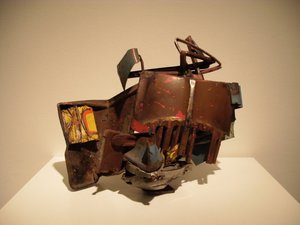
Fancy That: A Monumental Exploration of Assemblage
John Angus Chamberlain’s sculpture “Fancy That,” created around 1963, stands as an arresting testament to the transformative power of repurposing industrial detritus into profound artistic expression. More than just a visually striking assemblage—a deliberate juxtaposition of disparate materials—it embodies the core tenets of Neo-Dada and echoes the legacy of Abstract Expressionism, marking Chamberlain’s indelible contribution to American sculpture.
The artwork itself is dominated by a substantial red chair constructed from wood and metal. Its seat is crafted from solid timber, providing stability and grounding the piece, while a robust steel frame contributes structural integrity and hints at the machine age aesthetic prevalent during its creation. However, it’s the deliberate incorporation of crushed automobile parts—primarily fenders and hoods—that elevates “Fancy That” beyond conventional sculptural forms.
- Technique: Chamberlain's method involved meticulously crushing car bodies into fragments before welding them together with remarkable precision. This process wasn’t merely destructive; it was a calculated act of reimagining, transforming discarded objects into monumental sculptures that challenge notions of beauty and materiality.
- Style: Strongly influenced by Marcel Duchamp’s conceptual approach to art—specifically the readymade—Chamberlain deliberately eschewed traditional artistic skill in favor of embracing chance and improvisation. This stylistic choice aligns perfectly with the spirit of Abstract Expressionism, prioritizing emotional resonance over technical virtuosity.
- Historical Context: Produced during the mid-1960s, “Fancy That” reflects the broader cultural milieu of its time—a period marked by experimentation in art and design, fueled by anxieties about technological advancement and a desire to disrupt established artistic conventions. It’s a direct response to the prevailing trends of the era.
The sculpture's impact transcends mere visual appeal; it compels contemplation on themes of decay, transformation, and the relationship between nature and industry. The juxtaposition of organic wood against cold metal creates a dynamic tension that mirrors the complexities of the human experience. Chamberlain’s masterful manipulation of material invites viewers to consider the beauty inherent in imperfection and the potential for artistic innovation within unexpected sources.
“Fancy That” isn't simply an object; it’s a statement—a bold assertion of artistic freedom and a celebration of the transformative capacity of art. Its enduring presence in contemporary art discourse underscores Chamberlain’s position as a visionary artist who redefined sculpture and cemented his place within the canon of American modernism.
Vprašanja in odgovori
Za kakšno uporabo se priporoča tiskanina dela "Fancy"?
Priporočena uporaba tiska dela "Fancy" je Akcent.
Kakšna je svetlobnost dela "Fancy" avtorja John Angus Chamberlain?
"Fancy" avtorja John Angus Chamberlain ima Svetla ravnovesja luminanco. Luminanca opisuje, koliko svetlobe se zdi, da barve odražajo.
Kaj predstavlja "Fancy"?
Tematika v delu "Fancy" avtorja John Angus Chamberlain vključuje sculpture, assemblage, automobile parts, abstraction, john chamberlain, neo dada, metal sculpture, ki skupaj predstavljajo vsebino umetninškega dela.
Biografija umetnika
The Alchemist of Automobilia: The Life and Legacy of John Angus Chamberlain
In the intersection of industrial decay and high art, few figures loom as large or as provocatively as John Angus Chamberlain. Born in 1927 in Rochester, Indiana, Chamberlain did not merely create sculpture; he orchestrated a metamorphosis of the discarded. To look upon his work is to witness a violent yet poetic dialogue between the mechanical past and the abstract present. He possessed a singular vision that allowed him to see not just rusted scrap, but a vocabulary of form, color, and texture. His journey from the son of a saloonkeeper in the American Midwest to a titan of the Neo-Dada movement is a testament to an unyielding creative impulse that sought to find beauty within the crushed and the broken.
Chamberlain’s artistic consciousness was forged through a diverse and rigorous educational odyssey. After serving in the United States Navy during the pivotal years of World War II, he utilized the GI Bill to immerse himself in the burgeoning avant-garde scenes of America. His time at the Art Institute of of Chicago provided him with a foundational mastery of form, but it was his tenure at the legendary Black Mountain College that truly expanded his intellectual horizons. At Black Mountain, he moved beyond the purely visual, studying under influential poets such as Charles Olson and Robert Creeley. This literary immersion profoundly shaped his sculptural language; he famously viewed his collection of automotive fragments as a reservoir of words, where the act of welding was akin to composing a stanza, seeking the perfect placement of one jagged edge against another to achieve a rhythmic, poetic resonance.
A Symphony of Steel and Spontaneity
The hallmark of Chamberlain’s oeuvre lies in his revolutionary technique of assemblage. While many of his contemporaries were exploring the flat planes of Abstract Expressionist painting, Chamberlain sought to bring that same gestural energy into three-dimensional space. He became a master of the "crushed" aesthetic, meticulously dismantling abandoned automobiles and extracting their vibrant, enamel-coated metal components. Through the intense processes of welding, bending, and compressing, he transformed these industrial remnants into monumental forms that pulsed with an almost organic vitality.
His work defies easy categorization, existing in a fluid state between several major movements:
- Abstract Expressionism: He translated the spontaneous, emotional brushstrokes of painters like Pollock into the physical manipulation of steel and chrome.
- Neo-Dada: By utilizing found objects and "readymades" from the industrial age, he challenged the sanctity of traditional sculptural materials like marble or bronze.
- Pop Art: His use of consumerist detritus—the very skin of the American automobile—connected his high-art ambitions to the burgeoning mass culture of the mid-20th century.
There is a palpable tension in his sculptures, a sense of captured motion and compressed energy. The bright flashes of Cadillac red or Chevrolet blue, often peeking through layers of rust and grime, create a chromatic intensity that mirrors the dynamism of urban life. He did not seek to represent the car, but rather to capture the spirit of its movement and the inevitable entropy of its decay.
Historical Significance and the Enduring Pulse of Art
Throughout his prolific career, Chamberlain’s presence was felt across the most significant art hubs of the world, from Manhattan and Los Angeles to Shelter Island and even Belgium. His ability to disrupt the boundaries between sculpture and painting left an indelible mark on the trajectory of modern art. He proved that the debris of the industrial revolution could serve as the medium for a profound spiritual and aesthetic inquiry. Critics often noted that while his materials were cold and hard, the emotional impact of his work was deeply visceral, aiming—as he himself desired—to "make the viewer’s heart beat."
As we reflect on his life, which concluded in 2011, Chamberlain remains a pivotal figure who bridged the gap between the mechanical and the lyrical. He taught us that art is not merely about the creation of something new, but about the radical reimagining of what already exists. His legacy lives on in every artist who looks at the wreckage of the world and sees the potential for a masterpiece, reminding us that even in the crushed and the discarded, there is an eternal, unyielding beauty waiting to be welded back together.
John Angus Chamberlain
1927 - 2011 , United States of America
Ključne informacije
- Full Name: John Angus Chamberlain
- Nationality: American
- Date Of Birth: 1927
- Date Of Death: 2011
- Place Of Birth: Rochester, United States of America
- Notable Artworks:
- Fancy
- Sleeping Giant
- Artistic Movement Or Style: Abstract Expressionism
- Artists Who Influenced This Artist:
- Robert Delaunay
- Jean Dubuffet
- Artists Or Movements Influenced By This Artist: ['Neo-Dada']