Early Renaissance · 1425
Trinity (Мазаччо, 1425)
Мазаччо (1401–1428) создал(а) Trinity. Создано в 1425. Относится к направлению Early Renaissance. Выполнено в технике Fresco. Хранится в Санта-Мария-Новелла в Флоренция, Италия. Размер: 640 × 317 cm
- 1425
- Fresco
- 640 × 317 cm
- Санта-Мария-Новелла, Флоренция

 Картина маслом ручной работы
 Поделиться
 Поделиться
 Информационный лист


 Скачать
 Похожие предметы
 Слайд-шоу
 Вопросы и ответы

 Статистика просмотров
Trinity вкратце
- Название
- Trinity
- Автор
- Мазаччо (1401–1428)
- Дата рождения художника
- Сан-Джованни-Вальдарно, Италия
- Дата
- 1425
- Техника
- Fresco
- Размеры
- 640 × 317 cm
- Где посмотреть
- Санта-Мария-Новелла, Флоренция, Италия
- Движение
- Early Renaissance
- Период
- Renaissance
- Сюжет
- perspective, religion, humanism, classicalelements, florence, biblicalscene
Что изображено на Trinity?
A Portal to the Divine: The Dawn of Renaissance Realism
To step before Masaccio’s Holy Trinity is to witness the exact moment when the flattened, symbolic world of the Middle Ages dissolved into the profound, breathing reality of the Renaissance. Painted between 1425 and 1427 within the hallowed walls of Santa Maria Novella in Florence, this fresco does not merely depict a religious scene; it carves a hole in the very wall of the chapel, inviting the viewer to step into a sacred, three-dimensional space. At its heart lies a revolutionary commitment to humanism—the belief that the divine can be understood through the lens of human experience and physical truth. Through his masterful command of light and form, Masaccio transformed a static icon into a living drama of salvation.
The composition is anchored by the central figure of Jesus Christ, depicted with a startling naturalism that was unprecedented for his era. He stands as the axis of the universe, flanked by the Virgin Mary and Saint John the Evangelist. Unlike the ethereal, weightless figures of the preceding Gothic period, Masaccio’s subjects possess a palpable sense of mass and gravity. Their robes fall with heavy, realistic folds, and their faces carry an emotional depth that speaks to the viewer across centuries. This is not art meant for distant adoration alone; it is art designed to resonate with the human soul, making the theological mysteries of the Trinity feel intimately present within our own physical realm.
The Architecture of Illusion: Mastery of Perspective
Perhaps the most enduring legacy of this masterpiece is Masaccio’s pioneering use of linear perspective. By employing a single vanishing point, he created an architectural illusion so convincing that contemporary viewers felt they were looking into a real, deep chapel rather than at a painted surface. The coffered barrel vault above the figures recedes with mathematical precision, guiding the eye upward and inward. This technical triumph was not merely a display of skill; it served a profound symbolic purpose. By placing the holy figures within a believable, structured environment, Masaccio bridged the gap between the earthly and the divine, suggesting that the sacred exists within the very geometry of our world.
This sense of depth is further enhanced by his sophisticated use of chiaroscuro. The subtle interplay of light and shadow—the way light seems to strike the figures from a consistent source—gives them a sculptural quality. This technique breathes life into the flesh, defining the musculature of Christ and the gentle contours of Mary’s face. For the modern collector or interior designer, this mastery of volume offers a sense of structural elegance and intellectual depth, making it a piece that commands attention through its quiet, commanding presence.
A Timeless Legacy for the Discerning Collector
Beyond the technical brilliance, the Holy Trinity remains an emotional powerhouse. It captures the tension between human mortality and eternal hope. At the base of the composition, the inclusion of the donors—the mortal figures who commissioned the work—serves as a poignant reminder of our own place in the grand tapestry of history. They stand at the threshold, looking up toward the divine, mirroring the journey of every viewer who encounters this fresco.
For those seeking to adorn a space with art that inspires contemplation and awe, a high-quality reproduction of this Masaccio masterpiece offers more than mere decoration. It brings into a home or gallery a piece of the very foundation of Western art. Whether placed in a study filled with books or as a focal point in a grand living space, the Holy Trinity provides an atmosphere of profound stability, historical richness, and enduring beauty. It is an invitation to pause, to look deeper, and to rediscover the breathtaking realism that first ignited the Renaissance.
В каком музее находится Trinity?
Санта-Мария-Новелла
Флоренция, Италия
Здание и его архитектура Базилика считается важнейшим памятником романско-готического стиля в Тоскане. Ее структура отражает длительный период развития: строительство нижней части романско-готического фасада началось в 1350 году и было окончательно завершено лишь в 1920 году. Сам фасад обладает самобытным обликом благодаря геометрическим узорам из белого и зеленого мрамора.


Изображения в высоком разрешении: Trinity

Общественное достояние: художник умер в 1428.
Другие размеры, фрагменты и цитирование →Мазаччо, Trinity (1425), Санта-Мария-Новелла. Общественное достояние
Ответы на вопросы о Trinity
В каком музее хранится оригинал «Trinity»?
Вы можете увидеть оригинал произведения «Trinity» в Санта-Мария-Новелла, Флоренция, Италия.
В каком году было создано произведение «Trinity», Мазаччо?
В какой технике выполнено произведение «Trinity», Мазаччо?
Каковы размеры оригинала «Trinity»?
Размер оригинала произведения «Trinity» составляет 640 x 317 cm. Оригинальные размеры могут служить полезным ориентиром при выборе размера репродукции.
Что изображено на картине «Trinity»?
Находится ли изображение «Trinity», Мазаччо в общественном достоянии?
К какому художественному направлению относится «Trinity», Мазаччо?
Об авторе, Мазаччо

1401–1428, Италия
Мазаччо
Массо (1401–1428): Начало Ренессанса Реализма Массо был одним из самых выдающихся художников раннего итальянского Возрождения, чьи фрески в церкви Санта-Мария-дель-Кармине во Флоренции оказали влияние на искусство всего европейского континента. Его жизнь была коротка и трагична – он умер в возрасте 26 лет в Риме в конце жизни. Несмотря на это короткое время творчества, Массо оставил неизгладимый след в истории искусства, заложив новые стандарты натурализма и вдохновив последующие поколения художников. Ранняя Жизнь и Обучение Массо родился 21 декабря 1401 года в Сан-Джованни Вальдарно, Италия – городе, расположенном между Арезцо и Флоренцией.
Другие работы Мазаччо
 Троица1428
 Дань1425
 Изгнание из Рая1426
 Отдельный фрагмент «Оплаты десятины»
Эссе к произведению Trinity
 Understanding Gothic and Renaissance Art: Key Differences and FeaturesMaster the differences between Gothic and Renaissance art through expert analysis of technique and style. Discover the evolution of art tod…
 25 Masterpieces by Duccio di Buoninsegna: The Dawn of Sienese ArtJourney through the Sienese School with our curated guide to Duccio di Buoninsegna’s top 25 masterpieces. From the Maesta to iconic Madonna…
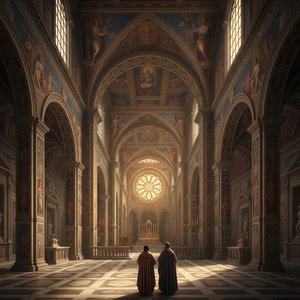 Mastering Depth: The Architectural Power of Linear Perspective in Renaissance MasterpiecesExplore the profound impact of linear perspective on Renaissance art. Discover how masters like Brunelleschi and Uccello used mathematical …