

 Примерить в интерьере
 Отправить
 Поделиться
 Подробнее
 Руководство

 Скачать
 Похожие объекты
 Рентгенография
 Слайд-шоу
 Статистика
Multiplex D
 Acrylic On Canvas
- WallArt
- Geometric Abstraction
 1948
1948 22.0 x 30.0 cm
 Музей де Йонг
 Развернуть текст
Произведение искусства, представленное на этой странице, защищено законом об авторском праве, что исключает возможность законного создания или продажи его точной репродукции. Данная защита обеспечивается международными соглашениями, такими как Бернская конвенция и национальным законодательством, включая положения, изложенные в Закон США об авторском праве — Раздел 17.
В качестве достойной и законной альтернативы мы предлагаем авторские картины ручной работы, вдохновленные оригиналом. Наши опытные профессиональные художники тщательно изучают стиль, настроение и художественную суть оригинала, чтобы создать новое, уникальное произведение, которое вызывает те же чувства, оставаясь при этом самостоятельным оригинальным творением.
Этот метод полностью соответствует нормам авторского права, так как он не предполагает копирования или дублирования защищенного произведения. Напротив, это творческая реинтерпретация — создание новой картины, которая вдохновлена оригиналом, но не является его точной копией.
Масляная репродукция ручной работы
Картина маслом на холсте в выбранном вами размере и раме, написанная на заказ нашими художниками. ( Переключиться на печать Перейти к цифровым изображениям)




P118B $10

P118H $10

P118W $10

P438Z $10

P508JH $12

P508YH $12

P805H $10

P805Z $10

P919BZ $10

P919G $10

P919XJ $10

P959ZH $10

P968JZ $12

W106C $8

W218G $10

W218JH $8

W218Y $10

W307PJ $10

W316G $10

W316PJ $8

W316Y $10

W398PJ $8

W4111J $10

W500HY $15

W500JH $15

W692G $12

W849H $8

W940BG $15

W953PJ $8




Выберите один из наших стандартных размеров, соответствующих оригинальным пропорциям произведения искусства.

Введите необходимую ширину и высоту, чтобы репродукция подошла к вашей раме или стене. Поскольку работа выполняется вручную, при изменении пропорций художник может немного увеличить область вокруг картины или, наоборот, обрезать края — выбор за вами. Перед началом работы мы пришлем вам цифровой макет на утверждение. Изображение на этой странице не является точным результатом — увидеть реальный вид можно только на макете.
После оформления заказа команда OriginalUniqueArt.com свяжется с клиентом по электронной почте для уточнения деталей и предоставит предварительный макет
Доставка по всему миру () за 3–4 недели вместо стандартных 5 недель. (23 Октябрь). Без компромиссов в качестве.

Бесплатная экспресс-доставка по всему миру

Высококачественный льняной холст

Полное страхование при транспортировке

Гарантия возврата таможенных пошлин

Гарантия точного цветового соответствия

100-дневный период возврата (только при обнаружении дефектов)

Гарантия возврата 100% средств

Скидка при заказе нескольких работ
 Вариант со стеклом доступен только для размеров менее 110 см

Multiplex D
Материал репродукции
Размер репродукции
-


Итоговая стоимость
$ 300
Josef Albers’s Geometric Exploration of Color and Perception
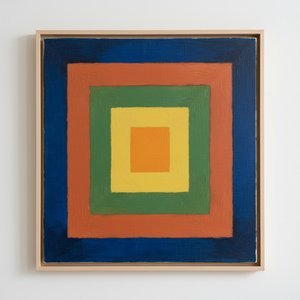
Josef Albers's "Multiplex D," created in 1948, stands as a cornerstone of American Abstract Expressionism while simultaneously embodying the principles of Bauhaus design—a testament to his multifaceted artistic vision. This deceptively simple woodcut print showcases nine squares meticulously arranged on a rectangular canvas, each square subtly offset from its neighbors, creating an illusion of depth and movement that transcends mere visual representation. Albers’s masterful manipulation of tonal variations within the squares contributes significantly to this perceptual experience, prompting viewers to contemplate how color interacts with form and how individual perception shapes our understanding of reality.- Artist: Josef Albers (American (born Germany), Bottrop 1888–1976 New Haven, Connecticut)
- Medium: Woodcut on Paper
- Dimensions: Sheet: 9 × 12 1/16 in
- Date: 1948
The Bauhaus Influence and Geometric Precision
Albers’s formative years were deeply rooted in the Bauhaus school of art and design, where he absorbed the revolutionary ideas championed by Walter Gropius regarding functionalism and the unification of art and craft. This influence is palpable in “Multiplex D,” which rejects representational imagery in favor of geometric abstraction—a deliberate choice to prioritize form over content and to explore the fundamental properties of visual perception. The repetition of squares, a motif prevalent throughout Bauhaus aesthetics, underscores the school’s belief that simplified shapes could convey complex ideas effectively.Color Theory and Illusionistic Depth
“Multiplex D” exemplifies Albers's pioneering contributions to color theory—specifically his concept of simultaneous contrast. He understood that adjacent squares emit hues that appear differently depending on the surrounding colors, generating a dynamic interplay between perception and reality. This technique isn’t merely decorative; it serves as a conduit for investigating how our eyes perceive color and how these perceptions are influenced by context. The subtle gradations of tone within each square amplify this illusionistic depth, inviting contemplation about the nature of visual experience.Symbolism Beyond Surface Appearance
While seemingly devoid of narrative content, “Multiplex D” possesses a profound symbolic resonance. The squares themselves can be interpreted as representing stability and order—characteristics aligned with Bauhaus ideals—yet their overlapping positions suggest interconnectedness and the complexities inherent in human experience. Albers’s deliberate use of monochrome reinforces this notion, stripping away extraneous details to focus on the essential relationship between color and form. It encourages viewers to consider how visual elements communicate ideas beyond literal depiction.A Legacy of Influence
“Multiplex D” solidified Josef Albers's reputation as a visionary artist who reshaped the landscape of modern art. His meticulous attention to detail, coupled with his groundbreaking exploration of color perception, continues to inspire artists and designers globally. The print’s enduring appeal lies in its ability to provoke intellectual curiosity while simultaneously conveying an understated elegance—a reflection of Albers's unwavering commitment to artistic integrity and his profound understanding of the transformative power of visual art. Its inclusion in museums like The Metropolitan Museum of Art demonstrates its significance as a pivotal piece within American art history.Вопросы и ответы
Является ли «Multiplex D» типичным для того, что обычно создавал Йозеф Альберс?
Повторяющиеся темы в творчестве Йозеф Альберс включают color exploration, geometric abstraction, bauhaus legacy, minimalist aesthetic, formal experimentation; работа "Multiplex D" сосредоточена на squares, color theory, geometric forms, composition, minimalism, printmaking, bauhaus.
К какому художественному направлению относится «Multiplex D», Йозеф Альберс?
«Multiplex D» — это произведение в стиле Geometric Abstraction. Данное направление указывает на художественную традицию, к которой относится эта работа.
Есть ли работы, похожие на "Multiplex D"?
Работы, похожие на «Multiplex D», Йозеф Альберс, собраны на странице Похожие работы этого произведения.
Биография художника
A Life Forged in Material: The Early Years and Bauhaus Formation
Josef Albers’s artistic journey began not amidst the rarefied air of established academies, but within the pragmatic world of his father’s contracting business in Bottrop, Germany. Born in 1888, young Josef absorbed a deep respect for materials – carpentry, plumbing, house-painting – skills that would fundamentally shape his aesthetic sensibility. This wasn't merely vocational training; it was an immersion into the very essence of making, understanding how forms materialized and the inherent qualities within each medium. He learned to appreciate the subtle textures of wood grain, the precise angles required for a perfect joint, the transformative power of color in a freshly painted wall. Before dedicating himself fully to art, Albers spent five years as a schoolteacher, honing patience and pedagogical skill—attributes that would later define his influential teaching career. This early experience instilled in him a profound understanding of observation, careful measurement, and the importance of clear communication – qualities he would bring to his artistic practice. Formal artistic training commenced at the Königliche Kunstschule in Berlin between 1913 and 1915, where he explored printmaking, painting, and, crucially, stained glass. His early commission, “Rosa Mystica Ora Pro Nobis” (1918), a stunning stained-glass window for a church in Munich, foreshadowed his lifelong fascination with the interplay of light and color, hinting at the abstract explorations to come. This initial work wasn’t simply decorative; it was an investigation into how light *transformed* material, a theme that would resonate throughout his career – a delicate dance between pigment and illumination.The Bauhaus Crucible: Color as Subject
A pivotal moment arrived in 1922 when Albers joined the faculty of the Bauhaus, a revolutionary school seeking to unify all artistic disciplines under Walter Gropius’s visionary leadership. Initially tasked with teaching the preliminary course – *Werklehre* (workshop practice) – he immersed himself in its core principles: functionalism, geometric abstraction, and material exploration. This period proved transformative. Albers began a systematic investigation into color perception, moving away from representational art towards an increasingly abstract vocabulary. He wasn’t interested merely in *what* colors were, but *how* they interacted, how they influenced each other, and how our eyes perceived them. The influence of fellow Bauhaus masters like Paul Klee and Wassily Kandinsky is discernible in his early work, yet Albers charted a unique course, prioritizing empirical observation over metaphysical interpretation. He wasn’t seeking spiritual truths through color; he was meticulously documenting its physical effects – a scientific rigor that became the hallmark of his artistic method. This focus on perception, on how we *see*, rather than what is *seen*, set him apart and laid the groundwork for his future explorations. The Bauhaus environment fostered experimentation with unconventional materials—glass, metal, wood—and encouraged students to challenge traditional notions of art and design. Albers embraced this spirit of innovation, pushing the boundaries of material manipulation and exploring new ways to represent visual relationships.Homage to the Square: A Laboratory of Perception
Following a period teaching at Black Mountain College – where he fostered a generation of American artists including Robert Rauschenberg and Cy Twombly – Albers embarked on what would become his most iconic series in 1949: “Homage to the Square.” This ongoing project consisted of paintings featuring nested squares within squares, each iteration exploring subtle variations in color relationships. It’s a deceptively simple premise, but one that belies an incredibly complex and rigorous investigation. Albers meticulously documented his experiments, revealing how colors aren't static entities but dynamic forces governing each other through internal logic – often misleading to the eye. A seemingly brighter square might appear to recede while a darker one advances, defying intuitive understanding. The series wasn’t intended as a celebration of geometry; rather, it was a laboratory for studying color perception. He used a systematic approach, varying the size and placement of squares, and carefully documenting the resulting visual effects. This research culminated in his seminal book, “Interaction of Color” (1963), a foundational text still studied by artists and designers today – a testament to Albers’ belief that seeing is not passive, but an active process of interpretation. The book isn't a treatise on color theory; it's a series of exercises designed to demonstrate how our perception of color is relative and contextual – a profound exploration of the subjective nature of visual experience.Legacy and Enduring Influence
Josef Albers’s impact extends far beyond his paintings. His tenure as head of the design department at Yale University, from 1950 until his retirement in 1958, cemented his reputation as a profoundly influential teacher. He emphasized hands-on experimentation, critical observation, and relentless questioning of assumptions. Students weren't simply taught *what* to paint; they were taught *how* to see – to analyze, to deconstruct, and to understand the underlying principles governing visual experience. Albers’s approach fostered independent thinking and encouraged students to develop their own unique artistic voices. “Homage to the Square” remains iconic for its exploration of perceptual phenomena, demonstrating that even within seemingly simple forms, there exists an infinite complexity waiting to be discovered. His work continues to inspire artists, designers, and educators alike – a testament to the power of observation, experimentation, and the enduring mystery of color. Albers died on March 25, 1976, in New Haven, Connecticut, leaving behind a legacy that continues to illuminate the world of art and design.Notable Works
- Gray Instrumentation I Prospectus (1975): A minimalist monochrome painting exemplifying geometric balance and subtle tonal variations.
- Study for Homage to the Square – Beaming (Date Unknown): A classic example of Albers’s exploration of color interaction within nested squares, evoking a sense of calm and spatial depth.
- Rosa Mystica Ora Pro Nobis (1918): His early stained-glass commission, foreshadowing his lifelong fascination with light and color.

Йозеф Альберс
1888 - 1976 , Германия
Краткая справка
- Artistic Movement Or Style: Геометрическое абстракционизм
- Artists Or Movements Influenced By This Artist:
- Минимализм
- Полевая живопись
- Artists Who Influenced This Artist:
- Клее
- Кандинский
- Date Of Birth: 19 марта 1888 г.
- Date Of Death: 25 марта 1976 г.
- Full Name: Josef Albers
- Nationality: Немецко-американец
- Notable Artworks:
- Homage to the Square
- Gray Instrumentation I Prospectus
- Rosa Mystica Ora Pro Nobis
- Place Of Birth: Боттруп, Германия
Похожие статьи
Josef Albers: A Homage to Color Interaction & the Foundations of Visual Perception
Explore Josef Albers's groundbreaking color theory & the 'Homage to the Square' series. Discover how his work revolutionized visual perception and influenced modern art movements like Minimalism & Op Art. Learn about his Bauhaus roots & lasting legacy.

Beyond Form & Color: Geometric Abstraction's Enduring Legacy in Art History
Explore the captivating world of geometric abstraction! Discover its origins, key artists like Malevich & Mondrian, and why this movement remains highly valued by art collectors today. Expert insights at OriginalUniqueArt.

Beyond Form & Color: Geometric Abstraction's Evolution in 20th/21st Century Art
Explore the evolution of geometric abstraction from Cubism to contemporary art. Discover key artists like Malevich & Mondrian, investment insights, and expert collecting advice at OriginalUniqueArt.

The Enduring Appeal of Geometric Patterns in Art: A Historical & Contemporary Exploration
Explore the captivating history of geometric abstraction in art, from ancient roots to contemporary masters. Expert insights for collectors & enthusiasts. Discover key artists, movements & investment potential.

Геометрическая абстракция: 10 шедевров, изменивших искусство | OriginalUniqueArt.com
Погрузитесь в мир геометрической абстракции! От Кандинского до Малевича – 10 шедевров, изменивших искусство. Узнайте историю создания и значение культовых картин. Репродукции музейного качества на OriginalUniqueArt.com. Вдохновение для вашего интерьера!