Expressionism
Prophet (Эмиль Нольде)
Эмиль Нольде (1867–1956) создал(а) Prophet. Относится к направлению Expressionism. Выполнено в технике Woodcut.
- Woodcut

 Предпросмотр

 Картина маслом ручной работы
 Поделиться
 Поделиться
 Руководство


 Скачать
 Похожие предметы
 Рентгенография
 Слайд-шоу
 Вопросы и ответы

 Статистика просмотров
Prophet: основные сведения
- Название
- Prophet
- Автор
- Эмиль Нольде (1867–1956)
- Дата рождения художника
- Нольде, Дания
- Техника
- Woodcut
- Движение
- Expressionism
- Период
- Modern
- Сюжет
- man, face, beard, black and white, portrait, eyes
Что изображено на Prophet?
The Portrait of Prophet by Emil Nolde
In Prophet, the German Expressionist painter Emil Nolde captures a man who exists between the physical and the divine. The subject is a portrait of a man likely intended to represent a prophet, a figure carved from shadow and light. His beard and hairstyle suggest a man from a distant past or a religious leader, a person shaped by the weight of revelation. The face is a landscape of heavy lines and stark contrasts.
The man’s intense gaze pierces through the grain of the medium. A furrowed brow carries the imprint of deep emotion, perhaps a mixture of sadness, concern, or a singular, driving determination. This is not a likeness of a person in repose, but a study of a soul under pressure. The features are simplified, stripped of unnecessary detail to reveal the raw essence of the subject's internal state.
Emil Nolde uses the starkness of the form to emphasize this spiritual tension. Every line serves the gravity of the man's expression. The eyes do not merely look; they witness. The stillness of the portrait holds a quiet, heavy ache.
Composition and Visual Elements
The man's face occupies the center, a heavy presence that fills most of the frame. His head tilts slightly, caught in a moment of quiet anguish or deep contemplation. Around him, the background remains largely empty, a void that forces the eye back to the subject's features. There is no horizon, only the weight of the gaze.
Bold, thick lines carve the anatomy of the man. They define the coarse texture of his beard, the sharp ridge of his nose, and the deep-set hollows of his eyes. These lines are not smooth; they are angular and sharp, cutting through the space to shape his hair and facial structure. The geometry is simplified, reducing the man to essential, striking forms.
The color palette is stripped of all distraction. It exists in a narrow world of black and white, bridged only by subtle shades of grey. This lack of color heightens the dramatic tension, turning the portrait into a study of light and shadow. The starkness leaves no room for anything but the raw emotion of the expression.
Technique and Artistic Medium
The work emerges from the physical resistance of wood. This woodcut print relies on the deliberate act of carving lines into a solid block to define its form. Each stroke is a subtraction, a removal of material that leaves behind a sharp, angular topography. The artist works with wood, ink, and paper to translate a vision into a permanent, tactile presence.
Ink meets the paper through the pressure of the press. This contact creates a grainy texture across the surface, a subtle roughness that speaks of the material's origin. The depth of the shadows and the brightness of the highlights depend entirely on the variation of the lines. Thicker cuts hold more ink to create heavy shadows, while thinner, delicate lines allow the paper to breathe through the composition. The result is a stark, high-contrast landscape of light and dark.
The medium demands a directness of hand. There is no blending here, only the immediate impact of the carved edge. The grain of the wood and the weight of the ink settle into the fibers of the paper, creating a surface that feels both raw and finished. It is a quiet collision of tool and grain.
Prophet в высоком разрешении
Общественное достояние: художник умер в 1956.
Эмиль Нольде, Prophet. Общественное достояние
Цифровой эксперт сверяет цвета с оригинальной картиной и ретуширует файл, сохраняя верность манере письма художника.
Купить изображение в высоком разрешенииВопросы о Prophet
В какой технике выполнено произведение «Prophet», Эмиль Нольде?
Для создания «Prophet» Эмиль Нольде использовал(а) технику Woodcut. Эта техника определяет материальную природу оригинального произведения.
Что изображено на картине «Prophet»?
Сюжеты произведения «Prophet» — это man, face, beard, black and white, portrait, eyes.
Является ли произведение «Prophet» свободным от авторских прав?
Произведение «Prophet», Эмиль Нольде находится в общественное достояние — срок действия авторского права истёк. Этот статус определяет правила воспроизведения изображения данного произведения.
Кто создал "Prophet"?
«Prophet» был создан Эмиль Нольде. Информация на этой странице описывает оригинальную работу Эмиль Нольде.
К какому художественному направлению относится «Prophet», Эмиль Нольде?
«Prophet», Эмиль Нольде относится к направлению Expressionism. Это направление определяет стилистический контекст произведения.
Почему произведение «Prophet» имеет именно такой статус авторского права?
Произведение «Prophet» за авторством Эмиль Нольде находится в общественное достояние — срок действия авторского права истёк. Срок действия авторского права исчисляется со дня смерти автора; Эмиль Нольде скончался(а) в 1956 году.
Как работа «Prophet» соотносится с общим творчеством Эмиль Нольде?
В творческом наследии Эмиль Нольде работа «Prophet» относится к стилю Expressionism и созвучна темам post-impressionism, die brücke, religious themes, expressionist style.
Как «Prophet» соотносится с привычными темами творчества Эмиль Нольде?
Среди зафиксированных тем Эмиль Нольде — post-impressionism, die brücke, religious themes, expressionist style — в работе "Prophet" особый акцент сделан на man, face, beard, black and white, portrait, eyes.
Об авторе, Эмиль Нольде
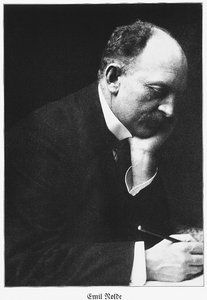
1867–1956, Дания
Эмиль Нольде
Жизнь и самопознание Эмиля Нольде Рожденный 7 августа 1867 года под именем Ганс Эмиль Хансен, человек, которому суждено было стать известным как Эмиль Нольде, вырос в окрестностях деревни Нольде в герцогстве Шлезвиг. Его ранние годы были неразрывно связаны с сельским, аграрным укладом жизни его семьи. Со временем он решил сойти с этого предначертанного пути, выбрав вместо земледелия ремесло резчика по дереву и декоратора мебели. Этот тактильный, физический труд стал своего рода прелюдией к его последующему переходу к живописи и графике.
Другие работы Эмиль Нольде
 Sunset
 Sea with Red Sky
 Couple on the beach1903
 Masks1911
Эссе к произведению Prophet
 Stone and Sinew: The Sculptural Foundations of Modigliani’s PortraitsExplore the sculptural roots and structural mastery of Modigliani's portraits. Discover the secrets behind his iconic, carved style now.
 Expressionism vs. New Objectivity: Emotion vs. Precision in German ArtMaster the tension between Expressionist emotion and New Objectivity precision. Explore the soul of German modern art now.
 Emile Nolde: A Journey into Expressionist Nature & the Primal SelfExplore the powerful Expressionism of Emile Nolde – a pioneer of emotive landscapes & spiritual themes. Discover his journey, influences, a…