Portretul lui William Morris

Cele 26 cele mai faimoase picturi ale lui William Morris, o selecție de galerie

Actualizat Noiembrie 2026 · clasat în funcție de scorul nostru de popularitate (căutări, vizite și comenzi pentru fiecare operă) · 37 lucrări ale lui William Morris în catalogul nostru

Pe scurt

Dintre toate originalele lăsate de William Morris, cea mai faimoasă este Strawberry Thief (1936), din colecția Cleveland Museum of Art, Cleveland. Imediat după acestea urmează The Little Tree (Hammersmith Rug) (1895) și Snakeshead (1900). Catalogul nostru cuprinde 37 lucrări ale lui William Morris; galeria a păstrat cele 26 pe care lumea le admiră cel mai mult, fiecare fiind prezentată împreună cu data, muzeul și povestea sa.

1834 – 1896, Walthamstow Romantic revival Cele mai multe lucrări: William Morris Gallery

Cele mai importante 10 picturi ale lui William Morris: selecția galeriei

1
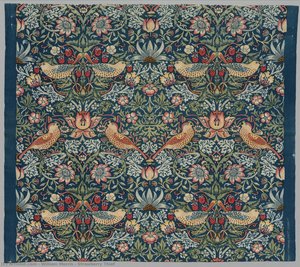
Strawberry Thief (1936) de William Morris

Strawberry Thief

1936 · Textile · Cleveland Museum of Art, Cleveland

William Morris's "Strawberry Thief," completed in 1936, isn’t merely a decorative textile; it’s a vibrant distillation of the Arts and Crafts movement’s core tenets – a celebration of nature, a rejection of industrialization, and a subtle yet potent expression of social critique. This iconic design, now instantly recognizable, draws its inspiration from Morris's own garden at Kelmscott Manor in Oxfordshire, specifically the mischievous thrushes that frequented his fruit beds. The…

2
The Little Tree (Hammersmith Rug) (1895) de William Morris

The Little Tree (Hammersmith Rug)

1895 · Textile · Museum of Applied Arts, Budapesta

William Morris’s “The Little Tree” (Hammersmith Rug), completed in 1895, isn't merely a decorative textile; it’s a meticulously crafted portal to a world steeped in medieval romance, folklore, and the enduring beauty of nature. Born from the fertile imagination of one of England’s most influential artists and designers, this rug embodies the core tenets of the Arts and Crafts movement – a rejection of mass-produced industrialism in favour of handcrafted…

3
Snakeshead (1900) de William Morris

Snakeshead

1900 · Textile · Cleveland Museum of Art, Cleveland

The fabric breathes with a heavy, rhythmic energy, pulling the eye into a dense thicket of color. Deep reds and stark blacks collide in a pattern that feels both grounded and strikingly bold. Small, delicate motifs move across the surface, creating a sense of movement that mimics the swaying of wildflowers in a summer breeze. There is a certain tension here, found in the way the dark tones press against…

4
Design for (1881) de William Morris

Design for

1881 · Textile · William Morris Gallery, Walthamstow

Before he was a revolutionary socialist, a poet of immense talent, or simply one of the most celebrated textile designers in history, William Morris was a young man captivated by the remnants of a lost world. Born in Walthamstow, Essex, in 1834, his childhood was steeped in the romanticism of medieval chivalry and the beauty of the English countryside—a landscape he would relentlessly strive to capture within his designs. This…

5
Design for (1876) de William Morris

Design for

1876 · William Morris Gallery, Walthamstow

In the delicate interplay of flora and geometry, Design for stands as a profound testament to the visionary genius of William Morris. Created in 1876, this exquisite piece is far more than a mere decorative pattern; it is a bridge between the artisanal traditions of the past and the burgeoning aesthetic movements of the nineteenth century. The work captures a moment where nature and craftsmanship converge, offering a rhythmic dance…

8
Design for (1862) de William Morris

Design for

1862 · Acrylic · William Morris Gallery, Walthamstow

A Celebration of Pastoral Harmony: Exploring William Morris’s Watercolor Design The watercolor painting titled “Design for” by William Morris stands as a testament to the Arts and Crafts movement's unwavering belief in the restorative power of nature and its rejection of mass production. Executed in 1862, this artwork isn’t merely a depiction of flora; it’s an embodiment of Morris’s artistic ethos—a deliberate attempt to recapture the idealized beauty of the…

9
Design for woven fabric with birds and palms (1870) de William Morris

Design for woven fabric with birds and palms

1870 · William Morris Gallery, Walthamstow

This sketch by William Morris was likely intended for a woven textile repeat pattern, but was never realised. It bears a resemblance to a number of bird designs Morris & Co. produced in the late 1870s, including ‘Bird’ and ‘Bird and Dragon’, both designed by Morris in 1878. The fabrics were manufactured at the Morris & Co. premises at Queen Square, London, before subsequently being woven on hand-activated jacquard looms…

10
Qui Bien Aime Tard Oublie (1860) de William Morris

Qui Bien Aime Tard Oublie

1860 · Embroidery · William Morris Gallery, Walthamstow

In the delicate interplay of thread and color, "Qui Bien Aime Tard Oublie" emerges as a breathtaking testament to the Pre-Raphaelite spirit and the profound connection between art and the natural world. Created in 1860 by the legendary William Morris, this extraordinary embroidery is far more than a mere decorative hanging; it is a window into a romanticized era where craftsmanship served as a vessel for deep emotion. The work…

Selecția pentru William Morris continuă, de la 11 la 26

Subiectele care i-au captivat privirea lui William Morris

Cele patru teme care revin cel mai des în aceste opere originale, fiecare având cel mai sublim exemplu.

Muzeele care păstrează originalele lui William Morris

Cele 6 muzee care dețin cele mai multe dintre picturile de pe această pagină.

Muzee Oraș Lucrări lui William Morris Picturi din această listă
William Morris Gallery, WalthamstowWilliam Morris Gallery Walthamstow 13 Design for, Design for, Design for
Cleveland Museum of Art, ClevelandCleveland Museum of Art Cleveland 2 Strawberry Thief, Snakeshead
Museum of Applied Arts, BudapestaMuseum of Applied Arts Budapesta 1 The Little Tree (Hammersmith Rug)
Boca Raton Museum of Art, Boca RatonBoca Raton Museum of Art Boca Raton 1 Vas Petroglif
The Baltimore Museum of Art, BaltimoreThe Baltimore Museum of Art Baltimore 1 Floare de Gălbănuță
Tate Britain, LondraTate Britain Londra 1 La Belle Iseult

William Morris deceniu cu deceniu: originalul care definește fiecare

Lucrări pe deceniu

Alege o deceniu pentru a descoperi opera originală care îl definește.

Întrebări ale colecționarilor despre picturile lui William Morris

Pentru ce operă este cel mai cunoscut William Morris?Află răspunsul

Strawberry Thief (1936), Cleveland Museum of Art, Cleveland. Urmează The Little Tree (Hammersmith Rug) (1895) și Snakeshead (1900).

Care sunt cele mai celebre zece picturi ale lui William Morris?Află răspunsul

Strawberry Thief, The Little Tree (Hammersmith Rug), Snakeshead, Design for, Design for, Fruit, Honeycomb, Design for, Design for woven fabric with birds and palms și Qui Bien Aime Tard Oublie. Clasamentul de mai sus indică anul și muzeul pentru fiecare piesă.

Câte picturi a lăsat William Morris?Află răspunsul

Catalogul nostru cuprinde 37 lucrări ale lui William Morris, datate între 1857 și 1895.

În ce muzee sunt expuse capodoperele lui William Morris?Află răspunsul

În principal în William Morris Gallery (Walthamstow), Cleveland Museum of Art (Cleveland) și Museum of Applied Arts (Budapesta). Tabelul cu muzee de mai sus le enumeră pe toate.

În ce ani a pictat William Morris cele mai cunoscute opere?Află răspunsul

În 1870s: 5 dintre cele 26 lucrări de pe această pagină au fost realizate atunci, fiind Design for dintre acestea.

Care sunt prima și ultima pictură originală celebră a lui William Morris?Află răspunsul

Pe această pagină, cea mai veche lucrare datează din Sword (1857), iar cea mai recentă este din The Little Tree (Hammersmith Rug) (1895).

Ce subiecte a ales cel mai des William Morris?Află răspunsul

Pattern (5), Floral pattern (4) și Textile art (4), din cele 26 lucrări de pe această pagină.

Ce tehnică a folosit cel mai des William Morris?Află răspunsul

Textile, pentru 4 dintre cele 26 lucrări de pe această pagină.

Din ce mișcare artistică face parte William Morris?Află răspunsul

Romantic revival, judecând după originalele de pe această pagină.

Ce lucrări ale lui William Morris sunt expuse la William Morris Gallery?Află răspunsul

Design for, Design for și Design for: William Morris Gallery, Walthamstow deține 10 dintre lucrările de pe această pagină.

William Morris: viață și operă

A Life Rooted in Nature and Romance

William Morris, born on March 24, 1834, in Walthamstow, Essex, emerged from a comfortably affluent middle-class background—a circumstance that afforded him the freedom to pursue passions rather than professions. His father’s success as a financier provided not only security but also an environment where aesthetic sensibilities could flourish. Morris's childhood was deeply shaped by the English countryside surrounding his home and a fascination with tales of medieval chivalry, laying the groundwork for a lifelong devotion to both natural beauty and romantic narratives. These early influences weren’t merely sentimental; they formed the core of his artistic philosophy. He wasn’t simply *inspired* by nature or the past—he believed in their inherent moral and aesthetic superiority to the rapidly industrializing present. His formal education at Oxford University initially steered him toward a clerical path, but it was within the vibrant intellectual circles of the university that his true calling began to take shape. He joined “The Set,” a group of students who shared an intense interest in art, literature, and medieval history, forging friendships—most notably with Edward Burne-Jones—that would profoundly impact his artistic trajectory. It was during this period that he encountered the writings of John Ruskin, whose critique of industrial society and advocacy for craftsmanship resonated deeply with Morris’s burgeoning beliefs.

The Arts & Crafts Revolution

Following Oxford, a brief foray into architecture quickly gave way to painting, as Morris collaborated with Dante Gabriel Rossetti on mural projects. However, it was the founding of Morris, Marshall, Faulkner & Co. in 1861—later known simply as Morris & Co.—that marked a pivotal moment, not just in his career but in the history of design. This wasn’t merely a business venture; it was an attempt to create a new way of life, one where art permeated every aspect of daily existence and craftsmanship was valued above all else. Alongside Burne-Jones, Rossetti, Philip Webb, and others, Morris sought to revive traditional techniques and produce beautiful, well-made objects for the home. The firm’s early work was profoundly influenced by Red House, a home Morris commissioned from Webb—a structure that embodied the Arts & Crafts ideal of creating a unified aesthetic environment through handcrafted furnishings and decoration. Morris became a leading voice in the burgeoning Arts & Crafts movement, championing handmade craftsmanship as an antidote to the perceived dehumanizing effects of mass production. He believed passionately that art should be accessible to all, not just the wealthy elite, and that it should be integrated into everyday life—a radical notion at a time when design was often seen as separate from function. This wasn’t simply about aesthetics; it was rooted in a deep social conscience and a desire to improve the lives of working people. He envisioned a society where beauty and utility coexisted harmoniously, rejecting the utilitarian dogma that dominated Victorian thought.

A Legacy Woven in Textiles, Poetry, and Print

Morris's artistic output spanned diverse mediums—painting, sculpture, illustration, poetry, and prose—each reflecting his unwavering commitment to naturalism and romantic idealism. His paintings often depicted landscapes imbued with symbolic meaning, drawing inspiration from medieval romances and folklore. Notable works include *Sun and moon angels*, *Oak leaves in All Saints*, and *Judas Maccabaeus*, demonstrating his mastery of color and composition. However, it was Morris’s textile designs that cemented his reputation as one of the most influential figures in Victorian decorative arts. These weren't merely patterns; they were intricate narratives woven with flowing floral motifs, lush foliage, and rich, evocative colors—a deliberate rejection of the repetitive geometric designs favored by industrial manufacturers. He meticulously researched traditional weaving techniques and employed natural dyes to achieve stunning hues that captured the essence of the English countryside. His wallpapers, similarly, moved away from sterile imitation toward nature-inspired creations that were both beautiful and functional. The firm Morris & Co., established in 1861, became synonymous with Arts & Crafts excellence, shaping interior design trends for decades to come.

Socialism, Conservation, and Enduring Influence

Morris’s artistic vision was inextricably linked to his political convictions—specifically, a fervent belief in socialism. Influenced by Friedrich Engels and deeply moved by the plight of working-class communities, he advocated for social reform and championed the dignity of labor. He saw industrial capitalism as fundamentally corrupting human nature and undermining moral values, arguing that true progress could only be achieved through collective action and a commitment to ethical principles. This conviction fueled his involvement in various socialist organizations and informed his writings on social justice. Furthermore, Morris recognized the importance of preserving historic buildings and landscapes for future generations—a stance that foreshadowed the growing environmental awareness of the 20th century. He understood that these structures weren’t merely relics of the past but vital links to cultural heritage and artistic inspiration. His dedication to craftsmanship, natural beauty, and social responsibility continues to resonate today, securing his place as a pivotal figure in Victorian art and culture—a testament to the enduring power of an artist who dared to challenge prevailing orthodoxies and envision a more humane world. His unwavering belief in the transformative potential of art and design remains as relevant now as it was during his lifetime, inspiring artists and designers alike to strive for excellence while upholding ethical values.