Comută pe versiunea Print
 Vezi mai mult







































 Pentru opere de artă sau reproduceri care depășesc 105 cm (aproximativ 41 de inch) pe oricare dintre laturi, cadrul va fi livrat demontat, sub formă de kit. Această metodă asigură o livrare sigură și previne deteriorarea în timpul transportului.


A Divine Encounter in Oil and Wood
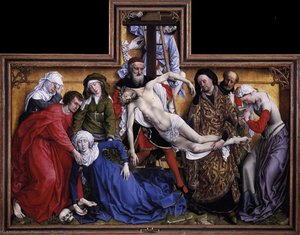
To stand before the Sforza Triptych is to step through a portal into the profound spiritual landscape of the Northern Renaissance. Completed around 1460, this extraordinary altarpiece by the Flemish Master Rogier van der Weyden (or his highly skilled workshop) serves as much more than a religious relic; it is a masterclass in the intersection of human emotion and divine grace. The work was commissioned for Alessandro Sforza, a prominent member of the Milanese dynasty, and it carries within its three hinged panels a narrative of devotion that remains as palpable today as it was in the fifteenth century. As light dances across the meticulously rendered surfaces, the viewer is invited into a sacred space where the boundaries between the earthly and the celestial begin to blur.
The composition of the triptych is famously irregular, yet this very asymmetry lends the piece an organic, breathing quality that draws the eye in a rhythmic dance across the panels. In the central scene, the weight of the Crucifixion anchors the soul, with Christ’s sacrifice presented with a raw, poignant realism. Surrounding him, the figures are not merely static icons but vessels of grief and reverence. The technique employed—oil paint on wood panels—allows for an unprecedented luminosity. Through the delicate application of glazes, Van der Weyden achieved a depth of color that seems to glow from within, capturing the subtle sheen of fine fabrics, the cold hardness of armor, and the soft, translucent quality of human skin with breathtaking precision.
The Language of Symbolism and Detail
Every brushstroke in the Sforza Triptych serves a higher purpose, weaving a complex tapestry of symbolism that rewards the contemplative observer. The artist’s background as a goldsmith is evident in the microscopic attention to texture; one can almost feel the heavy weight of the velvet drapery and the intricate metallic glints of period attire. This dedication to detail was not merely for aesthetic pleasure but was deeply rooted in the devotio moderna movement, which encouraged believers to find the divine in the minute details of the physical world. The presence of saints such as St. Bavo, St. Francis, St. Catherine, and St. Barbara on the wings provides a celestial court that flanks the central mystery, creating a sense of a continuous, eternal liturgy.
For the modern collector or interior designer, this piece offers a profound sense of historical gravity and intellectual depth. The triptych does not simply decorate a space; it commands it. Its ability to evoke a mood of quiet contemplation makes it an ideal centerpiece for environments that value heritage, stillness, and sophistication. Whether viewed as a window into the pious heart of the 15th century or as a triumph of Early Netherlandish technical mastery, the Sforza Triptych remains an enduring symbol of how art can bridge the gap between the temporal and the eternal.
Întrebări și răspunsuri
Unde pot achiziționa o printă a lucrării "Sforza Triptych" de Rogier van der Weyden?
Pentru a achiziționa o ediție print a lucrării "Sforza Triptych" de Rogier van der Weyden, vă este suficient să o comandați pe pagina dedicată Print Fine Art: o printă fine art pe canvas din bumbac sau pe hârtie canvas arhivistică.
Din ce stil face parte "Sforza Triptych"?
"Sforza Triptych" de Rogier van der Weyden face parte din mișcarea Early Netherlandish Renaissance. Acest curent oferă contextul stilistic al operei.
"Sforza Triptych" de Rogier van der Weyden este păstrat în țara de origine a artistului?
Da - opera de artă este păstrată în țara de origine a artistului. Țara natală a Rogier van der Weyden este Belgia, iar muzeul care păstrează originalul operei „Sforza Triptych” se află în Belgia.
 Previzualizare
 Trimite prin felicitare
 Distribuie
 Detalii despre lucrare
 Ghid
Ghid

 Descarcă imaginea
 Produse similare
 Radiografie
 Galerie foto
 Q&A
Q&A Statistici