Comută pe versiunea Print
 Vezi mai mult







































 Pentru opere de artă sau reproduceri care depășesc 105 cm (aproximativ 41 de inch) pe oricare dintre laturi, cadrul va fi livrat demontat, sub formă de kit. Această metodă asigură o livrare sigură și previne deteriorarea în timpul transportului.


The Quiet Resonance of Genius: A Portrait of Marietta Robusti
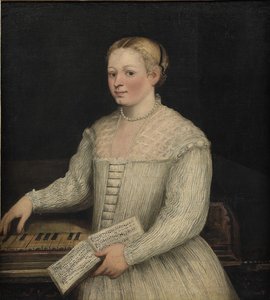
To stand before this depiction of Marietta Robusti is to encounter not merely a likeness, but a moment suspended in the rich, vibrant tapestry of late Renaissance Venice. The air around her seems thick with the scent of aged varnish and the ghost notes of music yet unplayed. She is captured in an intimate, three-quarter pose, seated before the elegant expanse of a harpsichord. Her gaze, though directed slightly away from the viewer, possesses an undeniable intelligence—a quiet dignity that speaks volumes of her intellect and artistic immersion. The composition itself guides the eye with masterful subtlety; the gentle diagonal sweep created by her posture and the instrument anchors the scene, while the dark, undifferentiated background serves to heighten the luminosity emanating solely from her figure.
Technique and Material Mastery
The artist, working in a style deeply rooted in Venetian portraiture, demonstrates an exquisite command of oil paint. One can almost feel the meticulous layering that gives depth to the textures presented. Observe the contrast between the smooth, porcelain quality of her skin—highlighted by soft, diffused light catching her cheekbone—and the crisp articulation of the lace at her collar. The handling of fabric is particularly noteworthy; the woven texture of her gown and the delicate folds suggest a painter who understood how light interacts with different materials. The inclusion of sheet music adds another layer of technical brilliance, requiring fine, precise lines to delineate the paper's edges against the polished wood of the keyboard. This attention to varied surface quality elevates the piece beyond simple representation into a study of material existence.
A Window into Venetian Culture and Ambition
This portrait is more than just a depiction of a musician; it is a cultural artifact from 1580 Venice. Marietta, daughter of the celebrated Tintoretto, lived within an environment where artistic genius was both nurtured and constrained by social expectation. The presence of the instrument and music serves as potent symbolism: it speaks to her cultivated talent, perhaps hinting at patronage or the intellectual life afforded to women of means. Her attire subtly communicates her standing within Venetian society. It is a portrait steeped in the gravity of an era where art was inextricably linked to status, making her quiet composure feel like a declaration of self-worth.
Emotional Echoes for the Modern Collector
For the contemporary collector or designer seeking pieces that breathe history into modern interiors, this reproduction offers profound emotional resonance. The mood is one of contemplative beauty—a sense of focused artistry and enduring grace. It invites quiet reflection, suggesting that true genius often resides not in grand pronouncements, but in moments of deep concentration. Owning a piece like this allows one to curate an atmosphere steeped in the romance of the Renaissance masters, bringing home a tangible echo of Venetian brilliance.
Întrebări și răspunsuri
Ce intensitate de culoare are "Self-Portrait" de Marietta Robusti?
"Self-Portrait" de Marietta Robusti prezintă o intensitate a culorii Monochromatic.
Ce emoție transmite "Self-Portrait" de Marietta Robusti?
Tonul emoțional înregistrat pentru "Self-Portrait" de Marietta Robusti este Reflective. Acesta rezumă sentimentul exprimat de operă.
În ce perioadă a carierei lui Marietta Robusti se încadrează "Self-Portrait"?
În cariera lui Marietta Robusti, „Self-Portrait” aparține perioadei Renaissance. Această etapă facilitează compararea sa cu celelalte opere ale artistului.
Mai multe detalii despre această pictură
 Previzualizare
 Trimite prin felicitare
 Distribuie
 Detalii despre lucrare
 Ghid
Ghid

 Descarcă imaginea
 Produse similare
 Radiografie
 Galerie foto
 Întrebări și răspunsuri
 Statistici