Meniu

() ·

A painting made for you, by hand

Reproducere pictată manual în ulei

Pictură în ulei pe pânză, pictată manual de artiștii noștri la dimensiunea și ramele dorite de dumneavoastră, pe comandă. ( Comută pe versiunea Print Comută pe Imagine Digitală)

Descriere obiect de colecție

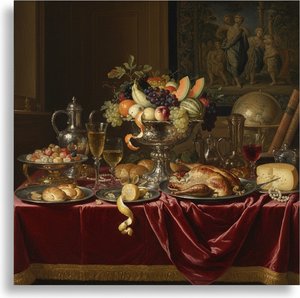
A lavish still life by Juriaen van Streeck showcases opulent objects—fruit, porcelain, and silver—reflecting Dutch Golden Age wealth and symbolism. Explore its intricate details and artistic mastery.

Biografie artist

Juriaen van Streeck (1632-1687) a fost un pictor olandez de aur din secolul al XVII-lea, renumit pentru scenele sale de încărcare bogate și simbolismul profund, explorând teme precum trecerea vieții și valoarea efemeră.

from ·

Chapter 1

How large should it be?

Slide to change the size; the wall on the left shows it at its real scale. The proportions of the original are kept.

Standard
personalizat
CM
INCH

Alegeți dintre dimensiunile noastre prestabilite, care respectă proporțiile originale ale operei de artă.

lățime
înălțime

Introduceți lățimea și înălțimea necesare pentru a se potrivi ramei sau peretelui dumneavoastră. Această lucrare este pictată manual, așa că, pentru o dimensiune cu o formă diferită, artistul poate picta puțin mai mult în jurul imaginii sau poate tăia puțin din margini — dumneavoastră decideți. Vă vom trimite o simulare digitală pentru aprobare înainte de a începe pictarea. Imaginea afișată pe această pagină nu reprezintă rezultatul real — doar simularea este reprezentativă.

Chapter 2

How should it arrive?

Choose the edges of the stretched canvas

Choose your frame

Corner sample of the WhiteWrap canvas edge finish, stretched on lemn masiv bars
White lei1
Corner sample of the BlurSideWrap canvas edge finish, stretched on lemn masiv bars
Blurside lei1
Corner sample of the ExtendedWrap canvas edge finish, stretched on lemn masiv bars
Extended lei1
Corner sample of the P118B picture frame: polistiren turnat, 5 cm wide and 3 cm thick
P118B lei10
Corner sample of the P118H picture frame: polistiren turnat, 5 cm wide and 3 cm thick
P118H lei10
Corner sample of the P118W picture frame: polistiren turnat, 5 cm wide and 3 cm thick
P118W lei10
Corner sample of the P438Z picture frame: polistiren turnat, 5.5 cm wide and 3.5 cm thick
P438Z lei10
Corner sample of the P508JH picture frame: polistiren turnat, 7 cm wide and 3.5 cm thick
P508JH lei12
Corner sample of the P508YH picture frame: polistiren turnat, 7 cm wide and 3.5 cm thick
P508YH lei12
Corner sample of the P805H picture frame: polistiren turnat, 5 cm wide and 3.5 cm thick
P805H lei10
Corner sample of the P805Z picture frame: polistiren turnat, 5 cm wide and 3.5 cm thick
P805Z lei10
Corner sample of the P919BZ picture frame: polistiren turnat, 7 cm wide and 3.5 cm thick
P919BZ lei10
Corner sample of the P919G picture frame: polistiren turnat, 7 cm wide and 3.5 cm thick
P919G lei10
Corner sample of the P919XJ picture frame: polistiren turnat, 7 cm wide and 3.5 cm thick
P919XJ lei10
Corner sample of the P959ZH picture frame: polistiren turnat, 5 cm wide and 3 cm thick
P959ZH lei10
Corner sample of the P968JZ picture frame: polistiren turnat, 6 cm wide and 4 cm thick
P968JZ lei12
Corner sample of the W106C picture frame: lemn masiv, 5 cm wide and 3 cm thick
W106C lei8
Corner sample of the W218G picture frame: lemn masiv, 5 cm wide and 3 cm thick
W218G lei10
Corner sample of the W218JH picture frame: lemn masiv, 5 cm wide and 3 cm thick
W218JH lei8
Corner sample of the W218Y picture frame: lemn masiv, 5 cm wide and 3 cm thick
W218Y lei10
Corner sample of the W307PJ picture frame: lemn masiv, 6 cm wide and 3 cm thick
W307PJ lei10
Corner sample of the W316G picture frame: lemn masiv, 6 cm wide and 3 cm thick
W316G lei10
Corner sample of the W316PJ picture frame: lemn masiv, 6 cm wide and 3 cm thick
W316PJ lei8
Corner sample of the W316Y picture frame: lemn masiv, 6 cm wide and 3 cm thick
W316Y lei10
Corner sample of the W398PJ picture frame: lemn masiv, 5 cm wide and 3 cm thick
W398PJ lei8
Corner sample of the W4111J picture frame: lemn masiv, 6.5 cm wide and 3.5 cm thick
W4111J lei10
Corner sample of the W500HY picture frame: lemn masiv, 7 cm wide and 5 cm thick
W500HY lei15
Corner sample of the W500JH picture frame: lemn masiv, 7 cm wide and 5 cm thick
W500JH lei15
Corner sample of the W692G picture frame: lemn masiv, 8 cm wide and 4 cm thick
W692G lei12
Corner sample of the W849H picture frame: lemn masiv, 5 cm wide and 3 cm thick
W849H lei8
Corner sample of the W940BG picture frame: lemn masiv, 7.5 cm wide and 4.5 cm thick
W940BG lei15
Corner sample of the W953PJ picture frame: lemn masiv, 6 cm wide and 3.5 cm thick
W953PJ lei8
Corner sample of the H24-GOLD picture frame: lemn sculptat cu gesso, 10 cm wide and 6 cm thick
H24-GOLD lei30
Corner sample of the H24-SILVER picture frame: lemn sculptat cu gesso, 10 cm wide and 6 cm thick
H24-SILVER lei30
Corner sample of the H36-GOLD picture frame: lemn sculptat cu gesso, 15 cm wide and 6.5 cm thick
H36-GOLD lei45
Corner sample of the H36-SILVER picture frame: lemn sculptat cu gesso, 15 cm wide and 6.5 cm thick
H36-SILVER lei45

Moulding: . Overall size with the frame: .

Chapter 3

Who paints it, and should anything change?

Examples of what can be changed: Replace face with customer photo; Add pet (e.g., replace cat with dog); Include hidden message in background; Change background landscape or elements.
After order, OriginalUniqueArt.com team will email client for instructions and provide a mockup preview

Livrare în întreaga lume () în 3-4 săptămâni, în loc de cele 5 săptămâni standard. (29 Octombrie). Fără compromisuri în ceea ce privește calitatea.

Chapter 4

The finishing touches

A nameplate, as in a museum?

Detalii plăcuță din bronz gravat

This elegant plaque features the artist's name and the title of the artwork, finely engraved for a timeless presentation.

It is made from bronze with a refined, elegant finish. The text is precisely laser-engraved for a sharp and permanent result. Measuring 9x2 cm, the plaque is compact yet easy to read. It's built to be durable and scratch-resistant, offering a professional, museum-quality look. Mounting is simple thanks to the included adhesive backing.

Detalii plăcuță din acril transparent

The plaque includes essential engraved details such as the artist's name, the title of the artwork, the date it was created, the type of media used-like oil on canvas or watercolor-a brief description of the piece, and a QR code that links to the complete artwork information.

It is crafted from clear acrylic, offering a sleek, modern appearance. The text is UV-engraved in black to ensure strong visual contrast. With a size of 10x15 cm, it ensures optimal readability. It comes equipped with two metal hooks for secure wall mounting. The plaque is designed to be weather-resistant, making it suitable for various environments, and it includes interactive features that work seamlessly with smartphone scanning.

Detalii placă din acril negru

This elegant plaque includes engraved information such as the artist's name, the title of the artwork, the date it was created, the type of media used (like oil on canvas or watercolor), a short description of the artwork, and a QR code for quick access to more information.

The plaque itself is made from refined black acrylic with a premium finish. The text is laser-engraved in white for high contrast and readability. Its size is 10x15 cm, designed to be easy to read. It comes with two metal hooks for professional mounting. The design is sleek and fits any interior style. It is also weather-resistant and durable, with built-in digital integration for mobile compatibility.

A protective varnish?

When do you need it?

Chapter 5

Your painting, as you ordered it

Still-Life

Tehnică de reproducere

Dimensiune reproducere

-

Selecție de artiști de elită

Mai multe detalii, rafinament și timp suplimentar de execuție

-

Ramă pentru reproducere artistică

-

-

Pentru opere de artă sau reproduceri care depășesc 105 cm (aproximativ 41 de inch) pe oricare dintre laturi, cadrul va fi livrat demontat, sub formă de kit. Această metodă asigură o livrare sigură și previne deteriorarea în timpul transportului.

Este necesară asamblarea profesională – acest produs nu este de tip DIY (de făcut singur).
Kitul trebuie asamblat, iar pânza întinsă, de către un legător de cadre experimentat, utilizând adeziv pentru lemn (neinclus în colet), o cheie pentru întinderea pânzei și cleme pentru a menține barele la unghi drept în timp ce adezivul se usucă. Asamblarea incorectă sau tensiunea neuniformă a pânzei pot deteriora permanent opera de artă și nu sunt acoperite de garanția noastră.

  • Toate barele din lemn masiv sunt incluse, tăiate cu precizie la dimensiunea necesară.

  • Asamblat cu șuruburile incluse, plus adeziv pentru lemn pentru îmbinările de colț, care nu este furnizat și trebuie achiziționat de către tâmplarul dumneavoastră.

  • Sunt necesare unelte profesionale care nu sunt incluse: o șipte de întindere a pânzei (tensionator) și cleme pentru a menține barele la unghi drept în timp ce adezivul se usucă.

Important:
Îmbinările de colț necesită adeziv pentru lemn, barele trebuie fixate cu clești de strângere până când adezivul este complet uscat, iar întinderea pânzei pe cadrul asamblat necesită un clește pentru întins pânza. Niciunul dintre aceste elemente nu este inclus în kit. Vă rugăm să consultați un încadrator profesionist cu experiență înainte de a comanda această dimensiune.

Etichetă de prezentare

-

-

Lac de protecție

Lac lucios (intensifică nuanțele și oferă protecție împotriva luminii și a umidității)

-

Personalizează opera mea de artă

Exemple de elemente ce pot fi personalizate: Înlocuirea feței cu fotografia clientului; Adăugarea unui animal de companie (de exemplu, înlocuirea unei pisici cu un câine); Includerea unui mesaj ascuns în fundal; Modificarea peisajului sau a elementelor din fundal.

-

Livrare rapidă

Livrare la nivel mondial () în 3-4 săptămâni, în loc de cele 5 săptămâni standard. (29 Octombrie). Fără compromisuri când vine vorba de calitate.

-

Livrare rapidă

Livrare la nivel mondial () în 5 săptămâni. (5 Noiembrie).

Inclus

Preț total calculat

lei 1395

Preț total lei 1395

Opțiunea cu sticlă este disponibilă doar pentru dimensiuni de sub 110 cm

Included with every order

  • Livrare expres gratuită la nivel mondial
  • Pânză de in de înaltă calitate
  • Asigurare completă pentru transport
  • Garanție de rambursare a taxelor vamale
  • Garanția fidelității culorilor
  • Politica de retur în 100 de zile (doar pentru defecte de fabricație)
  • Garanție de rambursare 100%
  • Ofertă pentru comenzi multiple

The Enigmatic Still Life of Juriaen van Streeck

Juriaen van Streeck’s “Still-Life,” a remarkably preserved panel dating from the mid-17th century, offers a captivating glimpse into the world of Dutch Golden Age painting. More than simply a depiction of objects—a bowl of fruit, a porcelain ewer, and a scattering of silverware—it's an intricate meditation on light, texture, and the fleeting nature of beauty itself. The painting resides within the Bavarian State Painting Collections, a testament to its enduring quality and artistic merit.

Van Streeck’s style is deeply rooted in the traditions established by Willem Kalf, yet possesses a subtle individuality. He masterfully employs chiaroscuro—the dramatic contrast between light and shadow—to imbue each object with a palpable sense of volume and realism. The artist doesn't merely represent; he sculpts with light, creating an illusion of depth that draws the viewer into the scene. Notice how the folds of the velvet cloth seem to ripple in the reflected light, or how the sheen on the porcelain gleams with an almost ethereal quality.

A Symphony of Objects and Symbolism

The composition itself is a carefully orchestrated arrangement of seemingly disparate elements. The central focus rests upon a rich still life featuring a blue and white Wan-li bowl, overflowing with luscious peaches, a vibrant lemon, and an orange – each rendered with meticulous detail. A porcelain ewer and vase, alongside a gleaming silver knife, complete the tableau. But these are not merely decorative objects; they carry layers of symbolic meaning deeply embedded within the context of 17th-century Dutch society.

The inclusion of fruit, particularly peaches and oranges, was a deliberate reference to prosperity and abundance – hallmarks of the burgeoning merchant class that dominated the Netherlands at the time. The porcelain ewer, with its intricate floral patterns, speaks to the appreciation for luxury goods imported from the East. Even the loaf of bread, partially consumed, subtly alludes to the transient nature of earthly pleasures, a common theme in Dutch Golden Age art reflecting on mortality and the vanity of worldly possessions. The two butterflies fluttering amongst the objects further enhance this sense of ephemeral beauty.

The Painter’s Technique and Historical Context

Van Streeck's skill lies not just in his ability to render objects with photographic accuracy, but also in his understanding of how light interacts with different surfaces. He demonstrates a remarkable control over brushwork, creating subtle gradations of tone that mimic the way light would fall upon these materials. The painting’s palette is restrained yet sophisticated, dominated by rich browns, golds, and deep reds – colors that evoke the opulence of the Dutch merchant elite.

Created during a period of immense artistic innovation, “Still-Life” reflects the broader cultural trends of the time. The rise of the middle class fueled a demand for art depicting domestic life and luxurious objects, while artists like Van Streeck continued to explore themes of beauty, mortality, and the complexities of human experience. The painting’s provenance – its acquisition by the Princeton University Art Museum in 1954 – underscores its historical significance and enduring appeal.

A Timeless Appeal: Reproduction and Beyond

Reproductions of “Still-Life” offer a remarkable opportunity to bring this exquisite work into your home or office. The meticulous detail, the masterful use of light, and the profound symbolism combine to create a piece that is both visually stunning and intellectually stimulating. Consider pairing it with pieces that evoke similar themes – perhaps a richly textured rug, a vintage silver tray, or a collection of antique ceramics – to create an interior space that reflects your appreciation for beauty, history, and the enduring power of art.

Întrebări și răspunsuri

Ce dimensiune de print pentru "Still-Life" de Juriaen van Streeck se potrivește cu camera recomandată?

Pentru o Living Room, dimensiunea recomandată de imprimare pentru "Still-Life" de Juriaen van Streeck este Medium.

Care este nuanța dominantă în "Still-Life"?

Culoarea dominantă a operei "Still-Life" de Juriaen van Streeck este Warm Sunset Tones. Această nuanță constituie tonul de bază al paletei cromatice.

Ce reprezintă "Still-Life"?

Temele prezente în "Still-Life" de Juriaen van Streeck includ still life, fruit, food, gold, velvet, music, symbolism, dutch painting. Împreună, acestea definesc subiectul întregii opere de artă.

In numbers

  • 29frames to choose from
  • standard sizes, in its own proportions
  • 5weeks to paint and deliver it
Juriaen van Streeck

Juriaen van Streeck

1632 - 1687, Olanda

Detalii rapide

  • Artistic Movement Or Style: Still life, Baroc
  • Artists Or Movements Influenced By This Artist: ['Barend van der Meer']
  • Artists Who Influenced This Artist: ['Willem Kalf']
  • Date Of Birth: 1632
  • Date Of Death: 1687
  • Full Name: Juriaen van Streeck
  • Nationality: Olandez
  • Notable Artworks:
    • Schouburg Plate K
    • Snack
    • Still-Life
  • Place Of Birth: Amsterdam, Olanda

Biografie artist

A Life in Stillness: Unveiling the World of Juriaen van Streeck

Juriaen van Streeck, a name that whispers softly within the rich tapestry of Dutch Golden Age painting, invites us into a world meticulously rendered and profoundly imbued with symbolic contemplation. Born in Amsterdam in 1632, during an era of unprecedented artistic flourishing—a time when wealth, trade, and a subtle awareness of mortality intertwined to shape the cultural landscape—Van Streeck dedicated his life not to grand narratives or dramatic scenes, but to the quiet intimacy of still life painting. This genre, often overlooked in favor of more flamboyant forms, became for him a vehicle for exploring fundamental questions about existence, beauty, and the fleeting nature of earthly possessions. While details of his early years remain shrouded in some obscurity—records are scarce, reflecting the realities of life during that period—we know he emerged into a society captivated by material prosperity and an underlying awareness of its transience, themes that would become the very bedrock of his artistic vision. He married Grietje Claes in 1653, establishing a family life within the bustling Jordaan district, a vibrant neighborhood known for its independent spirit and close-knit communities. Their household eventually grew to include nine children, a testament to their resilience and commitment—though tragically, three of these young lives were cut short by illness, casting a poignant shadow over his family’s existence. Later in life, Van Streeck supplemented his income through a more pragmatic pursuit: he became an innkeeper on Kerkstraat, a street lined with taverns and shops, offering a glimpse into the everyday realities of 17th-century Amsterdam—a shift that perhaps reflected both economic necessity and a desire for greater stability.

The Language of Objects: Style and Influences

Van Streeck’s artistry blossomed within the established tradition of Dutch still life painting, a genre characterized by its remarkable attention to detail, exquisite craftsmanship, and profound symbolic depth. He wasn't simply replicating objects; he was engaging in a deliberate act of interpretation, imbuing each arrangement with layers of meaning. His compositions frequently featured an array of carefully chosen items—gleaming helmets and swords, leather-bound books and scrolls, delicate letters penned in elegant script, resonant musical instruments like lutes and harps, luscious fruits bursting with color, and, crucially, *memento mori* – symbols of mortality such as skulls, decaying game, and wilted flowers. These elements weren’t merely decorative; they were integral to the Vanitas tradition, a powerful artistic current that served as a poignant reminder of life's ephemeral nature and the ultimate futility of worldly possessions. The influence of Willem Kalf is undeniably present in Van Streeck’s work—Kalf was a master of Dutch still life, renowned for his masterful use of rich color palettes, dramatic lighting, and meticulous detail. However, Van Streeck possessed a distinct artistic voice, characterized by a subtle restraint and an almost meditative quality. He wasn't merely imitating Kalf; he was building upon his legacy while forging his own unique path. His ability to capture the textures of various materials—the cool sheen of silver, the velvety softness of peaches, the fragile transparency of glass—was exceptional, creating visual feasts for the eye that simultaneously prompted deeper philosophical reflection. He demonstrated a remarkable understanding of how light and shadow could be used to enhance the drama and symbolism of his compositions.

Vanitas and Beyond: Themes in Van Streeck’s Work

At the heart of Van Streeck's oeuvre lies a profound meditation on mortality, loss, and the transient nature of beauty—themes inextricably linked to the Vanitas tradition. The inclusion of *memento mori* symbols wasn’t simply an aesthetic choice; it was a deliberate attempt to engage viewers in a dialogue about life, death, and the pursuit of meaning. A skull resting amongst opulent objects served as a stark reminder that all earthly possessions are ultimately fleeting, while decaying fruit symbolized the inevitable decline of beauty and vitality. However, Van Streeck’s work extended beyond this overarching theme of mortality. He also explored themes of wealth, status, and the pleasures of everyday life—depicting scenes of feasting, music-making, and scholarly pursuits. His paintings weren't simply about death; they were about celebrating the beauty and richness of life while simultaneously acknowledging its inherent fragility. The careful arrangement of objects within each composition—the placement of a goblet next to a skull, or a book beside a wilting flower—created a visual narrative that invited contemplation and reflection. He wasn’t merely depicting objects; he was using them as symbols to convey complex ideas about human existence.

Notable Works and Historical Significance

Juriaen van Streeck's artistic output, though not as voluminous as some of his contemporaries, comprises a collection of remarkably accomplished still life paintings that continue to captivate viewers today. “Schouburg Plate K,” for example, is a particularly striking work—a meticulously rendered depiction of a silver plate adorned with intricate carvings and surrounded by a variety of objects, including fruit, wine, and a skull. This painting exemplifies Van Streeck’s mastery of detail and his ability to imbue seemingly mundane objects with symbolic weight. “Snack,” another notable example, showcases his talent for capturing the textures and colors of food—the glistening surface of oysters, the vibrant hues of peaches, and the delicate sheen of lemons. His work reflects a broader cultural fascination with observation and scientific inquiry that characterized the Golden Age. While not as widely celebrated as artists like Rembrandt or Vermeer during his lifetime, Van Streeck was recognized by art historian Arnold Houbraken, who praised his versatility in still life subjects. He contributed to the evolution of still life painting as a genre capable of conveying both aesthetic pleasure and profound intellectual depth. His legacy endures through works such as “Still-Life With Peaches And A Lemon On A Marble Table With A Fringed Carpet And Glasses,” which offer invaluable insights into the cultural and philosophical concerns of 17th-century Dutch society—its preoccupation with wealth, its awareness of mortality, and its search for meaning in a rapidly changing world.

Exploring Van Streeck’s World Today

  • Museum Collections: While not as frequently exhibited as some of his contemporaries, examples of Van Streeck's work can be found in institutions like the Museum Smidt van Gelder and the Museum Mayer van den Bergh, offering opportunities for art enthusiasts to encounter his paintings firsthand.
  • Online Resources: Websites such as the Web Gallery of Art (WGA) and Wikipedia provide valuable biographical information and images of his paintings, allowing researchers and casual viewers alike to explore his artistic world. Princeton University Art Museum also offers detailed analysis of a still life formerly attributed to him, highlighting ongoing scholarly debate surrounding his work.
  • Reproductions: Platforms like OriginalUniqueArt.com offer high-quality, hand-painted reproductions of Van Streeck’s masterpieces, allowing art lovers to bring the beauty and symbolism of his paintings into their own homes.

Informații rapide

  • Location: Bavarian State Painting Collections
  • Artistic style: Dutch Golden Age
  • Title: Still-Life
  • Dimensions: 54 x 44 cm
  • Subject or theme: Still life objects

Test de cunoștințe despre artă

Fiecare întrebare are un singur răspuns corect.

Întrebare 1:
What is the primary subject of Juriaen van Streeck’s ‘Still-Life’?
Întrebare 2:
The description mentions a ‘star attached’ to a veil. What does this likely symbolize?
Întrebare 3:
According to the provided information, what musical instruments are depicted in the painting?
Întrebare 4:
What is the approximate size of the ‘Still-Life’ painting?
Întrebare 5:
Juriaen van Streeck’s style is often described as emphasizing which artistic element?

More about this painting

Previzualizare Previzualizare AR Comută pe versiunea Print Comută pe Imagine Digitală Trimite prin felicitare
Detalii despre lucrare Ghid Adaugă la favorite Descarcă imaginea Produse similare Radiografie Galerie foto Q&A Statistici