Previzualizare
 Trimite prin felicitare
 Distribuie
 Detalii despre lucrare
 Ghid
Ghid

 Descarcă imaginea
 Produse similare
 Radiografie
 Galerie foto
 Statistici
The Holy Family
 Oil
Oil- WallArt
- Neoclassical Movement
 1760
1760- Early Modern
 126.0 x 154.0 cm
 Muzeul de Artă Fine din Budapesta
 Vezi mai mult
Giclée / Imprimare artistică
Printuri giclée sau pe canvas de calitate muzeală, cu proces de producție rapid și opțiuni flexibile de finisare. ( Comandă pictură realizată manual Comută pe Imagine Digitală)




P118B lei10

P118H lei10

P118W lei10

P438Z lei10

P508JH lei12

P508YH lei12

P805H lei10

P805Z lei10

P919BZ lei10

P919G lei10

P919XJ lei10

P959ZH lei10

P968JZ lei12

W106C lei8

W218G lei10

W218JH lei8

W218Y lei10

W307PJ lei10

W316G lei10

W316PJ lei8

W316Y lei10

W398PJ lei8

W4111J lei10

W500HY lei15

W500JH lei15

W692G lei12

W849H lei8

W940BG lei15

W953PJ lei8




Alegeți dintre dimensiunile noastre prestabilite, care respectă proporțiile originale ale operei de artă.

Introduceți lățimea și înălțimea necesare pentru a se potrivi ramei sau peretelui dumneavoastră. O printare poate fi doar tăiată, niciodată extinsă dincolo de dimensiunea imaginii originale, astfel încât o dimensiune cu o formă diferită va pierde o parte din imagine. Vă trimitem o simulare digitală pentru aprobare înainte de a imprima orice. Imaginea afișată pe această pagină nu prezintă tăierea reală — doar simularea arată acest lucru.
Livrare în întreaga lume () în 2 săptămâni, în loc de cele 4/5 săptămâni standard. (28 Octombrie)

Livrare expres gratuită la nivel mondial

Pânză de in de înaltă calitate

Asigurare completă pentru transport

Garanție de rambursare a taxelor vamale

Garanția fidelității culorilor

Politica de retur în 100 de zile (doar pentru defecte de fabricație)

Garanție de rambursare 100%

Ofertă pentru comenzi multiple
 Opțiunea cu sticlă este disponibilă doar pentru dimensiuni de sub 110 cm

The Holy Family
Giclée / Imprimare artistică
Dimensiune reproducere
-


Preț total calculat
lei 371
A Vision of Neoclassical Serenity
In the quietude of Anton Raphael Mengs’ “The Holy Family,” one finds more than just a religious tableau; one encounters a profound manifesto of the Neoclassical spirit. Created around 1760, this masterpiece serves as a deliberate and masterful departure from the swirling, ornamental excesses of the Rococo era. Instead of theatrical drama or gilded frivolity, Mengs invites the viewer into a realm of noble simplicity and rational grace. The painting captures a moment of sacred intimacy between Mary, Joseph, and the infant Jesus, rendered with such clarity and poise that it feels both timeless and deeply human. For the discerning collector or interior designer, this work offers a sense of anchored tranquility, making it an ideal centerpiece for spaces that value intellectual depth and understated elegance.
The technical brilliance of the piece lies in Mengs’ sophisticated use of grisaille—a monochrome technique that utilizes a refined spectrum of gray tones to sculpt form. By stripping away the distraction of vibrant color, Mengs directs our entire focus toward the subtle modeling of light and shadow. This meticulous approach creates a remarkable illusion of three-dimensionality, as if the figures were carved from fine marble rather than brushed onto canvas. The soft transitions of light across Mary’s features and the gentle weight of the Christ child in her arms demonstrate a level of precision that honors the classical traditions of antiquity. It is a technique that demands close inspection, rewarding the observer with a sense of sculptural permanence.
Historical Resonance and Emotional Depth
To understand the soul of this painting, one must look to the intellectual currents of the Enlightenment that flowed through Mengs’ life. Heavily influenced by the groundbreaking theories of Johann Joachim Winckelmann, Mengs sought to elevate art from mere decoration to a medium of spiritual and philosophical truth. The composition reflects the era's reverence for Greco-Roman ideals, emphasizing balance, symmetry, and a controlled emotional palette. While the subject matter is deeply rooted in Christian devotion, the execution is decidedly classical, bridging the gap between sacred narrative and the pursuit of idealized beauty.
Beyond its historical significance, "The Holy Family" radiates an emotional warmth that transcends its monochromatic palette. There is a palpable tenderness in the way Joseph gazes upon his family and the curious, wide-eyed wonder of the infant Jesus as he looks toward his mother. This shared connection creates a sanctuary of peace within the frame, offering a meditative quality that can transform the atmosphere of any room. Whether displayed in a sunlit gallery or a sophisticated private study, this reproduction brings with it an aura of contemplative grace, making it a profound choice for those looking to infuse their surroundings with a sense of enduring harmony and sacred light.
Întrebări și răspunsuri
Ce utilizare și ce spațiu sunt recomandate pentru "The Holy Family" de Anton Raphael Mengs?
„The Holy Family” este recomandat pentru Harmony, iar spațiul ideal de expunere este o Living Room.
Pentru ce este recomandată o reproducere a operei "The Holy Family" de Anton Raphael Mengs?
O reproducere a operei "The Holy Family" de Anton Raphael Mengs este recomandată pentru Harmony. Această sugestie derivă din subiectul, atmosfera și culorile lucrării.
Drepturile de autor asupra operei "The Holy Family" de Anton Raphael Mengs permit reproducerea acesteia?
Originalul „The Holy Family” se află la Muzeul de Artă Fine din Budapesta, iar opera este în domeniul public – drepturile de autor au expirat.
Biografie artist
A Bridge Between Worlds: The Life and Art of Anton Raphael Mengs
Anton Raphael Mengs emerged during a fascinating period in European art, a time when the ornate flourishes of the Rococo were beginning to yield to a renewed appreciation for classical ideals. Born in 1728 in Ústí nad Labem, Bohemia – a region now part of the Czech Republic – his artistic journey was profoundly shaped by both his lineage and the intellectual currents of the Enlightenment. His father, Ismael Mengs, a Danish painter who found patronage at the Dresden court, recognized young Anton’s exceptional talent early on. This recognition led to a pivotal move in 1741: a relocation to Rome, where the budding artist was immersed in the study of ancient masterpieces and the works of Renaissance masters like Raphael. It was this exposure that would indelibly mark his aesthetic sensibilities, instilling within him a deep reverence for classical form, clarity, and composition – qualities that would become hallmarks of his mature style. The early years were dedicated to meticulous copying, not merely as an exercise in technique but as a profound act of artistic pilgrimage, absorbing the essence of Raphael’s genius. His father's influence instilled within him a disciplined approach to art, prioritizing precision and intellectual rigor alongside creative expression. This dedication would prove invaluable as Mengs embarked on his formative years in Rome, where he diligently studied the works of Titian, Correggio, and Michelangelo – artists who championed monumental grandeur and masterful illusionism. He quickly gained renown for his skill in replicating celebrated paintings, demonstrating an uncanny ability to capture not only visual likeness but also the spirit of artistic tradition. This practice honed his technical prowess while simultaneously cultivating a deep understanding of compositional principles and stylistic nuances—skills that would serve as bedrock for his subsequent endeavors.From Dresden to Madrid: A Career Across Courts
Mengs’ career unfolded across several prominent European courts, each leaving its unique imprint on his artistic development. In 1749, he secured a prestigious position as court painter to Frederick Augustus II., Elector of Saxony, a role that provided both financial stability and the freedom to maintain a base in Rome – the epicenter of his artistic inspiration. However, it was his frescoes that truly established his reputation. The *Parnassus* at Villa Albani in Rome, completed around 1761, became an instant sensation, lauded for its harmonious composition, elegant figures, and subtle yet powerful evocation of classical mythology. This work wasn’t simply a decorative flourish; it was a deliberate assertion – a conscious effort to synthesize Baroque grandeur with emerging Neoclassical ideals. The fresco skillfully employed pyramidal structure and chiaroscuro—techniques perfected by Caravaggio—to create depth and drama while simultaneously adhering to the principles of clarity and proportion championed by Winckelmann. It solidified Mengs’ position as a leading voice in shaping artistic taste during his time. Following his tenure in Saxony, Mengs accepted an invitation from King Charles III of Spain, relocating to Madrid where he undertook ambitious commissions for royal palaces. His masterpiece, the ceiling fresco adorning the Banqueting Hall of Palacio Real, exemplifies his mastery of monumental decoration and spatial illusion. The subject matter—Triumphal Arch of Titus and Temple of Victory—was chosen to honor imperial grandeur and reinforce the monarchy’s legitimacy, reflecting the prevailing political climate of the era. Mengs skillfully blended Italianate elegance with Spanish sensibilities, demonstrating a remarkable ability to adapt artistic styles to diverse cultural contexts.The Winckelmann Connection: Shaping Neoclassical Thought
A crucial turning point came with his profound friendship and collaboration with Johann Joachim Winckelmann, the pioneering art historian whose writings would become foundational to the Neoclassical movement. Winckelmann’s seminal treatise *Geschichte der Kunst der Griechen und Römer* argued for a return to the perceived purity and simplicity of ancient Greek art, advocating for an aesthetic based on reason, order, and idealized forms—a stark contrast to the exuberant ornamentation characteristic of the Rococo. Mengs wholeheartedly embraced Winckelmann's vision, recognizing its intellectual underpinning and translating it into tangible artistic expressions. Together, they believed that true beauty resided not in superficial embellishment but in the underlying principles of harmony and proportion found in classical antiquity. This conviction fueled Mengs’ artistic endeavors, propelling him to create works imbued with a sense of noble restraint and serene contemplation—a stylistic hallmark of Neoclassicism. Mengs' unwavering devotion to Winckelmann extended beyond mere intellectual agreement; it manifested in their shared pursuit of artistic excellence. They corresponded regularly, exchanging ideas about technique and aesthetics, fostering a dynamic dialogue that shaped Mengs’ artistic trajectory. Winckelmann’s influence permeated his oeuvre, informing his compositional choices and guiding him toward an aesthetic rooted in classical ideals—a legacy that continues to resonate within the annals of art history.Legacy and Influence: A Pioneer of His Time
Anton Raphael Mengs died in Rome in 1779, leaving behind a legacy that extended far beyond his impressive body of work. He was more than just a painter; he was a pivotal figure in the transition from one artistic era to another—a bridge between Baroque grandeur and Neoclassical restraint. His meticulous attention to detail, combined with his masterful command of illusionistic techniques—inherited from Titian and Correggio—established him as a towering achievement of his time. He served as director of the Vatican Painting School, nurturing a new generation of artists committed to upholding classical principles and achieving artistic perfection. As Rudolf Wittkower eloquently remarked: “In last analysis, he is at least as much a terminus as it is an origin,” encapsulating Mengs’ enduring significance as a herald of Neoclassicism—a movement that would forever alter the course of European art history. His influence continues to inspire artists today, reminding us of the transformative power of embracing timeless ideals and striving for artistic excellence.
Anton Raphael Mengs
1728 - 1779 , Cehia
Detalii rapide
- Artistic Movement Or Style: Neoclasicism
- Artists Who Influenced This Artist:
- Raphael
- Winckelmann
- Date Of Birth: 12 martie 1728
- Date Of Death: 29 iunie 1779
- Full Name: Anton Raphael Mengs
- Nationality: German
- Notable Artworks:
- Parnassus
- The Dream of Joseph
- Place Of Birth: Ústí nad Labem, Cehia
Articole similare

Neoclassical Art: The Timeless Elegance of Order, Virtue, and Classical Grace
Explore the profound elegance of Neoclassical art. Discover the principles of order, symmetry, and virtue through the works of masters like David and Mengs. Immerse yourself in a journey of classical grace and timeless aesthetic perfection.
The Enduring Legacy of Classicism: Principles, Evolution & Influence in Western Art
Explore the enduring legacy of Classicism in Western art! Discover its historical context, key principles, iconic masterpieces & lasting influence. Learn about Renaissance and Neoclassical movements with OriginalUniqueArt.
Raphael: Cele Mai Remarcabile 25 de Capodopere – Artă Clasică pentru Decorul Casei Tale
Descoperă cele mai frumoase 25 de picturi ale lui Raphael, maestru al Renașterii italiene! Explorează Școala din Atena, Madonnele și alte capodopere clasice. Găsește inspirație pentru decorul casei tale cu artă renascentistă de calitate muzeală pe OriginalUniqueArt.com.
Top 10 Capodopere Neoclasice: Artă, Istorie și Decorațiuni Interioare de Lux
Descoperă top 10 capodopere neoclasice de la David, Ingres și Canova! Explorează istoria artei, tehnicile artistice și semnificația culturală a picturilor și sculpturilor clasice. Găsește reproducerea perfectă pentru decorul tău pe OriginalUniqueArt.com.
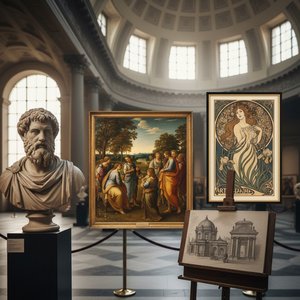
Timeless Resonance: Exploring Classic Vibe in Art – A Historical & Aesthetic Analysis
Explore the rich history & enduring aesthetic of Classicism art! Discover key movements, iconic artists like Raphael & David, and its lasting influence on Western art. Deepen your appreciation today.