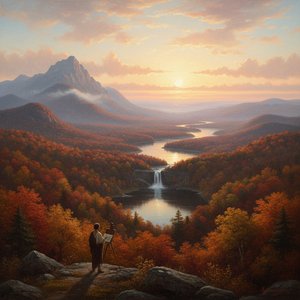
The Soul of the Hudson River School
William Hart stands as a profound voice within the illustrious Hudson River School, a movement that sought to capture the untamed majesty and spiritual essence of the American wilderness. His work is far more than a mere recording of topography; it is a poetic exploration of light, atmosphere, and the quiet dignity of the natural world. Through his canvases, one does not simply see a landscape, but rather experiences a carefully constructed tableau where the boundaries between reality and a deeper, more tranquil truth begin to dissolve. His ability to imbue scenes with a sense of quiet observation allows the viewer to find solace in the vastness of the American terrain, capturing a fleeting moment of peace that feels both eternal and intimately connected to the earth.Artistic Vision and Technique
The mastery of Hart lies in his delicate command over atmospheric perspective and the subtle interplay of light. Whether he was depicting the rugged, crashing waves of a coastline or the serene, sun-drenched meadows where cattle graze, his technique remained rooted in a deep reverence for detail and mood. He possessed a singular skill for creating depth through the use of soft, hazy horizons and the careful layering of tones, which invited the eye to wander through his compositions. In works such as Cows in the Meadow, one can observe an almost Impressionistic beauty, where the light seems to dance across the grass, evoking a sense of pastoral tranquility. His paintings often serve as windows into a bygone era, reflecting a time when the landscape was a primary source of national identity and spiritual reflection.Legacy and Lasting Impact
The significance of Hart’s contribution to American art is found in his ability to translate the grandeur of nature into a language of profound emotion. His landscapes, such as the evocative Scene at Napanoch or the atmospheric Near Tappan Zee, New York, continue to resonate because they capture the subtle melancholy and the breathtaking beauty inherent in the natural cycle. By focusing on the textures of the earth—the ruggedness of a cliffside or the stillness of a forest clearing—he helped establish a visual vocabulary for the American landscape that remains influential to this day. His work remains a testament to the power of observation and the enduring human connection to the wild, untamed spaces of our world.Perguntas e Respostas
Onde posso explorar as obras de William Hart mapeadas por tema?
As obras de William Hart podem ser exploradas por tema na página Atlas de Temas do artista.
Onde as obras de William Hart estão organizadas por cor?
A página Índice de Cores organiza as obras de William Hart por cor.
Onde posso ver as obras de William Hart organizadas por atmosfera?
As obras de William Hart podem ser exploradas por humor na página Coleção por Humor, que organiza as artes de acordo com seus humores registrados.
Como a carreira de William Hart é dividida em períodos?
Um relato cronológico da obra de William Hart está disponível na página Linha do tempo do artista, onde as obras são apresentadas em ordem de criação, capítulo por capítulo.