() ·

A painting made for you, by hand

Deposição

Reprodução em Óleo Feita à Mão

Óleo sobre tela pintado à mão no tamanho e moldura de sua escolha, feito sob encomenda pelos nossos artistas. ( Alternar para Impressão Alternar para Imagem Digital)

Descrição do Item

Experimente 'Deposição' de Rogier van der Weyden, obra-prima do Renascimento Nórdico do séc. XV. Explore sua profundidade emocional, detalhes ricos e importância histórica – um investimento atemporal.

Biografia do Artista

Rogier van der Weyden (1400-1464): Mestre da arte flamenga, conhecido por pinturas religiosas emotivas, cores ricas e detalhes naturalistas. Explore 'Lamentação' & mais!

from ·

Chapter 1

How large should it be?

Slide to change the size; the picture on the left shows the frame at its real width. The proportions of the original are kept.

Tamanho padrão
personalizado
CM
INCH

Escolha entre os nossos tamanhos pré-definidos que respeitam as proporções originais da obra de arte.

largura
altura

Insira a largura e a altura desejadas para se ajustarem à sua moldura ou parede. Como esta obra é pintada à mão, para um tamanho com proporções diferentes, o artista poderá pintar um pouco mais ao redor da imagem ou reduzir ligeiramente a composição — você escolhe. Enviamos uma maquete digital para sua aprovação antes de iniciar a pintura. A imagem exibida nesta página não representa o resultado real — apenas a maquete mostra o resultado final.

Chapter 2

How should it arrive?

Choose the edges of the stretched canvas

Choose your frame

Corner sample of the WhiteWrap canvas edge finish, stretched on madeira maciça bars
White €1
Corner sample of the BlurSideWrap canvas edge finish, stretched on madeira maciça bars
Blurside €1
Corner sample of the ExtendedWrap canvas edge finish, stretched on madeira maciça bars
Extended €1
Corner sample of the P118B picture frame: poliestireno moldado, 5 cm wide and 3 cm thick
P118B €10
Corner sample of the P118H picture frame: poliestireno moldado, 5 cm wide and 3 cm thick
P118H €10
Corner sample of the P118W picture frame: poliestireno moldado, 5 cm wide and 3 cm thick
P118W €10
Corner sample of the P438Z picture frame: poliestireno moldado, 5.5 cm wide and 3.5 cm thick
P438Z €10
Corner sample of the P508JH picture frame: poliestireno moldado, 7 cm wide and 3.5 cm thick
P508JH €12
Corner sample of the P508YH picture frame: poliestireno moldado, 7 cm wide and 3.5 cm thick
P508YH €12
Corner sample of the P805H picture frame: poliestireno moldado, 5 cm wide and 3.5 cm thick
P805H €10
Corner sample of the P805Z picture frame: poliestireno moldado, 5 cm wide and 3.5 cm thick
P805Z €10
Corner sample of the P919BZ picture frame: poliestireno moldado, 7 cm wide and 3.5 cm thick
P919BZ €10
Corner sample of the P919G picture frame: poliestireno moldado, 7 cm wide and 3.5 cm thick
P919G €10
Corner sample of the P919XJ picture frame: poliestireno moldado, 7 cm wide and 3.5 cm thick
P919XJ €10
Corner sample of the P959ZH picture frame: poliestireno moldado, 5 cm wide and 3 cm thick
P959ZH €10
Corner sample of the P968JZ picture frame: poliestireno moldado, 6 cm wide and 4 cm thick
P968JZ €12
Corner sample of the W106C picture frame: madeira maciça, 5 cm wide and 3 cm thick
W106C €8
Corner sample of the W218G picture frame: madeira maciça, 5 cm wide and 3 cm thick
W218G €10
Corner sample of the W218JH picture frame: madeira maciça, 5 cm wide and 3 cm thick
W218JH €8
Corner sample of the W218Y picture frame: madeira maciça, 5 cm wide and 3 cm thick
W218Y €10
Corner sample of the W307PJ picture frame: madeira maciça, 6 cm wide and 3 cm thick
W307PJ €10
Corner sample of the W316G picture frame: madeira maciça, 6 cm wide and 3 cm thick
W316G €10
Corner sample of the W316PJ picture frame: madeira maciça, 6 cm wide and 3 cm thick
W316PJ €8
Corner sample of the W316Y picture frame: madeira maciça, 6 cm wide and 3 cm thick
W316Y €10
Corner sample of the W398PJ picture frame: madeira maciça, 5 cm wide and 3 cm thick
W398PJ €8
Corner sample of the W4111J picture frame: madeira maciça, 6.5 cm wide and 3.5 cm thick
W4111J €10
Corner sample of the W500HY picture frame: madeira maciça, 7 cm wide and 5 cm thick
W500HY €15
Corner sample of the W500JH picture frame: madeira maciça, 7 cm wide and 5 cm thick
W500JH €15
Corner sample of the W692G picture frame: madeira maciça, 8 cm wide and 4 cm thick
W692G €12
Corner sample of the W849H picture frame: madeira maciça, 5 cm wide and 3 cm thick
W849H €8
Corner sample of the W940BG picture frame: madeira maciça, 7.5 cm wide and 4.5 cm thick
W940BG €15
Corner sample of the W953PJ picture frame: madeira maciça, 6 cm wide and 3.5 cm thick
W953PJ €8
Corner sample of the H24-GOLD picture frame: madeira entalhada com gesso, 10 cm wide and 6 cm thick
H24-GOLD €30
Corner sample of the H24-SILVER picture frame: madeira entalhada com gesso, 10 cm wide and 6 cm thick
H24-SILVER €30
Corner sample of the H36-GOLD picture frame: madeira entalhada com gesso, 15 cm wide and 6.5 cm thick
H36-GOLD €45
Corner sample of the H36-SILVER picture frame: madeira entalhada com gesso, 15 cm wide and 6.5 cm thick
H36-SILVER €45
Prévia da moldura
Com moldura

Moulding: . Overall size with the frame: .

Chapter 3

Who paints it, and should anything change?

Examples of what can be changed: Replace face with customer photo; Add pet (e.g., replace cat with dog); Include hidden message in background; Change background landscape or elements.
After order, OriginalUniqueArt.com team will email client for instructions and provide a mockup preview

Entrega mundial () em 3 a 4 semanas, em vez das 5 semanas padrão. (31 Outubro). Sem comprometer a qualidade.

Chapter 4

The finishing touches

A nameplate, as in a museum?

Detalhes da Placa de Bronze Gravada

This elegant plaque features the artist's name and the title of the artwork, finely engraved for a timeless presentation.

It is made from bronze with a refined, elegant finish. The text is precisely laser-engraved for a sharp and permanent result. Measuring 9x2 cm, the plaque is compact yet easy to read. It's built to be durable and scratch-resistant, offering a professional, museum-quality look. Mounting is simple thanks to the included adhesive backing.

Detalhes da Placa de Acrílico Transparente

The plaque includes essential engraved details such as the artist's name, the title of the artwork, the date it was created, the type of media used-like oil on canvas or watercolor-a brief description of the piece, and a QR code that links to the complete artwork information.

It is crafted from clear acrylic, offering a sleek, modern appearance. The text is UV-engraved in black to ensure strong visual contrast. With a size of 10x15 cm, it ensures optimal readability. It comes equipped with two metal hooks for secure wall mounting. The plaque is designed to be weather-resistant, making it suitable for various environments, and it includes interactive features that work seamlessly with smartphone scanning.

Detalhes da Placa de Acrílico Preto

This elegant plaque includes engraved information such as the artist's name, the title of the artwork, the date it was created, the type of media used (like oil on canvas or watercolor), a short description of the artwork, and a QR code for quick access to more information.

The plaque itself is made from refined black acrylic with a premium finish. The text is laser-engraved in white for high contrast and readability. Its size is 10x15 cm, designed to be easy to read. It comes with two metal hooks for professional mounting. The design is sleek and fits any interior style. It is also weather-resistant and durable, with built-in digital integration for mobile compatibility.

A protective varnish?

When do you need it?

Chapter 5

Your painting, as you ordered it

Deposição

Técnica de Reprodução

Tamanho da Reprodução

-

Artista Sênior de Elite

Mais detalhes, refinamento e tempo de produção adicional

-

Moldura para Reprodução

-

-

Para obras de arte ou reproduções com mais de 105 cm (aproximadamente 41 polegadas) em qualquer um dos lados, a moldura será enviada como um kit desmontado. Este método garante uma entrega segura e evita danos durante o transporte.

Montagem profissional necessária — este não é um produto DIY (faça você mesmo).
O kit deve ser montado e a tela esticada por um profissional de molduraria experiente, utilizando cola de madeira (não inclusa), um alicate de esticar tela e grampos para manter as travessas alinhadas enquanto a cola seca. A montagem incorreta ou a tensão desigual da tela podem danificar permanentemente a obra de arte e não estão cobertas pela nossa garantia.

  • Todas as barras de madeira maciça estão incluídas, precisamente cortadas ao tamanho certo.

  • Montado com os parafusos fornecidos, além de cola para madeira para as junções dos cantos, que não está inclusa e deve ser providenciada pelo seu moldurista.

  • São necessárias ferramentas profissionais não incluídas: um alicate de estiramento de tela (esticador) e grampos para manter as ripas alinhadas enquanto a cola seca.

Importante:
As junções dos cantos requerem cola para madeira, as ripas devem ser mantidas com grampos até que a cola esteja completamente seca, e o estiramento da tela na moldura montada requer um alicate de esticar tela. Nenhum destes itens está incluído no kit. Por favor, certifique-se de contar com um profissional de molduraria experiente antes de encomendar este tamanho.

Etiqueta de identificação

-

-

Verniz de Proteção

Verniz brilhante (realça as cores e protege contra a luz e a umidade)

-

Personalizar minha obra

Exemplos de alterações possíveis: Substituir o rosto por uma foto do cliente; Adicionar um animal de estimação (ex.: substituir gato por cachorro); Incluir uma mensagem oculta no fundo; Alterar a paisagem ou os elementos do fundo.

-

Urgente

Entrega mundial () em 3 a 4 semanas, em vez das 5 semanas padrão. (31 Outubro). Sem comprometer a qualidade.

-

Envio Expresso

Entrega mundial para em 5 semanas. (7 Novembro).

Com envio incluído

Preço Total

€ 267

Preço Total € 267

A opção de vidro está disponível apenas para tamanhos inferiores a 110 cm

Included with every order

  • Envio expresso gratuito para todo o mundo
  • Tela de Linho de Alta Qualidade
  • Seguro de transporte completo
  • Garantia de Reembolso de Impostos Alfandegários
  • Garantia de Fidelidade Cromática
  • Política de Devolução em 100 Dias (Apenas para Defeitos)
  • Garantia de reembolso de 100%
  • Oferta de desconto por quantidade

Uma Obra-Prima de Devoção e Luto

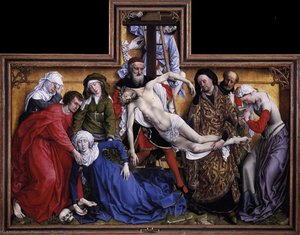
Nos corredores silenciosos e sagrados da história da arte, poucas obras comandam a alma com uma intensidade tão imediata e visceral quanto a Deposição de Rogier van der Weyden. Concluída por volta de 1435, esta pintura monumental em painel não é meramente a representação de um evento bíblico; é uma profunda paisagem psicológica que captura a própria essência da dor humana. A cena desenrola-se com um sentido de drama arrebatador, retratando o momento em que Cristo é descido da cruz, seu corpo sem vida amparado por aqueles que mais o amavam. Ao contemplar este quadro sagrado, o espectador não é apenas um observador de uma narrativa histórica, mas uma testemunha de um adeus íntimo e agonizante. A composição é uma aula magistral de arquitetura emocional, onde cada ombro caído e cada rosto marcado pelas lágrimas contribui para uma experiência coletiva de luto que transcende os séculos.

O brilho técnico de Van der Weyden reside na sua capacidade de unir a precisão meticulosa da tradição flamenga primitiva a uma profundidade emocional sem precedentes. Utilizando uma abordagem refinada do sfumato, o artista funde cores sutilmente para criar transições suaves e atmosféricas que conferem uma qualidade realista às figuras. Sua formação como mestre ourives é evidente na renderização requintada das texturas; é quase possível sentir o peso denso dos drapeados de veludo, a frie de la pele e os detalhes intrincados das vestimentas. Esta abordagem hiper-realista serve a um propósito superior: ao tornar o mundo físico tão tangível, ele torna o sofrimento espiritual das figuras inegavelmente real. As cores primárias vibrantes — vermelhos profundos, azuis celestiais e brancos puros — não são meramente decorativas, mas servem para guiar o olhar através da complexa coreografia do sofrimento.

Simbolismo e a Linguagem da Luz

Cada elemento dentro desta composição é carregado de significado simbólico, desenhado para convidar à contemplação profunda. O arranjo das figuras cria um ritmo visual marcante, frequentemente notado por sua configuração em forma de "T", que ecoa sutilmente o formato de uma besta — uma homenagem à Guilda dos Arqueiros de Leuven, que encomendou este magnífico retábulo. Maria, a Mãe de Cristo, serve como a âncora emocional da obra; sua postura de profunda humildade e compaixão materna espelha a forma lânguida e quebrada de seu filho. Este espelhamento de estados físicos sugere uma unidade espiritual em seu sofrimento. Até mesmo a luz dentro da pintura desempenha um papel narrativo, iluminando os rostos dos enlutados para destacar suas reações individuais — desde a força estoica de Nicodemos até a devoção frenética de Maria Madalena.

Para o colecionador exigente ou designer de interiores, uma reprodução de alta qualidade desta obra-prima oferece mais do que apenas beleza estética; ela traz um senso de gravidade histórica e profundidade intelectual a qualquer ambiente. A Deposição é um testemunho do poder da arte em capturar as emoções humanas mais complexas. Seja colocada em uma galeria curada ou como ponto focal em um escritório sofisticado, esta obra inspira um estado de reverência e reflexão silenciosa. Ela permanece como um ícone duradouro do Renascimento Borgonhês, lembrando-nos de que a verdadeira beleza muitas vezes reside nos momentos mais vulneráveis e profundos da condição humana.

Perguntas e Respostas

Onde deve ser pendurada uma reprodução de "Deposição", de Rogier van der Weyden?

Com o seu formato Paisagem, uma reprodução de "Deposição" é sugerida para um(a) Lobbies de Hotéis.

A obra "Deposição", de Rogier van der Weyden, pertencente ao acervo do Museu do Prado, pode ser reproduzida legalmente?

"Deposição", de Rogier van der Weyden, pertencente ao Museu do Prado, está em em domínio público — seus direitos autorais expiraram. Este status determina se reproduções da imagem podem ser feitas.

Qual é o nível de contraste de "Deposição", de Rogier van der Weyden?

O nível de contraste de "Deposição", de Rogier van der Weyden é Vibrante.

More about this painting

Visualizar na parede Visualizar em RA Alternar para Impressão Alternar para Imagem Digital Compartilhar
Detalhes Guia Adicionar aos favoritos Baixar imagem Semelhantes Raio X Ver diaporama Q&A Estatísticas

In numbers

  • 1435the year it was painted
  • 29frames to choose from
  • standard sizes, in its own proportions
  • 5weeks to paint and deliver it
Rogier van der Weyden

Rogier van der Weyden

1400 - 1464, Bélgica

Quick facts about Rogier van der Weyden

  • Artistic Movement Or Style: Pintura Flamenga
  • Artists Or Movements Influenced By This Artist:
    • Renascença Italiana
    • Pintura Espanhola
  • Artists Who Influenced This Artist:
    • Campin
    • Van Eyck
  • Date Of Birth: c. 1400
  • Date Of Death: 1464
  • Full Name: Rogier van der Weyden
  • Nationality: Beldica
  • Notable Artworks:
    • Lamentação
    • Deposição
    • Anunciação
    • Triptique Bladelin
  • Place Of Birth: Tournai, Bélgica

Biografia do Artista

A Master of Emotion: The Life and Legacy of Rogier van der Weyden

Rogier van der Weyden, a pivotal figure in the burgeoning world of Early Netherlandish painting, emerged from the vibrant city of Tournai around 1400. While details surrounding his early life remain somewhat shrouded in mystery, it’s believed he initially honed his skills not with brush and pigment alone, but as a goldsmith – a training that instilled within him an unwavering dedication to meticulous detail and a refined sensibility for craftsmanship, qualities that would become hallmarks of his artistic style. The precision demanded by working with precious metals undoubtedly translated into the exquisite rendering of textures, fabrics, and expressions that define his masterpieces. He wasn’t merely depicting reality; he was recreating it with painstaking accuracy, imbued with an almost reverent attention to detail.

From Tournai to Brussels: A Rising Star

By 1427, van der Weyden had ascended to the rank of master within the Guild of Saint Luke in Tournai – a significant turning point that solidified his position as a professional artist and opened doors to important commissions. His ascent continued when he entered the service of Philip the Good, Duke of Burgundy, in 1435 – a patronage that would profoundly shape his career for the remainder of his life. Serving as court painter afforded him not only financial security but also access to an elite circle of influence and exposure to some of the most discerning eyes of the era. It was during this period that van der Weyden’s artistic vision truly began to mature, moving away from the somewhat rigid conventions of earlier Netherlandish painters towards a more emotionally resonant and naturalistic approach. He wasn't simply painting religious scenes; he was striving to evoke genuine feeling in the viewer, to create an experience that transcended mere observation.

The Language of Feeling: Style and Technique

Rogier van der Weyden’s artistic signature is immediately recognizable through several defining characteristics. His palette was remarkably rich and diverse, a vibrant tapestry of colors carefully chosen to avoid repetition and create depth and complexity within his compositions. He possessed an extraordinary ability to convey profound emotion – *pathos* – particularly in depictions of religious subjects like the Lamentation, where grief and sorrow are palpable. This emotional intensity wasn’t achieved through dramatic gestures or exaggerated expressions; rather, it was subtly woven into the very fabric of the painting, conveyed through delicate nuances of facial expression, body language, and composition. His figures, while adhering to the conventions of the time, demonstrate a growing interest in realistic representation – not just in anatomy and drapery, but also in capturing the psychological states of his subjects. They possess a dignified, almost sculptural quality, particularly evident in his grand triptychs, lending them an air of solemnity and reverence. He masterfully employed oil paint, building up layers of translucent glazes to achieve luminous effects and create a sense of depth and realism that was revolutionary for its time.

Notable Works and Enduring Masterpieces

Throughout his prolific career, van der Weyden produced numerous works that stand as testaments to his artistic prowess. *St Luke Drawing a Portrait of the Madonna*, housed in the Museum of Fine Arts, Boston, showcases his mastery of oil on panel and meticulous observation. The *Lamentation*, residing in the Musée des Beaux-Arts Tournai, Belgium, is perhaps his most celebrated work – a powerfully emotive depiction of Christ’s mourning, renowned for its dramatic use of *chiaroscuro* and its ability to evoke profound sorrow in the viewer. Multiple versions of *The Deposition* exist, each demonstrating his skill in conveying grief and drama with breathtaking sensitivity. The *Annunciation*, a masterpiece of refined style and attention to detail, exemplifies his ability to imbue even the most traditional subjects with a sense of freshness and vitality. And finally, the intricate and richly detailed *Bladelin Triptych* stands as a monumental achievement – a complex altarpiece that showcases the full range of van der Weyden’s artistic abilities. These works, and many others, continue to captivate audiences today, solidifying his position as one of the most important painters of the 15th century.

Lasting Influence: A Legacy Forged in Paint

Van der Weyden’s influence extended far beyond the borders of his native Flanders. His works were highly sought after throughout Europe, particularly in Italy and Spain, where they introduced a new level of emotional depth and naturalism to local artistic traditions. Although his fame experienced a period of relative decline in the 17th century, a rediscovery during the 19th century cemented his place as one of the most important painters of the 15th century. He stands alongside Jan van Eyck and Robert Campin as one of the “three great” Early Flemish masters, each contributing uniquely to the development of Northern Renaissance art. His innovative techniques and emotionally charged compositions paved the way for future generations of artists, inspiring countless imitators and influencing the course of Western painting for centuries to come. He helped establish oil painting as the dominant medium and elevated the status of the artist within society, transforming them from skilled craftsmen into revered creators. Rogier van der Weyden’s legacy continues to resonate today, a testament to his enduring genius and his profound understanding of the human condition.

Informações Rápidas

  • Dimensões: 220 x 262 cm
  • Assunto ou tema: Iconografia religiosa; Cena da crucificação
  • Elementos ou técnicas notáveis: Realismo detalhado; Expressão emocional
  • Estilo artístico: Estilo Gótico Internacional
  • Movimento: Pintura Flamenga Primitiva
  • Artista: Rogier van der Weyden

Quiz de Arte

Cada pergunta possui apenas uma resposta correta.

Pergunta 1:
Qual é o tema principal retratado em ‘Deposição’ de Rogier van der Weyden?
Pergunta 2:
Qual técnica artística é empregada de forma proeminente por Rogier van der Weyden para transmitir emoção e realismo em ‘Deposição’?
Pergunta 3:
A pintura retrata um grupo de figuras ao redor de Jesus. O que é notável sobre as roupas usadas por esses indivíduos?
Pergunta 4:
Com base na descrição da imagem, qual é o foco central da cena?
Pergunta 5:
‘Deposição’ exemplifica uma característica fundamental da pintura flamenga primitiva. Qual é essa característica?