Visualizar na parede
 Compartilhar
 Compartilhar
 Detalhes
 Guia
Guia

 Baixar imagem
 Semelhantes
 Raio X
 Ver diaporama
 Perguntas e Respostas
 Estatísticas
Study of nudes

- 343.0 x 187.0 cm


 Ler mais
Giclée / Impressão de Arte
Impressão giclée ou em tela de qualidade de museu, com produção rápida e opções flexíveis de acabamento. ( Comprar pintura feita à mão Alternar para Imagem Digital)




P118B €10

P118H €10

P118W €10

P438Z €10

P508JH €12

P508YH €12

P805H €10

P805Z €10

P919BZ €10

P919G €10

P919XJ €10

P959ZH €10

P968JZ €12

W106C €8

W218G €10

W218JH €8

W218Y €10

W307PJ €10

W316G €10

W316PJ €8

W316Y €10

W398PJ €8

W4111J €10

W500HY €15

W500JH €15

W692G €12

W849H €8

W940BG €15

W953PJ €8




Escolha entre os nossos tamanhos pré-definidos que respeitam as proporções originais da obra de arte.

Insira a largura e a altura desejadas para se ajustarem à sua moldura ou parede. Uma impressão pode ser apenas cortada, nunca ampliada além da imagem original; portanto, um tamanho com proporções diferentes resultará na perda de parte da imagem. Enviamos uma maquete digital para sua aprovação antes de realizarmos a impressão. A imagem exibida nesta página não mostra o corte real — apenas a maquete o faz.
Entrega mundial () em 2 semanas, em vez das 4/5 semanas padrão. (8 Novembro)

Envio expresso gratuito para todo o mundo

Tela de Linho de Alta Qualidade

Seguro de transporte completo

Garantia de Reembolso de Impostos Alfandegários

Garantia de Fidelidade Cromática

Política de Devolução em 100 Dias (Apenas para Defeitos)

Garantia de reembolso de 100%

Oferta de desconto por quantidade
 A opção de vidro está disponível apenas para tamanhos inferiores a 110 cm

Study of nudes
Giclée / Impressão de Arte
Tamanho da Reprodução
-


Preço Total
€ 72
Luca Signorelli’s Study of Nudes: A Renaissance Masterpiece in Draftsmanship
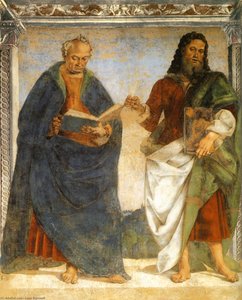
Luca Signorelli's "Study of Nudes," created around 1500, is not merely a preparatory sketch; it’s a profound meditation on the human form and a testament to the artist’s extraordinary skill as a draftsman. This intimate work, measuring just 343 x 187 cm, offers a rare glimpse into Signorelli's creative process – a world of charcoal smudges, subtle tonal shifts, and an intense focus on capturing the essence of human anatomy. It stands as a pivotal piece within his oeuvre, showcasing his mastery of foreshortening and his deep understanding of light and shadow, elements that would later define his monumental frescoes.
The scene depicts three nude men engaged in a quiet, contemplative gathering. Their postures are relaxed yet imbued with a sense of shared awareness, suggesting a moment of connection amidst the formality of Renaissance portraiture. The arrangement is deceptively simple: two figures lean towards one another, supported by a third who stands slightly behind them, all seemingly focused on an unseen point beyond the frame. The inclusion of two additional figures – one at the top right and another at the bottom left – adds layers of intrigue, hinting at a larger social context or perhaps simply reflecting Signorelli’s desire to explore compositional possibilities. These secondary figures are rendered with less detail, serving as compositional anchors rather than fully developed characters.
Renaissance Anatomy and Foreshortening
Signorelli's training under Piero della Francesca undoubtedly informed his meticulous approach to depicting the human body. Like his mentor, he possessed an unparalleled ability to render realistic musculature and skeletal structure with remarkable precision. However, Signorelli’s “Study of Nudes” goes beyond mere anatomical accuracy; it demonstrates a deep understanding of how light interacts with form. Notice the subtle gradations of tone – the delicate shading on the shoulders, the play of light across the limbs – that create a palpable sense of volume and weight.
Crucially, Signorelli’s mastery lies in his skillful use of foreshortening. The figures are arranged in complex spatial relationships, creating an illusion of depth and perspective that is both dynamic and convincing. The way he renders the receding forms, particularly those leaning towards the viewer, demonstrates a sophisticated understanding of linear perspective – a technique still evolving during this period. This wasn’t just about technical skill; it was about capturing the *experience* of seeing, conveying the illusion of space within a relatively small format.
Symbolism and Context
While seemingly straightforward, the “Study of Nudes” invites interpretation beyond its immediate visual elements. The nude male figure has long been a potent symbol in Western art, representing ideals of beauty, strength, and vulnerability. Here, however, the figures are not presented as idealized heroes or mythological gods; they appear to be engaged in a private moment of contemplation. This suggests a shift away from the overtly heroic narratives prevalent in earlier Renaissance art towards a more introspective and humanistic sensibility.
Created around 1500, during a period of immense artistic innovation in Italy, this work reflects the burgeoning interest in classical antiquity and the rediscovery of humanist ideals. Signorelli’s focus on the individual body aligns with the Renaissance emphasis on human potential and earthly experience. The painting's creation coincided with his time working in Florence, Siena and Rome, absorbing influences from various artistic circles.
A Reproduction for Your Space
OriginalUniqueArt is proud to offer a meticulously hand-painted reproduction of Luca Signorelli’s “Study of Nudes.” Our artists recreate the nuances of Signorelli's technique – the delicate charcoal marks, the subtle tonal variations, and the masterful use of foreshortening – with unparalleled accuracy. This reproduction captures not only the visual beauty of the original but also its underlying emotional depth. Whether displayed in a gallery, a study, or a living room, this artwork will serve as a timeless reminder of the enduring power of Renaissance art and the genius of Luca Signorelli.
Perguntas e Respostas
Que paleta e que sentimento "Study of nudes" evoca?
"Study of nudes", de Luca Signorelli combina uma paleta Neutrals com um tom Melancholic.
Como posso visualizar "Study of nudes", de Luca Signorelli em formato de apresentação de slides?
"Study of nudes", de Luca Signorelli pode ser visualizada em formato de slideshow na página de Apresentação de imagens da obra.
Qual tamanho de reprodução é sugerido para "Study of nudes", de Luca Signorelli?
O tamanho de impressão recomendado para "Study of nudes", de Luca Signorelli é Large.
Biografia do Artista
Luca Signorelli (c. 1450-1523) – A Titan of Fresco Painting
Luca Signorelli, born around 1441/1445 in Cortona, Tuscany, stands as one of the most influential figures within the Italian Renaissance artistic landscape. His mastery of disegno—drawing—combined with an unparalleled understanding of perspective and anatomy cemented his place among the foremost painters of his era, leaving behind a breathtaking corpus of monumental frescoes that continue to inspire awe centuries later. While precise biographical details remain elusive due to incomplete archival records, Signorelli’s formative years were steeped in the artistic fervor of Perugia, where he absorbed the stylistic nuances of artists like Benedetto Bonfigli and Pinturicchio—influences that would profoundly shape his distinctive approach to artmaking.Early Training and Apprenticeship
Giorgio Vasari recounts Signorelli's apprenticeship under Piero della Francesca by his maternal uncle, Lazaro Vasari, marking a pivotal moment in establishing his artistic foundation. This association instilled within him the principles of classical observation and meticulous detail—traits that would become hallmarks of Signorelli’s oeuvre. The young Signorelli honed his skills diligently, demonstrating an innate talent for capturing human form with remarkable accuracy and conveying emotion through subtle shading techniques. His early works reveal a preoccupation with idealized beauty and a fascination with humanist ideals prevalent during the Renaissance.Notable Works: A Symphony of Vision
Signorelli’s artistic output is characterized by ambitious projects that pushed the boundaries of artistic innovation. Perhaps his most celebrated achievement is “The Last Judgment,” executed between 1499 and 1503 for Orvieto Cathedral—a colossal fresco cycle depicting the apocalyptic vision of Judgement Day with unparalleled grandeur and psychological depth. The sheer scale of this undertaking, coupled with Signorelli’s masterful manipulation of perspective and chiaroscuro, established him as a pioneer in monumental painting and solidified his reputation as one of the greatest artists of his time. Equally impressive is “The Polyptych of St. Medard,” completed in 1507 for the Museo San Medardo in Arcevia—a testament to Signorelli’s meticulous attention to detail and his ability to convey spiritual contemplation through exquisitely rendered figures and landscapes.Technique and Artistic Innovation
Signorelli's artistic genius resided not merely in his technical prowess but also in his groundbreaking conceptual innovations. He championed the use of foreshortening—a technique that dramatically compressed spatial dimensions—creating an illusionistic depth that captivated viewers and revolutionized painting conventions. Signorelli’s meticulous anatomical studies, informed by humanist scholarship, ensured that his figures possessed a palpable sense of realism and conveyed profound emotional resonance. Furthermore, he skillfully employed chiaroscuro—the dramatic interplay between light and shadow—to sculpt forms with remarkable subtlety and to heighten the expressive power of his compositions.Legacy and Influence
Luca Signorelli’s impact on subsequent generations of artists is undeniable. His unwavering commitment to disegno and his masterful execution of monumental frescoes established him as a cornerstone of Renaissance art, influencing painters like Fra Angelico and shaping artistic trends throughout Europe. Today, Signorelli's works continue to inspire admiration for their beauty, psychological complexity, and technical brilliance—serving as enduring symbols of the humanist spirit and artistic excellence that defined the Italian Renaissance. His legacy persists in museums worldwide, where visitors can contemplate masterpieces that encapsulate the pinnacle of artistic achievement during a transformative period in Western history.
Luca Signorelli
1450 - 1523 , Itália
Dados Rápidos
- Artistic Movement Or Style: Renascimento
- Artists Or Movements Influenced By This Artist: ['Impressionismo']
- Artists Who Influenced This Artist:
- Piero della Francesca
- Fra Angelico
- Date Of Death: 16 outubro 1523
- Full Name: Luca di Egidio di Ventura Signorelli
- Nationality: Italiano
- Notable Artworks:
- Último Julgamento
- Escola de Pan
- Place Of Birth: Cortona, Itália
Artigos Relacionados

Luca Signorelli: Renaissance Innovation & Dramatic Foreshadowing of Modern Artistic Expression
Explore the revolutionary art of Luca Signorelli, a High Renaissance master renowned for his dramatic frescoes & anatomical precision. Discover his lasting impact on art history and techniques like foreshortening.

Leonardo da Vinci: As 25 Obras-Primas que Definem um Gênio | OriginalUniqueArt
Descubra as 25 obras-primas de Leonardo da Vinci! Explore a história, técnica e beleza atemporal de ícones como Mona Lisa e A Última Ceia. Encontre reproduções de arte renascentista de alta qualidade para decorar sua casa com OriginalUniqueArt.com.

The Eloquent Form: A Historical & Aesthetic Exploration of the Nude in Art
Explore the captivating history of the nude in art! From ancient Greece to modern masters, discover its evolving symbolism, techniques & enduring beauty. Expert insights for collectors and enthusiasts.

Italian Renaissance Art: A Procurement Guide to Timeless Masterpieces for High-End Hotel Interiors
A professional procurement guide for hotel designers seeking Italian Renaissance masterpieces. Discover how to utilize chiaroscuro, custom oil reproductions, and large-scale murals to elevate hospitality interiors with timeless, high-impact classical art.

The Enduring Allure of the Nude: A Historical & Artistic Exploration of the Human Form
Explore the captivating history of nude art! Discover iconic paintings & artists from classical to modern eras. Uncover symbolism, techniques & find museum-quality reproductions at OriginalUniqueArt.