Baroque
St. Peter (José de Ribera)
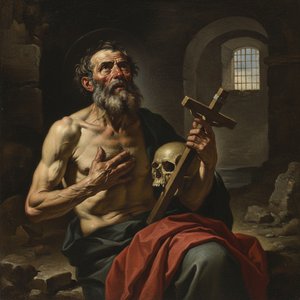
José de Ribera (1591–1652) criou St. Peter. Pertence ao movimento Baroque. É feito em Oil On Canvas. Está conservada no Museu do Prado, em Madrid, Espanha.
- Oil On Canvas
- Museu do Prado, Madrid

 Visualizar na parede

 Pintura a Óleo Feita à Mão
 Compartilhar
 Compartilhar
 Guia


 Baixar imagem
 Semelhantes
 Raio X
 Ver diaporama
 Perguntas e Respostas

 Estatísticas
St. Peter: o essencial
- Título
- St. Peter
- Artista
- José de Ribera (1591–1652)
- Artista nascido em
- Xàtiva, Espanha
- Técnica
- Oil On Canvas
- Onde ver
- Museu do Prado, Madrid, Espanha
- Movimento
- Baroque
- Período
- Early Modern
- Tema
- man, beard, book, keys, cloak, brown
O que St. Peter retrata?
The Portrait of St. Peter by Jusepe de Ribera
In this oil painting on canvas, Jusepe de Ribera presents us with a portrait of St. Peter. The subject, a central figure among the apostles of Jesus and recognized as the first Pope, is rendered with a profound sense of presence. Ribera focuses on the man himself, capturing the weight of his role and the character of his lived experience. There is a quiet intensity in the way the figure is presented, inviting a closer look at the weathered details of his countenance.
The work is a significant example of the Baroque style. Through this approach, the artist emphasizes the spiritual and human dimensions of the apostle. The depiction avoids idealization, opting instead for a directness that feels immediate. By focusing on the specific attributes of the saint, Ribera allows the subject to command the space, presenting a figure that is both a religious icon and a man of flesh and bone.
Composition and Visual Elements of the Portrait
The composition is built upon a stable pyramidal structure, with the head of St. Peter forming the apex of the form. He is presented from the waist up, his body turned slightly toward the viewer's left. In his right hand, he holds a book and a set of keys, objects that anchor the figure within the frame. This arrangement directs the eye upward toward his weathered features, creating a sense of quiet, grounded presence.
A strong light source enters from the left, illuminating his face and upper body while casting the rest of the figure into deep shadow. This light creates a sharp contrast against a background that is nearly black, pushing the subject forward into the viewer's space. The color palette is restrained, dominated by warm earth tones—ochre, brown, and gold—which emphasize the textures of his skin and the heavy folds of his clothing.
Technique and Artistic Style of the Work
The work is defined by a profound use of tenebrism, where the subject emerges from a nearly black background into a sharp, focused light. This dramatic chiaroscuro creates a sense of volume, pulling the figure forward and emphasizing the physical presence of the man. Such a heavy interplay of light and shadow reflects the influence of Caravaggio, grounding the religious subject in a palpable, earthly reality. The light source, positioned to the left, carves out the contours of the face and the weathered texture of the skin, casting deep shadows that heighten the emotional weight of the portrait.
Ribera’s approach to the medium is tactile and deliberate. He employs a technique of layering paint to build up depth, allowing the viewer to sense the physical weight of the drapery and the coarse nature of the beard. Visible brushstrokes are not hidden; instead, they contribute to the overall effect, lending a sense of immediacy to the rendering of the fabric and the aged features. Strong, defined lines delineate the eyes, nose, and mouth, providing a structural clarity that balances the more fluid, organic shapes of the figure. The result is a composition that feels both intensely personal and physically substantial.
Other Works by Jusepe de Ribera
The artist's exploration of this particular subject matter is reflected in several other significant pieces within our collection and major institutions. We hold St. Simeon 1 in our catalog, a work that speaks to the same profound human experience found in this portrait. Another notable piece in our collection is The Repentance of Saint Peter, which is currently housed in the Museum of Fine Arts, Lyon.
Beyond our own holdings, Ribera's preoccupation with the themes of remorse and spiritual weight is evident in other historical examples. The work known as Penitent St. Peter, dated about 1630, is held at the Kunsthistorisches Museum in Vienna. This piece shares a similar intensity in its depiction of the apostle's character. Additionally, The Tears of Saint Peter, which dates to 1612, is part of the collection at the Metropolitan Museum of Art in New York. These works collectively illustrate the artist's ability to capture the complexities of faith and the physical reality of the human condition through his characteristic use of light and shadow.
Em qual museu se encontra St. Peter?
Museu do Prado
Madrid, Espanha
A História do Museu do Prado As origens do Museu do Prado estão intrinsecamente ligadas à Coleção Real da Espanha, remontando ao século XVIII. O que começou como uma visão para um Gabinete de História Natural sob o reinado de Fernando VII, acabou por se transformar num santuário dedicado à pintura e à escultura. Esta transição metamorfoseou um empreendimento científico num repositório para os tesouros mais significativos da Coroa Espanhola.


St. Peter em alta resolução
José de Ribera, St. Peter, Museu do Prado. Domínio público.
Um especialista digital verifica as cores em relação à pintura original e retoca o ficheiro, respeitando fielmente a pincelada do artista.
Comprar a imagem em alta resoluçãoPerguntas sobre St. Peter
Onde "St. Peter", de José de Ribera está em exibição hoje?
A obra original "St. Peter", de José de Ribera encontra-se no Museu do Prado, Madrid, Espanha. Uma reprodução permite que a obra seja exibida em sua casa.
De que técnica é feita a obra "St. Peter"?
"St. Peter" é executada em Oil On Canvas.
Quais temas aparecem em "St. Peter", de José de Ribera?
Os temas presentes em "St. Peter", de José de Ribera incluem man, beard, book, keys, cloak, brown, gold, skin. Juntos, eles sintetizam o assunto da obra.
"St. Peter", de José de Ribera está em domínio público?
Informação de direitos autorais para "St. Peter", de José de Ribera: a obra está em em domínio público — seus direitos autorais expiraram. Isso determina se reproduções da imagem podem ser feitas livremente.
Quem criou "St. Peter"?
"St. Peter" foi criado por José de Ribera. As informações nesta página descrevem a obra original de José de Ribera.
A qual movimento artístico "St. Peter", de José de Ribera pertence?
"St. Peter", de José de Ribera pertence ao movimento Baroque. Este movimento fornece o contexto estilístico da obra.
A que fase da trajetória de José de Ribera "St. Peter" pertence?
Dentro da trajetória de José de Ribera, "St. Peter" pertence ao período Mature Period. Esta fase permite compará-la com outras obras do artista.
Qual é a situação dos direitos autorais de "St. Peter", de José de Ribera?
O status de direitos autorais de "St. Peter" - em domínio público — seus direitos autorais expiraram - decorre do falecimento do artista em 1652.
"St. Peter" permaneceu no país de origem do seu artista?
Sim – a obra de arte encontra-se no país de origem do artista. "St. Peter" está guardada em Espanha, enquanto José de Ribera nasceu em Espanha.
Sobre o artista, José de Ribera

1591–1652, Espanha
José de Ribera
A Life Forged in Shadow and Light Jusepe de Ribera, conhecido por muitos como Lo Spagnoletto – “o Espanholito” – foi uma figura imponente da era Barroca, um artista cujas telas pulsavam com intensidade dramática e realismo implacável. Nascido em Xàtiva, Espanha, em 1591, sua jornada o levou longe de suas origens valencianas, estabelecendo-o finalmente como um dos artistas mais significativos da Itália no século XVII, uma cidade então sob domínio espanhol. A vida de Ribera não foi meramente um relato do desenvolvimento artístico; foi uma narrativa tecida com dificuldades, ambição e um compromisso inabalável em retratar a condição humana em toda a sua complexidade crua. Embora os detalhes biográficos iniciais permaneçam parcialmente envoltos em mistério, sabemos que ele chegou à Itália por volta de 1607, inicialmente estabelecendo-se em Roma antes de se dirigir a Nápoles em 1616 – uma cidade que logo se tornaria tanto seu lar artístico quanto o crisol para seu estilo único.
Também de José de Ribera
 Magdalena Ventura com seu Marido e Filho1631
 O Pé Torto
 St. Onuphrius1637
 The Duel of Women (The Duel of Isabella de Carazzi and Diambra de Pettinella)1636
Ensaios sobre St. Peter
 Mastering the Shadows: The Dramatic Power of Chiaroscuro and Tenebrism in Baroque Fine ArtExplore the profound drama of chiaroscuro and tenebrism. Discover how masters like Caravaggio used light and shadow to sculpt emotion and v…
 Masterpieces of Light: The Top 25 Artworks by Duccio di BuoninsegnaJourney through the divine elegance of Duccio di Buoninsegna. Explore 25 iconic Sienese masterpieces, from the Maestà to the Rucellai Madon…
 Jusepe de Ribera: Dramatic Realism & Spiritual Intensity in the Spanish Golden AgeExplore the powerful Baroque paintings of Jusepe de Ribera, master of tenebrism and dramatic realism. Discover his spiritual intensity, inf…