Portret Pierre-Paul Prud’hon

100 najsłynniejszych obrazów artysty Pierre-Paul Prud’hon, każdy niepowtarzalny

Aktualizacja: Listopad 2026 · ranking według naszego wskaźnika popularności (liczba wyszukiwań, wizyt i zamówień dla każdego dzieła) · 207 dzieł Pierre-Paul Prud’hon w naszym katalogu

W skrócie

Portrait of the Empress Josephine (1805) to obraz autorstwa Pierre-Paul Prud’hon, który przyciąga najwięcej spojrzeń. Następnie wzrok kieruje się na Venus Bathing (1810) i Untitled (D2X835) (1817). Spośród 207 dzieł Pierre-Paul Prud’hon w naszym katalogu, tych 100 jest najbardziej znanych – każde z nich to unikatowy oryginał, przedstawiony wraz z rokiem powstania, muzeum oraz powodem, dla którego przetrwało próbę czasu.

1758 – 1823, Cluny Neo-classicism Najwięcej dzieł: Wallace Collection

10 najlepszych obrazów autorstwa Pierre-Paul Prud’hon według oka galerii

1
Portrait of the Empress Josephine (1805) autorstwa Pierre-Paul Prud’hon

Portrait of the Empress Josephine

1805 · Oil On Canvas

The Portrait of the Empress Josephine by Pierre-Paul Prud'hon presents a quiet, intimate moment captured in 1805. The subject of this work is Josephine Bonaparte, the first wife of Napoleon Bonaparte. Rather than appearing in the rigid splendor of the imperial court, she is seen here in a more private, natural setting. She sits upon the mossy rocks of the gardens at Malmaison, a place deeply connected to her own…
2
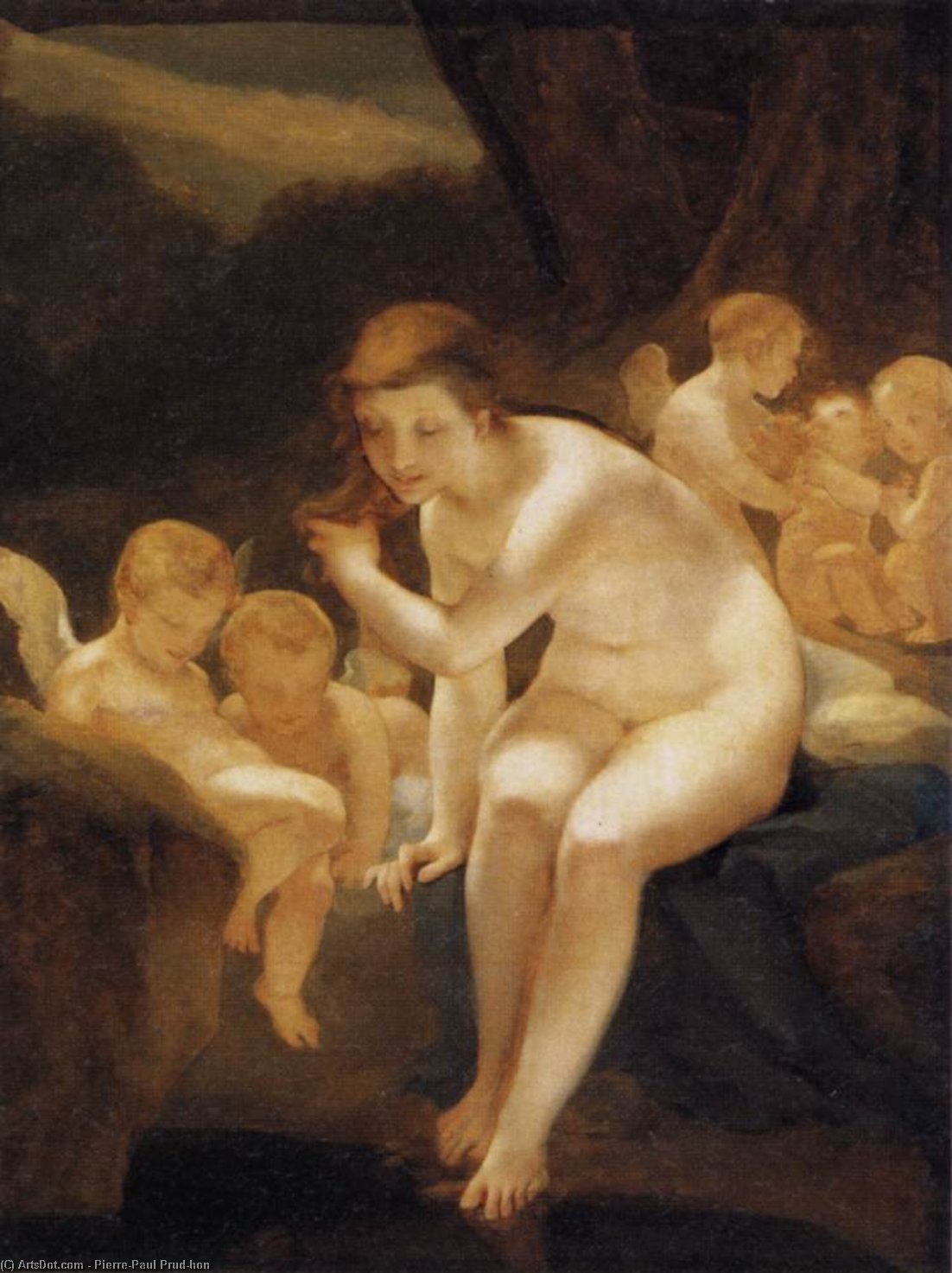
Venus Bathing (1810) autorstwa Pierre-Paul Prud’hon

Venus Bathing

1810 · Acrylic On Canvas · Luwr, Paryż

Pierre-Paul Prud’hon's “Venus Bathing” stands as a cornerstone of Neoclassical art, embodying the era’s pursuit of idealized beauty and rational order. Painted in 1810 during a period marked by significant artistic upheaval—the waning influence of Rococo giving way to Romantic fervor—this monumental oil on canvas (134 x 103 cm) resides within the hallowed halls of the Musée du Louvre, Paris, ensuring its enduring legacy.

3
Untitled (D2X835) (1817) autorstwa Pierre-Paul Prud’hon

Untitled (D2X835)

1817 · Acrylic On Canvas · Metropolitan Museum of Art, Nowy Jork

Pierre-Paul Prud’hon’s “Untitled (D2X835),” painted in 1817, offers a captivating glimpse into the world of Parisian society during the early 19th century. More than just a simple portrait, it's a carefully constructed tableau vivant—a staged scene brimming with subtle social commentary and an exquisite mastery of chiaroscuro, a technique that defines Prud’hon’s distinctive style. The painting depicts a gentleman in formal attire – a dark suit, top hat, and crisp…

4
Puppies (1795) autorstwa Pierre-Paul Prud’hon

Puppies

1795 · Oil · Wallace Collection, Londyn

The air in the room feels warm and still, filled with the soft scent of oil paint and the gentle breathing of young life. A seated child, draped in a luminous yellow dress that catches the light from an unseen window to the upper right, leans into a moment of pure connection. Beside them, another child stands, arms cradling a cluster of puppies. The scene is intimate, a private fragment…

5
The Glorification of the government of Burgundy (1786) autorstwa Pierre-Paul Prud’hon

The Glorification of the government of Burgundy

1786 · Oil

The heavens open in a dramatic display of divine authority, casting a celestial light upon the earthly realm below. High above the clouds, angels descend through a luminous sky, their forms caught in a moment of eternal motion. Some of these heavenly beings carry swords and shields, their presence signaling a power that transcends the mortal plane. Amidst this swirling movement, small cherubs drift through the air, adding a sense…

6
Drawing of Female Nude with charcoal and chalk (1800) autorstwa Pierre-Paul Prud’hon

Drawing of Female Nude with charcoal and chalk

1800 · Charcoal

A single figure occupies the space, a woman caught in a moment of quiet contemplation. She sits with her hand pressed against her head, her gaze turned upward toward an unseen source of light. The charcoal and chalk trace the soft contours of her skin, building a body through the delicate interplay of shadow and highlight. There is a stillness here, a pause in breath that feels heavy and intimate.…

7
The Zephyr (1814) autorstwa Pierre-Paul Prud’hon

The Zephyr

1814 · Oil · Wallace Collection, Londyn

The Zephyr is an oil sketch by Pierre-Paul Prud'hon, a work that captures a sense of mythological grace through its delicate handling of form. Created around 1814, this piece reflects the artist's ability to navigate the transition between Neoclassicism and Romanticism. The subject, often interpreted as a personification of the wind, is rendered with a lightness that suggests movement even within the stillness of the oil medium.

8
Louis Antoine de Saint Just (1793) autorstwa Pierre-Paul Prud’hon

Louis Antoine de Saint Just

1793 · Oil · Museum De Waag, Deventer

In the turbulent landscape of 1793, amidst the fervor and shadows of the French Revolution, Pierre-Paul Prud'hon captured more than just a likeness; he captured an era. His portrait of Louis Antoine de Saint Just serves as a profound window into a moment of intense political and personal transformation. The subject, a man whose name was synonymous with the radical shifts of the Reign of Terror, is presented not through…

9
Abundance (1823) autorstwa Pierre-Paul Prud’hon

Abundance

1823 · Oil · Musée Condé, Chantilly

In the painting Abundance, Pierre-Paul Prud'hon presents two human figures positioned in a close, intimate arrangement. Created about 1823, the work focuses on the interaction between these two subjects against a dark, indistinct background. The figures appear to be engaged in either a shared task or an embrace, though their exact movements remain partially obscured by the shadows. The composition centers on this physical proximity, placing the viewer in immediate…

10
Une Famille dans la désolation (A Grief-Stricken Family) (1821) autorstwa Pierre-Paul Prud’hon

Une Famille dans la désolation (A Grief-Stricken Family)

1821 · Oil On Canvas · Yale University Art Gallery, Nowe Havane

In this 1821 oil on canvas, we find ourselves drawn into a quiet, heavy moment of human suffering. The composition centers on a family bound together by a profound sense of loss, their bodies slumped in a way that speaks of exhaustion and despair. A man and a woman sit at the heart of the group, surrounded by children, creating an intimate, tight arrangement that emphasizes their collective grief. The…

Słynne obrazy artysty Pierre-Paul Prud’hon, od 11 do 100

11Dr. Thomas Dagoumer (1762-1833/1835) (1819) autorstwa Pierre-Paul Prud’honDr. Thomas Dagoumer (1762-1833/1835)1819 · Fogg Museum 12Innocence Choosing Between Love and Riches (1804) autorstwa Pierre-Paul Prud’honInnocence Choosing Between Love and Riches1804 · Art Institute of Chicago 13Wisdom and Truth Descending to Earth (1758) autorstwa Pierre-Paul Prud’honWisdom and Truth Descending to Earth1758 · Bawarskie Państwowe Zbiory Malarstwa 14The Preparations of War or The Preparations of Love (1790) autorstwa Pierre-Paul Prud’honThe Preparations of War or The Preparations of Love1790 · Musée Cognacq-Jay 15The Cruel Laughs at the Tears He Makes Fall (1794) autorstwa Pierre-Paul Prud’honThe Cruel Laughs at the Tears He Makes Fall1794 16Monument to Pope Clement XIV by Canova (1787) autorstwa Pierre-Paul Prud’honMonument to Pope Clement XIV by Canova1787 17Portrait of sculptor Nicolas Bornier (1788) autorstwa Pierre-Paul Prud’honPortrait of sculptor Nicolas Bornier1788 · Musée des Beaux-Arts de Dijon 18Minerva Illuminating the Genii of the Arts and Sciences (1800) autorstwa Pierre-Paul Prud’honMinerva Illuminating the Genii of the Arts and Sciences1800 19The Genius of Peace (1800) autorstwa Pierre-Paul Prud’honThe Genius of Peace1800 20Young Naiad Ravished by Loves (1800) autorstwa Pierre-Paul Prud’honYoung Naiad Ravished by Loves1800 21Diana Imploring Jupiter Not to Subject Her to the Laws of Hymen (1802) autorstwa Pierre-Paul Prud’honDiana Imploring Jupiter Not to Subject Her to the Laws of Hymen1802 22Minerva (1797) autorstwa Pierre-Paul Prud’honMinerva1797 23Apollo (1797) autorstwa Pierre-Paul Prud’honApollo1797 24Plutus (1797) autorstwa Pierre-Paul Prud’honPlutus1797 25Pan (1797) autorstwa Pierre-Paul Prud’honPan1797 26Time (1797) autorstwa Pierre-Paul Prud’honTime1797 27Old Age (1797) autorstwa Pierre-Paul Prud’honOld Age1797 28Two Winged Horses (1797) autorstwa Pierre-Paul Prud’honTwo Winged Horses1797 29Mnemosyne (1797) autorstwa Pierre-Paul Prud’honMnemosyne1797 30The Folly (1797) autorstwa Pierre-Paul Prud’honThe Folly1797 31Mercury (1797) autorstwa Pierre-Paul Prud’honMercury1797 32Bacchus (1797) autorstwa Pierre-Paul Prud’honBacchus1797 33Portrait of an Unknown Person (1800) autorstwa Pierre-Paul Prud’honPortrait of an Unknown Person1800 · Musée Carnavalet 34Diana begs Jupiter not to subject her to the hymen (1803) autorstwa Pierre-Paul Prud’honDiana begs Jupiter not to subject her to the hymen1803 35Portrait of Marguerite Duffour, wife of sculptor Nicolas Bornier (1796) autorstwa Pierre-Paul Prud’honPortrait of Marguerite Duffour, wife of sculptor Nicolas Bornier1796 36Male Nude Grasping his Wrists (1800) autorstwa Pierre-Paul Prud’honMale Nude Grasping his Wrists1800 37Seated Male Nude (1800) autorstwa Pierre-Paul Prud’honSeated Male Nude1800 38Female Nude from Behind (1800) autorstwa Pierre-Paul Prud’honFemale Nude from Behind1800 39Standing Female Nude (1800) autorstwa Pierre-Paul Prud’honStanding Female Nude1800 40Male Nude Raising his Arm (1800) autorstwa Pierre-Paul Prud’honMale Nude Raising his Arm1800 41Seated Female Nude by a Fountain (1800) autorstwa Pierre-Paul Prud’honSeated Female Nude by a Fountain1800 42Female Nude Reclining (1800) autorstwa Pierre-Paul Prud’honFemale Nude Reclining1800 43Female Nude Leaning (1800) autorstwa Pierre-Paul Prud’honFemale Nude Leaning1800 44Daphnis and Chloe (1802) autorstwa Pierre-Paul Prud’honDaphnis and Chloe1802 45Female Nude Bound (1800) autorstwa Pierre-Paul Prud’honFemale Nude Bound1800 46Male Nude Turning (1800) autorstwa Pierre-Paul Prud’honMale Nude Turning1800 47Male Nude Pointing (1800) autorstwa Pierre-Paul Prud’honMale Nude Pointing1800 48Female Nude Raising her Arm (1800) autorstwa Pierre-Paul Prud’honFemale Nude Raising her Arm1800 49The Source (1801) autorstwa Pierre-Paul Prud’honThe Source1801 50Drawing of Female Nude with charcoal and chalk (1800) autorstwa Pierre-Paul Prud’honDrawing of Female Nude with charcoal and chalk1800 51Portrait of Georges Anthony (1796) autorstwa Pierre-Paul Prud’honPortrait of Georges Anthony1796 · Musée des Beaux-Arts de Dijon 52Drawing of Female Nude with charcoal and chalk (1800) autorstwa Pierre-Paul Prud’honDrawing of Female Nude with charcoal and chalk1800 53Drawing of Female Nude with charcoal and chalk (1800) autorstwa Pierre-Paul Prud’honDrawing of Female Nude with charcoal and chalk1800 54Arts, Wealth, Pleasure and Philosophy: Wealth (1800) autorstwa Pierre-Paul Prud’honArts, Wealth, Pleasure and Philosophy: Wealth1800 55Drawing of Female Nude with charcoal and chalk (1800) autorstwa Pierre-Paul Prud’honDrawing of Female Nude with charcoal and chalk1800 56Arts, Wealth, Pleasure and Philosophy: Philosophy (1800) autorstwa Pierre-Paul Prud’honArts, Wealth, Pleasure and Philosophy: Philosophy1800 57Monsieur Vallet (1812) autorstwa Pierre-Paul Prud’honMonsieur Vallet1812 58Minerva Leading the Genius of the Arts to Immortality (1812) autorstwa Pierre-Paul Prud’honMinerva Leading the Genius of the Arts to Immortality1812 59Meeting of Napoleon I and Francis II of Austria, December 4, 1805 (1809) autorstwa Pierre-Paul Prud’honMeeting of Napoleon I and Francis II of Austria, December 4, 18051809 · Opera w Wersalu 60Victory and Peace (1807) autorstwa Pierre-Paul Prud’honVictory and Peace1807 · Musée Carnavalet 61The Empress Josephine (1807) autorstwa Pierre-Paul Prud’honThe Empress Josephine1807 · Wallace Collection 62Seated Woman Plucking a Flower (1810) autorstwa Pierre-Paul Prud’honSeated Woman Plucking a Flower1810 · Rhode Island School of Design Museum of Art 63Charles Maurice de Talleyrand Périgord (1754–1838), Prince de Bénévent (1807) autorstwa Pierre-Paul Prud’honCharles Maurice de Talleyrand Périgord (1754–1838), Prince de Bénévent1807 · Musée Carnavalet 64Study for 'Minerva leading the Genius of the Arts into Immortality' (1813) autorstwa Pierre-Paul Prud’honStudy for 'Minerva leading the Genius of the Arts into Immortality'1813 · Fitzwilliam Museum 65Young Zephyrus balancing above water (1814) autorstwa Pierre-Paul Prud’honYoung Zephyrus balancing above water1814 · Musée des Beaux-Arts de Dijon 66Abundance (1812) autorstwa Pierre-Paul Prud’honAbundance1812 · Museum of Fine Arts 67Venus Bathing (1814) autorstwa Pierre-Paul Prud’honVenus Bathing1814 · Fine Arts Museums of San Francisco 68Josephine Bonaparte (study) (1805) autorstwa Pierre-Paul Prud’honJosephine Bonaparte (study)1805 69Madame Jarre (1821) autorstwa Pierre-Paul Prud’honMadame Jarre1821 70The Dream of Happiness (sketch) (1818) autorstwa Pierre-Paul Prud’honThe Dream of Happiness (sketch)1818 71The Assumption of the Virgin (1817) autorstwa Pierre-Paul Prud’honThe Assumption of the Virgin1817 · Wallace Collection 72Flora and Zephyr (1820) autorstwa Pierre-Paul Prud’honFlora and Zephyr1820 · National Museum in Wrocław 73Gian Battista Sommariva (1815) autorstwa Pierre-Paul Prud’honGian Battista Sommariva1815 74Arnauld de Beaufort (1818) autorstwa Pierre-Paul Prud’honArnauld de Beaufort1818 · Saint Louis Art Museum 75The Happy Mother (1810) autorstwa Pierre-Paul Prud’honThe Happy Mother1810 · Wallace Collection 76Portrait of a Young Man (1874) autorstwa Pierre-Paul Prud’honPortrait of a Young Man1874 77Crucifixion (1822) autorstwa Pierre-Paul Prud’honCrucifixion1822 · Luwr 78Marquis de Lafayette (1820) autorstwa Pierre-Paul Prud’honMarquis de Lafayette1820 · National Portrait Gallery 79Homage to Beauty (1808) autorstwa Pierre-Paul Prud’honHomage to Beauty1808 · Musée Condé 80The King of Rome in the form of sleeping Cupid (1811) autorstwa Pierre-Paul Prud’honThe King of Rome in the form of sleeping Cupid1811 · Museo Glauco Lombardi 81Arts, Wealth, Pleasure and Philosophy (1800) autorstwa Pierre-Paul Prud’honArts, Wealth, Pleasure and Philosophy1800 · Musée Fabre 82Portrait of Charles Maurice de Talleyrand-Perigord autorstwa Pierre-Paul Prud’honPortrait of Charles Maurice de Talleyrand-Perigord 83Rutger Jan Schimmelpenninck with his Wife and Children (1801) autorstwa Pierre-Paul Prud’honRutger Jan Schimmelpenninck with his Wife and Children1801 · Rijksmuseum 84Venus and Cupid asleep, caressed and awakened by the Zephyrs (1806) autorstwa Pierre-Paul Prud’honVenus and Cupid asleep, caressed and awakened by the Zephyrs1806 · Musée Condé 85David Johnston (1808) autorstwa Pierre-Paul Prud’honDavid Johnston1808 · National Gallery of Art 86French, prudhon) (1758) autorstwa Pierre-Paul Prud’honFrench, prudhon)1758 87The First Kiss of Love (1795) autorstwa Pierre-Paul Prud’honThe First Kiss of Love1795 88Madame Copia (1792) autorstwa Pierre-Paul Prud’honMadame Copia1792 89The union of love and friendship (1793) autorstwa Pierre-Paul Prud’honThe union of love and friendship1793 90Nicolas Perchet (1795) autorstwa Pierre-Paul Prud’honNicolas Perchet1795 91Etienne Renon de Franois (1795) autorstwa Pierre-Paul Prud’honEtienne Renon de Franois1795 92Christ on the Cross. Mary Magdalene and the Virgin are at His feet (1800) autorstwa Pierre-Paul Prud’honChrist on the Cross. Mary Magdalene and the Virgin are at His feet1800 93Seated Female Nude (1800) autorstwa Pierre-Paul Prud’honSeated Female Nude1800 94Female Nude Raising her Arm (1800) autorstwa Pierre-Paul Prud’honFemale Nude Raising her Arm1800 95Drawing of Female Nude with charcoal and chalk (1800) autorstwa Pierre-Paul Prud’honDrawing of Female Nude with charcoal and chalk1800 96Portrait of Constance Mayer (1804) autorstwa Pierre-Paul Prud’honPortrait of Constance Mayer1804 97Arts, Wealth, Pleasure and Philosophy: Pleasure (1800) autorstwa Pierre-Paul Prud’honArts, Wealth, Pleasure and Philosophy: Pleasure1800 98Arts, Wealth, Pleasure and Philosophy: Arts (1800) autorstwa Pierre-Paul Prud’honArts, Wealth, Pleasure and Philosophy: Arts1800 99The wisdom and truth (1799) autorstwa Pierre-Paul Prud’honThe wisdom and truth1799 100Portrait of Josephine de Beauharnais (1800) autorstwa Pierre-Paul Prud’honPortrait of Josephine de Beauharnais1800

Słynne obrazy Pierre-Paul Prud’hon epoka po epoce

Tematy, które przyciągnęły wzrok Pierre-Paul Prud’hon

Cztery motywy najczęściej powracające w tych oryginałach, z których każdy doczekał się swojego najdoskonalszego przykładu.

Muzea przechowujące oryginały Pierre-Paul Prud’hon

8 muzeów, w których znajduje się najwięcej obrazów z tej strony.

Muzea Miasto Dzieła artysty Pierre-Paul Prud’hon Obrazy z tej listy
Wallace Collection, LondynWallace Collection Londyn 6 Puppies, The Zephyr, The Empress Josephine
Musée Condé, ChantillyMusée Condé Chantilly 3 Abundance, Homage to Beauty, Venus and Cupid asleep, caressed and awakened by the Zephyrs
Musée des Beaux-Arts de Dijon, DionMusée des Beaux-Arts de Dijon Dion 3 Portrait of sculptor Nicolas Bornier, Portrait of Georges Anthony, Young Zephyrus balancing above water
Musée Carnavalet, ParyżMusée Carnavalet Paryż 3 Portrait of an Unknown Person, Victory and Peace, Charles Maurice de Talleyrand Périgord (1754–1838), Prince de Bénévent
Luwr, ParyżLuwr Paryż 5 Venus Bathing, Crucifixion
Metropolitan Museum of Art, Nowy JorkMetropolitan Museum of Art Nowy Jork 2 Untitled (D2X835)
Rhode Island School of Design Museum of Art, ProvidenceRhode Island School of Design Museum of Art Providence 2 Seated Woman Plucking a Flower
Rijksmuseum, AmsterdamRijksmuseum Amsterdam 2 Rutger Jan Schimmelpenninck with his Wife and Children

Pierre-Paul Prud’hon na przestrzeni dekad: jeden unikatowy oryginał dla każdego

Dzieła według dekad

Wybierz dekadę, aby zobaczyć dzieło, które ją definiuje.

Obrazy artysty Pierre-Paul Prud’hon: pytania do galerii

Jakie jest najsłynniejsze dzieło artysty Pierre-Paul Prud’hon?Odkryj odpowiedź

Portrait of the Empress Josephine (1805). Następne są Venus Bathing (1810) oraz Untitled (D2X835) (1817).

W jakim wieku Pierre-Paul Prud’hon stworzył/a Portrait of the Empress Josephine?Odkryj odpowiedź

47 lat: Portrait of the Empress Josephine pochodzi z 1805, a Pierre-Paul Prud’hon urodził(a) się w 1758.

Które dziesięć obrazów Pierre-Paul Prud’hon jest najbardziej znanych?Odkryj odpowiedź

Portrait of the Empress Josephine, Venus Bathing, Untitled (D2X835), Puppies, The Glorification of the government of Burgundy, Drawing of Female Nude with charcoal and chalk, The Zephyr, Louis Antoine de Saint Just, Abundance i Une Famille dans la désolation (A Grief-Stricken Family). Powyższy ranking zawiera rok powstania oraz muzeum dla każdego z nich.

Ile znanych dzieł stworzył Pierre-Paul Prud’hon?Odkryj odpowiedź

Nasz katalog zawiera 207 dzieł artysty Pierre-Paul Prud’hon, datowanych od 1786 do 1823.

Gdzie można zobaczyć najsłynniejsze oryginały Pierre-Paul Prud’hon?Odkryj odpowiedź

W większości znajdują się w Wallace Collection (Londyn), Musée Condé (Chantilly) i Musée des Beaux-Arts de Dijon (Dion). Powyższa tabela muzeów zawiera ich pełną listę.

W jakim okresie Pierre-Paul Prud’hon stworzył/a swoje najsłynniejsze obrazy?Odkryj odpowiedź

W 1800s: 47 z 100 dzieł na tej stronie powstało w tym czasie, w tym Portrait of the Empress Josephine.

Który z najsłynniejszych obrazów artysty Pierre-Paul Prud’hon powstał najwcześniej, a który najpóźniej?Odkryj odpowiedź

Na tej stronie najwcześniejszy to The Glorification of the government of Burgundy (1786), a najpóźniejszy Abundance (1823).

Jakie tematy preferował Pierre-Paul Prud’hon?Odkryj odpowiedź

Woman (47), Man (34) i Nude (21), w ramach 100 dzieł na tej stronie.

Jakich materiałów Pierre-Paul Prud’hon używał najczęściej?Odkryj odpowiedź

Oil, dla 32 z 100 dzieł na tej stronie.

Do jakiego nurtu należy twórczość Pierre-Paul Prud’hon?Odkryj odpowiedź

Neo-classicism i Romantic neoclassicism, sądząc po oryginałach na tej stronie.

Jakie oryginały Pierre-Paul Prud’hon można zobaczyć w Wallace Collection?Odkryj odpowiedź

Puppies, The Zephyr i The Empress Josephine: Wallace Collection, Londyn posiada 5 dzieł widocznych na tej stronie.

Pierre-Paul Prud’hon: portret artysty

Pierre-Paul Prud'hon: Życie w sztuce

  • Urodzony: Cluny, Francja (1758)
  • Zmarł: 1823
  • Narodowość: Francuska

Pierre-Paul Prud’hon był postacią kluczową dla francuskiej sztuki, stanowiąc pomost między neoklasycyzmem a romantyzmem. Urodzony w Cluny, w departamencie Saône-et-Loire, przeszedł artystyczną drogę, która odzwierciedlała zmieniający się krajobraz estetyczny Europy przełomu XVIII i XIX wieku. Sławę przyniosły mu zarówno malarstwo alegoryczne, jak i portrety, w których wykazał się mistrzostwem w operowaniu światłocieniem oraz realizmem, co zachwycało ówczesnych widzów i wywarło głęboki wpływ na kolejne pokolenia twórców.

Wczesne lata i kształcenie

  • Prowincjonalne początki: Pierwsze kroki w edukacji artystycznej Prud’hon stawiał na francuskiej prowincji.
  • Stypendium w Dijon: W 1774 roku otrzymał miejskie stypendium, które pozwoliło mu studiować w École de Dessin w Dijon, co stanowiło przełomowy moment w jego formalnym kształceniu.
  • Rzym i wpływy neoklasyczne: Podróż do Rzymu w 1784 roku stała się czasem głębokiego zanurzenia w sztuce antycznej; artysta z podziwem studiował dzieła Canovy i Correggia. Ten okres trwale ukształtował jego wczesny styl, nadając mu elegancję oraz idealizację formy charakterystyczną dla epoki neoklasycyzmu.

Kariera artystyczna i mecenat królewski

  • Rewolucyjne alegorie: Twórczość Prud’hona zyskała na znaczeniu w dobie Rewolucji Francuskiej, kiedy to tworzył winiety, ilustracje książkowe oraz obrazy alegoryczne, które silnie rezonowały z ideałami republikańskimi.
  • Malarz dworu Napoleona: Jego niezwykły talent przyciągnął uwagę samego Napoleona Bonaparte, który zlecił mu namalowanie portretów zarówno Joséphine de Beauharnais, jak i Marie-Louise d’Autriche. Portret Joséphine, przedstawiający ją nie jako cesarzową, lecz jako urzekającą kobietę, stał się zarzewiem spekulacji na temat możliwego romansu między artystą a dawną królową.
  • Łączenie stylów: Prud'hon z niezwykłą biegłością poruszał się między ewoluującymi trendami swoich czasów, umiejętnie wplatając elementy neoklasycyzmu i romantyzmu w swoje dzieła. Choć zachowywał klasyczne fundamenty kompozycji i formy, nasycał swoje płótna emocjonalną głębią oraz dramatycznym światłem, które zwiastowało nadchodzący nurt romantyczny.

Najważniejsze dzieła i dziedzictwo artystyczne

  • Madame Georges Anthony i jej dwaj synowie (1796): Wczesny przykład jego kunsztu portretowego, prezentujący wyrafinowaną elegancję.
  • Dusza zrywająca więzy łączące ją z ziemią: Potężne dzieło alegoryczne, ukazujące zdolność artysty do przekazywania złożonych emocji poprzez symboliczną obrazowość.
  • Sen o szczęściu: Poruszająca eksploracja ludzkich aspiracji i pragnień.
  • Ukrzyżowanie (1822): Zamówione do katedry św. Etienne w Metz, obecnie znajdujące się w Luwrze; dzieło to uznaje się za jedno z jego najważniejszych osiągnięć.
  • Sprawiedliwość i Boska Zemsta ścigająca Zbrodnię: Monumentalne arcydzieło, które antycypuje dramatyzm znany z późniejszego „Tratwy Meduzy” Géricault.

Wpływ i znaczenie historyczne

Prud'hon wywarł niebagatelny wpływ na kolejne pokolenia francuskich artystów. Jego biegłość w posługiwaniu się światłocieniem, umiejętność nadania portretom psychologicznej głębi oraz synteza stylów neoklasycznego i romantycznego uczyniły go postacią niezwykle szanowaną w świecie sztuki. Twórcy tacy jak Théodore Géricault czy Eugène Delacroix przyznawali, że czerpali inspirację z jego dramatycznych kompozycji i emocjonalnej ekspresji. Warto również wspomnieć, że wybitne postaci literatury i malarstwa, jak Stendhal, Millet czy Baudelaire, dostrzegali artystyczną wartość dzieł Prud'hona, co ostatecznie ugruntowało jego miejsce w historii kultury francuskiej.