


1

The Grand Canal near the Salute
The Grand Canal near the Salute is an oil on canvas painting created by Michele Marieschi in 1733. This artwork is currently housed at the Musée du Louvre in Paris, France.

Aktualizacja: Listopad 2026 · ranking według naszego wskaźnika popularności (liczba wyszukiwań, wizyt i zamówień dla każdego dzieła) · 46 dzieł Michele Marieschi w naszym katalogu
W skrócie
The Grand Canal near the Salute (1733) to obraz autorstwa Michele Marieschi, który przyciąga najwięcej spojrzeń; oryginał znajduje się w Luwr, Paryż. Następnie wzrok kieruje się na Capriccio with Classical Arch and Goats (1741) i The Grand Canal with the Ca' Rezzonico and the Campo San Samuele (1742). Spośród 46 dzieł Michele Marieschi w naszym katalogu, tych 43 jest najbardziej znanych – każde z nich to unikatowy oryginał, przedstawiony wraz z rokiem powstania, muzeum oraz powodem, dla którego przetrwało próbę czasu.
The Grand Canal near the Salute is an oil on canvas painting created by Michele Marieschi in 1733. This artwork is currently housed at the Musée du Louvre in Paris, France.

The composition centers on the intersection of human architecture and the persistent force of the natural world. Crumbling stone arches and weathered columns, once symbols of structural precision, now lie partially reclaimed by thick foliage and creeping vines. In the foreground, a man, a boy, and a dog move through the ruins, providing a sense of scale against the heavy, decaying masonry. Beyond this immediate scene, a body of water…

The oil on canvas titled The Grand Canal with the Ca' Rezzonico and the Campo San Samuele captures a specific slice of Venetian life. Painted by Michele Marieschi, the work dates to about 1742. It presents a wide view of the waterways that define the city, focusing on the intersection of grand architecture and the constant movement of the canals.

Courtyard with a Staircase is an oil on canvas work by Michele Marieschi, executed in 1735. The composition functions as an architectural fantasy, presenting a structured arrangement of a staircase within a courtyard setting. This work belongs to the Venetian School, reflecting the topographical and imaginative traditions of 18th-century Italy.

In the heart of the eighteenth century, Venice was not merely a city but a stage, a shimmering spectacle of light and water where every canal served as a corridor for drama and commerce. Michele Marieschi, a master of the veduta, captures this ephemeral magic in his breathtaking work, The Grand Canal in Venice. This painting serves as a portal to a bygone era, inviting the viewer to step onto…

Michele Marieschi: Venice Captured in Light and Shadow The painting “The Rialto Bridge from the Riva del Vin” by Michele Marieschi stands as a testament to Venetian Veduta painting—a genre dedicated to capturing urban landscapes with remarkable precision and artistic flair. Executed around 1740, this artwork isn’t merely a depiction of Venice; it's an immersive experience designed to transport the viewer back to the bustling atmosphere of eighteenth-century Venice. Marieschi’s…

The oil on canvas depicts the Grand Canal in Venice, Italy, as it appeared in 1730. At the terminus of the waterway, the Santa Maria della Salute church occupies the central focus. The structure features a prominent dome and smaller domes situated on either side. The building's architecture is characterized by its position at the end of the canal, which directs the eye toward the church's facade. Numerous gondolas and…


 Fantastic Architecture of a Palace Courtyard1730 · Muzeum Narodowe w Warszawie
12
 Riva degli Schiavoni1730 · Muzeum Narodowe w Warszawie
13
 Coastal Landscape1730 · Muzeum Narodowe w Warszawie
14
 Fantastic Landscape with Ruins1730 · Muzeum Narodowe w Warszawie
15
 Italian scenery with figures1727
16
 View of the Piazzetta dei Leoni1734 · Bawarskie Państwowe Zbiory Malarstwa
17
 Saint Mark's Church and the Square in Venice1739
18
 View of the Grand Canal near Cà Pesaro1734 · Bawarskie Państwowe Zbiory Malarstwa
19
 Landscape Capriccio1735 · Minneapolis Institute of Art
20
 The Church of Santa Maria della Salute, Venice1740 · Art Institute of Chicago
21
 Courtyard in a Renaissance House1742 · Nationalmuseum
22
 Stairwell in a Renaissance Palace1742 · Nationalmuseum
23
 Architectural fantasy featuring a palace courtyard1738 · Muzeum Narodowe w Warszawie
24
 The Grand Canal with the Fishmarket (detail)1740
25
 The Grand Canal at San Geremia1740
26
 The Grand Canal with the Fishmarket1740
27
 View of the Rio di Cannareggio1740
28
 The Grand Canal at San Geremia (detail)1740
29
 The Grand Canal with the Palazzo Labia and Entry to the Cannareggio1742 · Berlińskie Muzea Państwowe
30
 Capriccio with Gothic Building and Obelisk1741 · Gallerie dell'Accademia di Venezia
31
 Piazza San Marco, Venice, with Saint Mark's Basilica, the Campanile and the Procuratie NuoveNational Gallery of Ireland
32
 View of the Dogana and Santa Maria della SaluteMuseum of Fine Arts
33
 View of Canale Grande in Venice with the Rialto BridgeStatens Museum for Kunst
34
 View of Canale Grande in VeniceStatens Museum for Kunst
35
 interior of a palazzo with scaffolding + figures
36
 View of a port
37
 palace - garden and walking people
38
 St. Marcus place in Venice
39
 Landscape with ruins and a bridgeMuzeum Narodowe w Warszawie
40
 Landscape with ruinsMuzeum Narodowe w Warszawie
41
 Architectural fantasy featuring a prison courtyardMuzeum Narodowe w Warszawie
42
 Imaginative View with Obelisk
43
 View of Campo SS. Giovanni e Paolo, Venice
Cztery motywy najczęściej powracające w tych oryginałach, z których każdy doczekał się swojego najdoskonalszego przykładu.
8 muzeów, w których znajduje się najwięcej obrazów z tej strony.
| Muzea | Miasto | Dzieła artysty Michele Marieschi | Obrazy z tej listy |
|---|---|---|---|
 Muzeum Narodowe w Warszawie |
Warszawa | 10 | Ponte di Rialto, Fantastic Architecture of a Prison Courtyard, Fantastic Architecture of a Palace Courtyard |
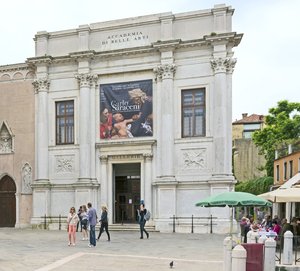 Gallerie dell'Accademia di Venezia |
Wenecja | 2 | Capriccio with Classical Arch and Goats, Capriccio with Gothic Building and Obelisk |
 Berlińskie Muzea Państwowe |
Berlin | 2 | The Grand Canal with the Ca' Rezzonico and the Campo San Samuele, The Grand Canal with the Palazzo Labia and Entry to the Cannareggio |
 Ermitaż |
Sankt Petersburg | 2 | Courtyard with a Staircase, Most Rialto z Riva del Vin |
 Bawarskie Państwowe Zbiory Malarstwa |
Monachium | 2 | View of the Piazzetta dei Leoni, View of the Grand Canal near Cà Pesaro |
 Nationalmuseum |
Stockholm | 2 | Courtyard in a Renaissance House, Stairwell in a Renaissance Palace |
 Statens Museum for Kunst |
Kopenhaga | 2 | View of Canale Grande in Venice with the Rialto Bridge, View of Canale Grande in Venice |
 Luwr |
Paryż | 1 | The Grand Canal near the Salute |
Wybierz dekadę, aby zobaczyć dzieło, które ją definiuje.

The Grand Canal near the Salute is an oil on canvas painting created by Michele Marieschi in 1733. This artwork is currently housed at the Musée du Louvre in Paris, France.
The composition centers on the intersection of human architecture and the persistent force of the natural world. Crumbling stone arches and weathered columns, once symbols of structural precision, now lie partially reclaimed by thick foliage and creeping vines. In the foreground, a man, a boy, and a dog move through the ruins, providing a sense of scale against the heavy, decaying masonry. Beyond this immediate scene, a body of water…
The Grand Canal near the Salute (1733), Luwr, Paryż. Następne są Capriccio with Classical Arch and Goats (1741) oraz The Grand Canal with the Ca' Rezzonico and the Campo San Samuele (1742).
23 lat: The Grand Canal near the Salute pochodzi z 1733, a Michele Marieschi urodził(a) się w 1710.
The Grand Canal near the Salute, Capriccio with Classical Arch and Goats, The Grand Canal with the Ca' Rezzonico and the Campo San Samuele, Courtyard with a Staircase, The Grand Canal in Venice, Most Rialto z Riva del Vin, The Grand Canal with Santa Maria della Salute, An Architectural Capriccio with Figures beside a River, Ponte di Rialto i Fantastic Architecture of a Prison Courtyard. Powyższy ranking zawiera rok powstania oraz muzeum dla każdego z nich.
Nasz katalog zawiera 46 dzieł artysty Michele Marieschi, datowanych od 1727 do 1742.
W większości znajdują się w Muzeum Narodowe w Warszawie (Warszawa), Gallerie dell'Accademia di Venezia (Wenecja) i Berlińskie Muzea Państwowe (Berlin). Powyższa tabela muzeów zawiera ich pełną listę.
W 1730s: 14 z 43 dzieł na tej stronie powstało w tym czasie, w tym The Grand Canal near the Salute.
Na tej stronie najwcześniejszy to Italian scenery with figures (1727), a najpóźniejszy The Grand Canal with the Ca' Rezzonico and the Campo San Samuele (1742).
Boats (4), Architecture (4) i Canal (3), w ramach 43 dzieł na tej stronie.
Oil On Canvas, dla 5 z 43 dzieł na tej stronie.
Rococo, sądząc po oryginałach na tej stronie.
Ponte di Rialto, Fantastic Architecture of a Prison Courtyard i Fantastic Architecture of a Palace Courtyard: Muzeum Narodowe w Warszawie, Warszawa posiada 10 dzieł widocznych na tej stronie.
In the golden age of the Venetian Rococo, few artists captured the ephemeral magic of the Serenissima with as much vitality as Michele Giovanni Marieschi. Born in Venice in 1710, Marieschi emerged from a lineage of craftsmanship, being the son of a woodcarver—a background that likely instilled in him a profound respect for structure, texture, and the physical essence of the objects he depicted. While his life was relatively brief, spanning only until his death in early 1744, his impact on the veduta tradition remains indelible. He did not merely document the architecture of Venice; he breathed life into its stone and water, transforming static cityscapes into breathing, luminous narratives of light and movement.
The development of Marieschi’s unique style was deeply rooted in the artistic currents flowing through 18th-century Italy. Scholars often point to the influence of masters such as Gaspare Diziani and the legendary Canaletto, whose works provided a blueprint for capturing the grandeur of urban environments. However, where Canaletto sought a certain topographical precision and a more restrained, classical clarity, Marieschi found his voice in a bolder, more emotive approach. He embraced a palette that pulsed with color and a brushwork that felt spontaneous and energetic. This stylistic distinction allowed him to move beyond mere architectural recording, infusing his landscapes with a sense of theatricality and atmosphere that suggested the very pulse of Venetian life.
Marieschi’s contribution to the veduta—the genre of highly detailed, large-scale topographical paintings—is characterized by an extraordinary command of perspective and light. His works often feature iconic landmarks such as the Grand Canal, the Salute, and various majestic palaces, yet they are far from being mere postcards of the era. Instead, he utilized a technique that blended meticulous detail with imaginative embellishment, creating scenes that felt both real and dreamlike. Through his eyes, the water of the canals becomes a mirror for the shifting sky, and the shadows cast by ancient churches become vessels for mystery and depth.
His technical prowess is perhaps most evident in his ability to manipulate light to evoke specific moods:
The historical significance of Michele Marieschi lies in his ability to bridge the gap between the rigid documentation of the early 18th century and the more expressive, emotive landscapes that would follow. He was a pivotal figure in transitioning the Venetian view from a purely observational medium into an art form capable of conveying profound emotional resonance. His work serves as a vital window into a vanished world, preserving the splendor of Venice before the seismic shifts of the late 18th century altered its social and political landscape forever.
Today, Marieschi’s canvases continue to captivate collectors and historians alike. Whether it is the breathtaking view of the Grand Canal near the Salute or his more intimate architectural studies, his paintings remain masterclasses in the Rococo spirit. He remains a celebrated figure for those seeking to experience the vibrant energy, the luminous light, and the enduring elegance of a Venice that continues to haunt the collective imagination of the art world.


