Portret Jan Brueghel

100 najsłynniejszych obrazów artysty Jan Brueghel, każdy niepowtarzalny

Aktualizacja: Listopad 2026 · ranking według naszego wskaźnika popularności (liczba wyszukiwań, wizyt i zamówień dla każdego dzieła) · 377 dzieł Jan Brueghel w naszym katalogu

W skrócie

Ogród Eden z upadkiem człowieka (1615) to obraz autorstwa Jan Brueghel, który przyciąga najwięcej spojrzeń; oryginał znajduje się w Mauritshuis, Haga. Następnie wzrok kieruje się na Triunf Śmierci (1610) i Krajobraz leśny (1610). Spośród 377 dzieł Jan Brueghel w naszym katalogu, tych 100 jest najbardziej znanych – każde z nich to unikatowy oryginał, przedstawiony wraz z rokiem powstania, muzeum oraz powodem, dla którego przetrwało próbę czasu.

1568 – 1625, Bruksela Barok Najwięcej dzieł: Bawarskie Państwowe Zbiory Malarstwa

10 najlepszych obrazów autorstwa Jan Brueghel według oka galerii

1
Ogród Eden z upadkiem człowieka (1615) autorstwa Jan Brueghel

Ogród Eden z upadkiem człowieka

1615 · Farba olejna · Mauritshuis, Haga

Powietrze zdaje się być ciężkie od zapachu wilgotnej ziemi i kwitnącej flory, gdy wkraczamy w ten bujny, pierwotny krajobraz. W cieniu rozłożystego drzewa Adam i Ewa trwają w momencie głębokiego bezruchu, a ich nagość jest znakiem niewinności, zanim padnie cień pokusy. Scena ta stanowi żywy dialog dwóch mistrzowskich dłoni: płynnych, pełnych energii pociągnięć pędzla Petera Paula Rubensa oraz skrupulatnej, encyklopedycznej precyzji Jana Bruegla Starszego. Rubens tchnął życie w postacie ludzkie,…

2
Triunf Śmierci (1610) autorstwa Jan Brueghel

Triunf Śmierci

1610 · Obraz olejny na płótnie · Museo del Prado, Madryt

Tematyka i Kompozycja Zanurz się w przejmującym tableau, które w sposób niezwykle żywy oddaje uniwersalny temat śmiertelności. To mistrzowskie dzieło przedstawia chaotyczny i ponury krajobraz, gdzie szkielety i konające postaci przeplatają się pośród scen zniszczenia i rozpaczy. Rozległa kompozycja prowadzi widza przez kolejne warstwy zamętu, od pełnego wrzenia pierwszego planu aż po mroczny horyzont, podkreślając nieubłagany marsz śmierci, który nie oszczędza nikogo. Skrupulatne rozmieszczenie elementów przez artystę zaprasza do kontemplacji…

3
Krajobraz leśny (1610) autorstwa Jan Brueghel

Krajobraz leśny

1610 · Obraz olejny na płótnie · Kunsthistorisches Museum, Wiedeń

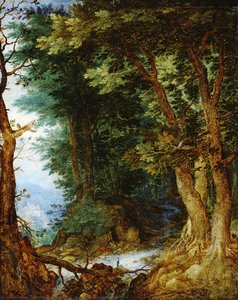
Spojrzenie na tę przedstawioną scenerię leśnego krajobrazu jest niczym przekroczenie progu do krainy zawieszonej między jawą a głęboką kontemplacją. To atmosfera ucieleśniona w formie, miejsce, w którym monumentalna wertykalność prastarych drzew zdaje się obejmować niebo w pełnym ciszy uścisku. Kompozycja nieuchronnie przyciąga wzrok do wewnątrz; wijący się strumień pełni rolę płynnego przewodnika, obiecując przejście w głąb kniei, a jednocześnie sugerując, że sama podróż jest prawdziwym celem. Ten obraz nie tylko…

4
Still Life with Garland and Golden Tazza (1618) autorstwa Jan Brueghel

Still Life with Garland and Golden Tazza

1618 · Oil On Canvas

To gaze upon Jan Brueghel the Elder’s Still Life with Garland and Golden Tazza is to step into a moment suspended in time, a quiet celebration of material beauty. This painting from 1618 is far more than a mere arrangement of objects; it is a meticulously composed meditation on luxury, nature's bounty, and the passage of refined taste. Brueghel, a master of the Flemish Baroque period, possessed an almost magical…

5
The Tower of Babel autorstwa Jan Brueghel

The Tower of Babel

In the sprawling, chaotic theater of Jan Brueghel the Elder’s The Tower of Babel, we are invited to witness one of humanity's most profound and tragic myths unfolding across a vast, undulating landscape. The canvas is dominated by a monumental structure that seems to pierce the very heavens, a dizzying feat of engineering that serves as both a marvel of architectural imagination and a sobering warning against hubris. As the…

6
Smell (1617) autorstwa Jan Brueghel

Smell

1617 · Oil On Panel · Museo del Prado, Madryt

In the lush, blooming landscape of Smell, Jan Brueghel the Elder invites the viewer into a sensory realm where the air feels heavy with fragrance. This work, an allegory of smell, emerges from a profound creative partnership between Jan Brueghel the Elder and Peter Paul Rubens. Together, they weave a scene where the invisible essence of scent becomes visible through a dense abundance of flora and symbolic objects. The painting…

7
The Garden of Eden with the Fall of Man (1613) autorstwa Jan Brueghel

The Garden of Eden with the Fall of Man

1613 · Oil On Canvas · Szépművészeti Múzeum, Budapeszt

To gaze upon this depiction of The Garden of Eden with the Fall of Man is to step across a threshold into an imagined, perfect antiquity. It is not merely a painting; it is a meticulously orchestrated vision of creation itself. Jan Brueghel the Elder, master of the Flemish landscape, has captured that sublime moment suspended between divine perfection and poignant loss. The sheer abundance depicted—the lush foliage, the teeming…

8
Flood with Noah (1601) autorstwa Jan Brueghel

Flood with Noah

1601 · Oil On Copper · Kunsthaus Zürich, Zurych

A Biblical Drama Unfolding in Copper and Oil The “Flood with Noah,” painted by Jan Brueghel the Elder around 1601, isn’t merely a depiction of a biblical deluge; it's a vibrant, teeming microcosm of human existence grappling with divine judgment. This monumental oil on copper panel transports us to a moment of profound consequence – the final preparations for humanity’s salvation aboard Noah’s Ark. Brueghel masterfully captures the chaotic energy…

9
Mountain Landscape with the Temptation of Christ autorstwa Jan Brueghel

Mountain Landscape with the Temptation of Christ

Oil On Panel · Kunsthistorisches Museum, Wiedeń

To stand before this depiction of a Mountain Landscape with the Temptation of Christ is to step directly into the richly colored, deeply textured world of the Flemish Baroque. The air itself seems thick with the scent of damp earth and ancient pine. This work masterfully combines the breathtaking scope of nature—the towering mountains and winding paths—with the profound drama of human spiritual struggle. It speaks to an era when…

10
Landscape with Diana Surprised by Actaeon (1594) autorstwa Jan Brueghel

Landscape with Diana Surprised by Actaeon

1594 · Oil On Copper · Nationalmuseum, Stockholm

The air in the woodland grove feels heavy and still, thick with the scent of damp earth and moss. Within a dark, cavernous rocky outcrop, the peace of a private ritual is shattered. Three female figures occupy the foreground, their pale skin glowing against the deep, shadowy greens of the forest. One figure, draped in a luminous golden-yellow cloth, reacts with a sudden, sharp distress. Beside her, a nymph kneels…

Słynne obrazy artysty Jan Brueghel, od 11 do 100

11A Woodland Road with Travelers (1607) autorstwa Jan BrueghelA Woodland Road with Travelers1607 · Metropolitan Museum of Art 12Flowers in a Wooden Vessel (1607) autorstwa Jan BrueghelFlowers in a Wooden Vessel1607 · Kunsthistorisches Museum 13River Landscape with Landing autorstwa Jan BrueghelRiver Landscape with LandingIndianapolis Museum of Art 14Assault on a Convoy (1612) autorstwa Jan BrueghelAssault on a Convoy1612 · Kunsthistorisches Museum 15The Temptation of Saint Anthony (1594) autorstwa Jan BrueghelThe Temptation of Saint Anthony1594 · Yale University Art Gallery 16The Flood with Noah's Ark autorstwa Jan BrueghelThe Flood with Noah's ArkKunsthaus Zürich 17Fish Market on the Banks of the River (1611) autorstwa Jan BrueghelFish Market on the Banks of the River1611 · Rheinisches Landesmuseum Bonn 18Venus and Cupid (1600) autorstwa Jan BrueghelVenus and Cupid1600 · Ermitaż 19Landscape with Travelers on a Woodland Path (1607) autorstwa Jan BrueghelLandscape with Travelers on a Woodland Path1607 20Garland of Flowers around an Allegory of Farming (1615) autorstwa Jan BrueghelGarland of Flowers around an Allegory of Farming1615 · Mauritshuis 21Ceres and the Four Elements (1604) autorstwa Jan BrueghelCeres and the Four Elements1604 · Kunsthistorisches Museum 22Garland with the Virgin, the Christ Child and two Angels (1619) autorstwa Jan BrueghelGarland with the Virgin, the Christ Child and two Angels1619 · Museo del Prado 23The Holy Family 1 autorstwa Jan BrueghelThe Holy Family 1Bawarskie Państwowe Zbiory Malarstwa 24Forest landscape with deer hunt (1593) autorstwa Jan BrueghelForest landscape with deer hunt1593 · Kunsthistorisches Museum 25Landscape with Wagons (1603) autorstwa Jan BrueghelLandscape with Wagons1603 · Museo del Prado 26The Last Judgement (1602) autorstwa Jan BrueghelThe Last Judgement1602 · Statens Museum for Kunst 27Landscape with village (1601) autorstwa Jan BrueghelLandscape with village1601 · Museo del Prado 28Farmstead on the Stream (1615) autorstwa Jan BrueghelFarmstead on the Stream1615 · Bawarskie Państwowe Zbiory Malarstwa 29Vase of Flowers (1612) autorstwa Jan BrueghelVase of Flowers1612 · Museo del Prado 30Roman Carnival: Allegory of Winter (1596) autorstwa Jan BrueghelRoman Carnival: Allegory of Winter1596 · Bawarskie Państwowe Zbiory Malarstwa 31Equestrian Battle near a Mill (1612) autorstwa Jan BrueghelEquestrian Battle near a Mill1612 32Rest on the Flight into Egypt (1595) autorstwa Jan BrueghelRest on the Flight into Egypt1595 · Kunsthistorisches Museum 33Wreath of Flowers with Saint Joseph (1617) autorstwa Jan BrueghelWreath of Flowers with Saint Joseph1617 · Bawarskie Państwowe Zbiory Malarstwa 34The visit to the tenant farmer (1568) autorstwa Jan BrueghelThe visit to the tenant farmer1568 · Fondation Custodia 35The Way of the Cross autorstwa Jan BrueghelThe Way of the CrossKunsthaus Zürich 36The Return from War. Mars Disarmed by Venus autorstwa Jan BrueghelThe Return from War. Mars Disarmed by VenusMuzeum J. Paula Getty'ego 37The Return from the Hunt autorstwa Jan BrueghelThe Return from the Hunt 38A Fantastic Cave Landscape with Odysseus ^ Calypso autorstwa Jan BrueghelA Fantastic Cave Landscape with Odysseus ^ Calypso 39The Holy Family in a Landscape (1596) autorstwa Jan BrueghelThe Holy Family in a Landscape1596 · Bawarskie Państwowe Zbiory Malarstwa 40Harbor Scene with St. Paul’s Departure from Caesarea (1596) autorstwa Jan BrueghelHarbor Scene with St. Paul’s Departure from Caesarea1596 · North Carolina Museum of Art 41Allegory of Fire (1608) autorstwa Jan BrueghelAllegory of Fire1608 · Pinacoteca Ambrosiana 42Marriage Dance (1595) autorstwa Jan BrueghelMarriage Dance1595 · Museum Mayer van den Bergh 43Aeneas and Sibyl in the Underworld (1600) autorstwa Jan BrueghelAeneas and Sibyl in the Underworld1600 · Szépművészeti Múzeum 44Allegory of the Four Elements (1600) autorstwa Jan BrueghelAllegory of the Four Elements1600 · Słowacka Galeria Narodowa w Bratysławie 45Aneas and the Cumean Sybil in the Underworld (1594) autorstwa Jan BrueghelAneas and the Cumean Sybil in the Underworld1594 · Słowacka Galeria Narodowa w Bratysławie 46River Landscape with Figures on a Quay before a Town (1607) autorstwa Jan BrueghelRiver Landscape with Figures on a Quay before a Town1607 47Landscape with Figures on a Road through a Wood (1607) autorstwa Jan BrueghelLandscape with Figures on a Road through a Wood1607 48Diana and the sleeping nymphs (1596) autorstwa Jan BrueghelDiana and the sleeping nymphs1596 · Bawarskie Państwowe Zbiory Malarstwa 49River landscape with the rest on the flight to Egypt (1600) autorstwa Jan BrueghelRiver landscape with the rest on the flight to Egypt1600 · Bawarskie Państwowe Zbiory Malarstwa 50Woodland landscape with St Jerome (1597) autorstwa Jan BrueghelWoodland landscape with St Jerome1597 · Bawarskie Państwowe Zbiory Malarstwa 51Diana and Actaeon (1605) autorstwa Jan BrueghelDiana and Actaeon1605 · Bawarskie Państwowe Zbiory Malarstwa 52Temptation of saint Anthony (1601) autorstwa Jan BrueghelTemptation of saint Anthony1601 · Bawarskie Państwowe Zbiory Malarstwa 53Christ and the Woman Taken in Adultery (1597) autorstwa Jan BrueghelChrist and the Woman Taken in Adultery1597 · Bawarskie Państwowe Zbiory Malarstwa 54Summer (1605) autorstwa Jan BrueghelSummer1605 · Noordbrabants Museum 55Village view with vegetable market (1600) autorstwa Jan BrueghelVillage view with vegetable market1600 · Centraal Museum 56Landscape (1607) autorstwa Jan BrueghelLandscape1607 · Statens Museum for Kunst 57The Marriage of Peleus and Thetis (1604) autorstwa Jan BrueghelThe Marriage of Peleus and Thetis1604 · Statens Museum for Kunst 58Callisto in Diana's Bath (1604) autorstwa Jan BrueghelCallisto in Diana's Bath1604 · Statens Museum for Kunst 59Adoration of the Magi (1599) autorstwa Jan BrueghelAdoration of the Magi1599 · Museum Mayer van den Bergh 60Virgin and Child in a Garland of Flowers (1606) autorstwa Jan BrueghelVirgin and Child in a Garland of Flowers1606 · Pinacoteca Ambrosiana 61Forest Landscape with Travellers (1607) autorstwa Jan BrueghelForest Landscape with Travellers1607 62Vase of Flowers (1601) autorstwa Jan BrueghelVase of Flowers1601 · Museo del Prado 63Spring (1616) autorstwa Jan BrueghelSpring1616 · Bawarskie Państwowe Zbiory Malarstwa 64Fishing nymphs (1621) autorstwa Jan BrueghelFishing nymphs1621 · Bawarskie Państwowe Zbiory Malarstwa 65Country Road with Elegant Travelers, Including Nursing Mother (1619) autorstwa Jan BrueghelCountry Road with Elegant Travelers, Including Nursing Mother1619 · Bawarskie Państwowe Zbiory Malarstwa 66Winter (1616) autorstwa Jan BrueghelWinter1616 · Bawarskie Państwowe Zbiory Malarstwa 67Two nymphs with hounds (1620) autorstwa Jan BrueghelTwo nymphs with hounds1620 · Bawarskie Państwowe Zbiory Malarstwa 68Flora im Blumengarten (1617) autorstwa Jan BrueghelFlora im Blumengarten1617 · Bawarskie Państwowe Zbiory Malarstwa 69Diana returning from the hunt (1620) autorstwa Jan BrueghelDiana returning from the hunt1620 · Bawarskie Państwowe Zbiory Malarstwa 70Allegory of Autumn (1616) autorstwa Jan BrueghelAllegory of Autumn1616 · Bawarskie Państwowe Zbiory Malarstwa 71Feast of the Olympian gods (1617) autorstwa Jan BrueghelFeast of the Olympian gods1617 · Bawarskie Państwowe Zbiory Malarstwa 72Triumph of Bacchus (1610) autorstwa Jan BrueghelTriumph of Bacchus1610 · Bawarskie Państwowe Zbiory Malarstwa 73Summer (1616) autorstwa Jan BrueghelSummer1616 · Bawarskie Państwowe Zbiory Malarstwa 74The Feast of the Gods. The Wedding of Peleus and Thetis (1610) autorstwa Jan BrueghelThe Feast of the Gods. The Wedding of Peleus and Thetis1610 · Statens Museum for Kunst 75The forge of the volcano / the fire (1615) autorstwa Jan BrueghelThe forge of the volcano / the fire1615 · Gemäldegalerie 76Flemish Dairy Farm (1621) autorstwa Jan BrueghelFlemish Dairy Farm1621 77Venus und Amor in der Schmiede des Vulkan (1625) autorstwa Jan BrueghelVenus und Amor in der Schmiede des Vulkan1625 · Bawarskie Państwowe Zbiory Malarstwa 78Archdukes Albrecht and Isabella in the garden of Coudenberg Palace, Brussels (1624) autorstwa Jan BrueghelArchdukes Albrecht and Isabella in the garden of Coudenberg Palace, Brussels1624 · Rubens House 79Pan and Syrinx (1625) autorstwa Jan BrueghelPan and Syrinx1625 · Staatliches Museum Schwerin 80Landscape with St. Fulgentius (1595) autorstwa Jan BrueghelLandscape with St. Fulgentius1595 · Kunsthistorisches Museum 81Air (Optics) autorstwa Jan BrueghelAir (Optics) 82Village Street with Canal autorstwa Jan BrueghelVillage Street with CanalYale University Art Gallery 83San Benito en los zarzales autorstwa Jan BrueghelSan Benito en los zarzales 84Mouse with Roses (1611) autorstwa Jan BrueghelMouse with Roses1611 85Juno in the Underworld (1595) autorstwa Jan BrueghelJuno in the Underworld1595 · Staatliche Kunstsammlungen Dresden 86The Children of the Planet Mercury, Jan Brueghel (II), c. 1645 (1645) autorstwa Jan BrueghelThe Children of the Planet Mercury, Jan Brueghel (II), c. 16451645 87Fall of Man (1596) autorstwa Jan BrueghelFall of Man1596 · Bawarskie Państwowe Zbiory Malarstwa 88Flowers in a Bowl (1615) autorstwa Jan BrueghelFlowers in a Bowl1615 · Museo del Prado 89Country Wedding (1612) autorstwa Jan BrueghelCountry Wedding1612 · Museo del Prado 90Landscape (1604) autorstwa Jan BrueghelLandscape1604 · Museo del Prado 91Vase of Flowers (1613) autorstwa Jan BrueghelVase of Flowers1613 · Museo del Prado 92Vase of Flowers (1609) autorstwa Jan BrueghelVase of Flowers1609 · Museo del Prado 93Adoration of the Magi (1599) autorstwa Jan BrueghelAdoration of the Magi1599 · Ermitaż 94Chinese porcelain vase of flowers on a tabletop (1609) autorstwa Jan BrueghelChinese porcelain vase of flowers on a tabletop1609 · Kunsthistorisches Museum 95Village on the edge of a river (1625) autorstwa Jan BrueghelVillage on the edge of a river1625 · Muzeum Plantin-Moretus 96Adoration of the Magi (1598) autorstwa Jan BrueghelAdoration of the Magi1598 · Kunsthistorisches Museum 97River Landscape (1607) autorstwa Jan BrueghelRiver Landscape1607 · National Gallery of Art 98Vase of Flowers (1600) autorstwa Jan BrueghelVase of Flowers1600 · Museo del Prado 99Inn at the road along the river (1601) autorstwa Jan BrueghelInn at the road along the river1601 · Bawarskie Państwowe Zbiory Malarstwa 100Aeneas and a Sibyl in the Underworld (1600) autorstwa Jan BrueghelAeneas and a Sibyl in the Underworld1600 · Kunsthistorisches Museum

Słynne obrazy Jan Brueghel epoka po epoce

Tematy, które przyciągnęły wzrok Jan Brueghel

Cztery motywy najczęściej powracające w tych oryginałach, z których każdy doczekał się swojego najdoskonalszego przykładu.

Muzea przechowujące oryginały Jan Brueghel

8 muzeów, w których znajduje się najwięcej obrazów z tej strony.

Muzea Miasto Dzieła artysty Jan Brueghel Obrazy z tej listy
Bawarskie Państwowe Zbiory Malarstwa, MonachiumBawarskie Państwowe Zbiory Malarstwa Monachium 58 The Holy Family 1, Farmstead on the Stream, Roman Carnival: Allegory of Winter
Museo del Prado, MadrytMuseo del Prado Madryt 39 Triunf Śmierci, Smell, Garland with the Virgin, the Christ Child and two Angels
Kunsthistorisches Museum, WiedeńKunsthistorisches Museum Wiedeń 19 Krajobraz leśny, Mountain Landscape with the Temptation of Christ, Flowers in a Wooden Vessel
Statens Museum for Kunst, KopenhagaStatens Museum for Kunst Kopenhaga 6 The Last Judgement, Landscape, The Marriage of Peleus and Thetis
Kunsthaus Zürich, ZurychKunsthaus Zürich Zurych 5 Flood with Noah, The Flood with Noah's Ark, The Way of the Cross
Ermitaż, Sankt PetersburgErmitaż Sankt Petersburg 6 Venus and Cupid, Adoration of the Magi
Pinacoteca Ambrosiana, MilanPinacoteca Ambrosiana Milan 5 Allegory of Fire, Virgin and Child in a Garland of Flowers
Mauritshuis, HagaMauritshuis Haga 4 Ogród Eden z upadkiem człowieka, Garland of Flowers around an Allegory of Farming

Jan Brueghel na przestrzeni dekad: jeden unikatowy oryginał dla każdego

Dzieła według dekad

Wybierz dekadę, aby zobaczyć dzieło, które ją definiuje.

Obrazy artysty Jan Brueghel: pytania do galerii

Jakie jest najsłynniejsze dzieło artysty Jan Brueghel?Odkryj odpowiedź

Ogród Eden z upadkiem człowieka (1615), Mauritshuis, Haga. Następne są Triunf Śmierci (1610) oraz Krajobraz leśny (1610).

W jakim wieku Jan Brueghel stworzył/a Ogród Eden z upadkiem człowieka?Odkryj odpowiedź

47 lat: Ogród Eden z upadkiem człowieka pochodzi z 1615, a Jan Brueghel urodził(a) się w 1568.

Które dziesięć obrazów Jan Brueghel jest najbardziej znanych?Odkryj odpowiedź

Ogród Eden z upadkiem człowieka, Triunf Śmierci, Krajobraz leśny, Still Life with Garland and Golden Tazza, The Tower of Babel, Smell, The Garden of Eden with the Fall of Man, Flood with Noah, Mountain Landscape with the Temptation of Christ i Landscape with Diana Surprised by Actaeon. Powyższy ranking zawiera rok powstania oraz muzeum dla każdego z nich.

Ile znanych dzieł stworzył Jan Brueghel?Odkryj odpowiedź

Nasz katalog zawiera 377 dzieł artysty Jan Brueghel, datowanych od 1593 do 1625.

Gdzie można zobaczyć najsłynniejsze oryginały Jan Brueghel?Odkryj odpowiedź

W większości znajdują się w Bawarskie Państwowe Zbiory Malarstwa (Monachium), Museo del Prado (Madryt) i Kunsthistorisches Museum (Wiedeń). Powyższa tabela muzeów zawiera ich pełną listę.

W jakim okresie Jan Brueghel stworzył/a swoje najsłynniejsze obrazy?Odkryj odpowiedź

W 1600s: 32 z 100 dzieł na tej stronie powstało w tym czasie, w tym Flood with Noah.

Który z najsłynniejszych obrazów artysty Jan Brueghel powstał najwcześniej, a który najpóźniej?Odkryj odpowiedź

Na tej stronie najwcześniejszy to Forest landscape with deer hunt (1593), a najpóźniejszy Venus und Amor in der Schmiede des Vulkan (1625).

Jakie tematy preferował Jan Brueghel?Odkryj odpowiedź

Trees (43), Landscape (31) i People (31), w ramach 100 dzieł na tej stronie.

Jakich materiałów Jan Brueghel używał najczęściej?Odkryj odpowiedź

Oil On Panel, dla 39 z 100 dzieł na tej stronie.

Do jakiego nurtu należy twórczość Jan Brueghel?Odkryj odpowiedź

Barok i Flemish baroque, sądząc po oryginałach na tej stronie.

Jakie oryginały Jan Brueghel można zobaczyć w Bawarskie Państwowe Zbiory Malarstwa?Odkryj odpowiedź

The Holy Family 1, Farmstead on the Stream i Roman Carnival: Allegory of Winter: Bawarskie Państwowe Zbiory Malarstwa, Monachium posiada 25 dzieł widocznych na tej stronie.

Jan Brueghel: portret artysty

Wczesne lata, rodzina i kształcenie

Jan Brueghel Starszy wkroczył w świat zdefiniowany przez ogromny ciężar artystycznego dziedzictwa. Urodzony w Brukseli w 1568 roku, był młodszym synem wybitnego malarza renesansu flamandzkiego, którym był Pieter Bruegel Starszy. Jego życie rodzinne kształtowała obecność matki, Marii, zwanej często Mayken Coecke van Aelst, oraz rodzeństwa – brata, czyli Jana Brueghela Młodszego, i siostry Marie. Jednak stabilność jego wczesnych lat okazała się ulotna. Po śmierci matki w 1578 roku sytuacja rodziny uległa zmianie, a Jan został wychowany przez swoją babkę, Mayken Verhulst.

To właśnie pod opieką Verhulst położono fundamenty techniczne Jana. Sama była ona utalentowaną artystką i stała się jego pierwszą nauczycielką, prowadząc jego młode dłonie przez delikatną dyscyplinę rysunku. Skupiła jej szkolenie na precyzyjnej sztuce miniaturowego malarstwa akwarelowego – metodzie wymagającej niepogłębiącej cierpliwości i niezwykle pewnego oka. To wczesne nauki w zakresie drobiazgowej, miniaturowej pracy towarzyszyły mu przez całe życie, wpływając na sposób, w jaki w późniejszych latach podchodził do przedstawiania świata natury.

Życie i działalność w Antwerpii oraz we Włoszech

U progu siedemnastego wieku Jan Brueghel Starszy ugruntował swoją pozycję w samym sercu artystycznego świata Niderlandów. Jego obecność w Antwerpii została oficjalnie usankcjonowana 4 października 1601 roku, kiedy to został wpisany na listę obywateli miasta. Okres ten przyniósł gwałtowny wzrost jego prestiżu zawodowego. W tym samym roku został wybrany na dziekana Gildii Świętego Łukasza – stanowisko niosące ze sobą ogromną odpowiedzialność w lokalnej społeczności. Zaufanie, jakim darzyli go współcześni, potwierdziło ponowne wybranie go na tę prestiżową funkcję już w 1602 roku.

Pragnąc wyjść poza ramy flamandzkich granic i poszerzyć swoje artystyczne horyzonty, Jan Brueghel Starszy udał się w podróż do Włoch. Ten czas wędrówki stał się dla niego okazją do zetknięcia się z odmiennymi wrażliwościami estetycznymi oraz nawiązania relacji z wybitnymi mecenasami sztuki. Podczas pobytu w Mediolanie znalazł się pod protekcją kardynała Federico Borromeo, co odegrało kluczową rolę w budowaniu jego sławy daleko poza rodzinnymi stronami. Pobyt we Włoszech pozwolił mu na chłonne przyswojenie nowych inspiracji, które w późniejszych latach harmonijnie splotły się z tradycjami wypracowanymi w czasach jego młodości.

Technika, styl i innowacje artystyczne

Jan Brueghel Starszy dysponował dłonią tak niezwykle precyzyjną, że zyskał przydomek „Aksamitny” Brueghel. Tytuł ten wypłynął z jego unikalnej zdolności do oddawania ciężkich, miękkich tekstur szlachetnych tkanin z realizmem, który zdawał się niemal namacalny. Artysta przeniósł technikę miniaturzystyczną na świat natury, traktując każdy liść, owada czy płatek kwiatu jako temat godny intensywnej i uważnej obserwacji. To skrupulatne podejście pozwoliło mu uchwycić ulotne detale przyrody z klarownością, z którą niewielu mistrzów mogło mu dorównać.

Jego fascynacja światem botanicznym przyniosła mu sławę znaną jako „Kwiatowy” Brueghel. Nie ograniczał się on jedynie do malowania kwiatów; stał się wręcz współtwórcą zupełnie nowych sposobów postrzegania ich na płótnie. Był kluczową postacią w rozwoju malarstwa festonowego, w którym bujne, bogate kompozycje kwiatowe tworzą ramy dla centralnej sceny religijnej lub mitologicznej. Brueghel stworzył również pejzaż rajski – gatunek łączący statyczność martwej natury z rozmachem krajobrazu, aby przedstawić idylliczne, niebiańskie krainy.

Współpraca i środowiska artystyczne

Jan Brueghel Starszy poruszał się w kręgach artystycznych Niderlandów Hiszpańskich z niezwykłą naturalnością, często łącząc siły z innymi twórcami, aby tchnąć życie w złożone i wielowymiarowe wizje. Jego najważniejsza więź artystyczna nawiązana została z Peterem Paulem Rubensem. Byli bliskimi przyjaciółmi, którzy wypracowali płynny i harmonijny sposób wspólnego tworzenia dzieł o tematyce religijnej oraz mitologicznej. W tych artystycznych partnerstwach Rubens zazwyczaj zajmował się malowaniem postaci ludzkich, podczas gdy Jan Brueghel Starszy skupiał się na misternych pejzażach i elementach martwej natury, które stanowiły malownicze tło dla przedstawionych scen.

Ten duch współpracy wykraczał daleko poza jego przyjaźń z Rubensem. Artysta był częstym współpracownikiem wielu współczesnych mu mistrzów, w tym Paula Brila, Joosa de Mompera, Paula Vredemana de Vries, Fransa Franckena Młodszego, Hendricka de Clercka, Pietera van Avonta oraz Hendricka van Balena Starszego. Jednym z najbardziej znamiennych przejawów tej wspólnej kreatywności był okres około lat 1607–1608, kiedy to współpracował z Hendrickiem van Balenem przy tworzeniu dzieła uznawanego za pierwszy znany obraz typu garland. Te wyjątkowe kompozycje często wykorzystywały bogate, misterne girlandy kwiatowe, które tworzyły ozdobną ramę dla centralnej sceny.

Jego wysoka pozycja zawodowa została dodatkowo ugruntowana przez prestiżową funkcję na dworze. Służył jako malarz dworski arcyksięcia i arcyksiężnej Albrechta oraz Izabeli, suwerenów Niderlandów Hiszpańskich. Rola ta zapewniała mu bezpośredni kontakt z najwyższymi szczeblami władzy i mecenatu w całym regionie, czyniąc go jednym z najbardziej wpływowych artystów epoki.

Dziedzictwo i artystyczny wpływ

Jan Brueghel Starszy pozostawił po sobie świat ukształtowany przez jego nieustanną ciekawość. Jego płótna uchwyciły wyjątkowy moment w historii, będąc odzwierciedleniem zarówno rodzącej się metody naukowej obserwacji, jak i głębokiego żaru religijnego kontrreformacji. Dzięki jego pędzlowi świat natury został udokumentowany z precyzją, która idealnie współgrała ze zmieniającym się krajobrazem intelektualnym XVII wieku. Był płodnym innowatorem, który pomógł zdefiniować zupełnie nowe gatunki, takie jak obrazy z girlandami kwiatów, co na zawsze zmieniło sposób, w jaki artyści podchodzili do styku botaniki i duchowości.

Jego wpływ przetrwał dzięki dłoniom tych, których sam wykształcił. Przekazał swoją wiedzę techniczną synowi, Janowi Brueghelowi Młodszemu, oraz Danielowi Seghersowi, dbając o to, by jego skrupulatne podejście do detalu pozostało żywym elementem flamandzkiej tradycji. Jego pozycja zawodowa była tak ugruntowana, że powierzono mu rolę wykonawcy testamentu Petera Paula Rubensa, u boku Hendricka van Balena Starszego, Cornelisa Schuta oraz Paulusa van Halmaele.