Portret Honoré Daumier

100 najsłynniejszych obrazów artysty Honoré Daumier – wybór z galerii

Aktualizacja: Październik 2026 · ranking według naszego wskaźnika popularności (liczba wyszukiwań, wizyt i zamówień dla każdego dzieła) · 355 dzieł Honoré Daumier w naszym katalogu

W skrócie

Spośród wszystkich dzieł oryginalnych, które pozostawił Honoré Daumier, najsłynniejszym jest Honoré Daumier Żądamy Barabba (1852), znajdujący się w kolekcji Museum Folkwang w Essen. Tuż za nimi znajdują się The Third-class Carriage (1860) oraz Unknown, maybe Hippolyte Lucien-Joseph Lucas (1807-1878), a Journalist, maybe P.Mendez de Vigo (1790-1860) a Spanish General, but Most Probably the Count Pelet de la Lozere (1785-1871), a Politician (1833). Nasz katalog zawiera 355 dzieł autorstwa Honoré Daumier; galeria zachowała 100 najbardziej podziwianych na świecie prac, z których każda została przedstawiona wraz z datą powstania, informacją o muzeum oraz jej historią.

1808 – 1879, Marsylia Realism Najwięcej dzieł: Musée d'Orsay

10 najlepszych obrazów artysty Honoré Daumier: wybór galerii

1
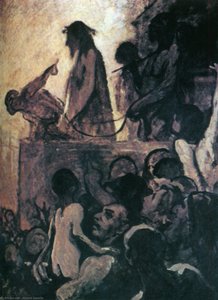
Honoré Daumier Żądamy Barabba (1852) autorstwa Honoré Daumier

Honoré Daumier Żądamy Barabba

1852 · Obraz olejny na płótnie · Museum Folkwang, Essen

Potężne przedstawienie ludzkiego cierpienia i sprawiedliwości społecznej To poruszające dzieło sztuki uchwyciło przejmującą biblijną scenę, która głęboko rezonuje z tematami współczucia, niesprawiedliwości oraz krytyki społecznej. Przedstawiona w surowym, ekspresyjnym stylu scena zaprasza widzów do momentu zbiorowego wzruszenia i moralnej refleksji. Postacie, ukazane z gesturalną bezpośredniością, przywołują poczucie pilności i ludzkiej bezbronności, czyniąc ten obraz głębokim manifestem sumienia społecznego i duchowej empatii. Styl artystyczny i technika wykonania Stworzone w 1852 roku…

2
The Third-class Carriage (1860) autorstwa Honoré Daumier

The Third-class Carriage

1860 · Oil On Canvas · Metropolitan Museum of Art, Nowy Jork

In the crowded, dimly lit confines of a mid-19th-century railway carriage, Honoré Daumier captures more than just a moment in transit; he captures the very essence of human endurance. The Third-class Carriage serves as a profound window into the burgeoning urban reality of France during the Second Empire. As the industrial revolution reshaped the landscape of Europe, Daumier turned his gaze away from the gilded salons of the aristocracy and…

3
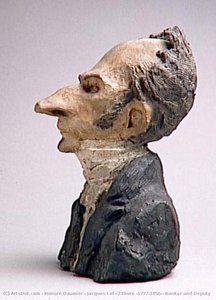
Unknown, maybe Hippolyte Lucien-Joseph Lucas (1807-1878), a Journalist, maybe P.Mendez de Vigo (1790-1860) a Spanish General, but Most Probably the Count Pelet de la Lozere (1785-1871), a Politician (1833) autorstwa Honoré Daumier

Unknown, maybe Hippolyte Lucien-Joseph Lucas (1807-1878), a Journalist, maybe P.Mendez de Vigo (1790-1860) a Spanish General, but Most Probably the Count Pelet de la Lozere (1785-1871), a Politician

1833 · Clay / Terracotta · Musée d'Orsay, Paryż

This evocative portrait captures more than just the likeness of an elderly gentleman; it arrests a moment in time, freezing the very essence of 19th-century Parisian intellectual life. The subject, whose identity is suggested by the possibilities of a journalist or politician, possesses a gaze that seems to look past the viewer, into some distant, weighty contemplation. Rendered with the unmistakable hand of Honoré Daumier, the piece transcends mere portraiture;…

4
Ratapoil (front view) (1850) autorstwa Honoré Daumier

Ratapoil (front view)

1850 · Bronze · Musée d'Orsay, Paryż

Honoré Daumier's "Ratapoil (front view)," created around 1850, is more than just a bronze sculpture; it’s a potent distillation of 19th-century French social commentary and political critique. This arresting figure, rendered with remarkable dynamism and a touch of unsettling realism, offers a captivating window into the turbulent world of post-Revolutionary France – a world grappling with nascent democracy, imperial ambitions, and the pervasive inequalities of its society. The sculpture’s enduring…

5
Intermission at the Comédie Française (1858) autorstwa Honoré Daumier

Intermission at the Comédie Française

1858 · Watercolor · Ermitaż, Sankt Petersburg

Honoré Daumier's “Intermission at the Comédie Française,” painted in 1858, isn’t merely a depiction of an elderly gathering; it’s a meticulously crafted observation of a specific moment frozen in time – and brimming with unspoken commentary. The artwork immediately draws the viewer into a densely packed scene: rows upon rows of men, their faces etched with age and lined with contemplation, are absorbed in reading newspapers or pamphlets within the…

6
Ratapoil (1850) autorstwa Honoré Daumier

Ratapoil

1850 · Bronze · Staatliche Kunsthalle Karlsruhe, Karlsruhe

The photograph captures a pivotal moment – a frozen dance of energy and emotion rendered in the enduring medium of bronze. This exquisite reproduction offers an intimate encounter with "Ratapoil," a sculpture by the visionary artist Honoré Daumier, born in Marseille in 1808 and tragically lost in 1879. More than just a depiction of a figure, it’s a window into the social anxieties and artistic fervor that defined mid-19th century…

8
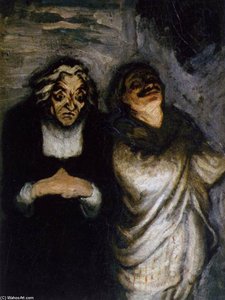
Scene from a Comedy (1858) autorstwa Honoré Daumier

Scene from a Comedy

1858 · Oil On Canvas · Musée d'Orsay, Paryż

Honoré Daumier's "Scene from a Comedy," painted in 1858, isn’t merely a depiction of two figures; it’s a meticulously crafted snapshot of Parisian society and the biting social commentary that defined the artist’s career. Housed within the walls of the Musée d’Orsay, this oil on canvas offers a rare glimpse into Daumier's world – a world brimming with observation, critique, and an undeniable sense of humor laced with profound sadness.…

9
Ratapoil (1850) autorstwa Honoré Daumier

Ratapoil

1850 · Acrylic On Canvas · Artizon Museum, Tokio

Honoré Daumier's "Ratapoil," created in 1850, isn’t merely a sculpture; it’s a distilled embodiment of the anxieties and frustrations simmering beneath the surface of mid-19th century France. This arresting figure, rendered in cast iron with a deliberate roughness that mirrors its subject matter, captures a moment of profound disillusionment – a silent indictment of societal hypocrisy and the precariousness of human existence. The sculpture’s power lies not just in its…

10
Family on the Barricades in 1848 (1854) autorstwa Honoré Daumier

Family on the Barricades in 1848

1854 · Oil · Národní galerie Praha, Praga

In the heart of Honoré Daumier’s 1854 masterpiece, Family on the Barricades in 1848, we find a moment suspended in the amber of history. This is not merely a painting of a political uprising; it is a profound psychological study of human resilience. As the Second French Revolution tore through the streets of Paris, Daumier captured the very essence of the era's turbulent spirit. The scene presents a family huddled…

The Honoré Daumier selection continues, 11 to 100

11Zbieracz Rysunków (1865) autorstwa Honoré DaumierZbieracz Rysunków1865 · Art Institute of Chicago 12The Republic (1848) autorstwa Honoré DaumierThe Republic1848 · Musée d'Orsay 13Comedy scene (scene from Molière) (1862) autorstwa Honoré DaumierComedy scene (scene from Molière)1862 · Musée d'Orsay 14On a Bridge at Night (1848) autorstwa Honoré DaumierOn a Bridge at Night1848 · The Phillips Collection 15Les Gens de Justice: Vous m (1845) autorstwa Honoré DaumierLes Gens de Justice: Vous m1845 16Burden (1850) autorstwa Honoré DaumierBurden1850 · Ermitaż 17Street Musicians (1855) autorstwa Honoré DaumierStreet Musicians1855 · Art Institute of Chicago 18Count Antoine-Maurice-Apollinaire d'Argout (1782-1858), Minister and Peer of France (1832) autorstwa Honoré DaumierCount Antoine-Maurice-Apollinaire d'Argout (1782-1858), Minister and Peer of France1832 · Musée d'Orsay 19The Studio (1870) autorstwa Honoré DaumierThe Studio1870 · Muzeum J. Paula Getty'ego 20Jean-Marie Fruchard (1788-1872), Deputy (1833) autorstwa Honoré DaumierJean-Marie Fruchard (1788-1872), Deputy1833 · Musée d'Orsay 21Load (Washerwoman) (1853) autorstwa Honoré DaumierLoad (Washerwoman)1853 · Národní galerie Praha 22Clément-François-Victor-Gabriel Prunelle (1774-1853), Doctor, Major of Lyon and Deputy (1832) autorstwa Honoré DaumierClément-François-Victor-Gabriel Prunelle (1774-1853), Doctor, Major of Lyon and Deputy1832 · Musée d'Orsay 23The Intoxication of Silène (1850) autorstwa Honoré DaumierThe Intoxication of Silène1850 24Two Lawyers (1860) autorstwa Honoré DaumierTwo Lawyers1860 · Art Institute of Chicago 25Outside the Print–Seller's Shop (1860) autorstwa Honoré DaumierOutside the Print–Seller's Shop1860 · Muzeum Sztuki w Dallas 26Exit from the Theater (1863) autorstwa Honoré DaumierExit from the Theater1863 · Nelson-Atkins Museum of Art 27Felix Barthe autorstwa Honoré DaumierFelix Barthe 28The Uprising (L (1848) autorstwa Honoré DaumierThe Uprising (L1848 · The Phillips Collection 29Le Peintre (The Painter) (1865) autorstwa Honoré DaumierLe Peintre (The Painter)1865 · Scottish National Gallery 30The Defender (1865) autorstwa Honoré DaumierThe Defender1865 · Musée d'Orsay 31The Good Samaritan (1855) autorstwa Honoré DaumierThe Good Samaritan1855 · Burrell Collection 32The Loge (In the Theatre Boxes) (1856) autorstwa Honoré DaumierThe Loge (In the Theatre Boxes)1856 · Walters Art Museum 33Susannah and the Elders (1853) autorstwa Honoré DaumierSusannah and the Elders1853 · Burrell Collection 34Penelopa's Dream (1842) autorstwa Honoré DaumierPenelopa's Dream1842 · Bibliothèque Nationale de France 35Jean-Auguste Chevandier de Valdrome, Parliamentarian (The Fool) (1832) autorstwa Honoré DaumierJean-Auguste Chevandier de Valdrome, Parliamentarian (The Fool)1832 · Musée d'Orsay 36The Washerwoman (1863) autorstwa Honoré DaumierThe Washerwoman1863 · Musée d'Orsay 37Masks of 1831 (1832) autorstwa Honoré DaumierMasks of 18311832 · Minneapolis Institute of Art 38Remembrances of St. Pelagie. (Souvenir de ste Pélagie) (1834) autorstwa Honoré DaumierRemembrances of St. Pelagie. (Souvenir de ste Pélagie)1834 39Mr. Joliv (Adolphe Joliv) (1833) autorstwa Honoré DaumierMr. Joliv (Adolphe Joliv)1833 · Musée d'art et d'histoire Paul Eluard 40Celebrités du Juste Milieu (1835) autorstwa Honoré DaumierCelebrités du Juste Milieu1835 · Zimmerli Art Museum at Rutgers University 41Grand Staircase of the Palace of Justice (1848) autorstwa Honoré DaumierGrand Staircase of the Palace of Justice1848 42The Conclusion of a Speech à la Demosthene (1848) autorstwa Honoré DaumierThe Conclusion of a Speech à la Demosthene1848 43Neighbourhood gossip (1855) autorstwa Honoré DaumierNeighbourhood gossip1855 · The Mesdag Collection 44Une salle d'attente (The Waiting Room) (1851) autorstwa Honoré DaumierUne salle d'attente (The Waiting Room)1851 · Buffalo AKG Art Museum 45Second-Class Carriage (1849) autorstwa Honoré DaumierSecond-Class Carriage1849 · Rhode Island School of Design Museum of Art 46Mme Pipelet, the Concierge (1849) autorstwa Honoré DaumierMme Pipelet, the Concierge1849 · Rhode Island School of Design Museum of Art 47Hunters by the fireside (1850) autorstwa Honoré DaumierHunters by the fireside1850 48Head of a Man (1855) autorstwa Honoré DaumierHead of a Man1855 · National Museum Cardiff 49The Miller, His Son and the Donkey (1849) autorstwa Honoré DaumierThe Miller, His Son and the Donkey1849 · Burrell Collection 50Bathers (1853) autorstwa Honoré DaumierBathers1853 51On the Shore (1853) autorstwa Honoré DaumierOn the Shore1853 52Return from the Market (1856) autorstwa Honoré DaumierReturn from the Market1856 · Museum collection Am Römerholz 53The Confidence or The Kiss of Judas (1859) autorstwa Honoré DaumierThe Confidence or The Kiss of Judas1859 · Petit Palais 54Four Heads (1857) autorstwa Honoré DaumierFour Heads1857 · Burrell Collection 55Head of an Old Woman (1858) autorstwa Honoré DaumierHead of an Old Woman1858 56Painting by Honoré Daumier (1862) autorstwa Honoré DaumierPainting by Honoré Daumier1862 57Scapin (1861) autorstwa Honoré DaumierScapin1861 · Harvard Art Museums 58Count Auguste-Hilarion de Kératry (1769-1859), Deputy, Peer of France (1832) autorstwa Honoré DaumierCount Auguste-Hilarion de Kératry (1769-1859), Deputy, Peer of France1832 · Musée d'Orsay 59The Beautiful Narcissus (1842) autorstwa Honoré DaumierThe Beautiful Narcissus1842 · Bibliothèque Nationale de France 60Sancho Panza, Resting Under a Tree (1865) autorstwa Honoré DaumierSancho Panza, Resting Under a Tree1865 61The Painter (1867) autorstwa Honoré DaumierThe Painter1867 · Musée des Beaux-Arts 62Au Palais de Justice (At the Law Courts) (1865) autorstwa Honoré DaumierAu Palais de Justice (At the Law Courts)1865 · Rhode Island School of Design Museum of Art 63The Two Colleagues (Lawyers) (1867) autorstwa Honoré DaumierThe Two Colleagues (Lawyers)1867 · Brooklyn Museum 64A Third Class Carriage (1865) autorstwa Honoré DaumierA Third Class Carriage1865 · National Museum Cardiff 65François-Pierre-Guillaume Guizot (1787-1874), Deputy, Minister and Historian (1833) autorstwa Honoré DaumierFrançois-Pierre-Guillaume Guizot (1787-1874), Deputy, Minister and Historian1833 · Musée d'Orsay 66Two Singers autorstwa Honoré DaumierTwo SingersHarvard Art Museums 67Jean-Claude Fulchiron (1774-1859), Deputy, Peer of France, and Poet (1832) autorstwa Honoré DaumierJean-Claude Fulchiron (1774-1859), Deputy, Peer of France, and Poet1832 · Musée d'Orsay 68Don Quixote and the Windmills (1850) autorstwa Honoré DaumierDon Quixote and the Windmills1850 · Art Institute of Chicago 69The Serenade (1858) autorstwa Honoré DaumierThe Serenade1858 · Scottish National Gallery 70The Print Amateur (1855) autorstwa Honoré DaumierThe Print Amateur1855 · Harvard Art Museums 71Le Wagon de troisième classe, huile sur toile The Coach of third class, oil on fabric autorstwa Honoré DaumierLe Wagon de troisième classe, huile sur toile The Coach of third class, oil on fabric 72Jacques Lefévre (1777-1856), Banker and Deputy (1833) autorstwa Honoré DaumierJacques Lefévre (1777-1856), Banker and Deputy1833 · Musée d'Orsay 73The Print Collector (1862) autorstwa Honoré DaumierThe Print Collector1862 · Burrell Collection 74Don Quixote and the Dead Mule (1860) autorstwa Honoré DaumierDon Quixote and the Dead Mule1860 · Metropolitan Museum of Art 75The Strong Man (1865) autorstwa Honoré DaumierThe Strong Man1865 · The Phillips Collection 76Head of Pasquin (1863) autorstwa Honoré DaumierHead of Pasquin1863 · Muzeum Sztuki w Dallas 77Baron Joseph de Podenas (1782-1851), Deputy (1833) autorstwa Honoré DaumierBaron Joseph de Podenas (1782-1851), Deputy1833 · Musée d'Orsay 78Charles Philipon (1800-1861), Journalist and Director of the Magazines Caricature and Charivari (1833) autorstwa Honoré DaumierCharles Philipon (1800-1861), Journalist and Director of the Magazines Caricature and Charivari1833 · Musée d'Orsay 79Rue Transnonain, April 15, 1834 (1834) autorstwa Honoré DaumierRue Transnonain, April 15, 18341834 · Bibliothèque Nationale de France 80Theater Audience (1856) autorstwa Honoré DaumierTheater Audience1856 · Narodowe Muzeum Sztuki Zachodniej 81Don Quixote Reading (1866) autorstwa Honoré DaumierDon Quixote Reading1866 · National Museum Cardiff 82Les Avocats et Les Plaideurs: Enfin! Nous avons obtenu la séparation de biens (1851) autorstwa Honoré DaumierLes Avocats et Les Plaideurs: Enfin! Nous avons obtenu la séparation de biens1851 83Le Ventre Legislatif (1834) autorstwa Honoré DaumierLe Ventre Legislatif1834 84Avant l (1865) autorstwa Honoré DaumierAvant l1865 85Two Drinkers (Les Deux buveurs) autorstwa Honoré DaumierTwo Drinkers (Les Deux buveurs)Barnes Foundation 86Two Lawyers autorstwa Honoré DaumierTwo Lawyers 87Crispin et Scapin ou Scapin et Sylvestre, huile sur toile Crispin and Scapin or Scapin and Sylvestre, oil on fabric autorstwa Honoré DaumierCrispin et Scapin ou Scapin et Sylvestre, huile sur toile Crispin and Scapin or Scapin and Sylvestre, oil on fabric 88Une cause célèbre, crayon et aquarelle A famous cause, pencil and watercolour autorstwa Honoré DaumierUne cause célèbre, crayon et aquarelle A famous cause, pencil and watercolour 89Don Quixote and Sancho Panza (1864) autorstwa Honoré DaumierDon Quixote and Sancho Panza1864 · Burrell Collection 90Don Quixote and Sancho Panza (1870) autorstwa Honoré DaumierDon Quixote and Sancho Panza1870 · Courtauld Gallery 91The Reader autorstwa Honoré DaumierThe Reader 92Street Scene (1864) autorstwa Honoré DaumierStreet Scene1864 · Museum Boijmans Van Beuningen 93Charles-Léonard Gallois (1774-1851), Publicist and Historian, Republican (1833) autorstwa Honoré DaumierCharles-Léonard Gallois (1774-1851), Publicist and Historian, Republican1833 · Musée d'Orsay 94André-Marie-Jean-Jacques Dupin, Also Called Dupin the Elder autorstwa Honoré DaumierAndré-Marie-Jean-Jacques Dupin, Also Called Dupin the Elder 95Le Drame, huile sur toile The Drama, oils on fabric autorstwa Honoré DaumierLe Drame, huile sur toile The Drama, oils on fabric 96The Hypochondriac (Le Malade imaginaire) autorstwa Honoré DaumierThe Hypochondriac (Le Malade imaginaire)Barnes Foundation 97To the Street (1850) autorstwa Honoré DaumierTo the Street1850 · The Phillips Collection 98Three Lawyers (1857) autorstwa Honoré DaumierThree Lawyers1857 · The Phillips Collection 99Honoré Daumier Le Martyre de saint Sébastien, esquisse, huile sur panneau The Martyrdom of Sebastien saint, draft, oil on panel (1850) autorstwa Honoré DaumierHonoré Daumier Le Martyre de saint Sébastien, esquisse, huile sur panneau The Martyrdom of Sebastien saint, draft, oil on panel1850 100Mother (1855) autorstwa Honoré DaumierMother1855 · Narodowe Muzeum Serbii

Słynne obrazy Honoré Daumier epoka po epoce

Tematy, które przyciągnęły wzrok Honoré Daumier

Cztery motywy najczęściej powracające w tych oryginałach, z których każdy doczekał się swojego najdoskonalszego przykładu.

Muzea przechowujące oryginały Honoré Daumier

8 muzeów, w których znajduje się najwięcej obrazów z tej strony.

Muzeum Miasto Dzieła artysty Honoré Daumier Obrazy z tej listy
Musée d'Orsay, ParyżMusée d'Orsay Paryż 33 Unknown, maybe Hippolyte Lucien-Joseph Lucas (1807-1878), a Journalist, maybe P.Mendez de Vigo (1790-1860) a Spanish General, but Most Probably the Count Pelet de la Lozere (1785-1871), a Politician, Ratapoil (front view), Ratapoil (rear view)
Burrell Collection, GlasgowBurrell Collection Glasgow 9 The Good Samaritan, Susannah and the Elders, The Miller, His Son and the Donkey
The Phillips Collection, WaszyngtonThe Phillips Collection Waszyngton 8 On a Bridge at Night, The Uprising (L, The Strong Man
Art Institute of Chicago, ChicagoArt Institute of Chicago Chicago 4 Zbieracz Rysunków, Street Musicians, Two Lawyers
National Museum Cardiff, CardiffNational Museum Cardiff Cardiff 8 Head of a Man, A Third Class Carriage, Don Quixote Reading
Rhode Island School of Design Museum of Art, ProvidenceRhode Island School of Design Museum of Art Providence 4 Second-Class Carriage, Mme Pipelet, the Concierge, Au Palais de Justice (At the Law Courts)
Bibliothèque Nationale de France, ParyżBibliothèque Nationale de France Paryż 3 Penelopa's Dream, The Beautiful Narcissus, Rue Transnonain, April 15, 1834
Harvard Art Museums, CambridgeHarvard Art Museums Cambridge 3 Scapin, Two Singers, The Print Amateur

Honoré Daumier dekada po dekadzie: oryginały definiujące każdy okres

Dzieła według dekad

Wybierz dekadę, aby zobaczyć dzieło, które ją definiuje.

Pytania kolekcjonerów o obrazy Honoré Daumier

Z jakiego dzieła najbardziej znany jest Honoré Daumier?Odkryj odpowiedź

Honoré Daumier Żądamy Barabba (1852), Museum Folkwang, Essen. Następne są The Third-class Carriage (1860) oraz Unknown, maybe Hippolyte Lucien-Joseph Lucas (1807-1878), a Journalist, maybe P.Mendez de Vigo (1790-1860) a Spanish General, but Most Probably the Count Pelet de la Lozere (1785-1871), a Politician (1833).

W jakim wieku był Honoré Daumier, gdy powstało Honoré Daumier Żądamy Barabba?Odkryj odpowiedź

44 lat: Honoré Daumier Żądamy Barabba pochodzi z 1852, a Honoré Daumier urodził(a) się w 1808.

Jakie są dziesięć najsłynniejszych obrazów, których autorem jest Honoré Daumier?Odkryj odpowiedź

Honoré Daumier Żądamy Barabba, The Third-class Carriage, Unknown, maybe Hippolyte Lucien-Joseph Lucas (1807-1878), a Journalist, maybe P.Mendez de Vigo (1790-1860) a Spanish General, but Most Probably the Count Pelet de la Lozere (1785-1871), a Politician, Ratapoil (front view), Intermission at the Comédie Française, Ratapoil, Ratapoil (rear view), Scene from a Comedy, Ratapoil i Family on the Barricades in 1848. Powyższy ranking zawiera rok powstania oraz muzeum dla każdego z nich.

Ile obrazów pozostawił po sobie Honoré Daumier?Odkryj odpowiedź

Nasz katalog zawiera 355 dzieł artysty Honoré Daumier, datowanych od 1832 do 1870.

W których muzeach znajdują się arcydzieła Honoré Daumier?Odkryj odpowiedź

W większości znajdują się w Musée d'Orsay (Paryż), Burrell Collection (Glasgow) i The Phillips Collection (Waszyngton). Powyższa tabela muzeów zawiera ich pełną listę.

W których latach Honoré Daumier namalował swoje najsłynniejsze dzieła?Odkryj odpowiedź

W 1850s: 34 z 100 dzieł na tej stronie powstało w tym czasie, w tym Honoré Daumier Żądamy Barabba.

Jakie są pierwsze i ostatnie słynne oryginały Honoré Daumier?Odkryj odpowiedź

Na tej stronie najwcześniejszy to Count Antoine-Maurice-Apollinaire d'Argout (1782-1858), Minister and Peer of France (1832), a najpóźniejszy The Studio (1870).

Jakie tematy Honoré Daumier wybierał najczęściej?Odkryj odpowiedź

People (18), Satire (15) i Man (13), w ramach 100 dzieł na tej stronie.

Której techniki Honoré Daumier używał najczęściej?Odkryj odpowiedź

Oil On Canvas, dla 14 z 100 dzieł na tej stronie.

Do jakiego nurtu artystycznego należy Honoré Daumier?Odkryj odpowiedź

Realism, sądząc po oryginałach na tej stronie.

Które dzieła Honoré Daumier znajdują się w Musée d'Orsay?Odkryj odpowiedź

Unknown, maybe Hippolyte Lucien-Joseph Lucas (1807-1878), a Journalist, maybe P.Mendez de Vigo (1790-1860) a Spanish General, but Most Probably the Count Pelet de la Lozere (1785-1871), a Politician, Ratapoil (front view) i Ratapoil (rear view): Musée d'Orsay, Paryż posiada 19 dzieł widocznych na tej stronie.

Czy mogę zamówić reprodukcję obrazu Honoré Daumier?Odkryj odpowiedź

Tak, jako reprodukcja: oryginał pozostaje w muzeum, ale każdy obraz na tej stronie może zostać namalowany ręcznie specjalnie dla Ciebie, na zamówienie, z poziomu strony danego dzieła.

Honoré Daumier: życie i twórczość

Wprowadzenie do Świata Honoré Daumiéra

Honoré-Victorin Daumier, postać niezwykle złożona i fascynująca, to artysta, którego twórczość wciąż wywołuje silne emocje i prowokuje do refleksji. Urodzony w 1808 roku w Marsylii, a zmarły w Valmondois w 1879 roku, Daumier był nie tylko malarzem, grafikiem i rzeźbiarzem, ale przede wszystkim obserwatorem ludzkiej natury – cynicznym, lecz pełnym współczucia. Jego życie, naznaczone trudami i niesprawiedliwością, stało się tłem dla jego niezwykle bogatego i różnorodnego dorobku artystycznego, który zrewolucjonizował świat grafiki i malarstwa.

Daumier, syn szklarza i poety, wyjechał do Paryża wraz z rodziną w 1814 roku. Wkrótce po przybyciu, rozpoczął naukę rysunku, a jego talent szybko stał się widoczny. Jego edukacja, choć nieformalna, była niezwykle wszechstronna – od klasycznych wpływów, przez obserwację życia ulicznego, aż po kontakty z wybitnymi artystami tamtych czasów. To właśnie ta mieszanka doświadczeń i inspiracji pozwoliła mu stworzyć unikalny styl, łączący realizm z ekspresją i satyrą.

Początki Kariery: Caricatura i Satyra

Przełom w karierze Daumiéra nastąpił wraz z rewolucją z 1830 roku. To wydarzenie otworzyło mu drogę do publikacji satyrycznych rysunków, które szybko zdobyły popularność. Zaczynając jako anonimowy ilustrator dla czasopism, szybko stał się znany dzięki swojej pracy w *Le Charivari*, gdzie pod kierownictwem Charlesa Philipona mógł swobodnie rozwijać swój talent. Rysunki Daumiéra nie były jedynie humorystycznymi portretami – to ostre i bezkompromisowe komentarze na temat francuskiego społeczeństwa, polityki i obyczajów. Jego satyra, często brutalna i prowokacyjna, dotykała najwrażliwszych tematów, od korupcji w sądzie po dekadencję arystokracji.

Jego najbardziej znane karykatury, takie jak "Robert Macaire" czy "Typy paryskie", stały się symbolem krytyki społecznej i politycznej. W 1832 roku, za szczególnie ostre rysunki, Daumier został aresztowany i osadzony w więzieniu na sześć miesięcy. Ta sytuacja, zamiast go zniechęcić, tylko wzmocniła jego determinację w dążeniu do prawdy i obnażaniu niesprawiedliwości.

Oprócz Caricatur: Malarstwo i Rzeźba

Mimo że Daumier jest najbardziej znany ze swoich grafik, nie można zapominać o jego twórczości malarskiej i rzeźbiarskiej. Jego obrazy, często przedstawiające sceny z życia codziennego paryskiego proletariatu – łazienników, kucharzy, prawników – charakteryzują się niezwykłą wrażliwością i empatią. Daumier nie malował idealizowanych portretów, lecz wiernie oddawał surowość i trudności życia, wykorzystując do tego celu dynamiczne kompozycje i dramatyczne oświetlenie.

Jego rzeźby, tworzone głównie z gliny (wiele z nich pozostaje niezakończonych), są świadectwem jego niezwykłego talentu modelarskiego. Poprzez gesty i mimikę, Daumier potrafił oddać całe bogactwo emocji i psychologicznych stanów, co czyni jego rzeźby prawdziwymi portretami duszy ludzkiej.

Wpływ i Dziedzictwo

Honoré Daumier był artystą, który zrewolucjonizował świat grafiki. Jego innowacyjne techniki litograficzne, jego bezkompromisowa satyra i jego niezwykła wrażliwość na los ludzki wywarły ogromny wpływ na kolejne pokolenia artystów. Jego twórczość zainspirowała takich mistrzów jak Gustave Courbet i Édouard Manet, a jego prace do dziś są źródłem inspiracji dla artystów i krytyków sztuki.

Daumier nie był tylko artystą – był obserwatorem, komentatorem i świadkiem swojej epoki. Jego dzieła, dostępne w wielu muzeach na całym świecie, wciąż prowokują do refleksji nad kondycją ludzką i wyzwaniami współczesnego świata. Jego legacy jest dowodem na to, że sztuka może być potężnym narzędziem zmiany społecznej i obrony prawdy.

Wszystkie 355 dzieła artysty Honoré Daumier →