Portret Thomas Wyck

80 najsłynniejszych obrazów artysty Thomas Wyck, każdy niepowtarzalny

Aktualizacja: Listopad 2026 · ranking według naszego wskaźnika popularności (liczba wyszukiwań, wizyt i zamówień dla każdego dzieła) · 89 dzieł Thomas Wyck w naszym katalogu

W skrócie

St Anthony, Archbishop of Florence (1654) to obraz autorstwa Thomas Wyck, który przyciąga najwięcej spojrzeń; oryginał znajduje się w Nationalmuseum, Stockholm. Następnie wzrok kieruje się na Interior of a Dutch Farm Cottage (1654) i The Alchemist (1650). Spośród 89 dzieł Thomas Wyck w naszym katalogu, tych 80 jest najbardziej znanych – każde z nich to unikatowy oryginał, przedstawiony wraz z rokiem powstania, muzeum oraz powodem, dla którego przetrwało próbę czasu.

1616 – 1677, Beverwijk Dutch golden age Najwięcej dzieł: Bawarskie Państwowe Zbiory Malarstwa

10 najlepszych obrazów autorstwa Thomas Wyck według oka galerii

1
St Anthony, Archbishop of Florence (1654) autorstwa Thomas Wyck

St Anthony, Archbishop of Florence

1654 · Oil · Nationalmuseum, Stockholm

The saint stands within a frame of heavy, arched architecture. He is a pillar of white and black, his monastic habit catching a sharp, directional light from the upper left. This light carves the folds of his robes and illuminates a face set with solemn authority. In one hand, he holds a tall processional cross; in the other, a scale. The metal of the scale catches the light, a small…

2
Interior of a Dutch Farm Cottage (1654) autorstwa Thomas Wyck

Interior of a Dutch Farm Cottage

1654 · Oil · Statens Museum for Kunst, Kopenhaga

In this 1654 work, we find ourselves drawn into the hushed, dim atmosphere of a rustic farm cottage. The composition is anchored by a heavy, dark architectural archway in the foreground, which acts as a threshold, inviting us to peer into a private, domestic world. A soft, directional light enters from a window on the left, casting a gentle glow across the scene. This light catches the subtle textures of…

3
The Alchemist (1650) autorstwa Thomas Wyck

The Alchemist

1650 · Oil · Mauritshuis, Haga

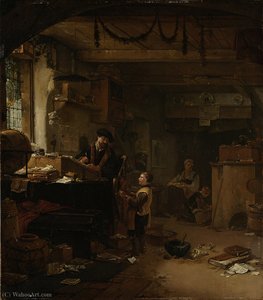
The Alchemist is a detailed 17th-century genre painting that captures a cluttered workshop filled with a sense of intense scholarly focus. The composition is densely packed, utilizing a deep, shadowed interior that directs the viewer's eye toward a light source entering from a window on the left. The color palette is dominated by earthy tones, such as ochres and browns, which are sharply interrupted by the vibrant, saturated red of…

4
The Tinker (1654) autorstwa Thomas Wyck

The Tinker

1654 · Oil On Canvas · Statens Museum for Kunst, Kopenhaga

The Tinker is a genre painting by the Dutch artist Thomas Wijck. Created about 1654, the work depicts a man engaged in his manual trade within a workshop setting. The subject matter focuses on the specific activities of a laborer, providing a view into the daily existence of a traveling repairman. This depiction of a craftsman at work places the figure within the tradition of seventeenth-century Dutch genre scenes.

5
Almsgiving (1660) autorstwa Thomas Wyck

Almsgiving

1660 · Oil On Canvas · Philadelphia Museum of Art, Filadelfia

Almsgiving is a somber and atmospheric genre painting from 1660 that depicts a scene of charity within an old European setting. The composition is framed by a large, dark architectural archway in the foreground, which creates a sense of depth and directs the viewer's eye toward the central group of figures. The subject matter focuses on the interaction between people in a moment of social welfare, evoking themes of piety,…

6
Capriccio of a Fort by the Sea, with Orientals and an Antique Statue (1673) autorstwa Thomas Wyck

Capriccio of a Fort by the Sea, with Orientals and an Antique Statue

1673 · Oil On Canvas · National Trust, Thames

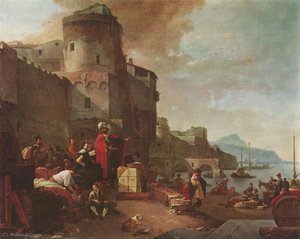
To gaze upon this magnificent Capriccio of a Fort by the Sea is to step directly into a sun-drenched moment plucked from the heart of the Dutch Golden Age. Thomas Wyck’s masterful oil painting, dated 1673, transports us to a vibrant, almost theatrical harbor scene where the solidity of classical architecture meets the ephemeral energy of human endeavor. It is more than just a depiction of a port; it is…

7
Woman at Her Sewing Table (1655) autorstwa Thomas Wyck

Woman at Her Sewing Table

1655 · Oil On Canvas · Städel Museum, Frankfurt nad Menem

In this intimate scene from 1655, we find ourselves drawn into a private, domestic moment. A woman sits at her sewing table, her attention entirely consumed by the needlework in her hands. The composition is tightly framed, pulling the viewer into the stillness of her world. Light enters from an unseen source to the left, washing over the bright white of her linen collar and the fabric she works upon,…

8
View of the Bay of Naples with Orientals and an Antique Statue (1673) autorstwa Thomas Wyck

View of the Bay of Naples with Orientals and an Antique Statue

1673 · Oil On Canvas · National Trust, Thames

Gaze upon this exquisite vision of the Bay of Naples, a scene that transports the viewer directly to an era of opulent leisure and artistic contemplation. The composition is alive with the gentle murmur of activity—the distant sails catching the sun, the figures gathered along the shore engaging in moments of quiet enjoyment. It is more than just a depiction of a beautiful vista; it is an immersion into a…

9
A rustic interior (1654) autorstwa Thomas Wyck

A rustic interior

1654 · Oil On Panel · Museum Boijmans Van Beuningen, Rotterdam

The air inside this room feels heavy and still, thick with the scent of woodsmoke and old stone. A low, heavy ceiling presses down upon the scene, creating a sense of profound intimacy that wraps around the figures like a shroud. Light enters from a single, unseen source to the left, slicing through the gloom to catch the bright white of a woman's headscarf. This sudden brightness pulls the eye…

10
An Alchemist in His Studio (1600) autorstwa Thomas Wyck

An Alchemist in His Studio

1600 · Oil · Science History Institute, Philadelphia

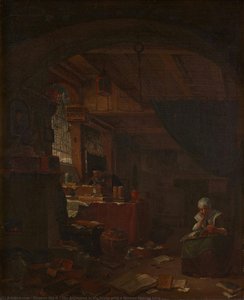
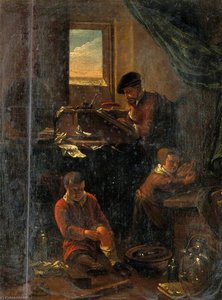
A soft, warm light spills across a cluttered desk, illuminating an old man lost in the silent labor of thought. He sits hunched over a book, his eyes tracing lines of text that perhaps hold the secrets of the universe. The room feels heavy with the scent of old parchment and the stillness of a life dedicated to study. Around him, the tools of his obsession are scattered like fragments…

Słynne obrazy artysty Thomas Wyck, od 11 do 80

11Harbor Scene (1646) autorstwa Thomas WyckHarbor Scene1646 · Bawarskie Państwowe Zbiory Malarstwa 12An Alchemist (1646) autorstwa Thomas WyckAn Alchemist1646 · Bawarskie Państwowe Zbiory Malarstwa 13Italian Landscape with Figures at a Fountain among Antique Ruins (1647) autorstwa Thomas WyckItalian Landscape with Figures at a Fountain among Antique Ruins1647 · Städel Museum 14man reading in his laboratory (1641) autorstwa Thomas Wyckman reading in his laboratory1641 15Southern Sea-Harbour with architecture; tradesmen (1641) autorstwa Thomas WyckSouthern Sea-Harbour with architecture; tradesmen1641 16Morra-Players (1640) autorstwa Thomas WyckMorra-Players1640 · Academy of Fine Arts Vienna 17On the Gulf of Naples (1650) autorstwa Thomas WyckOn the Gulf of Naples1650 · Bawarskie Państwowe Zbiory Malarstwa 18Interior with Two Men and a Woman with a Baby (1656) autorstwa Thomas WyckInterior with Two Men and a Woman with a Baby1656 19Merchants with commodities in a Levante Harbour (1660) autorstwa Thomas WyckMerchants with commodities in a Levante Harbour1660 · Musée Fabre 20Painting (1656) autorstwa Thomas WyckPainting1656 · National Museum of Art, Architecture and Design 21The Gipsy Woman Telling the Soldiers their Fortunes (1660) autorstwa Thomas WyckThe Gipsy Woman Telling the Soldiers their Fortunes1660 · Statens Museum for Kunst 22The Yard of an Italian Tavern (1654) autorstwa Thomas WyckThe Yard of an Italian Tavern1654 · Statens Museum for Kunst 23The Weaver at Work in his Home (1654) autorstwa Thomas WyckThe Weaver at Work in his Home1654 · Statens Museum for Kunst 24A scholar in his Study (1660) autorstwa Thomas WyckA scholar in his Study1660 · Hallwyl Museum 25Alchemist in his laboratory (1650) autorstwa Thomas WyckAlchemist in his laboratory1650 · Staatliches Museum Schwerin 26An alchemist's workshop (1654) autorstwa Thomas WyckAn alchemist's workshop1654 · Gemäldegalerie 27The Alchemist in his Study with a Woman Making Lace (1660) autorstwa Thomas WyckThe Alchemist in his Study with a Woman Making Lace1660 · Science History Institute 28An Alchemist in his Laboratory (1654) autorstwa Thomas WyckAn Alchemist in his Laboratory1654 · Statens Museum for Kunst 29An Alchemist and His Family (1660) autorstwa Thomas WyckAn Alchemist and His Family1660 · Science History Institute 30Landscape with Arch Bridge (1646) autorstwa Thomas WyckLandscape with Arch Bridge1646 · Bawarskie Państwowe Zbiory Malarstwa 31Italian street scene autorstwa Thomas WyckItalian street scene 32Alchemist autorstwa Thomas WyckAlchemistRijksmuseum 33Mountain Monastery (1646) autorstwa Thomas WyckMountain Monastery1646 · Bawarskie Państwowe Zbiory Malarstwa 34Rock Landscape (1646) autorstwa Thomas WyckRock Landscape1646 · Bawarskie Państwowe Zbiory Malarstwa 35At the Seaport (1646) autorstwa Thomas WyckAt the Seaport1646 · Bawarskie Państwowe Zbiory Malarstwa 36Vegetable Market (1646) autorstwa Thomas WyckVegetable Market1646 · Bawarskie Państwowe Zbiory Malarstwa 37Italian Harbor with Fortifications and Staffage (1641) autorstwa Thomas WyckItalian Harbor with Fortifications and Staffage1641 38Italian Coastal Landscape (1640) autorstwa Thomas WyckItalian Coastal Landscape1640 39Interior of a Cave (1640) autorstwa Thomas WyckInterior of a Cave1640 40Apple Seller at a City Gate (1654) autorstwa Thomas WyckApple Seller at a City Gate1654 · National Museum in Wrocław 41A washerwoman and children by a river before a walled bridge (1654) autorstwa Thomas WyckA washerwoman and children by a river before a walled bridge1654 · Wallraf-Richartz-Museum 42Figures in the Courtyard of a House (1660) autorstwa Thomas WyckFigures in the Courtyard of a House1660 · Fairfax House 43An Alchemist at Work, with a Mother by a Cradle Beyond (1650) autorstwa Thomas WyckAn Alchemist at Work, with a Mother by a Cradle Beyond1650 · Science History Institute 44View of port of Ripa Grande. (1670) autorstwa Thomas WyckView of port of Ripa Grande.1670 · Musée Fabre 45A View of the Forum (1674) autorstwa Thomas WyckA View of the Forum1674 · National Trust 46An Alchemist in His Laboratory (1673) autorstwa Thomas WyckAn Alchemist in His Laboratory1673 · National Trust 47Capriccio of a Seaport with Orientals, Ruins, and an Antique Statue (1673) autorstwa Thomas WyckCapriccio of a Seaport with Orientals, Ruins, and an Antique Statue1673 · National Trust 48An Alchemist in His Laboratory, with an Assistant (1673) autorstwa Thomas WyckAn Alchemist in His Laboratory, with an Assistant1673 · National Trust 49Italian Courtyard (1677) autorstwa Thomas WyckItalian Courtyard1677 · Galeria Dulwich 50Landscape with Bay (1646) autorstwa Thomas WyckLandscape with Bay1646 · Bawarskie Państwowe Zbiory Malarstwa 51Old Building autorstwa Thomas WyckOld BuildingKunsthistorisches Museum 52Interior of a Weaver's Cottage autorstwa Thomas WyckInterior of a Weaver's CottageNational Gallery of Ireland 53landscape with fountain and fig. autorstwa Thomas Wycklandscape with fountain and fig. 54horsemen resting before an inn autorstwa Thomas Wyckhorsemen resting before an inn 55Figures outside a tavern with a woman sewing, travellers on a bridge beyond autorstwa Thomas WyckFigures outside a tavern with a woman sewing, travellers on a bridge beyond 56Whitehall and St James's Park, London autorstwa Thomas WyckWhitehall and St James's Park, London 57Capriccio of a Roman Ruins with Orientals, a Fountain and an Antique Statue autorstwa Thomas WyckCapriccio of a Roman Ruins with Orientals, a Fountain and an Antique StatueNational Trust 58An Alchemist autorstwa Thomas WyckAn AlchemistErmitaż 59Dancing couple + many people at ruins autorstwa Thomas WyckDancing couple + many people at ruins 60A church interior autorstwa Thomas WyckA church interior 61Washerwomen at the Foot of the Torre delle Milizie, Rome autorstwa Thomas WyckWasherwomen at the Foot of the Torre delle Milizie, Rome 62Italian port autorstwa Thomas WyckItalian port 63Levantijnse haven autorstwa Thomas WyckLevantijnse havenRijksmuseum 64Southern Landscape autorstwa Thomas WyckSouthern Landscape 65Washerwomen in a yard. autorstwa Thomas WyckWasherwomen in a yard.Muzeum Narodowe w Warszawie 66The Alchemist autorstwa Thomas WyckThe AlchemistFitzwilliam College 67Riders by Italianate ruins with a seaport beyond autorstwa Thomas WyckRiders by Italianate ruins with a seaport beyond 68Italian Street Scene autorstwa Thomas WyckItalian Street SceneAshmolean Museum of Art and Archaeology 69Spinning farmer autorstwa Thomas WyckSpinning farmerRijksmuseum 70View of the Thames at Westminster on Lord Mayor's Day autorstwa Thomas WyckView of the Thames at Westminster on Lord Mayor's Day 71The Poor Being Fed at a Monastery autorstwa Thomas WyckThe Poor Being Fed at a Monastery 72The Wreckers, Stormy Coast Scene with Tower autorstwa Thomas WyckThe Wreckers, Stormy Coast Scene with Tower 73A Philosopher in His Study, with Two Children autorstwa Thomas WyckA Philosopher in His Study, with Two Children 74Interior with an Alchemist autorstwa Thomas WyckInterior with an Alchemist 75Interior with an Alchemist Making a Gesture of Surprise, and a Female Assistant autorstwa Thomas WyckInterior with an Alchemist Making a Gesture of Surprise, and a Female Assistant 76Interior with an Alchemist Examining a Bowl Brought by a Boy autorstwa Thomas WyckInterior with an Alchemist Examining a Bowl Brought by a Boy 77Interior with an Alchemist Studying a Book, His Assistant Pouring Liquid into a Bowl autorstwa Thomas WyckInterior with an Alchemist Studying a Book, His Assistant Pouring Liquid into a Bowl 78Interior with an Alchemist Seated at a Table, Looking out of the Picture autorstwa Thomas WyckInterior with an Alchemist Seated at a Table, Looking out of the Picture 79Interior with an Alchemist Seated at a Table, Looking out of the Picture autorstwa Thomas WyckInterior with an Alchemist Seated at a Table, Looking out of the Picture 80Kitchen interior autorstwa Thomas WyckKitchen interiorFinnish National Gallery

Słynne obrazy Thomas Wyck epoka po epoce

Tematy, które przyciągnęły wzrok Thomas Wyck

Cztery motywy najczęściej powracające w tych oryginałach, z których każdy doczekał się swojego najdoskonalszego przykładu.

Muzea przechowujące oryginały Thomas Wyck

8 muzeów, w których znajduje się najwięcej obrazów z tej strony.

Muzea Miasto Dzieła artysty Thomas Wyck Obrazy z tej listy
Bawarskie Państwowe Zbiory Malarstwa, MonachiumBawarskie Państwowe Zbiory Malarstwa Monachium 9 Harbor Scene, An Alchemist, On the Gulf of Naples
National Trust, ThamesNational Trust Thames 7 Capriccio of a Fort by the Sea, with Orientals and an Antique Statue, View of the Bay of Naples with Orientals and an Antique Statue, A View of the Forum
Statens Museum for Kunst, KopenhagaStatens Museum for Kunst Kopenhaga 6 Interior of a Dutch Farm Cottage, The Tinker, The Gipsy Woman Telling the Soldiers their Fortunes
Science History Institute, PhiladelphiaScience History Institute Philadelphia 4 An Alchemist in His Studio, The Alchemist in his Study with a Woman Making Lace, An Alchemist and His Family
Rijksmuseum, AmsterdamRijksmuseum Amsterdam 3 Alchemist, Levantijnse haven, Spinning farmer
Städel Museum, Frankfurt nad MenemStädel Museum Frankfurt nad Menem 2 Woman at Her Sewing Table, Italian Landscape with Figures at a Fountain among Antique Ruins
Musée Fabre, MontpellierMusée Fabre Montpellier 2 Merchants with commodities in a Levante Harbour, View of port of Ripa Grande.
Nationalmuseum, StockholmNationalmuseum Stockholm 1 St Anthony, Archbishop of Florence

Thomas Wyck na przestrzeni dekad: jeden unikatowy oryginał dla każdego

Dzieła według dekad

Wybierz dekadę, aby zobaczyć dzieło, które ją definiuje.

Obrazy artysty Thomas Wyck: pytania do galerii

Jakie jest najsłynniejsze dzieło artysty Thomas Wyck?Odkryj odpowiedź

St Anthony, Archbishop of Florence (1654), Nationalmuseum, Stockholm. Następne są Interior of a Dutch Farm Cottage (1654) oraz The Alchemist (1650).

W jakim wieku Thomas Wyck stworzył/a St Anthony, Archbishop of Florence?Odkryj odpowiedź

38 lat: St Anthony, Archbishop of Florence pochodzi z 1654, a Thomas Wyck urodził(a) się w 1616.

Które dziesięć obrazów Thomas Wyck jest najbardziej znanych?Odkryj odpowiedź

St Anthony, Archbishop of Florence, Interior of a Dutch Farm Cottage, The Alchemist, The Tinker, Almsgiving, Capriccio of a Fort by the Sea, with Orientals and an Antique Statue, Woman at Her Sewing Table, View of the Bay of Naples with Orientals and an Antique Statue, A rustic interior i An Alchemist in His Studio. Powyższy ranking zawiera rok powstania oraz muzeum dla każdego z nich.

Ile znanych dzieł stworzył Thomas Wyck?Odkryj odpowiedź

Nasz katalog zawiera 89 dzieł artysty Thomas Wyck, datowanych od 1640 do 1677.

Gdzie można zobaczyć najsłynniejsze oryginały Thomas Wyck?Odkryj odpowiedź

W większości znajdują się w Bawarskie Państwowe Zbiory Malarstwa (Monachium), National Trust (Thames) i Statens Museum for Kunst (Kopenhaga). Powyższa tabela muzeów zawiera ich pełną listę.

W jakim okresie Thomas Wyck stworzył/a swoje najsłynniejsze obrazy?Odkryj odpowiedź

W 1650s: 17 z 80 dzieł na tej stronie powstało w tym czasie, w tym St Anthony, Archbishop of Florence.

Który z najsłynniejszych obrazów artysty Thomas Wyck powstał najwcześniej, a który najpóźniej?Odkryj odpowiedź

Na tej stronie najwcześniejszy to Morra-Players (1640), a najpóźniejszy Italian Courtyard (1677).

Jakie tematy preferował Thomas Wyck?Odkryj odpowiedź

Man (14), Woman (12) i People (12), w ramach 80 dzieł na tej stronie.

Jakich materiałów Thomas Wyck używał najczęściej?Odkryj odpowiedź

Oil, dla 23 z 80 dzieł na tej stronie.

Do jakiego nurtu należy twórczość Thomas Wyck?Odkryj odpowiedź

Dutch golden age i Baroque, sądząc po oryginałach na tej stronie.

Jakie oryginały Thomas Wyck można zobaczyć w Bawarskie Państwowe Zbiory Malarstwa?Odkryj odpowiedź

Harbor Scene, An Alchemist i On the Gulf of Naples: Bawarskie Państwowe Zbiory Malarstwa, Monachium posiada 9 dzieł widocznych na tej stronie.

Thomas Wyck: portret artysty

Życie i dziedzictwo Tomasa Wijcka

Urodzony w rodzie twórców, Tomas Wijck wyłonił się jako wybitna postać w tętniącym życiem krajobrazie malarstwa Złotego Wieku Holandii. Jego artystyczna podróż rozpoczęła się pod czujnym okiem ojca, od którego odebrał podstawowe wykształcenie – początek ten głęboko zakorzenił go w tradycjach rzemiosła. Ta wczesna imersja w technicznych niuansach malarstwa olejnego przygotowała go do życia pełnego eksploracji i stylistycznej ewolucji. Jako malarz zarówno widoków portowych, jak i scen rodzajowych, Wyck posiadał unikalną zdolność chwytania tętniącej energii handlu morskiego oraz intymnych, często tajemniczych momentów codziennego życia.

Trajektoria jego kariery została w sposób głęboki ukształtowana przez podróże przez Morze Śródziemne. Choć historyczne zapisy dotyczące jego dokładnych przemieszczania się są przedmiotem naukowych debat, dowody sugerują, że około 1640 roku w Rzymie działał malarz znany jako Tommaso fiammingo, postać, którą wielu uważa za samego Wycka. Ten okres włoskich wpływów jest wyczuwalny w jego pracach; jego płótna często oddychają światłem i atmosferą rzymskich krajobrazów oraz nadmorskim pięknem Neapolu. W okolicach Neapolu z niezwykłą starannością tworzył szkice, które później rozkwitały w szczegółowe rysunki widoków wybrzeża, demonstrując bystre oko do punktów styku naturalnej wielkości i ludzkiej obecności.

Mistrzostwo gatunku i scen morskich

Artystyczny repertuar Wycka był niezwykle różnorodny, rozciągając się od teatralności krajobrazów italianizujących po głęboki symbolizm odnaleziony w malarstwie rodzajowym. Doskonale radził sobie w tworzeniu capriccios – wyobrażonych, często architektonicznych fantazji – takich jak jego przedstawienia fortów nad morzem, gdzie antyczność spotyka się z żywym ruchem współczesnego życia morskiego. Jego zdolność do wypełniania tych scen licznymi postaciami pozwalała mu na wplatanie złożonych narracji o handlu, rozrywce i historycznej czci w jedną, spójną kompozycję.

Poza rozległymi panoramami portów i zatok, Wyck zagłębiał się w bardziej mroczne, introspektywne zakamarki ludzkiego doświadczenia. Jego dzieło Alchemik stanowi zapierający dech w piersiach przykład jego umiejętności w oddawaniu napięcia intelektualnego. W tym utworze artysta wykorzystuje scenerię odizolowanego laboratorium, aby zbadać zatarte granice między rodzącą się nauką a starożytnym mistycyzmem. Poprzez staranny układ przedmiotów, takich jak zegary, książki i manuskrypty, zaprasza widza do kontemplacji tematów czasu, wytrwałości i nieustannego dążenia do ukrytej wiedzy.
Prestiż zawodowy i trwały wpływ

Po powrocie do północnych Holandii w 1642 roku, Wyck ugruntował swoją pozycję jako filar społeczności artystycznej. Jego status zawodowy został umocniony poprzez członkostwo w Haarlemskim cechu św. Łucjana, instytucji, w której ostatecznie piastował zaszczytne stanowisko dziekana w 1660 roku. Ten okres w jego życiu wyznaczył szczyt lokalnego wpływu i uznania, czyniąc go centralną postacią na holenderskiej scenie artystycznej.

Zasięg oddziaływania Wycka wykraczał daleko poza granice Holandii. Podczas ery angielskiej Restauracji podróżował do Anglii, gdzie jego talenty cieszyły się ogromnym uznaniem. Jego dziedzictwo zostało rozwinięte dzięki roli nauczyciela; jego syn i uczeń, Jan Wyck, stał się znaczącą postacią w rozwoju angielskiego malarstwa sportowego, podczas gdy jego uczeń Jan van der Vaart również przeniósł te tradycje na nowe ziemie. Dzięki swoim potomkom i uczniom, techniczna biegłość i atmosferyczna wrażliwość Tomasa Wijcka rezonowały przez stulecia, pozostawiając niezatarty ślad w historii malarstwa europejskiego.