Portret Simon De Vos

46 najsłynniejszych obrazów artysty Simon De Vos, każdy niepowtarzalny

Aktualizacja: Listopad 2026 · ranking według naszego wskaźnika popularności (liczba wyszukiwań, wizyt i zamówień dla każdego dzieła) · 49 dzieł Simon De Vos w naszym katalogu

W skrócie

Repentant Mary Magdalene (1630) to obraz autorstwa Simon De Vos, który przyciąga najwięcej spojrzeń; oryginał znajduje się w Ermitaż, Sankt Petersburg. Następnie wzrok kieruje się na The Magnanimity of Scipio Africanus (1641) i Marry Society (1631). Spośród 49 dzieł Simon De Vos w naszym katalogu, tych 46 jest najbardziej znanych – każde z nich to unikatowy oryginał, przedstawiony wraz z rokiem powstania, muzeum oraz powodem, dla którego przetrwało próbę czasu.

1603 – 1676, Antwerpia Flemish baroque Najwięcej dzieł: Ermitaż

10 najlepszych obrazów autorstwa Simon De Vos według oka galerii

1
Repentant Mary Magdalene (1630) autorstwa Simon De Vos

Repentant Mary Magdalene

1630 · Oil · Ermitaż, Sankt Petersburg

A heavy silence fills the cavernous space where a solitary woman sits in deep contemplation. The shadows of a dark grotto press in from the edges, isolating her in a moment of profound melancholy. She is draped in a deep, saturated red skirt that catches the light, creating a sharp contrast against the murky browns and blacks of her surroundings. Her chin rests heavily upon her hand, and her eyes…

2
The Magnanimity of Scipio Africanus (1641) autorstwa Simon De Vos

The Magnanimity of Scipio Africanus

1641 · Oil On Copper · Ermitaż, Sankt Petersburg

A single, white-clad figure kneels upon the stone, her hands a silent plea against the weight of fate. Above her, the air is thick with the tension of a decision made in the shadow of classical ruins. Scipio Africanus sits with a quiet, heavy authority, his presence anchoring the chaotic movement of the scene. The light falls sharply, catching the glint of metal armor and the soft folds of silk,…

3
Marry Society (1631) autorstwa Simon De Vos

Marry Society

1631 · Oil On Copper · Ermitaż, Sankt Petersburg

A single, bright white tablecloth anchors the scene, a pale island amidst a sea of deep browns and heavy shadows. Around this center, figures gather in a dimly lit, opulent room, their movements caught in a moment of social grace. The air feels thick with the scent of roasted poultry and the weight of velvet drapery. Light spills from an unseen source, catching the sheen of silk and the delicate…

4
St Peter (1630) autorstwa Simon De Vos

St Peter

1630 · Oil On Copper · Ermitaż, Sankt Petersburg

In this somber religious work, the figure of Saint Peter emerges from the shadows of a heavy, contemplative moment. Simon De Vos captures the apostle in a state of profound reflection, a scene that breathes with the weight of spiritual reckoning. The painting, titled St Peter, presents a quiet intensity that pulls the viewer into the immediate presence of the man and his internal struggle.

5
The Works of Mercy (1635) autorstwa Simon De Vos

The Works of Mercy

1635 · Oil On Canvas

Shadows cling to the heavy, decaying stone of a monumental triumphal arch, creating a dark stage for the human drama unfolding beneath it. In this Baroque scene, the air feels thick with the weight of duty and the quiet dignity of service. Light pierces through the gloom, catching the folds of white and red fabrics as figures move through the ruins. There is a profound sense of motion here; the…

6
Portrait of a man with a floppy hat (1625) autorstwa Simon De Vos

Portrait of a man with a floppy hat

1625 · Oil

In "Portrait of a man with a floppy hat" by Simon De Vos, a quiet presence emerges from a monochromatic, sepia-toned world. The composition follows a bust-length arrangement, positioning the subject slightly off-center to create a sense of natural poise. He meets the viewer with a calm, direct gaze that establishes an immediate, eye-level connection. This perspective pulls the observer into an intimate space, as if sharing a silent moment…

7
A Party outside an Inn (1625) autorstwa Simon De Vos

A Party outside an Inn

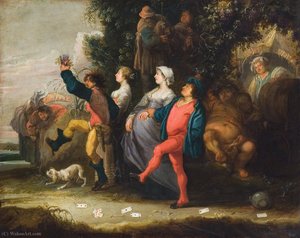
A Party outside an Inn is a work by the Flemish painter Simon De Vos. Created about 1625, the painting belongs to the artist's early period of production, characterized by small-format genre scenes. De Vos was born in 1603 in Antwerp, the son of Herman de Vos, a craftsman of dice, and Elisabeth van Oppen.

10
interior, (family - scene) (1628) autorstwa Simon De Vos

interior, (family - scene)

1628 · Oil

In the quietude of 1628, Simon De Vos rendered interior, (family - scene), a work that captures a private moment within a rustic, dimly lit room. The scene unfolds around a central group of figures, anchored by a man in period attire. He wears a wide-brimmed hat and a stiff ruff collar, his gaze directed toward a woman seated to the right. She cradles an infant in her arms, a…

Słynne obrazy artysty Simon De Vos, od 11 do 46

11Cupid's chastisement (1626) autorstwa Simon De VosCupid's chastisement1626 · Gemäldegalerie 12Golgotha (1639) autorstwa Simon De VosGolgotha1639 · Bawarskie Państwowe Zbiory Malarstwa 13The Adoration of the Shepherds (1644) autorstwa Simon De VosThe Adoration of the Shepherds1644 14Good Fortune or Fortune Telling (1646) autorstwa Simon De VosGood Fortune or Fortune Telling1646 · Narodowe Muzeum Sztuki Dawnej 15Marauding soldiers with harlots (1639) autorstwa Simon De VosMarauding soldiers with harlots1639 · Bawarskie Państwowe Zbiory Malarstwa 16Rest on the Flight into Egypt (1639) autorstwa Simon De VosRest on the Flight into Egypt1639 · Bawarskie Państwowe Zbiory Malarstwa 17The seven works of mercy (1641) autorstwa Simon De VosThe seven works of mercy1641 · Bawarskie Państwowe Zbiory Malarstwa 18Death of Decius Mus (1641) autorstwa Simon De VosDeath of Decius Mus1641 · Ermitaż 19Feat of Marcus Curtius (1641) autorstwa Simon De VosFeat of Marcus Curtius1641 · Ermitaż 20Meeting of Esau and Jacob (1641) autorstwa Simon De VosMeeting of Esau and Jacob1641 · Ermitaż 21Abigail Bringing Gift to David (1641) autorstwa Simon De VosAbigail Bringing Gift to David1641 · Ermitaż 22The Fortune Teller (1639) autorstwa Simon De VosThe Fortune Teller1639 · Królewskie Muzeum Sztuk Pięknych Antwerpia 23The Beheading of Saint Paul (1648) autorstwa Simon De VosThe Beheading of Saint Paul1648 · Królewskie Muzeum Sztuk Pięknych Antwerpia 24The massacre of the innocents (1647) autorstwa Simon De VosThe massacre of the innocents1647 25A garland of flowers surrounding a medallion of the Virgin in prayer (1643) autorstwa Simon De VosA garland of flowers surrounding a medallion of the Virgin in prayer1643 26The worship of Venus (1647) autorstwa Simon De VosThe worship of Venus1647 · Staatliche Kunsthalle Karlsruhe 27Carrying of the Cross (1649) autorstwa Simon De VosCarrying of the Cross1649 · Museum Catharijneconvent 28Funny company (1650) autorstwa Simon De VosFunny company1650 · Gemäldegalerie 29Merry Company (1631) autorstwa Simon De VosMerry Company1631 · Ermitaż 30Allegorical Scene (detail) (1635) autorstwa Simon De VosAllegorical Scene (detail)1635 · Národní galerie Praha 31Allegorical Scene (1635) autorstwa Simon De VosAllegorical Scene1635 · Národní galerie Praha 32Allegory of the Five Senses (1640) autorstwa Simon De VosAllegory of the Five Senses1640 33The Israelites after Crossing the Red Sea (1641) autorstwa Simon De VosThe Israelites after Crossing the Red Sea1641 · Ermitaż 34Resurrection of Christ and the van der Aa family autorstwa Simon De VosResurrection of Christ and the van der Aa familyPalais des Beaux-Arts de Lille 35Wedding at Cana autorstwa Simon De VosWedding at CanaMuzeum Narodowe w Warszawie 36The Adoration of the Magi autorstwa Simon De VosThe Adoration of the MagiMuzeum Narodowe w Warszawie 37The Acts of Mercy autorstwa Simon De VosThe Acts of MercyMuzeum Narodowe w Warszawie 38Donor and His Wife autorstwa Simon De VosDonor and His WifeKrólewskie Muzeum Sztuk Pięknych Antwerpia 39Merrymakers in an Inn autorstwa Simon De VosMerrymakers in an Inn 40A Garland of Flowers Surrounding a Mocking of Christ autorstwa Simon De VosA Garland of Flowers Surrounding a Mocking of Christ 41The arrest of Jesus in the Garden of Olives to the Palais des Beaux-Arts de Lille. autorstwa Simon De VosThe arrest of Jesus in the Garden of Olives to the Palais des Beaux-Arts de Lille.Palais des Beaux-Arts de Lille 42Christ on the Cross autorstwa Simon De VosChrist on the Cross 43The Martyrdom of St. Philip the Palais des Beaux-Arts de Lille. autorstwa Simon De VosThe Martyrdom of St. Philip the Palais des Beaux-Arts de Lille.Palais des Beaux-Arts de Lille 44Return of the Prodigal Son. autorstwa Simon De VosReturn of the Prodigal Son. 45The Raising of Lazarus autorstwa Simon De VosThe Raising of LazarusNational Gallery 46Village procession. autorstwa Simon De VosVillage procession.Muzeum Narodowe we Wrocławiu

Słynne obrazy Simon De Vos epoka po epoce

Tematy, które przyciągnęły wzrok Simon De Vos

Cztery motywy najczęściej powracające w tych oryginałach, z których każdy doczekał się swojego najdoskonalszego przykładu.

Muzea przechowujące oryginały Simon De Vos

8 muzeów, w których znajduje się najwięcej obrazów z tej strony.

Muzea Miasto Dzieła artysty Simon De Vos Obrazy z tej listy
Ermitaż, Sankt PetersburgErmitaż Sankt Petersburg 10 Repentant Mary Magdalene, The Magnanimity of Scipio Africanus, Marry Society
Bawarskie Państwowe Zbiory Malarstwa, MonachiumBawarskie Państwowe Zbiory Malarstwa Monachium 4 Golgotha, Marauding soldiers with harlots, Rest on the Flight into Egypt
Królewskie Muzeum Sztuk Pięknych Antwerpia, AntwerpiaKrólewskie Muzeum Sztuk Pięknych Antwerpia Antwerpia 3 The Fortune Teller, The Beheading of Saint Paul, Donor and His Wife
Palais des Beaux-Arts de Lille, LillePalais des Beaux-Arts de Lille Lille 3 Resurrection of Christ and the van der Aa family, The arrest of Jesus in the Garden of Olives to the Palais des Beaux-Arts de Lille., The Martyrdom of St. Philip the Palais des Beaux-Arts de Lille.
Muzeum Narodowe w Warszawie, WarszawaMuzeum Narodowe w Warszawie Warszawa 3 Wedding at Cana, The Adoration of the Magi, The Acts of Mercy
Gemäldegalerie, BerlinGemäldegalerie Berlin 2 Cupid's chastisement, Funny company
Národní galerie Praha, PragaNárodní galerie Praha Praga 2 Allegorical Scene (detail), Allegorical Scene
National Museum of Art, Architecture and Design, OsloNational Museum of Art, Architecture and Design Oslo 1 A Party outside an Inn

Simon De Vos na przestrzeni dekad: jeden unikatowy oryginał dla każdego

Dzieła według dekad

Wybierz dekadę, aby zobaczyć dzieło, które ją definiuje.

Obrazy artysty Simon De Vos: pytania do galerii

Jakie jest najsłynniejsze dzieło artysty Simon De Vos?Odkryj odpowiedź

Repentant Mary Magdalene (1630), Ermitaż, Sankt Petersburg. Następne są The Magnanimity of Scipio Africanus (1641) oraz Marry Society (1631).

W jakim wieku Simon De Vos stworzył/a Repentant Mary Magdalene?Odkryj odpowiedź

27 lat: Repentant Mary Magdalene pochodzi z 1630, a Simon De Vos urodził(a) się w 1603.

Które dziesięć obrazów Simon De Vos jest najbardziej znanych?Odkryj odpowiedź

Repentant Mary Magdalene, The Magnanimity of Scipio Africanus, Marry Society, St Peter, The Works of Mercy, Portrait of a man with a floppy hat, A Party outside an Inn, Gathering of Smokers and Drinkers, The penitent Saint Mary Magdalene i interior, (family - scene). Powyższy ranking zawiera rok powstania oraz muzeum dla każdego z nich.

Ile znanych dzieł stworzył Simon De Vos?Odkryj odpowiedź

Nasz katalog zawiera 49 dzieł artysty Simon De Vos, datowanych od 1625 do 1650.

Gdzie można zobaczyć najsłynniejsze oryginały Simon De Vos?Odkryj odpowiedź

W większości znajdują się w Ermitaż (Sankt Petersburg), Bawarskie Państwowe Zbiory Malarstwa (Monachium) i Królewskie Muzeum Sztuk Pięknych Antwerpia (Antwerpia). Powyższa tabela muzeów zawiera ich pełną listę.

W jakim okresie Simon De Vos stworzył/a swoje najsłynniejsze obrazy?Odkryj odpowiedź

W 1640s: 15 z 46 dzieł na tej stronie powstało w tym czasie, w tym The Magnanimity of Scipio Africanus.

Który z najsłynniejszych obrazów artysty Simon De Vos powstał najwcześniej, a który najpóźniej?Odkryj odpowiedź

Na tej stronie najwcześniejszy to Portrait of a man with a floppy hat (1625), a najpóźniejszy Funny company (1650).

Jakie tematy preferował Simon De Vos?Odkryj odpowiedź

People (21), Man (18) i Woman (17), w ramach 46 dzieł na tej stronie.

Jakich materiałów Simon De Vos używał najczęściej?Odkryj odpowiedź

Oil, dla 22 z 46 dzieł na tej stronie.

Do jakiego nurtu należy twórczość Simon De Vos?Odkryj odpowiedź

Flemish baroque, sądząc po oryginałach na tej stronie.

Jakie oryginały Simon De Vos można zobaczyć w Ermitaż?Odkryj odpowiedź

Repentant Mary Magdalene, The Magnanimity of Scipio Africanus i Marry Society: Ermitaż, Sankt Petersburg posiada 10 dzieł widocznych na tej stronie.

Simon De Vos: portret artysty

Antwerpski cudowniec: Wczesne lata i artystyczne fundamenty

W samym sercu siedemnastowiecznego Antwerpii, miasta pulsującego twórczą energią baroku flamandzkiego, Simon De Vos rozpoczął podróż, która ostatecznie wyryła jego nazwisko w annałach historii sztuki. Urodzony w 1603 roku w rodzinie Hermana de Vos, rzemieślnika wytwarzającego kości do gry, oraz Elisabeth van Oppen, De Vos od narodzin był zanurzony w środowisku, gdzie skrupulatne umiejętności i namacalna sztuka stanowiły codzienną tkankę życia. Jego prawdziwe przeznaczenie objawiło się jednak w wieku zaledwie dwunastu lat, kiedy trafił do pracowni szanowanego malarza Cornelisa de Vosa. Pod czujnym okiem mistrza młody artysta zaczął chłonąć niuanse portretu oraz dramatyczny potencjał światła, kładąc fundamenty pod techniczną precyzję, która wspierała jego późniejsze, bardziej rozległe eksploracje ludzkiej kondycji.

Ta wczesna nauka była czymś więcej niż tylko instruktażem; była inicjacją w linię flamandzkiej doskonałości. Studiując u współczesnego, który ściśle współpracował z gigantami epoki, De Vos odziedziczył głęboki szacunek dla gry między rzeczywistością a teatralnością. Jego formacyjne lata upłynęły na opanowywaniu delikatnych tekstur skóry, ciężkiego połysku aksamitu oraz subtelnych zmian w ekspresji, które odróżniają zwykłe podobieństwo od żywej duszy.

Blask radosnych biesiad

W miarę dojrzewania talentu, De Vos zyskał sławę dzięki swoim urzekającym „obrazom gabinetowym” – dziełom o małym formacie, które chwytały radosną esencję wspólnotowego świętowania. Dzieła te, często określane jako Merry Companies, wykazywały głębokie fascynacje tradycją karawaggionowską. Wykorzystywał on dramatyczne chiaroscuro, pozwalając światłu przebijać się przez cienie, by oświetlić radosny chaos spotkań towarzyskich. W tych scenach odnajdujemy mistrzowską władzę nad kolorem; żywe czerwienie, głębokie błękity i soczyste zielenie tańczą na płótnie, odzwierciedlając śmiech, muzykę i towarzyską serdeczność przedstawionych postaci.

Geniusz jego malarstwa rodzajowego tkwi w zdolności do przekształcenia prostej chwili odpoczynku w głębokie studium ludzkiej więzi. Dzięki jego pędzlowi brzęk kieliszków i łagodne melodie instrumentów muzycznych stają się niemal namacalne. Posiadał on niezwykłą zdolność do uchwycenia:
  • ulotnych niuansów mimiki twarzy podczas chwil radości
  • złożonych tekstur luksusowych tkanin i delikatnej koronki
  • atmosferycznego napięcia tworzonego przez dramatyczne, kierunkowe oświetlenie
Te prace nie były jedynie przedstawieniami uczt, lecz oknami na społeczną witalność epoki flamandzkiej, oddanymi z wrażliwością celebrującą efemeryczne piękno życia.

Od intymności do epiki: Ewolucja mistrza

W miarę postępów w karierze, De Vos przeszedł znaczącą ewolucję stylistyczną, przechodząc od kameralnej skali scen rodzajowych do monumentalnego przepychu malarstwa historycznego. Ta zmiana zaowocowała przyjęciem większych formatów i bardziej teatralnego podejścia, silnie inspirowanego rozbuchanym dynamizmem, jaki prezentował Peter Paul Rubens, oraz wyrafinowaną elegancją Anthony van Dyck. Jego późniejsze dzieła odeszły od zabawnej intymności karczmy i salonu w stronę epickich narracji o znaczeniu religijnym i alegorycznym.

W arcydziełach takich jak The Return of the Prodigal Son oraz The Raising of Lazarus, De Vos wykazał się zdolnością do poruszania złożonych tematów teologicznych z zapierającą dech w piersiach autorytetem. Połączył on dystans między beztroską flamandzkiej sztuki rodzajowej a wysokim dramatem ruchu baroku, nasycając swoje większe płótna głębią psychologiczną, która pozostawała spójna z jego wcześniejszymi pracami. Jego dziedzictwo pozostaje dziedzictwem malarza, który potrafił uchwycić zarówno najmniejsze drgnienie emocji w zatłoczonym pokoju, jak i najgłębsze prawdy duchowe na wielkiej scenie, pozostawiając po sobie dorobek, który nieustannie zachwyca swoim świetlistym pięknem i nieprzemijającą prawdą o człowieku.