


1


Aktualizacja: Listopad 2026 · ranking według naszego wskaźnika popularności (liczba wyszukiwań, wizyt i zamówień dla każdego dzieła) · 35 dzieł Pieter Wouwerman w naszym katalogu
W skrócie
Spośród wszystkich dzieł oryginalnych, które pozostawił Pieter Wouwerman, najsłynniejszym jest Forest with staffage figures (1642), znajdujący się w kolekcji Villa Vauban w Luxembourg. Tuż za nimi znajdują się Dice-Playing Soldiers in Front of an Inn (1652) oraz Officer on Horseback (1660). Nasz katalog zawiera 35 dzieł autorstwa Pieter Wouwerman; galeria zachowała 34 najbardziej podziwianych na świecie prac, z których każda została przedstawiona wraz z datą powstania, informacją o muzeum oraz jej historią.


 View of Paris seen from the Place Dauphine1660 · Statens Museum for Kunst
12
 Frederik Hendrik at the surrender of Maastricht, 22 August 16321650 · Rijksmuseum
13
 Battle with cavalry against infantry1661 · Staatliche Kunsthalle Karlsruhe
14
 Hunting party on horseback with servants and dogs1661 · Staatliche Kunsthalle Karlsruhe
15
 Beach Scene with Fisher Woman1668 · Gemäldegalerie Alte Meister im Schloss Wilhelmshöhe
16
 View of Paris with the tower and porch of Nesle, in the backgroud the Pont Neuf and la Place Dauphine1664
17
 Landscape with a dapple grey horse1667 · Museum Boijmans Van Beuningen
18
 The storming of Coevorden, December 30, 16721672 · Rijksmuseum
19
 Horsemarket in Delft1670 · Het Prinsenhof
20
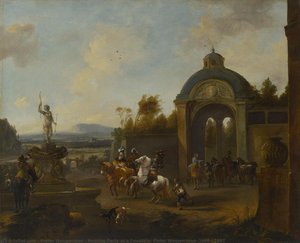 Hunting Party at a Fountain, Pieter Wouwerman, 1660 - 16821682 · Rijksmuseum
21
 Cavalry Skirmish with Foot SoldiersKrólewskie Muzeum Sztuk Pięknych Antwerpia
22
 Landscape with riders
23
 Boy with white horse in landscape
24
 Departure for huntingMuzeum Narodowe w Warszawie
25
 The watering place
26
 Landscape with a genre sceneMuzeum Narodowe w Warszawie
27
 Setting Off On A Falcon Hunt
28
 The stableFitzwilliam Museum
29
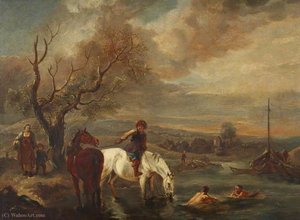 Country Scene with a Man on Horseback and Bathers
30
 Landscape with resting travellers
31
 Cavalry Men by a Suttler's Tent
32
 Dune landscape with figuresCleveland Museum of Art
33
 Encampment beside an Ale HouseFitzwilliam Museum
34
 Polowanie na jelenieErmitaż
Cztery motywy najczęściej powracające w tych oryginałach, z których każdy doczekał się swojego najdoskonalszego przykładu.
8 muzeów, w których znajduje się najwięcej obrazów z tej strony.
| Muzea | Miasto | Dzieła artysty Pieter Wouwerman | Obrazy z tej listy |
|---|---|---|---|
 Staatliche Kunsthalle Karlsruhe |
Karlsruhe | 3 | The Collision, Battle with cavalry against infantry, Hunting party on horseback with servants and dogs |
 Muzeum Narodowe w Warszawie |
Warszawa | 3 | Groom and horses, Departure for hunting, Landscape with a genre scene |
 Rijksmuseum |
Amsterdam | 3 | Frederik Hendrik at the surrender of Maastricht, 22 August 1632, The storming of Coevorden, December 30, 1672, Hunting Party at a Fountain, Pieter Wouwerman, 1660 - 1682 |
 Ermitaż |
Sankt Petersburg | 2 | Horses in the Pasture, Polowanie na jelenie |
 Gemäldegalerie Alte Meister im Schloss Wilhelmshöhe |
Kassel | 2 | Landscape with horsemen at a blacksmith, Beach Scene with Fisher Woman |
 Fitzwilliam Museum |
2 | The stable, Encampment beside an Ale House | |
 Villa Vauban |
Luxembourg | 1 | Forest with staffage figures |
 Bawarskie Państwowe Zbiory Malarstwa |
Monachium | 1 | Dice-Playing Soldiers in Front of an Inn |
Wybierz dekadę, aby zobaczyć dzieło, które ją definiuje.
Forest with staffage figures (1642), Villa Vauban, Luxembourg. Następne są Dice-Playing Soldiers in Front of an Inn (1652) oraz Officer on Horseback (1660).
19 lat: Forest with staffage figures pochodzi z 1642, a Pieter Wouwerman urodził(a) się w 1623.
Forest with staffage figures, Dice-Playing Soldiers in Front of an Inn, Officer on Horseback, The Combat, The Collision, Groom and horses, Army Camp, Horses in the Pasture, Landscape with horsemen at a blacksmith i Sandhills with Figure. Powyższy ranking zawiera rok powstania oraz muzeum dla każdego z nich.
Nasz katalog zawiera 35 dzieł artysty Pieter Wouwerman, datowanych od 1642 do 1682.
W większości znajdują się w Staatliche Kunsthalle Karlsruhe (Karlsruhe), Muzeum Narodowe w Warszawie (Warszawa) i Rijksmuseum (Amsterdam). Powyższa tabela muzeów zawiera ich pełną listę.
W 1660s: 8 z 34 dzieł na tej stronie powstało w tym czasie, w tym Officer on Horseback.
Na tej stronie najwcześniejszy to Forest with staffage figures (1642), a najpóźniejszy Hunting Party at a Fountain, Pieter Wouwerman, 1660 - 1682 (1682).
The Collision, Battle with cavalry against infantry i Hunting party on horseback with servants and dogs: Staatliche Kunsthalle Karlsruhe, Karlsruhe posiada 3 dzieł widocznych na tej stronie.
