Portret Lyonel Feininger

Obrazy: 100 najsłynniejszych dzieł artysty Lyonel Feininger – spojrzenie galerii

Aktualizacja: Październik 2026 · ranking według naszego wskaźnika popularności (liczba wyszukiwań, wizyt i zamówień dla każdego dzieła) · 188 dzieł Lyonel Feininger w naszym katalogu

W skrócie

Według galerii najsłynniejszym obrazem Lyonel Feininger jest The honeymooners. Boats (1917) i Sailing Boats dopełniają trio, które zna każde oko. Z 188 dzieł Lyonel Feininger w naszym katalogu, galeria prezentuje poniżej 100 najsłynniejszych prac – każda z nich jest oryginałem z podaniem roku powstania, muzeum oraz cech wyróżniających ją na tle innych.

1871 – 1956, Nowy Jork Expressionism Najwięcej dzieł: Art Institute of Chicago

10 najlepszych obrazów artysty Lyonel Feininger w galerii

1
The honeymooners autorstwa Lyonel Feininger

The honeymooners

Oil On Canvas

is a work by Lyonel Feininger. Born in New York City in 1871, the artist developed a distinctive visual language that bridged the gap between commercial graphic design and fine art. His career transitioned from successful caricatures for various magazines to a significant role within the Expressionist movement.

2
Boats (1917) autorstwa Lyonel Feininger

Boats

1917 · Oil On Canvas

In the vast landscape of early twentieth-century modernism, few works capture the rhythmic pulse of movement and light as elegantly as Lyonel Feininger’s Boats. Painted in 1917, this masterpiece serves as a breathtaking bridge between the whimsical precision of graphic illustration and the profound structural depth of Cubism. At first glance, the viewer is greeted by a serene maritime scene, yet upon closer inspection, the water and vessels dissolve into…

3
Sailing Boats autorstwa Lyonel Feininger

Sailing Boats

Watercolor

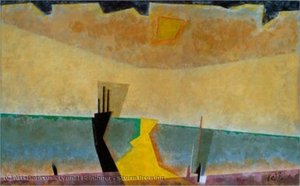
Sailing Boats is a work by the American artist Lyonel Feininger. The composition focuses on the subject of sailing boats at sea, capturing a specific moment of maritime activity or tranquility. The arrangement of the vessels suggests a quietude within the expanse of the water.

4
Blue Coast autorstwa Lyonel Feininger

Blue Coast

Oil On Canvas

The scene unfolds in Blue Coast, a work that captures a quiet moment upon the water. The artist, Lyonel Feininger, directs our gaze toward a serene maritime setting where sailboats drift through a calm expanse. There is a sense of stillness here, as if the wind has paused its movement to allow the vessels to glide toward one another in a silent meeting. The composition centers on these nautical forms,…

5
Gelmeroda XI autorstwa Lyonel Feininger

Gelmeroda XI

Watercolor

In Gelmeroda XI, Lyonel Feininger presents a stylized, geometric representation of a European townscape. The subject matter focuses on the essential architectural elements of the village, specifically the buildings, their roofs, and a central church. A prominent church steeple rises through the composition, acting as a focal point amidst the fragmented forms. The scene is bathed in a soft, diffused light that creates a hazy atmosphere, softening the edges of…

6
Gelmeroda IX autorstwa Lyonel Feininger

Gelmeroda IX

Painting · Museum Folkwang, Essen

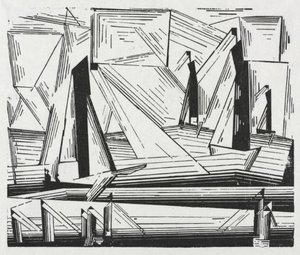
To stand before this evocative scene, captured in the timeless interplay of black and white, is to step across a threshold into a moment suspended between memory and permanence. Gelmeroda IX presents us with a tableau vivant centered around an imposing church structure, its large tower rising like a steadfast sentinel against an unseen sky. The composition is richly populated, not by dramatic action, but by the quiet gathering of…

7
Carnival autorstwa Lyonel Feininger

Carnival

Oil On Canvas

The street comes alive in Carnival, a spirited oil on canvas work by Lyonel Feininger. Created in 1911, this piece captures a moment of public celebration. The scene unfolds with a sense of movement, as if the viewer has just stepped into the middle of a bustling procession. People move through the space, their presence adding a layer of human energy to the urban setting.

Obrazy artysty Lyonel Feininger, uszeregowane od 11 do 100 miejsca

11Carnival in Arcueil (1911) autorstwa Lyonel FeiningerCarnival in Arcueil1911 · Art Institute of Chicago 12Vollersroda III (1916) autorstwa Lyonel FeiningerVollersroda III1916 13Gelmeroda II (1917) autorstwa Lyonel FeiningerGelmeroda II1917 · Neue Galerie 14Church of the Minorites II (1926) autorstwa Lyonel FeiningerChurch of the Minorites II1926 · Walker Art Center 15The Motor Boat autorstwa Lyonel FeiningerThe Motor Boat 16Stranded autorstwa Lyonel FeiningerStranded 17Yachts (1950) autorstwa Lyonel FeiningerYachts1950 · Narodowa Galeria Kanady 18Fishing boats 1 autorstwa Lyonel FeiningerFishing boats 1 19City at Night autorstwa Lyonel FeiningerCity at Night 20Cathedral of Socialism autorstwa Lyonel FeiningerCathedral of Socialism 21Markwippach autorstwa Lyonel FeiningerMarkwippach 22Possendorf III autorstwa Lyonel FeiningerPossendorf III 23Darkened street autorstwa Lyonel FeiningerDarkened street 24Longeuil, Normandie (1909) autorstwa Lyonel FeiningerLongeuil, Normandie1909 · Art Institute of Chicago 25Railroad Embankment with Barracks, Zehlendorf autorstwa Lyonel FeiningerRailroad Embankment with Barracks, Zehlendorf 26Adventure II autorstwa Lyonel FeiningerAdventure II 27Merry Xmas! autorstwa Lyonel FeiningerMerry Xmas! 28Ship with Sun and Moon autorstwa Lyonel FeiningerShip with Sun and Moon 29Dune II autorstwa Lyonel FeiningerDune II 30The Gay Child autorstwa Lyonel FeiningerThe Gay Child 31Postal party lanterns autorstwa Lyonel FeiningerPostal party lanterns 32Leo studies Bach fugues autorstwa Lyonel FeiningerLeo studies Bach fugues 33Railroad Workers autorstwa Lyonel FeiningerRailroad Workers 34Star House autorstwa Lyonel FeiningerStar House 35Winter Night autorstwa Lyonel FeiningerWinter Night 36Characters from ''Wee Willie Winkie'' autorstwa Lyonel FeiningerCharacters from ''Wee Willie Winkie'' 37Inside the city wall autorstwa Lyonel FeiningerInside the city wall 38Old Shell Backs autorstwa Lyonel FeiningerOld Shell Backs 39Arrival of the Boat autorstwa Lyonel FeiningerArrival of the Boat 40The green bridge 1 autorstwa Lyonel FeiningerThe green bridge 1 41Karneval in Gelmeroda II autorstwa Lyonel FeiningerKarneval in Gelmeroda II 42Rainy Day on the Beach autorstwa Lyonel FeiningerRainy Day on the Beach 43Jesuits I autorstwa Lyonel FeiningerJesuits I 44The sleeper - Julia autorstwa Lyonel FeiningerThe sleeper - Julia 45The red violonist autorstwa Lyonel FeiningerThe red violonist 46People on the boardwalk autorstwa Lyonel FeiningerPeople on the boardwalk 47Sketch for the 41 birthday of Walter Gropius 1924 autorstwa Lyonel FeiningerSketch for the 41 birthday of Walter Gropius 1924 48La dama de malva autorstwa Lyonel FeiningerLa dama de malva 49Girl with green stockings autorstwa Lyonel FeiningerGirl with green stockings 50Werder I autorstwa Lyonel FeiningerWerder I 51Gelmeroda, VIII autorstwa Lyonel FeiningerGelmeroda, VIII 52Benz VI (1914) autorstwa Lyonel FeiningerBenz VI1914 53Bridge I (1913) autorstwa Lyonel FeiningerBridge I1913 54Gelmeroda IV (1915) autorstwa Lyonel FeiningerGelmeroda IV1915 · Solomon R. Guggenheim Museum 55Zirchow II (1912) autorstwa Lyonel FeiningerZirchow II1912 56Schlossgasse (1915) autorstwa Lyonel FeiningerSchlossgasse1915 · Crystal Bridges Museum of American Art 57The Village Pond of Gelmeroda (1922) autorstwa Lyonel FeiningerThe Village Pond of Gelmeroda1922 · Städel Museum 58Klarissenkirche, Ribnitz (1927) autorstwa Lyonel FeiningerKlarissenkirche, Ribnitz1927 59Yellow Village Church I (1927) autorstwa Lyonel FeiningerYellow Village Church I1927 60Village (1927) autorstwa Lyonel FeiningerVillage1927 · The Phillips Collection 61Gate Tower II (1925) autorstwa Lyonel FeiningerGate Tower II1925 · Staatliche Kunsthalle Karlsruhe 62Sail Pyramid (1930) autorstwa Lyonel FeiningerSail Pyramid1930 63At the Flea Market (1929) autorstwa Lyonel FeiningerAt the Flea Market1929 64The Bölbergasse (1931) autorstwa Lyonel FeiningerThe Bölbergasse1931 65East Choir of the Dom in Halle (1931) autorstwa Lyonel FeiningerEast Choir of the Dom in Halle1931 66Marktkirche at Evening Hour (1930) autorstwa Lyonel FeiningerMarktkirche at Evening Hour1930 67Barns at Night (1930) autorstwa Lyonel FeiningerBarns at Night1930 · Muzeum Izraela 68Market Church in Halle (1930) autorstwa Lyonel FeiningerMarket Church in Halle1930 · Bawarskie Państwowe Zbiory Malarstwa 69Red Tower II (1930) autorstwa Lyonel FeiningerRed Tower II1930 70Mid-Ocean (1937) autorstwa Lyonel FeiningerMid-Ocean1937 71Spook I (1940) autorstwa Lyonel FeiningerSpook I1940 · The Phillips Collection 72Storm Brewing (1939) autorstwa Lyonel FeiningerStorm Brewing1939 73Courtyard III (1949) autorstwa Lyonel FeiningerCourtyard III1949 74Jesuits III (1915) autorstwa Lyonel FeiningerJesuits III1915 75Town (1910) autorstwa Lyonel FeiningerTown1910 76Nacht autorstwa Lyonel FeiningerNacht 77The Bridge autorstwa Lyonel FeiningerThe Bridge 78Untitled 4 autorstwa Lyonel FeiningerUntitled 4 79The Gate autorstwa Lyonel FeiningerThe Gate 80Varying Mystery Of Grey autorstwa Lyonel FeiningerVarying Mystery Of Grey 81Troistedt autorstwa Lyonel FeiningerTroistedt 82Village with Skier autorstwa Lyonel FeiningerVillage with Skier 83Cathedral autorstwa Lyonel FeiningerCathedral 84House autorstwa Lyonel FeiningerHouse 85Manhattan 1, stone 2 autorstwa Lyonel FeiningerManhattan 1, stone 2 86Expanding Horizon autorstwa Lyonel FeiningerExpanding Horizon 87Braunlage, Harz autorstwa Lyonel FeiningerBraunlage, Harz 88Houses in Old Paris autorstwa Lyonel FeiningerHouses in Old Paris 89Dorf Mellingen autorstwa Lyonel FeiningerDorf Mellingen 90Locomotive on the Bridge autorstwa Lyonel FeiningerLocomotive on the Bridge 91Manhattan 3, stone 2 autorstwa Lyonel FeiningerManhattan 3, stone 2 92Manhattan II autorstwa Lyonel FeiningerManhattan II 93Fishing Boats autorstwa Lyonel FeiningerFishing Boats 94Untitled 5 autorstwa Lyonel FeiningerUntitled 5 95Untitled 6 autorstwa Lyonel FeiningerUntitled 6 96Untitled 3 autorstwa Lyonel FeiningerUntitled 3 97Untitled (Roadstead) autorstwa Lyonel FeiningerUntitled (Roadstead) 98Untitled 2 autorstwa Lyonel FeiningerUntitled 2 99Untitled (Hafen) autorstwa Lyonel FeiningerUntitled (Hafen) 100Skt. Nikolai autorstwa Lyonel FeiningerSkt. Nikolai

Tematy, które przyciągnęły wzrok Lyonel Feininger

Cztery motywy najczęściej powracające w tych oryginałach, z których każdy doczekał się swojego najdoskonalszego przykładu.

Muzea przechowujące oryginały Lyonel Feininger

8 muzeów, w których znajduje się najwięcej obrazów z tej strony.

Muzea Miasto Dzieła artysty Lyonel Feininger Obrazy z tej listy
Art Institute of Chicago, ChicagoArt Institute of Chicago Chicago 3 Carnival in Arcueil, Longeuil, Normandie
The Phillips Collection, WaszyngtonThe Phillips Collection Waszyngton 2 Village, Spook I
Museum Folkwang, EssenMuseum Folkwang Essen 1 Gelmeroda IX
Neue Galerie, Nowy JorkNeue Galerie Nowy Jork 1 Gelmeroda II
Walker Art Center, MinneapolisWalker Art Center Minneapolis 1 Church of the Minorites II
Narodowa Galeria Kanady, OttawaNarodowa Galeria Kanady Ottawa 1 Yachts
Solomon R. Guggenheim Museum, Nowy JorkSolomon R. Guggenheim Museum Nowy Jork 1 Gelmeroda IV
Crystal Bridges Museum of American Art, BentonvilleCrystal Bridges Museum of American Art Bentonville 1 Schlossgasse

Lyonel Feininger, jedno kultowe dzieło na dekadę

Dzieła według dekad

Wybierz dekadę, aby zobaczyć dzieło, które ją definiuje.

Obrazy artysty Lyonel Feininger: odpowiedzi galerii

Który obraz Lyonel Feininger jest najsłynniejszy ze wszystkich?Odkryj odpowiedź

The honeymooners. Następne są Boats (1917) oraz Sailing Boats.

Które to 10 najlepszych obrazów Lyonel Feininger?Odkryj odpowiedź

The honeymooners, Boats, Sailing Boats, Blue Coast, Gelmeroda XI, Gelmeroda IX, Carnival, The Green Bridge, Zeitungsleser (Newspaper Readers II) i On the Bridge (Ober-Weimar). Powyższy ranking zawiera rok powstania oraz muzeum dla każdego z nich.

Ile dzieł stworzył/a Lyonel Feininger?Odkryj odpowiedź

Nasz katalog zawiera 188 dzieł artysty Lyonel Feininger, datowanych od 1909 do 1950.

Gdzie można znaleźć najsłynniejsze oryginały autorstwa Lyonel Feininger?Odkryj odpowiedź

W większości znajdują się w Art Institute of Chicago (Chicago), The Phillips Collection (Waszyngton) i Museum Folkwang (Essen). Powyższa tabela muzeów zawiera ich pełną listę.

Kiedy Lyonel Feininger stworzył swoje najsłynniejsze obrazy?Odkryj odpowiedź

W 1910s: 12 z 100 dzieł na tej stronie powstało w tym czasie, w tym Boats.

Które z najsłynniejszych dzieł Lyonel Feininger należą do jego najwcześniejszych i najpóźniejszych prac?Odkryj odpowiedź

Na tej stronie najwcześniejszy to The Green Bridge (1909), a najpóźniejszy Yachts (1950).

Do jakich tematów Lyonel Feininger powracał najczęściej?Odkryj odpowiedź

Boats (6), Buildings (4) i Geometric forms (4), w ramach 100 dzieł na tej stronie.

W jakiej technice najczęściej tworzył Lyonel Feininger?Odkryj odpowiedź

Oil On Canvas, dla 5 z 100 dzieł na tej stronie.

Z jakim nurtem związany jest Lyonel Feininger?Odkryj odpowiedź

Expressionism i Cubism, sądząc po oryginałach na tej stronie.

Które oryginały artysty Lyonel Feininger znajdują się w zbiorach Art Institute of Chicago?Odkryj odpowiedź

Carnival in Arcueil i Longeuil, Normandie: Art Institute of Chicago, Chicago posiada 2 dzieł widocznych na tej stronie.

Lyonel Feininger: artysta

Early Life and Artistic Roots

Lyonel Charles Adrian Feininger, a name synonymous with the vibrant intersection of Expressionism and modern art, was born in New York City on July 17, 1871. His lineage was deeply rooted in artistic heritage; his father, Karl Wilhelm Friedrich Feininger, was a celebrated German-American violinist and composer, while his mother, Elizabeth Feininger, possessed a remarkable voice as an American singer. This familial legacy of musical and artistic talent profoundly shaped Lyonel’s early development, instilling within him a deep appreciation for creative expression from a remarkably young age.

His childhood was marked by extensive travels throughout Europe, experiences that proved pivotal in shaping his artistic sensibilities. Beginning at the tender age of sixteen, he embarked on a journey to study music in Hamburg and Berlin, immersing himself in the rich cultural landscape of these European capitals. However, it wasn’t solely music that captivated him; a burgeoning interest in visual arts quickly took hold, leading him to pursue drawing studies in both cities. These formative years exposed him to diverse artistic styles and techniques, laying the groundwork for his distinctive approach to painting.

A Career Forged in Commercial Art

Following his European sojourn, Feininger established a successful career as a caricaturist, a profession that would occupy much of his time from 1894 until the mid-1930s. He quickly gained recognition for his witty and engaging comic strips, which appeared in numerous German, French, and American magazines. Titles like “The Kin-der-Kids” and “Wee Willie Winkie’s World” became immensely popular, showcasing his remarkable ability to capture character and humor with a unique graphic style. This period provided him with invaluable experience in visual communication and commercial art, honing his skills in composition, layout, and audience engagement – skills that would later prove essential to his development as a fine artist.

The Transformative Influence of Expressionism and the Bauhaus

A significant turning point in Feininger’s artistic trajectory occurred at the age of thirty-six when he decisively transitioned from commercial art to fine art. This decision coincided with the rise of Expressionism, a movement characterized by its emphasis on emotional expression and subjective experience. He eagerly embraced this burgeoning artistic philosophy, joining influential groups such as Die Brücke, Novembergruppe, and Gruppe 1919, immersing himself in the vibrant creative atmosphere of Berlin’s avant-garde scene.

In 1919, a truly momentous opportunity presented itself: he was appointed as the first faculty member at the Bauhaus, the revolutionary art school founded by Walter Gropius. This appointment marked a profound shift in his career and provided him with access to an unparalleled environment for artistic experimentation. As the master artist in charge of the printmaking workshop, Feininger exerted a considerable influence on numerous students, shaping their artistic perspectives and fostering a spirit of innovation.

A Unique Artistic Style: Cubism, Architecture, and the Sea

Feininger’s artistic style was instantly recognizable, characterized by a distinctive blend of influences. He skillfully incorporated elements of Cubism, utilizing fragmented forms and multiple viewpoints to create dynamic compositions. Simultaneously, he drew inspiration from stained glass aesthetics, employing translucent colors and intricate patterns to evoke a sense of ethereal beauty. Furthermore, his work frequently referenced architecture, particularly the imposing structures of German churches and buildings, reflecting a deep fascination with form and space.

The sea played an equally significant role in his artistic vision. He repeatedly depicted maritime scenes, capturing the power and majesty of the Baltic Sea with remarkable precision and emotional intensity. These recurring motifs—architecture, stained glass, and the sea—became hallmarks of his unique style, distinguishing his work from that of other Expressionist artists.

Major Works and a Lasting Legacy

Throughout his prolific career, Feininger produced a vast body of artwork encompassing watercolors, drawings, prints, and paintings. Notable works include “Werder I,” a captivating watercolor depicting the German landscape; “Gaberndorf II,” a poignant paper drawing capturing a moment of quiet contemplation; and “Boats,” a vibrant cubist painting that exemplifies his innovative approach to form and color. These pieces, along with countless others, demonstrate his remarkable versatility and artistic depth.

Following the rise of Nazism in 1933, Feininger emigrated to the United States, where he continued to paint and create art until his death on January 13, 1956. Despite facing significant challenges during this period, he remained a dedicated artist, producing works that reflected both his personal experiences and his enduring artistic vision. Lyonel Feininger’s legacy extends far beyond his individual creations; he is remembered as a pivotal figure in the development of Expressionism and a key contributor to the Bauhaus movement, whose innovative ideas continue to inspire artists today.