Portret Luis De Morales

50 najsłynniejszych obrazów artysty Luis De Morales, każdy niepowtarzalny

Aktualizacja: Listopad 2026 · ranking według naszego wskaźnika popularności (liczba wyszukiwań, wizyt i zamówień dla każdego dzieła) · 51 dzieł Luis De Morales w naszym katalogu

W skrócie

Virgin and Child with the Infant St John the Baptist (1550) to obraz autorstwa Luis De Morales, który przyciąga najwięcej spojrzeń; oryginał znajduje się w Museo del Prado, Madryt. Następnie wzrok kieruje się na The Crucifixion (1566) i The Annuncation (1565). Spośród 51 dzieł Luis De Morales w naszym katalogu, tych 50 jest najbardziej znanych – każde z nich to unikatowy oryginał, przedstawiony wraz z rokiem powstania, muzeum oraz powodem, dla którego przetrwało próbę czasu.

1509 – 1586, Badajoz Spanish renaissance Najwięcej dzieł: Museo del Prado

10 najlepszych obrazów autorstwa Luis De Morales według oka galerii

1
Virgin and Child with the Infant St John the Baptist (1550) autorstwa Luis De Morales

Virgin and Child with the Infant St John the Baptist

1550 · Oil On Canvas · Museo del Prado, Madryt

In this 1550 portrait, the Virgin Mary holds the infant Jesus in a close, physical embrace. The child is depicted nursing, a detail that grounds the religious scene in a moment of biological necessity and maternal intimacy. To the left and right of the central figures, two winged beings—angels or saints—occupy the periphery of the frame. These figures are positioned against a backdrop of dense trees, which provides a sense…

2
The Crucifixion (1566) autorstwa Luis De Morales

The Crucifixion

1566 · Oil On Panel · Museo del Prado, Madryt

The heavy silence of the scene is held within The Crucifixion, a profound work of religious art created by the Spanish painter Luis de Morales. Dating to 1566, this piece captures a moment of intense spiritual weight. The central focus remains fixed upon the Crucifixion of Jesus Christ, a subject that demands the viewer's immediate and solemn attention.

3
The Annuncation (1565) autorstwa Luis De Morales

The Annuncation

1565 · Oil On Panel · Museo del Prado, Madryt

The Annunciation by Luis de Morales captures a moment of divine stillness. Painted about 1565, the work presents a quiet encounter between the celestial and the earthly. The Archangel Gabriel and the Virgin Mary occupy a shared, intimate space, separated by a single white lily in a slender vase. A white dove descends through soft light, marking the presence of the Holy Spirit above the figures.

4
The Resurrection of Christ (1566) autorstwa Luis De Morales

The Resurrection of Christ

1566 · Oil · Museo del Prado, Madryt

A sudden, vertical force breaks the stillness of the tomb. Christ rises from the heavy stone sarcophagus, his body caught in a moment of divine momentum. The light is not merely a glow; it is a weightless, golden flood that carves the musculature of his torso out of the surrounding shadows. Behind him, a shroud of reddish-pink fabric billows like a sudden flame, tracing the path of his upward movement.…

5
The Birth of the Virgin (1562) autorstwa Luis De Morales

The Birth of the Virgin

1562 · Oil · Museo del Prado, Madryt

The air in the room feels heavy, thick with the quiet gravity of a life beginning. Within this shallow, intimate space, four women gather, their forms tightly grouped as if to shield the profound miracle unfolding before them. A woman reclines in the bed, her presence marked by the soft contours of her face and the weight of the linens surrounding her. Nearby, another figure holds a newborn infant, the…

6
The Virgin and Child with a Spindle (1566) autorstwa Luis De Morales

The Virgin and Child with a Spindle

1566 · Oil · Museo del Prado, Madryt

The composition is a vertical portrait set against a dark, undifferentiated background. In the center, the Virgin Mary holds the Christ Child. She wears a red gown beneath a heavy blue mantle, while a translucent veil rests upon her head. The skin of both figures appears pale and luminous against the deep shadows. The child holds a wooden spindle, its straight, thin lines cutting through the soft folds of the…

7
Saint John the Baptist (1566) autorstwa Luis De Morales

Saint John the Baptist

1566 · Oil On Panel · Museo del Prado, Madryt

The portrait presents a close-up, bust-length view of Saint John the Baptist, positioned slightly off-center. He gazes toward the left with an expression defined by weariness and contemplation. The composition utilizes a chiaroscuro technique, where a strong directional light source illuminates one side of the face, carving out the hollows of the eyes and the texture of the beard against deep, shadowy recesses. This interplay of light and dark creates…

8
Virgin and Child-Morales (1586) autorstwa Luis De Morales

Virgin and Child-Morales

1586 · Oil On Canvas · Machado de Castro National Museum, Koimbra

The Virgin gently cradles her son within a space defined by shadow and soft light. A newborn hand tucks through the folds of a red gown, searching for milk. This small gesture anchors the composition, pulling the viewer into a quiet, domestic moment of care. The faces of mother and child lean toward one another, their gazes interlocking with a tender, silent weight. Behind them, a pitch-dark background swallows the…

9
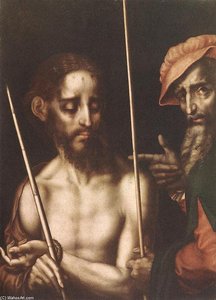
Ecce Homo (1565) autorstwa Luis De Morales

Ecce Homo

1565 · Oil On Canvas · Museo del Prado, Madryt

The shadows press closely against the figure, creating a void that seems to swallow everything but the man himself. In this vertical portrait, the upper torso and head of Jesus Christ emerge from a near-black background, caught in a heavy, dramatic chiaroscuro. A soft light descends from the upper left, catching the smooth, porcelain-like texture of his skin and casting gentle shadows across the musculature of his chest and arms.…

10
Pietà autorstwa Luis De Morales

Pietà

Oil On Panel · Luwr, Paryż

In the quiet, somber depths of Luis de Morales’s Pietà, one encounters more than just a religious scene; one enters a profound meditation on human suffering and divine grace. Executed between 1565 and 1570, this masterpiece serves as a cornerstone of the Spanish Renaissance, capturing the exact moment when the weight of mortality meets the infinite strength of maternal love. The painting depicts the Virgin Mary cradling the lifeless, broken…

Słynne obrazy artysty Luis De Morales, od 11 do 50

11Christ Justifying his Passion (1565) autorstwa Luis De MoralesChrist Justifying his Passion1565 · Museo del Prado 12Christ, Man of Sorrows (1566) autorstwa Luis De MoralesChrist, Man of Sorrows1566 · Museo del Prado 13Pietà (1567) autorstwa Luis De MoralesPietà1567 · Museo del Prado 14Saint Juan de Ribera (1566) autorstwa Luis De MoralesSaint Juan de Ribera1566 · Museo del Prado 15Ecce Homo (1547) autorstwa Luis De MoralesEcce Homo1547 · Staatliche Kunstsammlungen Dresden 16The Adoration of the Shepherds (1567) autorstwa Luis De MoralesThe Adoration of the Shepherds1567 · Museo del Prado 17Man of Sorrows (1560) autorstwa Luis De MoralesMan of Sorrows1560 · Minneapolis Institute of Art 18The Lamentation (1560) autorstwa Luis De MoralesThe Lamentation1560 · Metropolitan Museum of Art 19The Purification of the Virgin or The Presentation in the Temple (1562) autorstwa Luis De MoralesThe Purification of the Virgin or The Presentation in the Temple1562 · Museo del Prado 20Pietà (1560) autorstwa Luis De MoralesPietà1560 · Real Academia de Bellas Artes de San Fernando 21Ecce Homo (1570) autorstwa Luis De MoralesEcce Homo1570 · Museu Nacional d'Art de Catalunya 22The Virgin and Child with the Infant Saint John the Baptist (1570) autorstwa Luis De MoralesThe Virgin and Child with the Infant Saint John the Baptist1570 · Museo del Prado 23The Virgin Dolorosa (1565) autorstwa Luis De MoralesThe Virgin Dolorosa1565 · Museo del Prado 24The Adoration of the Magi (1567) autorstwa Luis De MoralesThe Adoration of the Magi1567 · Museo del Prado 25Christ Carrying the Cross (1547) autorstwa Luis De MoralesChrist Carrying the Cross1547 · Bawarskie Państwowe Zbiory Malarstwa 26Christ Carrying the Cro (1546) autorstwa Luis De MoralesChrist Carrying the Cro1546 · Yale University Art Gallery 27Triptych of the Pietà, St John and St Mary Magdalene (1567) autorstwa Luis De MoralesTriptych of the Pietà, St John and St Mary Magdalene1567 · Museo del Prado 28Holy Family (1557) autorstwa Luis De MoralesHoly Family1557 · Hispanic Society Museum - Library 29Saint Jerome in the Wilderness (1570) autorstwa Luis De MoralesSaint Jerome in the Wilderness1570 · National Gallery of Ireland 30Ecce Homo (1565) autorstwa Luis De MoralesEcce Homo1565 · Fundación Banco Santander 31Christ before Pilate (1570) autorstwa Luis De MoralesChrist before Pilate1570 · Real Academia de Bellas Artes de San Fernando 32Christ Carrying the Cross (1566) autorstwa Luis De MoralesChrist Carrying the Cross1566 · Museo del Patriarca 33The Agony in the Garden (1545) autorstwa Luis De MoralesThe Agony in the Garden1545 · Museo del Prado 34Madonna and Child autorstwa Luis De MoralesMadonna and ChildBowes Museum 35The Virgin and Child (1567) autorstwa Luis De MoralesThe Virgin and Child1567 · Ashmolean Museum of Art and Archaeology 36Virgin and Child (1520) autorstwa Luis De MoralesVirgin and Child1520 · Museu do Caramulo 37Virgin and Child with a Spindle (1567) autorstwa Luis De MoralesVirgin and Child with a Spindle1567 · Berlińskie Muzea Państwowe 38Christ at the Column autorstwa Luis De MoralesChrist at the ColumnNational Museum of Fine Arts 39Virgin and Child autorstwa Luis De MoralesVirgin and ChildMuseum of Fine Arts 40Madonna and Child autorstwa Luis De MoralesMadonna and ChildCampion Hall 41Pietà 1724 autorstwa Luis De MoralesPietà 1724 42Christ at the Column autorstwa Luis De MoralesChrist at the ColumnKingston Lacy 43Triptych of Bishop Juan de Ribera autorstwa Luis De MoralesTriptych of Bishop Juan de RiberaMuzeum w Kadyksu 44The Virgin and Child autorstwa Luis De MoralesThe Virgin and ChildNational Gallery 45Ecce Homo autorstwa Luis De MoralesEcce HomoHispanic Society Museum - Library 46Christ as the Man of Sorrows autorstwa Luis De MoralesChrist as the Man of Sorrows 47St Stephen autorstwa Luis De MoralesSt StephenMuseo del Prado 48Madonna with the Child (1570) autorstwa Luis De MoralesMadonna with the Child1570 · Museo del Prado 49Mater Dolorosa (1570) autorstwa Luis De MoralesMater Dolorosa1570 · Ermitaż 50Madonna with the Child (1570) autorstwa Luis De MoralesMadonna with the Child1570 · Ermitaż

Słynne obrazy Luis De Morales epoka po epoce

Tematy, które przyciągnęły wzrok Luis De Morales

Cztery motywy najczęściej powracające w tych oryginałach, z których każdy doczekał się swojego najdoskonalszego przykładu.

Muzea przechowujące oryginały Luis De Morales

8 muzeów, w których znajduje się najwięcej obrazów z tej strony.

Muzea Miasto Dzieła artysty Luis De Morales Obrazy z tej listy
Museo del Prado, MadrytMuseo del Prado Madryt 21 Virgin and Child with the Infant St John the Baptist, The Crucifixion, The Annuncation
Real Academia de Bellas Artes de San Fernando, MadrytReal Academia de Bellas Artes de San Fernando Madryt 2 Pietà, Christ before Pilate
Hispanic Society Museum - Library, Nowy JorkHispanic Society Museum - Library Nowy Jork 2 Holy Family, Ecce Homo
Ermitaż, Sankt PetersburgErmitaż Sankt Petersburg 2 Mater Dolorosa, Madonna with the Child
Machado de Castro National Museum, KoimbraMachado de Castro National Museum Koimbra 1 Virgin and Child-Morales
Luwr, ParyżLuwr Paryż 1 Pietà
Staatliche Kunstsammlungen Dresden, DreznoStaatliche Kunstsammlungen Dresden Drezno 1 Ecce Homo
Minneapolis Institute of Art, MinneapolisMinneapolis Institute of Art Minneapolis 1 Man of Sorrows

Luis De Morales na przestrzeni dekad: jeden unikatowy oryginał dla każdego

Dzieła według dekad

Wybierz dekadę, aby zobaczyć dzieło, które ją definiuje.

Obrazy artysty Luis De Morales: pytania do galerii

Jakie jest najsłynniejsze dzieło artysty Luis De Morales?Odkryj odpowiedź

Virgin and Child with the Infant St John the Baptist (1550), Museo del Prado, Madryt. Następne są The Crucifixion (1566) oraz The Annuncation (1565).

W jakim wieku Luis De Morales stworzył/a Virgin and Child with the Infant St John the Baptist?Odkryj odpowiedź

41 lat: Virgin and Child with the Infant St John the Baptist pochodzi z 1550, a Luis De Morales urodził(a) się w 1509.

Które dziesięć obrazów Luis De Morales jest najbardziej znanych?Odkryj odpowiedź

Virgin and Child with the Infant St John the Baptist, The Crucifixion, The Annuncation, The Resurrection of Christ, The Birth of the Virgin, The Virgin and Child with a Spindle, Saint John the Baptist, Virgin and Child-Morales, Ecce Homo i Pietà. Powyższy ranking zawiera rok powstania oraz muzeum dla każdego z nich.

Ile znanych dzieł stworzył Luis De Morales?Odkryj odpowiedź

Nasz katalog zawiera 51 dzieł artysty Luis De Morales, datowanych od 1520 do 1586.

Gdzie można zobaczyć najsłynniejsze oryginały Luis De Morales?Odkryj odpowiedź

W większości znajdują się w Museo del Prado (Madryt), Real Academia de Bellas Artes de San Fernando (Madryt) i Hispanic Society Museum - Library (Nowy Jork). Powyższa tabela muzeów zawiera ich pełną listę.

W jakim okresie Luis De Morales stworzył/a swoje najsłynniejsze obrazy?Odkryj odpowiedź

W 1560s: 23 z 50 dzieł na tej stronie powstało w tym czasie, w tym The Crucifixion.

Który z najsłynniejszych obrazów artysty Luis De Morales powstał najwcześniej, a który najpóźniej?Odkryj odpowiedź

Na tej stronie najwcześniejszy to Virgin and Child (1520), a najpóźniejszy Virgin and Child-Morales (1586).

Jakie tematy preferował Luis De Morales?Odkryj odpowiedź

Man (22), Woman (20) i Dark background (18), w ramach 50 dzieł na tej stronie.

Jakich materiałów Luis De Morales używał najczęściej?Odkryj odpowiedź

Oil On Panel, dla 27 z 50 dzieł na tej stronie.

Do jakiego nurtu należy twórczość Luis De Morales?Odkryj odpowiedź

Spanish renaissance, sądząc po oryginałach na tej stronie.

Jakie oryginały Luis De Morales można zobaczyć w Museo del Prado?Odkryj odpowiedź

Virgin and Child with the Infant St John the Baptist, The Crucifixion i The Annuncation: Museo del Prado, Madryt posiada 21 dzieł widocznych na tej stronie.

Luis De Morales: portret artysty

Luis de Morales: Boski Malarz z Badajoz

Luis de Morales (ok. 1509 – 9 maja 1586), czule nazywany „El Divino”, zajmuje miejsce wśród najbardziej czczonych postaci hiszpańskiego renesansu—malarza, którego głęboka duchowość i zdumiewający realizm porywały widzów za jego życia i nieustannie budzą podziw wieki później. Urodzony w Badajoz, w regionie Extremadura, artystyczna droga Moralesa rozwijała się na tle rozkwitających idei humanistycznych i religijnego żaru, co ukształtowało go jako niezrównanego mistrza obrazów dewocyjnych i utrwaliło jego dziedzictwo jako kwintesencję artysty swojej epoki.
  • Wczesne lata i wpływy: Mało wiemy o formacyjnych latach Moralesa poza udokumentowanymi zapisami wskazującymi, że urodził się w Badajoz około 1509 roku. Jego szkolenie artystyczne prawdopodobnie rozpoczęło się pod opieką Hernando Sturmio, flamandzkiego malarza osiadłego w Badajoz, a być może także Pedro de Campaña, wybitnego artysty związanego z Sewillą—miejscami słynącymi z tętniących życiem tradycji artystycznych okresu renesansu.
  • Szkoła lombardzka i florenckie echa: Wczesne dzieła Moralesa noszą niepodważalne znamiona szkoły lombardzkiej Leonarda da Vinci – charakteryzującej się subtelnym sfumato (rozmyciem konturów) oraz perspektywą powietrzną. Jednocześnie chłonął on wpływy Michała Anioła, którego monumentalne rzeźby zaszczepiły w nim mistrzowskie zrozumienie anatomii i ekspresyjnego gestu. Te formacyjne doświadczenia głęboko wpłynęły na jego wrażliwość artystyczną.

Okres zdefiniowany przez anatomiczną precyzję i duchową głębię

Twórczość Moralesa można szeroko podzielić na dwa odrębne okresy, odzwierciedlające ewoluujące trendy stylistyczne i prądy intelektualne. Pierwsza faza, trwająca mniej więcej od 1539 do 1560 roku, była czasem nieustannego zaangażowania w estetykę florencką—szczególnie w zakresie anatomicznej rygorystyczności Michała Anioła—co zaowocowało obrazami przesyconymi namacalnym emocjami i dramatycznym napięciem. Dzieła takie jak La Virgen del Pajarito stanowią przykład tego wczesnego stylu, prezentując drobiazgowy detal i przekazując głęboką duchową kontemplację.
  • Drugi rozkwit: Po zawarciu małżeństwa z Leonor de Chaves i późniejszym przeniesieniu się do Alcántary, Morales przeżył niezwykły renesans artystyczny. W tym okresie stworzył arcydzieła przesuwające granice renesansowej techniki—szczególnie w kontekście dokładności anatomicznej—czerpiąc inspirację z malarzy niemieckich i flamandzkich, którzy propagowali chiaroscuro (kontrast między światłem a cieniem) oraz skrupulatną obserwację natury.
  • Wyróżniające się osiągnięcia: Do jego najsławniejszych obrazów należą La Piedad (1560), znajdująca się w katedrze w Badajoz, zapierająca dech w piersiach przedstawienie Marii opłakującej śmierć Jezusa—świadectwo nieporównywalnej umiejętności Moralesa w oddawaniu żalu; San Juan de Ribera (1564), znajdujący się w Muzeum Prado w Madrycie; oraz Ecce Homo, wystawiane w Hispanic Society of America. Dzieła te pozostają trwałymi symbolami renesansowej pobożności i artystycznej doskonałości.

Dziedzictwo i uznanie

Wpływ Luisa de Moralesa wykraczał daleko poza jego własne życie, czyniąc go filarem hiszpańskiego renesansu i zapewniając mu miejsce wśród największych malarzy jego pokolenia. Jego niezłomne oddanie tematom religijnym—wyrażone z zapierającym dech realizmem i przesycone namacalną emocją—głęboko rezonowało z odbiorcami w całej Europie. Dziś jego obrazy znajdują się w prestiżowych instytucjach na całym świecie—w tym w Muzeum Prado w Madrycie oraz Kingston Lacy House w Dorset—co świadczy o ich trwałej wartości artystycznej i znaczeniu historycznym. Dziedzictwo Moralesa nadal inspiruje zarówno artystów, jak i uczonych, sprawiając, że „El Divino” pozostaje latarnią duchowej sztuki dla przyszłych pokoleń.

Wybrane dzieła

  • La Virgen del Pajarito (Madonna z ptaszkiem) (1546), przechowywana w kościele San Agustín w Madrycie.
  • La Piedad (1560), przechowywana w katedrze w Badajoz.
  • San Juan de Ribera (1564), w Muzeum Prado, Madryt.
  • Ecce Homo, w Kingston Lacy House (National Trust), Dorset, Wielka Brytania.
  • Virgen de la leche (Madonna karmiąca), w Muzeum Prado.
  • Święty Hieronim na pustyni, w National Gallery of Ireland, Dublin.