Portret Jan Baptist Weenix

78 najsłynniejszych obrazów artysty Jan Baptist Weenix – wybór z galerii

Aktualizacja: Listopad 2026 · ranking według naszego wskaźnika popularności (liczba wyszukiwań, wizyt i zamówień dla każdego dzieła) · 86 dzieł Jan Baptist Weenix w naszym katalogu

W skrócie

Spośród wszystkich dzieł oryginalnych, które pozostawił Jan Baptist Weenix, najsłynniejszym jest Tobit, asleep under a vine, is blinded (1642), znajdujący się w kolekcji Museum Boijmans Van Beuningen w Rotterdam. Tuż za nimi znajdują się Italian landscape with shelter and antiques ruins (1658) oraz Still Life with a Dead Swan (1651). Nasz katalog zawiera 86 dzieł autorstwa Jan Baptist Weenix; galeria zachowała 78 najbardziej podziwianych na świecie prac, z których każda została przedstawiona wraz z datą powstania, informacją o muzeum oraz jej historią.

1621 – 1659, Amsterdam Dutch golden age Najwięcej dzieł: Bawarskie Państwowe Zbiory Malarstwa

10 najlepszych obrazów artysty Jan Baptist Weenix: wybór galerii

1
Tobit, asleep under a vine, is blinded (1642) autorstwa Jan Baptist Weenix

Tobit, asleep under a vine, is blinded

1642 · Oil On Canvas · Museum Boijmans Van Beuningen, Rotterdam

A single man reclines in the heavy shade of a vine. He is Tobit, lost to a deep, unsuspecting sleep. The air around him feels thick, weighted by the muted tones of ochre and forest green. Sunlight does not flood this scene; instead, it pierces through the foliage in sharp, controlled beams, illuminating the textures of his slumped posture and the coarse fabric of his clothing. He rests amidst a…

2
Italian landscape with shelter and antiques ruins (1658) autorstwa Jan Baptist Weenix

Italian landscape with shelter and antiques ruins

1658 · Oil On Panel · Mauritshuis, Haga

The oil on panel painting titled Italian landscape with shelter and antiques ruins was executed by the artist Jan Baptist Weenix in 1658. This landscape painting depicts a specific pastoral setting within an Italianate environment. The scene is populated by a group of peasants and various livestock, including sheep and goats. These figures are situated near a rustic cottage and several ancient architectural ruins that occupy the landscape.

3
Still Life with a Dead Swan (1651) autorstwa Jan Baptist Weenix

Still Life with a Dead Swan

1651 · Oil On Canvas · Detroit Institute of Arts, Detroit

The painting Still Life with a Dead Swan by Jan Baptist Weenix captures a heavy, silent moment of the hunt. Created about 1651, the work presents a collection of fallen game as a trophy of the chase. A white swan rests at the center, its pale plumage a stark contrast to the darker forms surrounding it. This central figure is accompanied by a turkey, two partridges, and a small finch,…

4
Tobit Sleeping Under the Vine (1641) autorstwa Jan Baptist Weenix

Tobit Sleeping Under the Vine

1641 · Oil · Museum Catharijneconvent, Utrecht

In this work, titled Tobit Sleeping Under the Vine, we encounter a significant piece by the Dutch Golden Age painter Jan Baptist Weenix. Created around 1642, the painting belongs to the Baroque period, a time when the interplay of light and shadow began to define the dramatic tension of Northern European art. Weenix, born in Amsterdam, Netherlands, brought a disciplined approach to his subjects, often blending meticulous observation with a…

5
The Scissors Grinder (1641) autorstwa Jan Baptist Weenix

The Scissors Grinder

1641 · Oil · Bawarskie Państwowe Zbiory Malarstwa, Monachium

The air feels heavy with the scent of damp stone and the rhythmic, metallic scrape of steel against stone. Under a vast, expansive sky, a group of figures gathers within the skeletal remains of a classical ruin. A man leans into his work, operating a grinding wheel that cuts through the quietude of the scene. Beside him, a woman sits in repose, while a small child stands close by, watching…

6
Hunters Near Ruins (1648) autorstwa Jan Baptist Weenix

Hunters Near Ruins

1648 · Oil On Canvas · Cleveland Museum of Art, Cleveland

Hunters Near Ruins is an oil on canvas painting by Jan Baptist Weenix. The work is dated 1648. This piece belongs to the Dutch Golden Age, a period during which the artist developed a specific approach to landscape and human figures.

7
Portrait of René Descartes (1647) autorstwa Jan Baptist Weenix

Portrait of René Descartes

1647 · Oil · Centraal Museum, Utrecht

In this 1647 oil painting, Jan Baptist Weenix captures the French philosopher René Descartes. The subject appears in a medium close-up, his presence defined by a heavy, somber stillness. He is an elderly man, his face marked by the weight of thought and the passage of years. A bright white collar cuts through the darkness of his attire, framing a pale countenance that emerges from a deep, umber shadow.

8
Monument at a Harbour (1648) autorstwa Jan Baptist Weenix

Monument at a Harbour

1648 · Oil · Statens Museum for Kunst, Kopenhaga

The composition relies on strong vertical elements, primarily through imposing columns and a central, highly ornate pedestal topped with a large urn. These structures anchor the scene, providing a sense of scale against the scattered human figures in the foreground and middle ground. Through a use of deep recession, the perspective draws the eye past a colonnade toward a distant, hazy horizon where the masts of ships are visible.

9
Harbour with Antique Ruins (1648) autorstwa Jan Baptist Weenix

Harbour with Antique Ruins

1648 · Oil On Canvas · Nationalmuseum, Stockholm

The scene unfolds in 1648, a moment captured in the oil on canvas known as Harbour with Antique Ruins. This work belongs to the hand of Jan Baptist Weenix, an artist who brings the weight of history into a living, breathing maritime setting. The painting presents a world where the weathered stone of classical antiquity meets the constant, rhythmic movement of a working harbor. It is a vision of a…

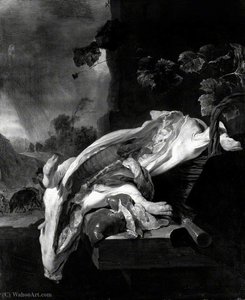
10
The Angel Raphael Leaving Tobias's Family (1648) autorstwa Jan Baptist Weenix

The Angel Raphael Leaving Tobias's Family

1648 · Oil · Nationalmuseum, Stockholm

In "The Angel Raphael Leaving Tobias's Family" by Jan Baptist Weenix, a divine departure unfolds with sudden, celestial energy. The scene captures the exact moment the Angel Raphael ascends toward the heavens, leaving the family below in a state of profound awe and reverence. A powerful diagonal movement pulls the eye from the lower left foreground upward toward the upper left, where the angelic figure climbs into a swirling formation…

Kontynuacja zestawienia Jan Baptist Weenix, od 11 do 78

11vegetable-sellers at the house-door, 5 figures (1646) autorstwa Jan Baptist Weenixvegetable-sellers at the house-door, 5 figures1646 12caravane near the shore (1646) autorstwa Jan Baptist Weenixcaravane near the shore1646 13Mother and Child (1647) autorstwa Jan Baptist WeenixMother and Child1647 14Circumcision of Moses' son (1640) autorstwa Jan Baptist WeenixCircumcision of Moses' son1640 · Muzeum Narodowe w Warszawie 15Still Life with Game, Hunter and Two Dogs (1652) autorstwa Jan Baptist WeenixStill Life with Game, Hunter and Two Dogs1652 · Bawarskie Państwowe Zbiory Malarstwa 16Butterfly Dog and Dead Bird (1649) autorstwa Jan Baptist WeenixButterfly Dog and Dead Bird1649 · Museum Mayer van den Bergh 17Pleasure boating (1650) autorstwa Jan Baptist WeenixPleasure boating1650 18The Sleeping Shepherdess (1658) autorstwa Jan Baptist WeenixThe Sleeping Shepherdess1658 · National Gallery of Ireland 19Roman Tinker (1656) autorstwa Jan Baptist WeenixRoman Tinker1656 · Städel Museum 20The love letter (1650) autorstwa Jan Baptist WeenixThe love letter1650 · National Museum of Art, Architecture and Design 21Italian Harbour (1651) autorstwa Jan Baptist WeenixItalian Harbour1651 · Ermitaż 22Italian Peasants among Ruins (1650) autorstwa Jan Baptist WeenixItalian Peasants among Ruins1650 · Detroit Institute of Arts 23Sleeping girl (1656) autorstwa Jan Baptist WeenixSleeping girl1656 · Bawarskie Państwowe Zbiory Malarstwa 24Rest on the Flight into Egypt (1657) autorstwa Jan Baptist WeenixRest on the Flight into Egypt1657 · Museum Boijmans Van Beuningen 25Merry Company on a Ferry (1649) autorstwa Jan Baptist WeenixMerry Company on a Ferry1649 · Museum Gouda 26Battle at the foot of the mountain. (1650) autorstwa Jan Baptist WeenixBattle at the foot of the mountain.1650 · Muzeum Narodowe w Warszawie 27Christina Lepper de Kempenaer and Her Children (1653) autorstwa Jan Baptist WeenixChristina Lepper de Kempenaer and Her Children1653 28Italian port scene, 1649 (1649) autorstwa Jan Baptist WeenixItalian port scene, 16491649 · Centraal Museum 29Italian Landscape with Horsemen by a Spring (1657) autorstwa Jan Baptist WeenixItalian Landscape with Horsemen by a Spring1657 · Centraal Museum 30Before the walls of Rome (1650) autorstwa Jan Baptist WeenixBefore the walls of Rome1650 · National Museum in Wrocław 31Portrait of a man with a letter (1650) autorstwa Jan Baptist WeenixPortrait of a man with a letter1650 · Agnes Etherington Art Center 32A Landscape with a Ford (1660) autorstwa Jan Baptist WeenixA Landscape with a Ford1660 · Regionalna Galeria w Liberecku 33In the Campagna (1669) autorstwa Jan Baptist WeenixIn the Campagna1669 · National Gallery of Ireland 34Dead Fowl Being Eaten by a Cat (1653) autorstwa Jan Baptist WeenixDead Fowl Being Eaten by a Cat1653 · Städel Museum 35Departure of an Oriental Entourage (1647) autorstwa Jan Baptist WeenixDeparture of an Oriental Entourage1647 · Luwr 36Display of Dead Game (1641) autorstwa Jan Baptist WeenixDisplay of Dead Game1641 · Petit Palais 37Dead Game (1641) autorstwa Jan Baptist WeenixDead Game1641 38River Landscape with a Ferry (1650) autorstwa Jan Baptist WeenixRiver Landscape with a Ferry1650 · Montreal Museum of Fine Arts 39Still Life with Dead Game and Poultry (1656) autorstwa Jan Baptist WeenixStill Life with Dead Game and Poultry1656 · Centraal Museum 40Still Life with Fowl (1650) autorstwa Jan Baptist WeenixStill Life with Fowl1650 · Museum of Fine Arts Ghent (MSK) 41Marine with a Venetian Bucintoro (1650) autorstwa Jan Baptist WeenixMarine with a Venetian Bucintoro1650 · Staatliche Kunsthalle Karlsruhe 42The Dutch Ambassador on his Way to Isfahan, Jan Baptist Weenix, 1653 - 1659 (1659) autorstwa Jan Baptist WeenixThe Dutch Ambassador on his Way to Isfahan, Jan Baptist Weenix, 1653 - 16591659 · Rijksmuseum 43After the Hunt, Jan Baptist Weenix, c. 1656 (1656) autorstwa Jan Baptist WeenixAfter the Hunt, Jan Baptist Weenix, c. 16561656 · Rijksmuseum 44Still Life with White Mouse (1680) autorstwa Jan Baptist WeenixStill Life with White Mouse1680 · Ernest Zmeták Art Gallery 45Still Life with Game autorstwa Jan Baptist WeenixStill Life with GameHarvard Art Museums 46The Ford in the River (1647) autorstwa Jan Baptist WeenixThe Ford in the River1647 · Ermitaż 47Harbor View with Rider in Oriental Dress, autorstwa Jan Baptist WeenixHarbor View with Rider in Oriental Dress,Groninger Museum 48The Holy Women at the Tomb autorstwa Jan Baptist WeenixThe Holy Women at the TombNational Gallery of Ireland 49An Italian Seaport autorstwa Jan Baptist WeenixAn Italian SeaportKrólewskie Muzeum Sztuk Pięknych Antwerpia 50Architectural interior with foreign shippers, ruins and a shipyard beyond autorstwa Jan Baptist WeenixArchitectural interior with foreign shippers, ruins and a shipyard beyond 51Study of a sheep autorstwa Jan Baptist WeenixStudy of a sheep 52A pig's carcase autorstwa Jan Baptist WeenixA pig's carcase 53The Tinker and His Dog autorstwa Jan Baptist WeenixThe Tinker and His Dog 54Landscape with Peasants and Animals autorstwa Jan Baptist WeenixLandscape with Peasants and Animals 55Dead Partridge (1650) autorstwa Jan Baptist WeenixDead Partridge1650 · Mauritshuis 56Goat Lying Down, Jan Baptist Weenix, 1645 - 1660 (1660) autorstwa Jan Baptist WeenixGoat Lying Down, Jan Baptist Weenix, 1645 - 16601660 · Rijksmuseum 57A Dog and a Cat near a partially disembowelled Deer, Jan Baptist Weenix, 1645 - 1660 (1660) autorstwa Jan Baptist WeenixA Dog and a Cat near a partially disembowelled Deer, Jan Baptist Weenix, 1645 - 16601660 · Rijksmuseum 58Still Life with Dead Poultry, Lidded Pitcher and Passglas autorstwa Jan Baptist WeenixStill Life with Dead Poultry, Lidded Pitcher and PassglasBawarskie Państwowe Zbiory Malarstwa 59Game-piece autorstwa Jan Baptist WeenixGame-pieceNational Gallery of Ireland 60Dead game and hunting tackle in landscape autorstwa Jan Baptist WeenixDead game and hunting tackle in landscape 61Hound with a Joint of Meat and a Cat Looking on autorstwa Jan Baptist WeenixHound with a Joint of Meat and a Cat Looking on 62Bouquet of flowers autorstwa Jan Baptist WeenixBouquet of flowersGemäldegalerie 63Shipping in Harbour autorstwa Jan Baptist WeenixShipping in Harbour 64Herons and Lapwings autorstwa Jan Baptist WeenixHerons and Lapwings 65Still Life of Dead Game in a Landscape with a Huntsman autorstwa Jan Baptist WeenixStill Life of Dead Game in a Landscape with a Huntsman 66An italian port scene autorstwa Jan Baptist WeenixAn italian port scene 67Shepherds and Flocks among Classical Ruins autorstwa Jan Baptist WeenixShepherds and Flocks among Classical Ruins 68A Coast Scene with Classical Ruins autorstwa Jan Baptist WeenixA Coast Scene with Classical RuinsWallace Collection 69Still Life with Dead Game autorstwa Jan Baptist WeenixStill Life with Dead Game 70Hounds and an Owl with Dead Birds and Sculptures in a Landscape autorstwa Jan Baptist WeenixHounds and an Owl with Dead Birds and Sculptures in a Landscape 71Still Life with Dead Birds autorstwa Jan Baptist WeenixStill Life with Dead Birds 72Family in a Mediterranean Seaport autorstwa Jan Baptist WeenixFamily in a Mediterranean Seaport 73Figures near a Seaport autorstwa Jan Baptist WeenixFigures near a SeaportScottish National Gallery 74A Huntsman cutting up a Dead Deer, with Two Deerhounds autorstwa Jan Baptist WeenixA Huntsman cutting up a Dead Deer, with Two DeerhoundsNational Gallery 75Ancient Ruins autorstwa Jan Baptist WeenixAncient RuinsSzépművészeti Múzeum 76Figures among ruins autorstwa Jan Baptist WeenixFigures among ruinsThe Kremer Collection 77Ancient Ruins (detail) autorstwa Jan Baptist WeenixAncient Ruins (detail)Szépművészeti Múzeum 78Girl as Shepherdess (1650) autorstwa Jan Baptist WeenixGirl as Shepherdess1650 · Musée de Picardie

Słynne obrazy Jan Baptist Weenix epoka po epoce

Tematy, które przyciągnęły wzrok Jan Baptist Weenix

Cztery motywy najczęściej powracające w tych oryginałach, z których każdy doczekał się swojego najdoskonalszego przykładu.

Muzea przechowujące oryginały Jan Baptist Weenix

8 muzeów, w których znajduje się najwięcej obrazów z tej strony.

Muzea Miasto Dzieła artysty Jan Baptist Weenix Obrazy z tej listy
Bawarskie Państwowe Zbiory Malarstwa, MonachiumBawarskie Państwowe Zbiory Malarstwa Monachium 4 The Scissors Grinder, Still Life with Game, Hunter and Two Dogs, Sleeping girl
Centraal Museum, UtrechtCentraal Museum Utrecht 4 Portrait of René Descartes, Italian port scene, 1649, Italian Landscape with Horsemen by a Spring
National Gallery of Ireland, DublinNational Gallery of Ireland Dublin 4 The Sleeping Shepherdess, In the Campagna, The Holy Women at the Tomb
Rijksmuseum, AmsterdamRijksmuseum Amsterdam 4 The Dutch Ambassador on his Way to Isfahan, Jan Baptist Weenix, 1653 - 1659, After the Hunt, Jan Baptist Weenix, c. 1656, Goat Lying Down, Jan Baptist Weenix, 1645 - 1660
Museum Boijmans Van Beuningen, RotterdamMuseum Boijmans Van Beuningen Rotterdam 2 Tobit, asleep under a vine, is blinded, Rest on the Flight into Egypt
Mauritshuis, HagaMauritshuis Haga 2 Italian landscape with shelter and antiques ruins, Dead Partridge
Detroit Institute of Arts, DetroitDetroit Institute of Arts Detroit 2 Still Life with a Dead Swan, Italian Peasants among Ruins
Nationalmuseum, StockholmNationalmuseum Stockholm 2 Harbour with Antique Ruins, The Angel Raphael Leaving Tobias's Family

Jan Baptist Weenix rok po roku: oryginały, które definiują każdy z nich

Od 1640 do 1659, Jan Baptist Weenix tworzył przez 20 lat: zestawienie to ukazuje tę długą karierę rok po roku, poprzez jej najwspanialsze oryginały.

Dzieła według lat

Wybierz rok, aby zobaczyć oryginały.

Pytania kolekcjonerów o obrazy Jan Baptist Weenix

Z jakiego dzieła najbardziej znany jest Jan Baptist Weenix?Odkryj odpowiedź

Tobit, asleep under a vine, is blinded (1642), Museum Boijmans Van Beuningen, Rotterdam. Następne są Italian landscape with shelter and antiques ruins (1658) oraz Still Life with a Dead Swan (1651).

W jakim wieku był Jan Baptist Weenix, gdy powstało Tobit, asleep under a vine, is blinded?Odkryj odpowiedź

21 lat: Tobit, asleep under a vine, is blinded pochodzi z 1642, a Jan Baptist Weenix urodził(a) się w 1621.

Jakie są dziesięć najsłynniejszych obrazów, których autorem jest Jan Baptist Weenix?Odkryj odpowiedź

Tobit, asleep under a vine, is blinded, Italian landscape with shelter and antiques ruins, Still Life with a Dead Swan, Tobit Sleeping Under the Vine, The Scissors Grinder, Hunters Near Ruins, Portrait of René Descartes, Monument at a Harbour, Harbour with Antique Ruins i The Angel Raphael Leaving Tobias's Family. Powyższy ranking zawiera rok powstania oraz muzeum dla każdego z nich.

Ile obrazów pozostawił po sobie Jan Baptist Weenix?Odkryj odpowiedź

Nasz katalog zawiera 86 dzieł artysty Jan Baptist Weenix, datowanych od 1640 do 1659.

W których muzeach znajdują się arcydzieła Jan Baptist Weenix?Odkryj odpowiedź

W większości znajdują się w Bawarskie Państwowe Zbiory Malarstwa (Monachium), Centraal Museum (Utrecht) i National Gallery of Ireland (Dublin). Powyższa tabela muzeów zawiera ich pełną listę.

W których latach Jan Baptist Weenix namalował swoje najsłynniejsze dzieła?Odkryj odpowiedź

W 1650: 11 z 78 dzieł na tej stronie powstało w tym czasie, w tym Pleasure boating.

Jakie są pierwsze i ostatnie słynne oryginały Jan Baptist Weenix?Odkryj odpowiedź

Na tej stronie najwcześniejszy to Circumcision of Moses' son (1640), a najpóźniejszy The Dutch Ambassador on his Way to Isfahan, Jan Baptist Weenix, 1653 - 1659 (1659).

Jakie tematy Jan Baptist Weenix wybierał najczęściej?Odkryj odpowiedź

Landscape (18), Ruins (17) i Sky (13), w ramach 78 dzieł na tej stronie.

Której techniki Jan Baptist Weenix używał najczęściej?Odkryj odpowiedź

Oil On Canvas, dla 30 z 78 dzieł na tej stronie.

Do jakiego nurtu artystycznego należy Jan Baptist Weenix?Odkryj odpowiedź

Dutch golden age i Baroque, sądząc po oryginałach na tej stronie.

Które dzieła Jan Baptist Weenix znajdują się w Bawarskie Państwowe Zbiory Malarstwa?Odkryj odpowiedź

The Scissors Grinder, Still Life with Game, Hunter and Two Dogs i Sleeping girl: Bawarskie Państwowe Zbiory Malarstwa, Monachium posiada 4 dzieł widocznych na tej stronie.

Jan Baptist Weenix: życie i twórczość

Wizjoner Holenderskiego Złotego Wieku

Jan Baptist Weenix jawi się jako postać niezwykła w kręgu holenderskiego złotego wieku, celebrowana za swój unikalny splot skrupulatnej obserwacji z wyobraźnią. Choć jego dorobek artystyczny był stosunkowo skromny w porównaniu z takimi współczesnymi mu gigantami jak Rembrandt czy Vermeer, wkład Weenixa w historię sztuki niderlandzkiej jest niezaprzeczalny – szczególnie jego nowatorskie eksploracje włoskich krajobrazów przesyconych ludzkimi postaciami, co ustanowiło precedens stylistyczny rezonujący przez kolejne pokolenia. Urodzony w 1621 roku w Amsterdamie, nieopodal tętniącego życiem portu, Weenix wywodził się z rodziny architektów, co prawdopodobnie ukształtowało jego wczesne lata spędzone w atmosferze intelektualnego i strukturalnego fermentu epoki.

Mimo osobistych trudności – przekazy sugerują, że zmagał się z wadą mowy wynikającą z problemów zdrowotnych – Weenix posiadał żarliwą pasję do literatury i sztuki, pielęgnowaną przez matkę, która z wielką troską zadbała o jego naukę u boku Jana Mickera, szwagra Rembrandta. To wczesne szkolenie zaszczepiło w nim zdyscyplinowane podejście do rysunku i obserwacji, które stały się znakami rozpoznawczymi jego dzieł. Dalsze doskonalenie umiejętności odbywało się w Utrechcie pod okiem Abrahama Bloemaerta, a następnie w Amsterdamie, gdzie studiował u Claes Corneliszoon Moeyaert, utwierdzając swoją biegłość w dominujących wówczas nurtach artystycznych Niderlandów.

Podróż przez światło i krajobraz

Trajektoria kariery Weenixa została głęboko odmieniona przez podróże, a zwłaszcza przez wyprawę do Rzymu w 1643 roku u boku Nicolaesa Pieterszoona Berchema. Ta eskapada pozwoliła mu zetknąć się z tętniącym życiem intelektualnym i artystycznym środowiskiem cechu Bentvueghels, co pchnęło go w stronę znacznie szerszego wachlarza stylistycznego. W Rzymie przyjął styl włoski, charakteryzujący się ciepłym, złotym światłem i klasycznymi krajobrazami, które pięknie kontrastowały z chłodniejszymi, bardziej stonowanymi tonami tradycyjnego malarstwa holenderskiego. Ten okres rzymskich wpływów pozwolił mu opanować sztukę „krajobrazu włoskiego”, w którym surowe piękno południowej Europy zostało przemyślane na nowo przez pryzmat północnoeuropejskiego spojrzenia.

Jego twórczość z tego okresu często łączyła majestat klasycznych scenerii z intymnymi, ludzkimi elementami. Bez względu na to, czy przedstawiał sceny portowe szepczące o morskiej wymianie handlowej, czy rozległe panoramy przywołujące poczucie ponadczasowości, Weenix posiadał unikalną zdolność chwytania atmosfery miejsca. Jego mistrzostwo nie ograniczało się jednak tylko do dalekich horyzontów; równie sprawnie potrafił oddać cichą, często wręcz namacalną rzeczywistość życia w swoich martwych naturach. Przedstawienia upolowanej zwierzyny i zwierząt cechował uderzający realizm, w którym każda tekstura – od szorstkiej sierści psa myśliwskiego po delikatny połysk piór – została oddana z zapierającą dech w piersiach precyzją.

Dziedzictwo realizmu i kunsztu

Znaczenie Jana Baptista Weenixa tkwi w jego zdolności do budowania mostu między surowym realizmem tradycji holenderskiej a idealizowanym pięknem nurtu włoskiego. Jego wszechstronność pozwalała mu swobodnie poruszać się między różnorodną tematyką – od dramatycznego napięcia odnalezionego w dziełach takich jak Po polowaniu, po cichą, niemal melancholijną intensywność studiów nad zwierzętami. Poprzez jego pędzel widz zostaje zaproszony do świata, w którym granice między obserwowanym światem natury a wyobrażoną klasyczną przeszłością ulegają pięknemu zatarciu.

Refleksja nad jego życiem i twórczością pozwala wyróżnić kilka kluczowych elementów definiujących jego trwałe znaczenie:

  • Innowacja stylistyczna: Był pionierem w integrowaniu elementów włoskiego krajobrazu z tradycją holenderską, tworząc nowy język wizualny dla swoich współczesnych.
  • Techniczne mistrzostwo: Dyscyplina jego szkolenia pozwoliła na osiągnięcie niezwykłego poziomu szczegółowości zarówno w wielkoformatowych krajobrazach, jak i intymnych martwych naturach.
  • Wszechstronność: Zdolność do płynnego przechodzenia między scenami portowymi, motywami łowieckimi a portretami zwierząt świadczy o rzadko spotykanej szerokości talentu.
  • Wpływ historyczny: Jako członek Bentvueghels, przyczynił się do rozwoju międzynarodowej wymiany idei artystycznych, która definiowała świat sztuki XVII wieku.

Choć jego życie było stosunkowo krótkie i zakończyło się w 1661 roku, piętno pozostawione przez Jana Baptista Weenixa pozostaje widoczne w ewolucji malarstwa pejzażowego. Nauczył on przyszłe pokolenia, jak patrzeć na horyzont nie tylko jako na granicę, ale jako na płótno dla światła, historii i ludzkich emocji.