Portret Francesco Botticini

43 najsłynniejszych obrazów artysty Francesco Botticini, każdy niepowtarzalny

Aktualizacja: Listopad 2026 · ranking według naszego wskaźnika popularności (liczba wyszukiwań, wizyt i zamówień dla każdego dzieła) · 44 dzieł Francesco Botticini w naszym katalogu

W skrócie

Madonna and Child Enthroned with Saints and Angels (1481) to obraz autorstwa Francesco Botticini, który przyciąga najwięcej spojrzeń; oryginał znajduje się w Metropolitan Museum of Art, Nowy Jork. Następnie wzrok kieruje się na Saints Anna and Joachim (1460) i Incoronation of Mary (1460). Spośród 44 dzieł Francesco Botticini w naszym katalogu, tych 43 jest najbardziej znanych – każde z nich to unikatowy oryginał, przedstawiony wraz z rokiem powstania, muzeum oraz powodem, dla którego przetrwało próbę czasu.

1446 – 1498, Florencja Early renaissance Najwięcej dzieł: Gemäldegalerie

10 najlepszych obrazów autorstwa Francesco Botticini według oka galerii

1
Madonna and Child Enthroned with Saints and Angels (1481) autorstwa Francesco Botticini

Madonna and Child Enthroned with Saints and Angels

1481 · Tempera On Panel · Metropolitan Museum of Art, Nowy Jork

The painting presents a central, elevated throne holding the Virgin Mary and the Christ Child. Mary is positioned in a frontal view, wearing a deep ultramarine blue mantle over a crimson red garment. The infant Jesus rests in her arms, his form rendered with anatomical clarity. Flanking the central throne, two angels are depicted in motion, while four saints occupy the foreground. These saints are identified by specific attributes, including…

2
Saints Anna and Joachim (1460) autorstwa Francesco Botticini

Saints Anna and Joachim

1460 · Tempera On Panel · Brooklyn Museum, Brooklyn

This Renaissance-era tempera painting presents a serene and devotional scene featuring two holy figures, likely Saints Anna and Joachim, depicted in profile. The composition is intimate and vertical, with the subjects positioned slightly to the right of the center. They are set against a background consisting of a blue sky and a reddish-brown crenelated wall.

3
Incoronation of Mary (1460) autorstwa Francesco Botticini

Incoronation of Mary

1460 · Tempera On Panel · Gemäldegalerie, Berlin

Incoronation of Mary by Francesco Botticini unfolds as a profound moment of divine recognition. This panel, dating to about 1460, captures a celestial event frozen in time. The scene centers on the kneeling Virgin Mary as she receives her crown, a moment of profound spiritual weight that bridges the gap between the heavens and the earth. Every figure in this assembly seems to hold its breath, caught in the stillness…

4
Madonna and Child with Tobias and the Angel Raphael (1470) autorstwa Francesco Botticini

Madonna and Child with Tobias and the Angel Raphael

1470 · Tempera On Panel · Cleveland Museum of Art, Cleveland

In this work, Madonna and Child with Tobias and the Angel Raphael, Francesco Botticini organizes the sacred narrative within a vertically oriented composition, contained by an arched frame. At the center, the Madonna is captured in a moment of quiet prayer, kneeling before the Christ Child who rests upon the ground. To the left, the artist has placed a smaller, secondary scene depicting the figures of Tobias and the Angel…

5
Madonna and Child (1475) autorstwa Francesco Botticini

Madonna and Child

1475 · Tempera On Panel · Cleveland Museum of Art, Cleveland

The Virgin Mary sits in a vertical stillness, her form defined by the soft pink of a pleated tunic. She holds the infant Jesus against a landscape that recedes into pale blue skies and earthy greens. A translucent veil rests upon her hair, its fine pattern catching a light that seems to emanate from within the skin of the figures. The child is a pale, luminous weight in her arms.…

6
Noli Me Tangere (1485) autorstwa Francesco Botticini

Noli Me Tangere

1485 · Tempera On Panel · Yale University Art Gallery, Nowe Havane

The air in the enclosed garden feels still, held in a suspension of shock and divine presence. On the left, a male figure emerges from the shadows of the resurrection, his form draped in a long, flowing blue robe that catches the soft, diffused light. He holds a staff, a quiet marker of his transition from the tomb to the living world. Facing him, a woman kneels upon the green…

7
The Resurrection (1485) autorstwa Francesco Botticini

The Resurrection

1485 · Tempera On Panel · Yale University Art Gallery, Nowe Havane

In this tempera on wood panel from 1485, we find a scene of profound spiritual transition. Christ rises from a stone sarcophagus, his form luminous against the earthy greens of a rolling Florentine landscape. He holds a white banner marked with a red cross, a symbol of victory over death, while his skin possesses a pale, translucent quality that suggests an inner light. Below, the earthly realm remains in a…

8
Way to Calvary (1475) autorstwa Francesco Botticini

Way to Calvary

1475 · Tempera On Panel · Yale University Art Gallery, Nowe Havane

In this religious art painting, titled Way to Calvary, we encounter a significant work by the Florentine artist Francesco Botticini. Created around 1475, the piece belongs to the Early Renaissance period. It is a tempera painting on wood, a medium that allows for a specific kind of clarity in its depiction of sacred narratives.

9
Agony in the Garden (1485) autorstwa Francesco Botticini

Agony in the Garden

1485 · Tempera On Panel · Yale University Art Gallery, Nowe Havane

In this tempera on wood panel from 1485, we find ourselves in a quiet, somber landscape where the weight of a divine burden is felt through stillness. The composition is divided into two distinct narrative zones, creating a tension between the spiritual and the earthly. On the left, a solitary figure of Christ kneels in prayer, his form defined by soft, contour-driven lines that suggest a profound sense of isolation.…

10
Madonna and Child with a Breviary (1475) autorstwa Francesco Botticini

Madonna and Child with a Breviary

1475 · Tempera On Panel · Cincinnati Art Museum, Cincinnati

The air feels still, as if the very light of the Florentine morning has paused to watch this intimate encounter. Within the soft, circular boundary of the tondo, the Virgin Mary sits in a moment of profound stillness, her presence anchoring the entire composition. She is draped in a mantle of deep ultramarine blue that flows around her, contrasting sharply with the rich vermilion red of her tunic. On her…

Słynne obrazy artysty Francesco Botticini, od 11 do 43

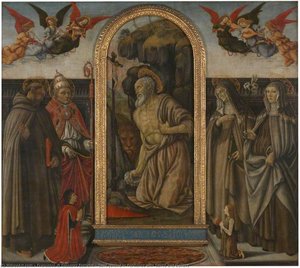
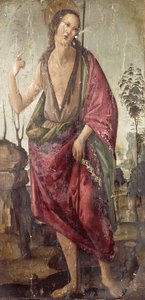
11Madonna and Child with St. Mary Magdalene, St. Bernard, Angels, Cherubim and Seraphim (1485) autorstwa Francesco BotticiniMadonna and Child with St. Mary Magdalene, St. Bernard, Angels, Cherubim and Seraphim1485 12Madonna Adoring the Christ Child (1470) autorstwa Francesco BotticiniMadonna Adoring the Christ Child1470 · Birmingham Museum of Art 13Crucifixion with Saints Vincent Ferrer, Peter Martyr, Stephen, Catherine of Siena and the Blessed Antonius at the Foot of the Cross (1474) autorstwa Francesco BotticiniCrucifixion with Saints Vincent Ferrer, Peter Martyr, Stephen, Catherine of Siena and the Blessed Antonius at the Foot of the Cross1474 · Courtauld Gallery 14Mary with the Child, the Boy John Adoring the Child, and Two Saints (1480) autorstwa Francesco BotticiniMary with the Child, the Boy John Adoring the Child, and Two Saints1480 · Gemäldegalerie 15Christ on the Cross and Four Saints (1475) autorstwa Francesco BotticiniChrist on the Cross and Four Saints1475 · Gemäldegalerie 16Virgin and Child with the Infant Saint John the Baptist (1472) autorstwa Francesco BotticiniVirgin and Child with the Infant Saint John the Baptist1472 · Isabella Stewart Gardner Museum 17The three archangels with the little Tobias (1491) autorstwa Francesco BotticiniThe three archangels with the little Tobias1491 · Bawarskie Państwowe Zbiory Malarstwa 18Madonna Adoring the Christ Child with St. John the Baptist and Two Angels (1487) autorstwa Francesco BotticiniMadonna Adoring the Christ Child with St. John the Baptist and Two Angels1487 19Mary and John Adoring the Child (1490) autorstwa Francesco BotticiniMary and John Adoring the Child1490 · Gemäldegalerie 20Virgin and Child (1475) autorstwa Francesco BotticiniVirgin and Child1475 21Madonna and Child in a Landscape with the Infant St. John the Baptist (1487) autorstwa Francesco BotticiniMadonna and Child in a Landscape with the Infant St. John the Baptist1487 22Scenes from the Life of Saint Jerome Predella (1490) autorstwa Francesco BotticiniScenes from the Life of Saint Jerome Predella1490 23Saint Jerome in Penitence with Saints and Donors (1490) autorstwa Francesco BotticiniSaint Jerome in Penitence with Saints and Donors1490 24Madonna with Child, St John the Baptist, and Angels (1490) autorstwa Francesco BotticiniMadonna with Child, St John the Baptist, and Angels1490 25Virgin and Child Enthroned (1495) autorstwa Francesco BotticiniVirgin and Child Enthroned1495 · National Gallery of Scotland 26St. Nicolas and Sts. Catherine, Lucy, Margaret and Apollonia autorstwa Francesco BotticiniSt. Nicolas and Sts. Catherine, Lucy, Margaret and ApolloniaNarodowe Muzeum Sztuki Zachodniej 27Virgin Adoring the Child autorstwa Francesco BotticiniVirgin Adoring the ChildFitzwilliam Museum 28Portrait of a Young Man autorstwa Francesco BotticiniPortrait of a Young Man 29TRIPTYQUE, LA VIERGE ET L'ENFANT autorstwa Francesco BotticiniTRIPTYQUE, LA VIERGE ET L'ENFANT 30Saint Cecilia Between Saint Valerian and Saint Tiburtius with a Donor autorstwa Francesco BotticiniSaint Cecilia Between Saint Valerian and Saint Tiburtius with a DonorThyssen-Bornemisza Museum 31John the Baptist autorstwa Francesco BotticiniJohn the BaptistRijksmuseum 32Scenes from the Life of Saint Jerome - Predella autorstwa Francesco BotticiniScenes from the Life of Saint Jerome - Predella 33La Vierge adorant l'enfant entourée de saint Jean Baptiste enfant et de deux anges autorstwa Francesco BotticiniLa Vierge adorant l'enfant entourée de saint Jean Baptiste enfant et de deux angesLuwr 34LA VIERGE ET L'ENFANT EN GLOIRE ENTOURES D'ANGES, DE SAINTE MARIE MADELEINE ET DE SAINT BERNARD autorstwa Francesco BotticiniLA VIERGE ET L'ENFANT EN GLOIRE ENTOURES D'ANGES, DE SAINTE MARIE MADELEINE ET DE SAINT BERNARDLuwr 35Saint Sebastian autorstwa Francesco BotticiniSaint Sebastian 36Saint Nicholas of Tolentino autorstwa Francesco BotticiniSaint Nicholas of Tolentino 37Saint Jerome in Penitence with Saints and Donors autorstwa Francesco BotticiniSaint Jerome in Penitence with Saints and DonorsNational Gallery 38S. gerolamo altarpiece autorstwa Francesco BotticiniS. gerolamo altarpieceNational Gallery 39The Assumption of the Virgin autorstwa Francesco BotticiniThe Assumption of the VirginNational Gallery 40Madonna and Child with the Infant St. John the Baptist (1487) autorstwa Francesco BotticiniMadonna and Child with the Infant St. John the Baptist1487 41The Three Archangels with Tobias (1470) autorstwa Francesco BotticiniThe Three Archangels with Tobias1470 · Galleria degli Uffizi 42Madonna with child St. John and Angel (1470) autorstwa Francesco BotticiniMadonna with child St. John and Angel1470 · Musée Des Beaux 43Saint Sebastian autorstwa Francesco BotticiniSaint SebastianMetropolitan Museum of Art

Słynne obrazy Francesco Botticini epoka po epoce

Tematy, które przyciągnęły wzrok Francesco Botticini

Cztery motywy najczęściej powracające w tych oryginałach, z których każdy doczekał się swojego najdoskonalszego przykładu.

Muzea przechowujące oryginały Francesco Botticini

8 muzeów, w których znajduje się najwięcej obrazów z tej strony.

Muzea Miasto Dzieła artysty Francesco Botticini Obrazy z tej listy
Gemäldegalerie, BerlinGemäldegalerie Berlin 4 Incoronation of Mary, Mary with the Child, the Boy John Adoring the Child, and Two Saints, Christ on the Cross and Four Saints
Yale University Art Gallery, Nowe HavaneYale University Art Gallery Nowe Havane 4 Noli Me Tangere, The Resurrection, Way to Calvary
National Gallery, LondynNational Gallery Londyn 3 Saint Jerome in Penitence with Saints and Donors, S. gerolamo altarpiece, The Assumption of the Virgin
Metropolitan Museum of Art, Nowy JorkMetropolitan Museum of Art Nowy Jork 2 Madonna and Child Enthroned with Saints and Angels, Saint Sebastian
Cleveland Museum of Art, ClevelandCleveland Museum of Art Cleveland 2 Madonna and Child with Tobias and the Angel Raphael, Madonna and Child
Luwr, ParyżLuwr Paryż 2 La Vierge adorant l'enfant entourée de saint Jean Baptiste enfant et de deux anges, LA VIERGE ET L'ENFANT EN GLOIRE ENTOURES D'ANGES, DE SAINTE MARIE MADELEINE ET DE SAINT BERNARD
Brooklyn Museum, BrooklynBrooklyn Museum Brooklyn 1 Saints Anna and Joachim
Cincinnati Art Museum, CincinnatiCincinnati Art Museum Cincinnati 1 Madonna and Child with a Breviary

Francesco Botticini na przestrzeni dekad: jeden unikatowy oryginał dla każdego

Dzieła według dekad

Wybierz dekadę, aby zobaczyć dzieło, które ją definiuje.

Obrazy artysty Francesco Botticini: pytania do galerii

Jakie jest najsłynniejsze dzieło artysty Francesco Botticini?Odkryj odpowiedź

Madonna and Child Enthroned with Saints and Angels (1481), Metropolitan Museum of Art, Nowy Jork. Następne są Saints Anna and Joachim (1460) oraz Incoronation of Mary (1460).

W jakim wieku Francesco Botticini stworzył/a Madonna and Child Enthroned with Saints and Angels?Odkryj odpowiedź

35 lat: Madonna and Child Enthroned with Saints and Angels pochodzi z 1481, a Francesco Botticini urodził(a) się w 1446.

Które dziesięć obrazów Francesco Botticini jest najbardziej znanych?Odkryj odpowiedź

Madonna and Child Enthroned with Saints and Angels, Saints Anna and Joachim, Incoronation of Mary, Madonna and Child with Tobias and the Angel Raphael, Madonna and Child, Noli Me Tangere, The Resurrection, Way to Calvary, Agony in the Garden i Madonna and Child with a Breviary. Powyższy ranking zawiera rok powstania oraz muzeum dla każdego z nich.

Ile znanych dzieł stworzył Francesco Botticini?Odkryj odpowiedź

Nasz katalog zawiera 44 dzieł artysty Francesco Botticini, datowanych od 1460 do 1495.

Gdzie można zobaczyć najsłynniejsze oryginały Francesco Botticini?Odkryj odpowiedź

W większości znajdują się w Gemäldegalerie (Berlin), Yale University Art Gallery (Nowe Havane) i National Gallery (Londyn). Powyższa tabela muzeów zawiera ich pełną listę.

W jakim okresie Francesco Botticini stworzył/a swoje najsłynniejsze obrazy?Odkryj odpowiedź

W 1470s: 11 z 43 dzieł na tej stronie powstało w tym czasie, w tym Madonna and Child with Tobias and the Angel Raphael.

Który z najsłynniejszych obrazów artysty Francesco Botticini powstał najwcześniej, a który najpóźniej?Odkryj odpowiedź

Na tej stronie najwcześniejszy to Saints Anna and Joachim (1460), a najpóźniejszy Virgin and Child Enthroned (1495).

Jakie tematy preferował Francesco Botticini?Odkryj odpowiedź

Woman (14), Child (13) i Landscape (9), w ramach 43 dzieł na tej stronie.

Jakich materiałów Francesco Botticini używał najczęściej?Odkryj odpowiedź

Tempera On Panel, dla 23 z 43 dzieł na tej stronie.

Do jakiego nurtu należy twórczość Francesco Botticini?Odkryj odpowiedź

Early renaissance, sądząc po oryginałach na tej stronie.

Jakie oryginały Francesco Botticini można zobaczyć w Gemäldegalerie?Odkryj odpowiedź

Incoronation of Mary, Mary with the Child, the Boy John Adoring the Child, and Two Saints i Christ on the Cross and Four Saints: Gemäldegalerie, Berlin posiada 4 dzieł widocznych na tej stronie.

Francesco Botticini: portret artysty

Florencki mistrz: Życie i dziedzictwo Francesco Botticini

W tętniących życiem, skąpanych w słońcu ulicach XV-wiecznego Florencji, pośród rozkwitającego intelektu Wczesnego Renesansu, żył malarz, którego pędzel potrafił uchwycić głęboką duchową esencję epoki. Francesco Botticini, urodzony około 1446 roku, był kimś znacznie więcej niż tylko współczesnym gigantom swoich czasów; był żywą nicią w bogatym gobelinie sztuki florenckiej. Podczas gdy historia często kieruje światło reflektorów na monumentalne cienie Leonarda da Vinci czy Michała Anioła, dzieła Botticini oferują okno na okres niezwykłego przejścia, w którym sztywne struktury średniowiecznej pobożności zaczęły przenikać się z humanistyczną gracją Renesansu.

Podróż Botticini w samo serce artyzmu była przeznaczona przez jego pochodzenie. Urodzony w rodzinie głęboko zakorzenionej w tradycjach rzemiosła, był synem Giovanniego di Domenico di Piero, biegłego malarza kart do gry. Ta wczesna ekspozycja na skrupulatne wymagania pigmentu i wzornictwa położyła fundamenty pod karierę definiowaną przez precyzję i oddanie. Jego formalna edukacja rozpoczęła się w prestiżowej pracowni Neri di Bicci, gdzie jako uczeń w 1459 roku chłonął podstawowe zasady fresku oraz wspólnotowego ducha florenckiego systemu warsztatowego. Jednak to późniejsze zanurzenie w atelier legendarnego Andrea del Verrocchio prawdziwie odmieniło jego wizję. W warsztacie Verrocchio – tym samym tyglu, który wykarmił Leonarda da Vinci – Botticini nauczył się łączyć rzeźbiarską głębię trójwymiarowej formy z eterycznym pięknem malarstwa temperowego.

Symfonia pobożności i techniki

Dzieło Botticini jest świadectwem jego zdolności do przywoływania boskości poprzez to, co namacalne. Jego styl, silnie inspirowany liryczną elegancją Botticellego oraz strukturalną klarownością Filippino Lippi, często koncentrował się na narracjach religijnych zapraszających do głębokiej kontemplacji. Nie można mówić o jego mistrzostwie, nie wspominając o monumentalnym osiągnięciu, jakim jest "Wniebowzięcie Najświętszej Maryi Panny." Ta wielkoformatowa tempera na drewnianej desce, znajdująca się obecnie w National Gallery w Londynie, stanowi zapierające dech w piersiach widowisko jego technicznej biegłości. W tym dziele niebiosa otwierają się, ukazując niebiańską hierarchię aniołów, podczas gdy świat ziemski wypełniony jest przez uczniów i fundatorów, a wszystko to oddane z delikatną równowagą między ruchem a spokojem.

Talent Botticini wykraczał poza wielkie ołtarze, sięgając do intymnego świata kameralnych paneli religijnych i portretów. Jego umiejętność operowania światłem i cieniem pozwalała mu tworzyć sceny o głębokiej intymności, takie jak "Madonna z Dzieciątkiem na tronie,", gdzie granice między tym, co święte, a tym, co ludzkie, zdają się zacierać. W swojej technice często wykorzystywał tradyjne medium, jakim była tempera, która nadawała skórze jego świętych postaci świetlistą, niemal przezroczystą jakość, sprawiając, że zdawały się one promieniować wewnętrznym, duchowym światłem. Bez względu na to, czy przedstawiał uczoną powagę św. Hieronima, czy czułą łagodność Madonny, Botticini posiadał unikalny dar chwytania emocjonalnego ciężaru swoich tematów.

Znaczenie historyczne i odkrycie na nowo

Historyczna trajektoria Francesco Botticini jest równie poruszająca, co sztuka, którą tworzył. Przez wieki duża część jego wkładu pozostawała ukryta pod przytłaczającym dziedzictwem jego bardziej znanych rówieśników. Wiele jego prac przypisywano innym mistrzom, gubiąc się w zmiennych nurtach atrybucji historii sztuki. Dopiero dzięki skrupulatnym wysiłkom współczesnych uczonych — rekonstruującym jego dorobek poprzez analizę stylistyczną i badania archiwalne — Botticini został odzyskany jako znaczący głos Quattrocenta.

Dziś uznajemy Botticini nie tylko jako ucznia Verrocchio czy kontynuatora florenckiej tradycji, ale jako artystę, który wniósł odrębne poczucie spokoju i duchowej głębi w czasy Renesansu. Jego dziedzictwo przejawia się w:

  • Integracji formy rzeźbiarskiej: nadawaniu poczucia ciężaru i obecności postaciom religijnym dzięki szkoleniu pod okiem Verrocchio.
  • Mistrzostwie stylu florenckiego: współtworzeniu estetycznego języka wdzięku, linii i świetlistości, który definiował tę epokę.
  • Duchowym opowiadaniu historii: tworzeniu dzieł, które służyły zarówno jako narzędzia edukacyjne dla wiernych, jak i głębokie obiekty medytacji.

Kiedy spoglądamy na jego zachowane panele, widzimy coś więcej niż tylko farbę na drewnie; widzimy nieprzemijającego ducha mistrza, który, choć żył w cieniu gigantów, pozostawił niezatarty ślad w duszy Florencji.