Portret Caesar Van Everdingen

41 najsłynniejszych obrazów artysty Caesar Van Everdingen, każdy niepowtarzalny

Aktualizacja: Listopad 2026 · ranking według naszego wskaźnika popularności (liczba wyszukiwań, wizyt i zamówień dla każdego dzieła) · 41 dzieł Caesar Van Everdingen w naszym katalogu

W skrócie

Woman praying (1650) to obraz autorstwa Caesar Van Everdingen, który przyciąga najwięcej spojrzeń; oryginał znajduje się w Rijksmuseum, Amsterdam. Następnie wzrok kieruje się na Jupiter and Callisto (1655) i Winter (1646). Spośród 41 dzieł Caesar Van Everdingen w naszym katalogu, tych 41 jest najbardziej znanych – każde z nich to unikatowy oryginał, przedstawiony wraz z rokiem powstania, muzeum oraz powodem, dla którego przetrwało próbę czasu.

1616 – 1678, Alkmaar Baroque Najwięcej dzieł: Stedelijk Museum

10 najlepszych obrazów autorstwa Caesar Van Everdingen według oka galerii

1
Woman praying (1650) autorstwa Caesar Van Everdingen

Woman praying

1650 · Oil On Panel · Rijksmuseum, Amsterdam

The quiet intensity of Woman praying draws the viewer into a private moment of devotion. Attributed to the hand of Caesar van Everdingen, this intimate portrait captures a figure lost in contemplation. The work is also known by the title Mary Praying, as the subject is identified as the Virgin Mary. She exists in a space of profound stillness, her presence felt through the weight of her silent plea.

2
Jupiter and Callisto (1655) autorstwa Caesar Van Everdingen

Jupiter and Callisto

1655 · Oil On Canvas · Nationalmuseum, Stockholm

A single mask lies discarded in the upper corner, a silent witness to a deception. Beneath it, the nymph Callisto reclines upon heavy folds of fabric, her skin catching a pale, directional light that carves her form from the surrounding gloom. She looks upward, her gaze meeting the eyes of a man she believes to be a friend, yet the viewer sees the truth of his divinity. Jupiter stands near…

3
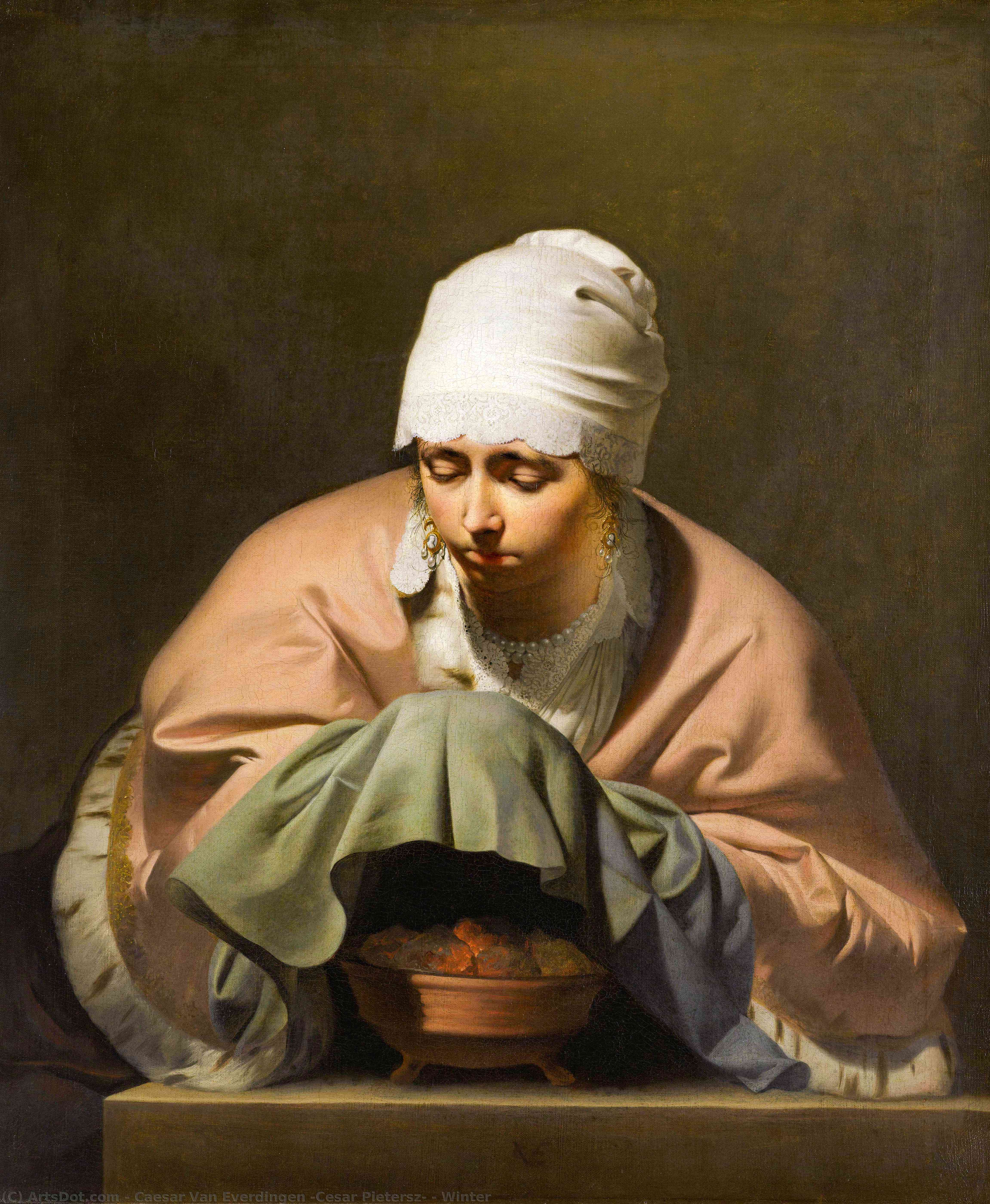
Winter (1646) autorstwa Caesar Van Everdingen

Winter

1646 · Oil On Canvas · Rijksmuseum, Amsterdam

To gaze upon Caesar Van Everdingen’s Winter is to step directly into the hushed, contemplative atmosphere of the Dutch Golden Age. This painting, executed in 1646, transcends a mere depiction of a season; it captures an ephemeral moment—a pause in the rhythm of daily life under the soft dominion of winter's breath. The composition immediately draws the eye to the central figure: a young woman whose presence is both delicate…

4
Vertumnus and Pomona (1631) autorstwa Caesar Van Everdingen

Vertumnus and Pomona

1631 · Oil

In this 1631 oil painting, the tension of a mythological pursuit unfolds within a dense, shadowed landscape. Vertumnus, the god of seasons, is depicted as an older man seated upon the earth, his gaze directed upward toward Pomona. She is positioned to the right, her back turned to the viewer, her sculptural physique partially draped in white cloth. The composition relies on a heavy use of chiaroscuro, where dramatic light…

5
Vertumnus and Pomona (1638) autorstwa Caesar Van Everdingen

Vertumnus and Pomona

1638 · Oil On Canvas · Thyssen-Bornemisza Museum, Madryt

This work, titled Vertumnus and Pomona, is a significant example of the mythological painting produced by Caesar van Everdingen. The piece is dated about 1637–1640, a period during which the artist was establishing his presence within the Dutch Golden Age. It is a work that captures a specific moment of classical narrative, rendered with the precision characteristic of his training in Utrecht.

6
Officers of the Orange Compagny of the Old Civic Guard (1641) autorstwa Caesar Van Everdingen

Officers of the Orange Compagny of the Old Civic Guard

1641 · Oil On Canvas · Stedelijk Museum, Alkmaar

In this 1641 portrait, we find ourselves standing before a dense assembly of men, the officers of the Orange Company of the Old Civic Guard. There is a certain weight to the composition, a horizontal arrangement that feels both crowded and deeply organized. These men are not merely subjects; they are a collective force, their postures providing a structural rhythm to the canvas. The lighting, descending from the upper left,…

7
Portret van Aechje Claesdr. Moer (1585-1640) (1636) autorstwa Caesar Van Everdingen

Portret van Aechje Claesdr. Moer (1585-1640)

1636 · Oil · Stedelijk Museum, Alkmaar

This 1636 oil portrait presents a three-quarter length view of an elderly woman, Aechje Claesdr. Moer, set against a somber, atmospheric backdrop. The composition relies on a sharp tonal contrast between her dark, light-absorbing gown and a large, bright white ruff collar. This millstone ruff, with its rhythmic pleats, directs the eye toward the subject's face, which is rendered with naturalistic precision. A soft, directional light enters from the upper…

8
Portrait of Pieter Cornelisz. van Everdingen (1575-1662) (1636) autorstwa Caesar Van Everdingen

Portrait of Pieter Cornelisz. van Everdingen (1575-1662)

1636 · Photography · Stedelijk Museum, Alkmaar

A woman occupies the foreground, her gaze directed toward the viewer from a waist-up perspective. She is positioned within a rural, village setting characterized by traditional thatched-roof huts and sparse vegetation. The composition utilizes linear perspective to draw the eye toward these structures, creating a sense of depth behind the central figure. Natural, bright daylight illuminates the scene, casting soft shadows that define the textures of her skin and the…

9
Vertumnus and Pomona (1650) autorstwa Caesar Van Everdingen

Vertumnus and Pomona

1650 · Oil · Muzeum J. Paula Getty'ego, Los Angeles

This Baroque-style oil painting presents an intimate mythological scene featuring two figures, Vertumnus and Pomona, set against a dark and atmospheric landscape. The composition centers on a tactile exchange of fruit between a seated figure on the left and a woman on the right. The scene is characterized by a dramatic use of chiaroscuro, where light highlights the faces and hands of the subjects while casting much of the background…

10
Portrait of an unknown girl (1651) autorstwa Caesar Van Everdingen

Portrait of an unknown girl

1651 · Oil On Canvas · Herzog Anton Ulrich Museum, Brunszwik

The work before us is the Portrait of an unknown girl, a quiet study by the Dutch Golden Age painter Caesar van Everdingen. This portrait, which is also known by the titles Girl in a Large Hat or Meisje met brede hoed, offers a glimpse into the meticulous portraiture practiced during the mid-17th century. It captures a sense of individual presence through a restrained and dignified approach to the subject.

Słynne obrazy artysty Caesar Van Everdingen, od 11 do 41

11Officers and standard-bearers of New Civic Guard in Alkmaar (1657) autorstwa Caesar Van EverdingenOfficers and standard-bearers of New Civic Guard in Alkmaar1657 · Stedelijk Museum 12Portrait of Cornelis Jacobsz. Groot (?-1661) (1656) autorstwa Caesar Van EverdingenPortrait of Cornelis Jacobsz. Groot (?-1661)1656 · Kunsthandel P. de Boer 13Four Muses and Pegasus on Parnassus (1650) autorstwa Caesar Van EverdingenFour Muses and Pegasus on Parnassus1650 · Huis ten Bosch 14Lycurgus Demonstrates the Benefits of Education (1660) autorstwa Caesar Van EverdingenLycurgus Demonstrates the Benefits of Education1660 · Stedelijk Museum 15Self-portrait of Caesar van Everdingen (?-1678) (1670) autorstwa Caesar Van EverdingenSelf-portrait of Caesar van Everdingen (?-1678)1670 · Stedelijk Museum 16Portrait of a woman, possibly a sister of Cornelis Jacobsz. Groot (1664) autorstwa Caesar Van EverdingenPortrait of a woman, possibly a sister of Cornelis Jacobsz. Groot1664 · Kunsthandel P. de Boer 17Portrait of Wollebrand Geleynsz de Jongh (1594-1674), with a servant and a child (1674) autorstwa Caesar Van EverdingenPortrait of Wollebrand Geleynsz de Jongh (1594-1674), with a servant and a child1674 · Stedelijk Museum 18Four Evangelists: John (1676) autorstwa Caesar Van EverdingenFour Evangelists: John1676 · Stedelijk Museum 19Four Evangelists: Luke (1676) autorstwa Caesar Van EverdingenFour Evangelists: Luke1676 · Stedelijk Museum 20Four Evangelists: Mark (1676) autorstwa Caesar Van EverdingenFour Evangelists: Mark1676 · Stedelijk Museum 21Joueuse de Cistre (1678) autorstwa Caesar Van EverdingenJoueuse de Cistre1678 · Musée des Beaux-Arts de Rouen 22Allegory of the Birth of Frederik Hendrik (1650) autorstwa Caesar Van EverdingenAllegory of the Birth of Frederik Hendrik1650 · Huis ten Bosch 23Female Figure, possibly Lucretia (1793) autorstwa Caesar Van EverdingenFemale Figure, possibly Lucretia1793 · Nationalmuseum 24Diogenes Seeks a True Man (1652) autorstwa Caesar Van EverdingenDiogenes Seeks a True Man1652 · Mauritshuis 25Still-Life with a Bust of Venus (1665) autorstwa Caesar Van EverdingenStill-Life with a Bust of Venus1665 · Mauritshuis 26View of the Oranjezaal (1650) autorstwa Caesar Van EverdingenView of the Oranjezaal1650 · Huis ten Bosch 27Amor Holding a Glass Orb (1660) autorstwa Caesar Van EverdingenAmor Holding a Glass Orb1660 28Count Willem II of Holland Granting Privileges (1655) autorstwa Caesar Van EverdingenCount Willem II of Holland Granting Privileges1655 · Gemeenlandshuis 29Officers and Standard-Bearers of the Old Civic Guard (1657) autorstwa Caesar Van EverdingenOfficers and Standard-Bearers of the Old Civic Guard1657 · Stedelijk Museum 30Nymphs Offering the Young Bacchus Wine, Fruit and Flowers (1670) autorstwa Caesar Van EverdingenNymphs Offering the Young Bacchus Wine, Fruit and Flowers1670 · Museum Kunstpalast 31Holy Family (1660) autorstwa Caesar Van EverdingenHoly Family1660 · Museum Catharijneconvent 32Portrait of a Girl as a Huntress (1665) autorstwa Caesar Van EverdingenPortrait of a Girl as a Huntress1665 · Koninklijk Museum voor Schone Kunsten 33Portrait of a Two-Year-Old Boy (1664) autorstwa Caesar Van EverdingenPortrait of a Two-Year-Old Boy1664 · Cannon Hall Museum 34Elisabeth van Kessel (1640-1717), Wife of Willem Jacobsz Baert, Caesar Boëtius van Everdingen, 1671 (1671) autorstwa Caesar Van EverdingenElisabeth van Kessel (1640-1717), Wife of Willem Jacobsz Baert, Caesar Boëtius van Everdingen, 16711671 · Rijksmuseum 35Willem Jacobsz Baert (1636-84), Burgomaster of Alkmaar and Amsterdam, Caesar Boëtius van Everdingen, 1671 (1671) autorstwa Caesar Van EverdingenWillem Jacobsz Baert (1636-84), Burgomaster of Alkmaar and Amsterdam, Caesar Boëtius van Everdingen, 16711671 · Rijksmuseum 36The four muses with pegasus autorstwa Caesar Van EverdingenThe four muses with pegasusHuis ten Bosch 37Portrait of a Dutch Commander autorstwa Caesar Van EverdingenPortrait of a Dutch CommanderNational Gallery 38Bacchus with Two Nymphs And Cupid autorstwa Caesar Van EverdingenBacchus with Two Nymphs And Cupid 39Pan and Syrinx, Caesar Boëtius van Everdingen, c. 1637 - c. 1640 (1640) autorstwa Caesar Van EverdingenPan and Syrinx, Caesar Boëtius van Everdingen, c. 1637 - c. 16401640 · Rijksmuseum 40Girl in a Large Hat (1647) autorstwa Caesar Van EverdingenGirl in a Large Hat1647 · Rijksmuseum 41Bacchus with Nymphs and Cupid (1660) autorstwa Caesar Van EverdingenBacchus with Nymphs and Cupid1660 · Gemäldegalerie Alte Meister

Słynne obrazy Caesar Van Everdingen epoka po epoce

Tematy, które przyciągnęły wzrok Caesar Van Everdingen

Cztery motywy najczęściej powracające w tych oryginałach, z których każdy doczekał się swojego najdoskonalszego przykładu.

Muzea przechowujące oryginały Caesar Van Everdingen

8 muzeów, w których znajduje się najwięcej obrazów z tej strony.

Muzea Miasto Dzieła artysty Caesar Van Everdingen Obrazy z tej listy
Stedelijk Museum, AlkmaarStedelijk Museum Alkmaar 11 Officers of the Orange Compagny of the Old Civic Guard, Portret van Aechje Claesdr. Moer (1585-1640), Portrait of Pieter Cornelisz. van Everdingen (1575-1662)
Rijksmuseum, AmsterdamRijksmuseum Amsterdam 6 Woman praying, Winter, Elisabeth van Kessel (1640-1717), Wife of Willem Jacobsz Baert, Caesar Boëtius van Everdingen, 1671
Huis ten Bosch, The HagueHuis ten Bosch The Hague 4 Four Muses and Pegasus on Parnassus, Allegory of the Birth of Frederik Hendrik, View of the Oranjezaal
Nationalmuseum, StockholmNationalmuseum Stockholm 2 Jupiter and Callisto, Female Figure, possibly Lucretia
Kunsthandel P. de BoerKunsthandel P. de Boer 2 Portrait of Cornelis Jacobsz. Groot (?-1661), Portrait of a woman, possibly a sister of Cornelis Jacobsz. Groot
Mauritshuis, HagaMauritshuis Haga 2 Diogenes Seeks a True Man, Still-Life with a Bust of Venus
Thyssen-Bornemisza Museum, MadrytThyssen-Bornemisza Museum Madryt 1 Vertumnus and Pomona
Muzeum J. Paula Getty'ego, Los AngelesMuzeum J. Paula Getty'ego Los Angeles 1 Vertumnus and Pomona

Caesar Van Everdingen na przestrzeni dekad: jeden unikatowy oryginał dla każdego

Dzieła według dekad

Wybierz dekadę, aby zobaczyć dzieło, które ją definiuje.

Obrazy artysty Caesar Van Everdingen: pytania do galerii

Jakie jest najsłynniejsze dzieło artysty Caesar Van Everdingen?Odkryj odpowiedź

Woman praying (1650), Rijksmuseum, Amsterdam. Następne są Jupiter and Callisto (1655) oraz Winter (1646).

W jakim wieku Caesar Van Everdingen stworzył/a Woman praying?Odkryj odpowiedź

34 lat: Woman praying pochodzi z 1650, a Caesar Van Everdingen urodził(a) się w 1616.

Które dziesięć obrazów Caesar Van Everdingen jest najbardziej znanych?Odkryj odpowiedź

Woman praying, Jupiter and Callisto, Winter, Vertumnus and Pomona, Vertumnus and Pomona, Officers of the Orange Compagny of the Old Civic Guard, Portret van Aechje Claesdr. Moer (1585-1640), Portrait of Pieter Cornelisz. van Everdingen (1575-1662), Vertumnus and Pomona i Portrait of an unknown girl. Powyższy ranking zawiera rok powstania oraz muzeum dla każdego z nich.

Ile znanych dzieł stworzył Caesar Van Everdingen?Odkryj odpowiedź

Nasz katalog zawiera 41 dzieł artysty Caesar Van Everdingen, datowanych od 1631 do 1678.

Gdzie można zobaczyć najsłynniejsze oryginały Caesar Van Everdingen?Odkryj odpowiedź

W większości znajdują się w Stedelijk Museum (Alkmaar), Rijksmuseum (Amsterdam) i Huis ten Bosch (The Hague). Powyższa tabela muzeów zawiera ich pełną listę.

W jakim okresie Caesar Van Everdingen stworzył/a swoje najsłynniejsze obrazy?Odkryj odpowiedź

W 1650s: 12 z 41 dzieł na tej stronie powstało w tym czasie, w tym Woman praying.

Który z najsłynniejszych obrazów artysty Caesar Van Everdingen powstał najwcześniej, a który najpóźniej?Odkryj odpowiedź

Na tej stronie najwcześniejszy to Vertumnus and Pomona (1631), a najpóźniejszy Joueuse de Cistre (1678).

Jakie tematy preferował Caesar Van Everdingen?Odkryj odpowiedź

Woman (13), Man (11) i Drapery (5), w ramach 41 dzieł na tej stronie.

Jakich materiałów Caesar Van Everdingen używał najczęściej?Odkryj odpowiedź

Oil On Canvas, dla 15 z 41 dzieł na tej stronie.

Do jakiego nurtu należy twórczość Caesar Van Everdingen?Odkryj odpowiedź

Baroque i Dutch golden age, sądząc po oryginałach na tej stronie.

Jakie oryginały Caesar Van Everdingen można zobaczyć w Stedelijk Museum?Odkryj odpowiedź

Officers of the Orange Compagny of the Old Civic Guard, Portret van Aechje Claesdr. Moer (1585-1640) i Portrait of Pieter Cornelisz. van Everdingen (1575-1662): Stedelijk Museum, Alkmaar posiada 11 dzieł widocznych na tej stronie.

Caesar Van Everdingen: portret artysty

Dziedzictwo światła i linii: Życie Caesara van Everdingena

W złotej erze malarstwa holenderskiego, gdy gra światła i cienia definiowała wizualną tożsamość narodu, Caesar van Everdingen wyłonił się jako mistrz subtelnych emocji i atmosferycznej głębi. Urodzony około 1616 roku w historycznym mieście Alkmaar w Holandii, jego artystyczna droga była głęboko spleciona z prestiżową linią rodową jego rodziny. Choć często omawia się go w kontekście jego sławnych braci, Allarta i Jana, Caesar wypracował dla siebie odrębne miejsce wewnątrz Złotego Wieku Holandii. Jego wczesne szkolenie pod okiem szanowanego Jana Gerritsza van Bronckhorsta w Utrechcie zapewniło mu rygorystyczne podstawy klasycznej estetyki, zaszczepiając w nim precyzję, która pozwoliła mu później wykroczyć poza czystą biegłość techniczną i osiągnąć prawdziwą wizję artystyczną.

Jego zawodowy wzrost nabrał tempa w 1632 roku, kiedy oficjalnie dołączył do cechu w Alkmaar. W tych formacyjnych latach jego repertuar charakteryzował się skrupulatnymi portretami i sugestywnymi scenami rodzajowymi – dziełami wymagającymi intensywnej obserwacji ludzkiej kondycji. Jednak wraz z dojrzewaniem talentu, rosły również jego ambicje. Wyszedł poza ramy dosłownej reprezentacji, rozwijając unikalną zdolność manipulowania pociągnięciami pędzla, aby uchwycić ulotne niuanse światła i ciężar atmosfery. Ta ewolucja wyznaczyła jego przejście od sprawnego rzemieślnika do wizjonerskiego malarza, zdolnego tchnąć życie w płótno.

Lata w Haarlem i wielkie ambicje

Kluczowy rozdział w życiu Van Everdingena otworzył się w 1648 roku, kiedy przeniósł się do tętniącego życiem, bogatego kulturowo miasta Haarlem. Ta przeprowadzka była czymś więcej niż tylko zmianą scenerii; było to zanurzenie się w samym sercu holenderskiego świata sztuki. Dzięki przystąpieniu do prestiżowego cechu św. Łukasza w Haarlem oraz aktywności w schutterij (straży obywatelskiej), Caesar wpisał się w samą tkankę społecznej i politycznej elity miasta. Te powiązania okazały się kluczowe w pozyskiwaniu zleceń, które miały zdefiniować jego historyczne znaczenie.

Być może najbardziej zapierającym dech w piersiach osiągnięciem jego kariery był udział w dekoracji Oranje Zaal (Sali Pomarańczowej) w pałacu Huis ten Bosch. To monumentalne przedsięciem wymagało mistrzostwa w malarstwie historycznym o dużej skali – gatunku wymagającym zarówno narracyjnej złożoności, jak i ogromnego rozmachu. W tym kontekście Caesar zaprezentował swoją biegłość w komponowaniu epickich scen, łącząc historyczną powagę z delikatnym dotykiem. Jego praca w tym okresie ukazała rozwijającą się zdolność do operowania skomplikowanymi kompozycjami, co sprawiło, że jego nazwisko zostało wyryte w architektonicznej historii Holandii.

Dojrzałość artystyczna i trwały wpływ

W późniejszych latach Caesar powrócił do swoich korzeni w Alkmaar, zakładając pracownię, która stała się sanktuarium nauki artystycznej. Ten okres jego życia charakteryzował się głębokim oddaniem doskonaleniu rzemiosła oraz mentorowaniem nowego pokolenia malarzy. Jego późne dzieła odzwierciedlają całe życie zgromadzonej mądrości, przejawiającej się w powracającej fascynacji tematami niebiańskimi i eterycznymi. Stał się szczególnie znany ze swoich przedstawień uskrzydlonych postaci – aniołów i istot boskich – oddanych z miękkością, która sugerowała obecność sacrum.

Znaczenie Caesara van Everdingena tkwi nie tylko w jego indywidualnych arcydziełach, ale także w jego roli jako pomostu między rygorystycznymi tradycjami wczesnego XVII wieku a bardziej emocjonalnymi, atmosferycznymi stylami, które nastąpiły później. Jego zdolność do połączenia precyzji holenderskiego portretu z wielkością narracji historycznej pozostaje świadectwem jego wszechstronności. Dziś jego prace służą jako żywe okna do duszy Holenderskiego Złotego Wieku, przypominając nam o czasach, gdy każde pociągnięcie pędzla było próbą uchwycenia wieczności w tym, co ulotne.