

 Zobacz w skali 1:1
 Wyślij
 Udostępnij
 Szczegóły
 Przewodnik

 Pobierz plik obrazu
 Podobne obiekty
 RTG
RTG Pokaz slajdów
 Statystyki
La Grande Guerre


 Czytaj więcej
Kup wysokiej rozdzielczości, ulepszony obraz cyfrowy o jakości znacznie przewyższającej podgląd online.
Każdy plik jest starannie przygotowywany przez naszych specjalistów przy użyciu zaawansowanych narzędzi oraz profesjonalnej, ręcznej retuszy. Dbamy o to, aby każdy obraz cechował się wyjątkową ostrością, precyzyjnym odwzorowaniem kolorów i subtelnymi detalami.
Ostateczny plik dostarczany jest drogą mailową w ciągu 72 godzin, zoptymalizowany do natychmiastowego wykorzystania w profesjonalnych zastosowaniach redakcyjnych i poligraficznych. To ta sama jakość, której ufają czołowe studia projektowe, wydawnictwa oraz galerie sztuki.
Obraz cyfrowy
Pobierz plik o wysokiej rozdzielczości do osobistego użytku, druku oraz projektów kreatywnych. ( Przełącz na wersję drukowaną Kup ręcznie malowany obraz)
W każdym zamówieniu na obraz cyfrowy znajduje się
Profesjonalna dostawa cyfrowa z gwarancją
Wybierając OriginalUniqueArt.com, nie otrzymujesz jedynie obrazu – otrzymujesz profesjonalnie udoskonalone cyfrowe dzieło sztuki, stworzone z najwyższą precyzją i objęte gwarancją satysfakcji. Oto wszystko, co automatycznie dołączane jest do Twojego zamówienia:

Błyskawiczna dostawa e-mailowa
Plik z obrazem cyfrowym w wysokiej rozdzielczości zostanie przesłany na Twój adres e-mail w ciągu 72 godzin od złożenia zamówienia – gotowy do natychmiastowego użycia.

Plik cyfrowy ulepszony przez AI
Twoja grafika została profesjonalnie zoptymalizowana przy użyciu zaawansowanych narzędzi AI oraz ręcznej edycji, co zapewnia maksymalną szczegółowość, klarowność i wierność kolorów.

Bezpłatna dożywotnia ponowna dostawa
Przypadkowo usunąłeś lub zgubiłeś swój plik? Bez obaw – prześlemy go Tobie ponownie w dowolnym momencie, bez żadnych opłat.

Bez opłat importowych – zawsze
Ciesz się swoją sztuką natychmiast, bez żadnych opłat celnych, należności ani kosztów dostawy – pliki cyfrowe są zawsze wolne od podatku.

Gwarancja odwzorowania kolorów
Dzięki zastosowaniu profesjonalnych narzędzi i procesów zarządzania barwą zapewniamy, że Twoje cyfrowe zdjęcie odzwierciedla oryginalne kolory tak wiernie, jak to tylko możliwe.

100 dni na satysfakcję
Jeśli nie będziesz zadowolony ze swojego cyfrowego obrazu, poprawimy go lub zwrócimy 100% kosztów w ciągu 100 dni – bez zbędnych pytań.

100% Gwarancja zwrotu pieniędzy
Nie jesteś zadowolony? Otrzymaj pełny zwrot kosztów w ciągu 100 dni od otrzymania pliku cyfrowego – bez zbędnych pytań.

Rabaty przy zamówieniach hurtowych
Kup 3 obrazy, oszczędź 10% - Kup 5, oszczędź 15% - Kup 10+, oszczędź 20%. Idealne do projektów kreatywnych, galerii i agencji.
A Dream Obscured: Delving into Magritte’s ‘The Great War’
René Magritte's 1964 painting, *The Great War*, is a quintessential example of Surrealist artistry – a work that simultaneously captivates and unsettles. It presents a formally dressed man, complete with bowler hat and dark suit, but crucially, his face is entirely concealed by a vibrant green apple. Above the apple float several delicate leaves against a backdrop of softly rendered clouds. This seemingly simple composition unlocks layers of symbolic meaning and psychological intrigue.Style & Technique: The Precision of Dreams
Magritte masterfully employs the hallmarks of his signature style in *The Great War*. His technique is rooted in traditional oil painting, characterized by meticulous detail and smooth application – a deliberate contrast to the chaotic energy often associated with Surrealism. Geometric lines define the man’s attire, sharply contrasting with the organic forms of the apple and leaves. The color palette is restrained, dominated by blacks and greys that amplify the startling vibrancy of the green apple. This calculated use of color draws immediate attention to the central symbol. Perspective is flattened, contributing to the dreamlike quality and a sense of spatial ambiguity.Symbolism & Interpretation: Beyond the Surface
The symbolism within *The Great War* is rich and open to interpretation. The apple, a recurring motif in Magritte’s work, often represents temptation, hidden knowledge, or even innocence. Here, obscuring the face, it suggests an obstruction of identity or perception. Is this a commentary on how war conceals individual humanity? Or perhaps a representation of societal conformity – the bowler hat and suit signifying adherence to norms that mask true selfhood? The leaves above the apple could symbolize fleeting life or lost memories. Given the title, “The Great War,” it’s reasonable to interpret the work as a meditation on the obscuring effects of conflict—how war hides individual stories and distorts reality.Historical Context: Post-War Reflections
Created two decades after the end of World War II, *The Great War* reflects a lingering sense of trauma and disillusionment. While Magritte wasn’t directly involved in depicting battlefield scenes, his work often grapples with themes of anxiety, alienation, and the fragility of existence – sentiments deeply felt in the post-war era. His Surrealist approach allowed him to explore these complex emotions through symbolic imagery rather than direct representation. The painting stands as a quiet yet powerful statement about the psychological impact of large-scale conflict.Emotional Impact & Aesthetic Appeal
*The Great War* evokes a profound sense of unease and mystery. The juxtaposition of familiar elements – a well-dressed man, an apple – with their illogical arrangement creates a disquieting effect. The painting isn’t overtly dramatic; its power lies in its subtle psychological tension. It invites contemplation, prompting viewers to question what lies beneath the surface and to confront the hidden realities of human experience. Its sophisticated composition and evocative symbolism make it a compelling addition to any art collection or interior space. This piece serves as a powerful statement piece, sparking conversation and adding depth to any environment. The painting’s muted tones and elegant simplicity lend themselves well to modern interiors, adding a touch of intellectual intrigue and surreal beauty.Pytania i odpowiedzi
Jakie pochodzenie narodowe stoi za Surrealism dzieła "La Grande Guerre"?
"La Grande Guerre" łączy nurt Surrealism z Belgia poprzez miejsce urodzenia jego twórcy.
W którym roku powstało dzieło "La Grande Guerre"?
Dzieło "La Grande Guerre" pochodzi z 1964 roku. Data ta pozwala umiejscowić pracę w kontekście twórczości René Magritte oraz epoki, w której powstała.
Jaka jest technika i data powstania „La Grande Guerre” autorstwa René Magritte?
"La Grande Guerre" powstało w 1964 roku przy użyciu techniki Olej na płótnie. Materiał i data opisują, w jaki sposób oraz kiedy wykonano oryginał.
Biografia artysty
Early Life and the Seeds of Surrealism
René Magritte, born René François Ghislain Magritte on November 21, 1898, in Lessines, Belgium, emerged into a world that would profoundly shape his enigmatic artistic vision. His early years were marked by an unsettling event – the suicide of his mother when he was just thirteen. The image of her body being recovered from the River Sambre, with her dress obscuring her face, became a haunting motif that would subtly permeate his later work, manifesting in veiled figures and a persistent exploration of hidden realities. This early trauma instilled within him a fascination with mystery, loss, and the unsettling power of what remains unseen. While details of his childhood remain somewhat elusive, it’s clear this formative experience laid the groundwork for his lifelong questioning of perception and representation. He began drawing lessons at age ten, revealing an innate inclination towards visual expression, but initially explored Impressionism before embarking on a path that would lead him to become one of the most significant figures in Surrealist art.Artistic Development and Influences
Magritte’s artistic journey was not immediate or straightforward. He studied at the Académie Royale des Beaux-Arts in Brussels, yet found its traditional methods stifling. His early work experimented with Futurism and Cubism, absorbing elements of these avant-garde movements but ultimately rejecting their purely formal concerns. It wasn't until encountering Giorgio de Chirico’s painting *The Song of Love* in 1922 that Magritte discovered a resonance that would irrevocably alter his artistic course. De Chirico’s dreamlike landscapes and unsettling juxtapositions unlocked within Magritte a new way of seeing – a world where the familiar could be rendered strange, and the ordinary imbued with profound mystery. This encounter sparked his commitment to Surrealism, though he often maintained a unique distance from its more overtly psychological or automatic approaches. He preferred a meticulous, almost clinical precision in his painting, using realistic techniques to depict illogical scenarios.The Heart of Surrealism: Challenging Reality
By 1926, Magritte had fully embraced the tenets of Surrealism, producing *Le Jockey Perdu (The Lost Jockey)*, widely considered his first truly surrealist work. However, his brand of Surrealism was distinct. He wasn’t interested in exploring the subconscious through free association or dream imagery in the manner of some of his contemporaries. Instead, Magritte sought to challenge viewers' perceptions of reality by presenting ordinary objects in unexpected contexts, forcing them to question their assumptions about the world around them. Iconic works like *The Treachery of Images (This is not a pipe)* (1929) brilliantly deconstructs the relationship between image and object, reminding us that a representation is never the thing itself. *Les Amants (The Lovers)* (1927-1928), with its shrouded figures, echoes the trauma of his mother’s death while simultaneously exploring themes of concealment and intimacy. *Time Transfixed* (1938) presents a locomotive bursting through a brick wall, disrupting our sense of space and time. And *The Human Condition* (1933), a canvas within a canvas, blurs the boundaries between representation and reality, prompting us to consider how we perceive and interpret the world.Later Life, Recognition, and Enduring Legacy
Despite initial struggles for recognition, Magritte’s work gradually gained prominence, particularly in the United States with exhibitions in 1936 and later retrospective shows at the Museum of Modern Art (1965) and the Metropolitan Museum of Art (1992). He remained politically engaged throughout his life, advocating for artistic autonomy. He continued to refine his signature style, exploring themes of repetition, illusion, and the power of language in paintings that are both intellectually stimulating and visually arresting. Magritte died on August 15, 1967, leaving behind a body of work that continues to captivate and challenge audiences worldwide. His influence extends far beyond the realm of painting, impacting pop art, minimalist art, conceptual art, and even advertising and film. Today, his paintings are held in major museum collections around the globe, including the Musées royaux des beaux-arts de Belgique in Brussels, which houses the Magritte Museum – dedicated entirely to his work and boasting the world’s largest collection of his creations.- Museum Collections: Musées royaux des beaux-arts de Belgique, Brussels; Magritte Museum.
Magritte's enduring legacy lies in his ability to make us see the familiar anew, to question our assumptions about reality, and to appreciate the power of art to provoke thought and inspire wonder. He wasn’t simply painting images; he was crafting visual paradoxes that continue to resonate with viewers decades after their creation, solidifying his position as a true master of Surrealism and a pivotal figure in 20th-century art.
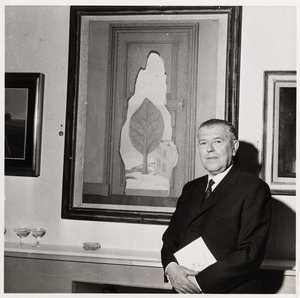
René Magritte
1898 - 1967 , Belgia
Najważniejsze informacje
- Artistic Movement Or Style: Surrealizm
- Artists Or Movements Influenced By This Artist:
- Pop art
- Minimalist sztuka
- Artists Who Influenced This Artist: ['Giorgio de Chirico']
- Date Of Birth: 21 listopada 1898
- Date Of Death: 15 sierpnia 1967
- Full Name: René François Ghislain Magritte
- Nationality: Belgijski
- Notable Artworks:
- Les Amants
- The Treachery of Images
- Time Transfixed
- Place Of Birth: Lessines, Belgia