 Zamów wydruk Kup cyfrowy obraz
 Udostępnij
 Udostępnij
 Szczegóły dzieła
 Dodaj do ulubionych

 Pobierz
 Podobne obiekty
 RTG
RTG
 Pokaz slajdów
Series I


 Rozwiń treść
Ręcznie malowana reprodukcja olejowa
Ręcznie malowany olej na płótnie w Twoim wymiarze i ramie, tworzony na zamówienie przez naszych artystów.




P118B $10

P118H $10

P118W $10

P438Z $10

P508JH $12

P508YH $12

P805H $10

P805Z $10

P919BZ $10

P919G $10

P919XJ $10

P959ZH $10

P968JZ $12

W106C $8

W218G $10

W218JH $8

W218Y $10

W307PJ $10

W316G $10

W316PJ $8

W316Y $10

W398PJ $8

W4111J $10

W500HY $15

W500JH $15

W692G $12

W849H $8

W940BG $15

W953PJ $8




Wybierz spośród naszych predefiniowanych rozmiarów, które zachowują oryginalne proporcje dzieła sztuki.

Możesz wprowadzić własne wymiary, aby dopasować obraz do konkretnej ramy lub przestrzeni. Jeśli wybrany rozmiar nie będzie odpowiadał proporcjom oryginału, przytniecie dzieło sztuki lub rozszerzymy je o dodatkowe elementy, ręcznie domalowane przez artystę. Przed rozpoczęciem produkcji wyślemy projekt cyfrowy do Twojej akceptacji.
Należy pamiętać, że podgląd na ekranie nie odzwierciedla rzeczywistego przycinania ani rozszerzania obrazu. Tylko projekt dokładnie pokaże ostateczną kompozycję.
Choć oferujemy możliwość zamówienia niestandardowych rozmiarów, zalecamy wybór wymiaru z gotowej listy, aby zachować oryginalne proporcje dzieła.
Po złożeniu zamówienia zespół OriginalUniqueArt.com skontaktuje się z klientem drogą mailową w celu uzyskania instrukcji i prześle wizualizację projektu
Dostawa na całym świecie () w ciągu 3/4 tygodni zamiast standardowych 5 tygodni. (16 Lipiec). Bez kompromisów w kwestii jakości.

Bezpłatna ekspresowa wysyłka na cały świat

Wysokiej jakości płótno lniane

Pełne ubezpieczenie przesyłki

Gwarancja zwrotu należności celnych

Gwarancja pełnego zgodności kolorystycznej

Polityka 60-dniowego zwrotu (tylko w przypadku wad)

Gwarancja 100% zwrotu pieniędzy

Zniżka przy większych zamówieniach
 Opcja szkła jest dostępna wyłącznie w rozmiarach poniżej 110 cm

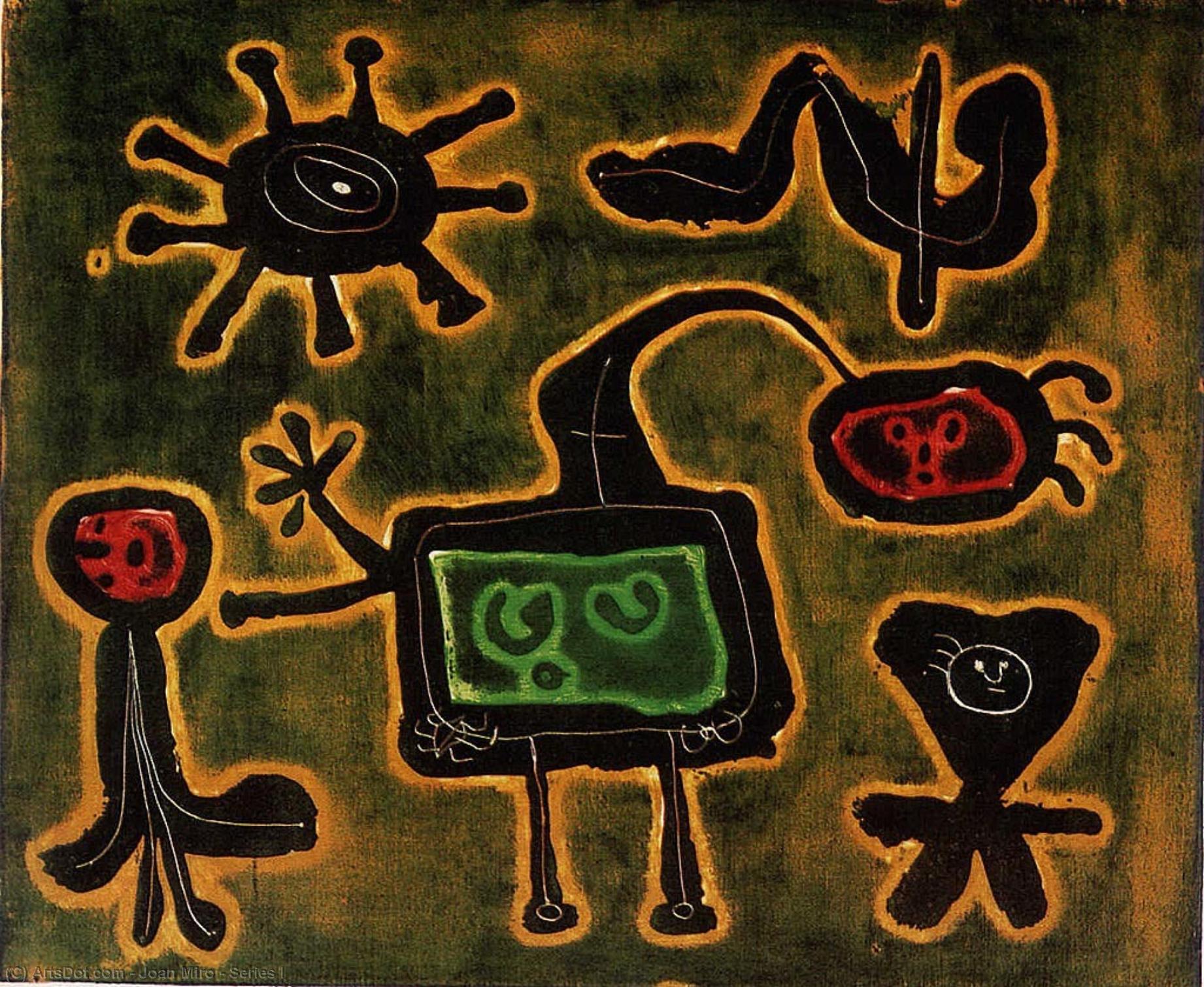
Series I
Technika reprodukcji
Wymiary reprodukcji
-


Cena całkowita
-
Opis dzieła
A Catalan Dreamscape: Exploring Joan Miró’s “Series I”
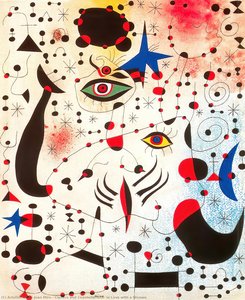
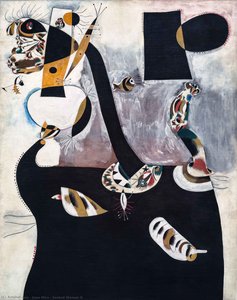
The painting "Series I" by Joan Miró, created in 1953, isn't merely an image; it’s a portal into the artist’s subconscious—a testament to his unwavering commitment to capturing the elusive realm of dreams and emotions. This seminal work exemplifies Abstract Expressionism, a movement that prioritized spontaneous gesture and emotional intensity over representational accuracy, rejecting the conventions of academic art in favor of unfiltered artistic expression. Miró's Barcelona upbringing profoundly shaped his artistic vision; the city’s architectural grandeur, particularly Gaudí’s fantastical structures—organic forms mirroring nature—served as an unspoken influence on his later explorations of abstraction.- Subject Matter: The composition presents a captivating interplay of figures and symbols – a television set perched atop one figure's head, representing the pervasive influence of media in the mid-century era; individuals holding hands, symbolizing connection and unity; and stylized representations of women, reflecting Miró’s fascination with feminine archetypes.
- Style: Miró’s style is unmistakably Abstract Expressionist. He eschewed precise depiction, opting instead for bold colors, swirling lines, and amorphous shapes that convey a sense of dynamism and spontaneity. This approach aligns perfectly with the movement's core belief in liberating art from traditional constraints.
- Technique: Miró employed a mixed media technique—primarily acrylic paint on canvas—allowing him to achieve textural richness and layering effects. The artist’s deliberate brushstrokes contribute to the painting’s expressive quality, emphasizing movement and conveying an emotional resonance that transcends literal representation.
Historical Context: The Rise of Surrealism and Abstract Expressionism
“Series I” emerged during a period of significant artistic upheaval. Surrealist ideas—drawing inspiration from Freud’s psychoanalytic theories—were gaining traction, encouraging artists to delve into the subconscious mind and explore dreamlike imagery. Simultaneously, Abstract Expressionism was blossoming in New York City, spearheaded by figures like Jackson Pollock and Willem de Kooning. Miró's work stands as a crucial bridge between these two influential movements, embodying their shared desire for emotional honesty and rejecting rational thought in favor of intuitive creativity. The painting reflects the anxieties and aspirations of its time—a yearning for transcendence amidst technological advancement.Symbolism and Emotional Resonance
Beyond its stylistic characteristics, “Series I” is laden with symbolic meaning. The television set symbolizes the intrusion of external forces into personal experience, highlighting a preoccupation with societal pressures. The figures holding hands represent human connection and empathy—a counterpoint to the anxieties of the era. Miró’s use of vibrant colors—particularly reds and yellows—evokes feelings of passion and vitality, mirroring the artist's own exuberant spirit. Viewing “Series I” evokes a sense of wonder and contemplation, inviting viewers to engage with its enigmatic imagery on an emotional level.A Legacy of Imagination
Joan Miró’s "Series I" remains a powerful emblem of Abstract Expressionism's legacy—a celebration of imagination and intuition. Its enduring appeal lies in its ability to bypass intellectual analysis, communicating directly with the viewer’s emotions. Reproductions crafted by OriginalUniqueArt.com offer an opportunity to experience this masterpiece firsthand, preserving its vibrant colors and textural nuances for generations to come.Biografia artysty
A Catalan Visionary: The Life and Art of Joan Miró
Joan Miró i Ferrà, born in Barcelona in 1893, stands as one of the most significant figures in 20th-century art. His journey was not merely a progression through styles but an exploration of inner worlds, translating dreams, memories, and Catalan identity onto canvas with a uniquely poetic visual language. From humble beginnings marked by illness and initial parental reservations about his artistic pursuits, Miró persevered, driven by an innate need to express the intangible—the emotions, sensations, and subconscious currents that lie beneath the surface of reality. His early life was steeped in the traditions of Barcelona, a city brimming with architectural marvels thanks to Antoni Gaudí, whose organic forms would subtly influence Miró’s later abstractions. The goldsmithing profession of his father instilled an appreciation for meticulous craftsmanship, while the rugged Catalan landscape became a recurring motif and source of inspiration throughout his career.Early Influences and the Path to Surrealism
Miró's formal artistic training began at La Llotja in Barcelona, where he honed his skills in traditional techniques. However, it was exposure to the avant-garde movements sweeping through Paris that truly ignited his creative evolution. The vibrant colors of Fauvism and the fragmented forms of Cubism resonated deeply, prompting him to move to Paris in 1920. This period proved pivotal as he encountered artists like Pablo Picasso and began experimenting with increasingly abstract compositions. Yet, Miró didn’t simply adopt these styles; he synthesized them, forging a path toward his own distinctive aesthetic. He sought to distill forms to their essence, stripping away representational details in favor of symbolic shapes and evocative colors. This exploration led him to the Surrealist group in 1924, aligning him with artists such as Max Ernst and Salvador Dalí. While embracing the Surrealist interest in the subconscious, Miró maintained a unique sensibility—his work was less about shocking imagery or Freudian symbolism than it was about creating a world of playful forms and poetic suggestion. He famously recounted that he returned to his Parisian studio at Rue Blomet without dinner and began sketching in his notebook, stating: “Those shapes appeared to me on the ceiling.”The Language of Symbols: Key Works and Artistic Innovations
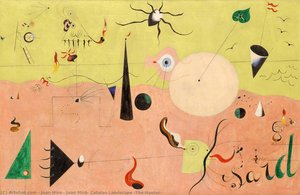
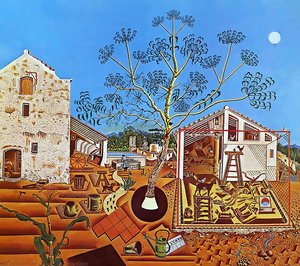
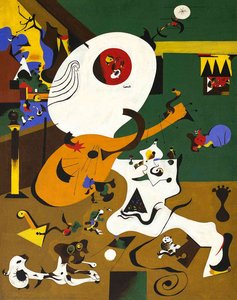
Throughout the 1920s and 30s, Miró developed his signature visual vocabulary—a universe populated by biomorphic shapes, floating forms, and vibrant colors. The Farm (1922) exemplifies this transition. It’s not merely a depiction of rural life but an evocation of Catalan identity and a symbolic representation of the natural world. His collaborative spirit led to innovative techniques like *grattage*, pioneered with Max Ernst in 1926 for designs intended for Sergei Diaghilev's ballet, where textures were revealed by scraping paint across canvas. The Dutch Interiors (1928) series demonstrated his ability to reinterpret the Old Masters through a distinctly modern lens, transforming domestic scenes into dreamlike abstractions. Painting (1933) encapsulates Miró’s exploration of the subconscious and his rejection of conventional artistic boundaries—bold colors and simplified forms conveying a profound emotional resonance. Beyond painting, Miró fearlessly experimented with sculpture, ceramics, and printmaking, expanding his creative horizons and demonstrating a remarkable versatility.Legacy and Enduring Influence
Joan Miró's impact on 20th-century art is undeniable. He wasn’t simply a painter; he was a visionary who challenged the very definition of artistic expression. His work paved the way for abstract expressionism and continues to inspire artists across disciplines. He established two foundations—the Fundació Joan Miró in Barcelona (1975) and the Fundació Pilar i Joan Miró in Palma de Mallorca (1981)—ensuring that his legacy would endure, providing spaces for artistic exploration and education. Throughout his long career, he remained committed to pushing boundaries, questioning conventions, and exploring the depths of human imagination. Miró’s art is a testament to the power of abstraction, symbolism, and poetic expression—a vibrant celebration of life, dreams, and the enduring spirit of Catalan culture. His work continues to resonate with audiences worldwide, inviting us to enter a world where anything is possible and the boundaries between reality and fantasy blur into a captivating dance of color and form.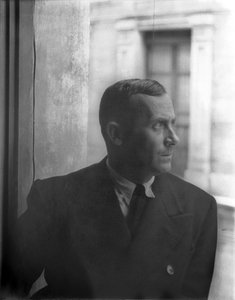
Joan Miró
1893 - 1983 , Hiszpania
Kluczowe informacje
- Artistic Movement Or Style: Surrealizm
- Artists Who Influenced This Artist:
- Pablo Picasso
- Wasilij Kandinskij
- Date Of Birth: 20 kwietnia 1893
- Date Of Death: 25 grudnia 1983
- Full Name: Joan Miró i Ferrà
- Nationality: Hiszpanka
- Notable Artworks:
- Farm
- Dutch Interiors
- Painting
- Place Of Birth: Barcelona, Hiszpania
Powiązane artykuły
10 Arcydzieł Surrealizmu: Ekspresjonistyczne Wizje w Twoim Domu | OriginalUniqueArt.com
Odkryj 10 arcydzieł surrealizmu! Poznaj historie Dalí, Magritte'a i innych mistrzów ekspresjonizmu. Inspiracje wnętrzarskie & reprodukcje obrazów najwyższej jakości na OriginalUniqueArt.com. Eksploruj kolekcję online!
André Masson: Automatism, Surrealism & Primal Expression in 20th-Century Art
Explore the revolutionary art of André Masson – pioneer of automatism & Surrealist expression. Discover his powerful imagery, innovative techniques, and lasting influence on modern art. Learn more at OriginalUniqueArt.
Joan Miró: 25 Najlepszych Dzieł Genialnego Katalońskiego Artysty | OriginalUniqueArt.com
Odkryj 25 arcydzieł Joan Miró – katalońskiego mistrza surrealizmu! Poznaj historie, techniki i inspiracje za jego kolorowymi, abstrakcyjnymi obrazami. Reprodukcje najwyższej jakości na OriginalUniqueArt.com. Eksploruj pełną kolekcję online!

Poza Granicami Rzeczywistości: Surrealizm i Ekspresjonizm w Sztuce XX Wieku – Przełomowe Kierunki i Ich Dziedzictwo
Odkryj fascynujący świat ekspresjonizmu i surrealizmu! Poznaj historię, cechy charakterystyczne oraz kluczowych artystów tych przełomowych kierunków w sztuce XX wieku. Analiza dzieł i inspiracji.
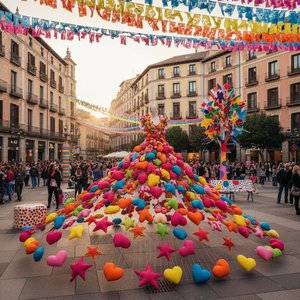
Águeda Ruiz de la Prada: A Study of Eclecticism & Emotional Resonance in Contemporary Spanish Painting
Discover the vibrant world of Ágatha Ruiz de la Prada, a leading figure in contemporary Spanish art. Explore her eclectic style, emotional depth & legacy – a must-read for discerning collectors.