Podgląd w skali 1:1
 Wyślij jako kartkę
 Udostępnij
 Szczegóły dzieła
 Przewodnik

 Pobierz obraz
 Podobne obiekty
 RTG
RTG Pokaz slajdów
 Statystyki
Para David Fernández Miró

 Rozwiń treść
Dzieło sztuki prezentowane na tej stronie podlega ochronie prawem autorskim, co oznacza, że nie mamy prawa do tworzenia ani sprzedaży jego identycznej reprodukcji. Ochrona ta jest egzekwowana na mocy umów międzynarodowych, takich jak Konwencja berneńska oraz przez przepisy prawa krajowego, w tym te określone w Prawo autorskie USA – Tytuł 17.
Metoda ta jest w pełni zgodna z przepisami prawa autorskiego, ponieważ nie polega na kopiowaniu ani powielaniu chronionego dzieła. Stanowi ona kreatywną reinterpretację – nowy obraz, który czerpie inspirację z oryginału, ale nie jest z nim tożsamy.
Giclée / Wydruk artystyczny
Wydruki giclée lub płótna o jakości muzealnej, szybka realizacja i szeroki wybór opcji wykończenia. ( Zamów ręcznie malowaną reprodukcję Przejdź do wersji cyfrowej)




P118B zł10

P118H zł10

P118W zł10

P438Z zł10

P508JH zł12

P508YH zł12

P805H zł10

P805Z zł10

P919BZ zł10

P919G zł10

P919XJ zł10

P959ZH zł10

P968JZ zł12

W106C zł8

W218G zł10

W218JH zł8

W218Y zł10

W307PJ zł10

W316G zł10

W316PJ zł8

W316Y zł10

W398PJ zł8

W4111J zł10

W500HY zł15

W500JH zł15

W692G zł12

W849H zł8

W940BG zł15

W953PJ zł8




Wybierz spośród naszych standardowych rozmiarów, które zachowują oryginalne proporcje dzieła sztuki.

Wpisz wymaganą szerokość i wysokość, aby dopasować grafikę do ramy lub ściany. Wydruk można jedynie przyciąć, nigdy nie powiększając go poza oryginalny obraz, dlatego format o innych proporcjach spowoduje utratę części kompozycji. Przed rozpoczęciem druku prześlemy Ci cyfrowy podgląd do zatwierdzenia. Obraz wyświetlany na tej stronie nie pokazuje rzeczywistego przycięcia — jedynie podgląd oddaje ten efekt.
Dostawa na cały świat () w ciągu 2 tygodni zamiast standardowych 4/5 tygodni. (26 Październik)

Bezpłatna ekspresowa wysyłka na cały świat

Wysokiej jakości płótno lniane

Pełne ubezpieczenie przesyłki

Gwarancja zwrotu należności celnych i podatków importowych

Gwarancja wiernego odwzorowania kolorów

100-dniowa polityka zwrotów (tylko w przypadku wad)

Gwarancja 100% zwrotu pieniędzy

Zniżka przy zakupie wielu sztuk
 Opcja ze szkłem jest dostępna wyłącznie w rozmiarach poniżej 110 cm

Para David Fernández Miró
Giclée / Wydruk artystyczny
Wymiary reprodukcji
-


Cena całkowita
zł 307
Introduction: A Dreamscape Unveiled – ‘Para David Fernández Miró’
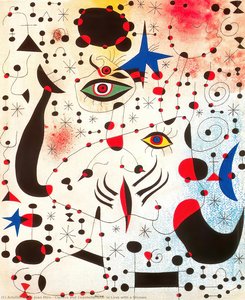
Joan Miró's 'Para David Fernández Miró', painted in 1964, isn’t merely a depiction of fish swimming through an ocean; it’s a portal into the artist’s subconscious, a vibrant embodiment of Surrealist principles and Catalan identity. This oil painting, brimming with color and imbued with a dreamlike quality, invites viewers to lose themselves within its swirling forms and playful symbolism. Miró, deeply influenced by the organic architecture of Gaudí and the rugged landscapes of his homeland, crafted this piece as a personal gift for David Fernández, a close friend and fellow artist – a testament to their shared artistic spirit and a window into Miró’s intensely private world.
The composition immediately captivates with its seemingly chaotic yet meticulously balanced arrangement. At least twelve fish, rendered in an astonishing array of hues—cerulean blues, fiery oranges, emerald greens, and deep violets—dance across the surface of a rich, ultramarine blue ocean. These aren’t realistic representations; they are abstracted symbols, each possessing a unique character and contributing to the overall sense of movement and fluidity. The fish don't swim in a linear fashion but rather drift and swirl, suggesting an underwater ballet governed by unseen forces – a direct reflection of Miró’s fascination with the irrational and the unpredictable.
The Language of Abstraction: Style and Technique
Miró’s signature style is powerfully evident in ‘Para David Fernández Miró’. He employs bold, gestural brushstrokes, creating a textured surface that pulsates with energy. The forms are deliberately ambiguous, resisting precise definition and inviting multiple interpretations. This abstraction isn't random; it’s rooted in a deep understanding of color theory and composition. The use of oil paint allows for incredible depth and luminosity, capturing the shimmering quality of water and the iridescent sheen of the fish scales. Notice how light seems to emanate from within the painting, creating an otherworldly glow.
Miró’s technique is a masterful blend of spontaneity and control. He began with loose sketches and intuitive gestures, allowing his subconscious to guide his hand. However, he then refined these initial marks, adding details and shaping forms with careful precision. This interplay between improvisation and deliberate execution results in a work that feels both deeply personal and remarkably polished.
Symbolism and the Catalan Soul
Beyond its purely aesthetic qualities, ‘Para David Fernández Miró’ is rich in symbolism, reflecting Miró's unique worldview and his connection to Catalonia. The fish themselves are frequently interpreted as symbols of fertility, abundance, and transformation – recurring motifs in Miró’s oeuvre. Their vibrant colors evoke the Mediterranean Sea, a defining element of Catalan identity and a source of endless inspiration for the artist. The scattered arrangement could also represent the fragmentation of memory or the fleeting nature of dreams.
Furthermore, the painting subtly incorporates elements of Catalan folklore and mythology. The swirling forms and organic shapes recall the intricate patterns found in traditional Catalan textiles and ceramics. Miró often drew upon these cultural traditions to create works that were both deeply personal and universally resonant. The overall effect is a potent distillation of Catalan spirit – a celebration of beauty, mystery, and the power of imagination.
A Legacy of Surrealism: Historical Context
‘Para David Fernández Miró’ stands as a significant example of Surrealist art, a movement that sought to liberate the mind from the constraints of reason and explore the depths of the unconscious. Miró embraced the principles of automatism – spontaneous creation without conscious control – but he infused his work with a distinctly personal style, rejecting the rigid dogma of the group. This painting exemplifies Miró’s ability to translate his inner world onto canvas, creating images that are both dreamlike and profoundly moving.
Miró's exploration of the subconscious aligns perfectly with the broader Surrealist project, which aimed to challenge conventional notions of reality and reveal the hidden truths beneath the surface. ‘Para David Fernández Miró’ is a testament to Miró’s enduring influence on 20th-century art, continuing to inspire artists today with its bold vision and captivating beauty. It's a piece that invites contemplation, sparking the imagination and reminding us of the power of art to transport us beyond the boundaries of our everyday experience.
Pytania i odpowiedzi
Czy dzieło "Para David Fernández Miró" jest w ogólnym rozrachunku jaśniejsze czy ciemniejsze?
Jasność dzieła „Para David Fernández Miró” – Joan Miró wynosi bright, przy luminancji na poziomie Gentle Luminance.
W jaki sposób styl dzieła "Para David Fernández Miró" odnosi się do epoki jego twórcy?
„Para David Fernández Miró” – Joan Miró reprezentuje nurt Surrealist Movement, powstały w epoce Nowoczesność swojego twórcy.
Czy „Para David Fernández Miró” – Joan Miró znajduje się w domenie publicznej?
„Para David Fernández Miró” – Joan Miró znajduje się w domenie publicznej (nadal objęte ochroną prawa autorskiego). Status ten określa zasady reprodukcji obrazu tego dzieła.
Biografia artysty
A Catalan Visionary: The Life and Art of Joan Miró
Joan Miró i Ferrà, born in Barcelona in 1893, stands as one of the most significant figures in 20th-century art. His journey was not merely a progression through styles but an exploration of inner worlds, translating dreams, memories, and Catalan identity onto canvas with a uniquely poetic visual language. From humble beginnings marked by illness and initial parental reservations about his artistic pursuits, Miró persevered, driven by an innate need to express the intangible—the emotions, sensations, and subconscious currents that lie beneath the surface of reality. His early life was steeped in the traditions of Barcelona, a city brimming with architectural marvels thanks to Antoni Gaudí, whose organic forms would subtly influence Miró’s later abstractions. The goldsmithing profession of his father instilled an appreciation for meticulous craftsmanship, while the rugged Catalan landscape became a recurring motif and source of inspiration throughout his career.Early Influences and the Path to Surrealism
Miró's formal artistic training began at La Llotja in Barcelona, where he honed his skills in traditional techniques. However, it was exposure to the avant-garde movements sweeping through Paris that truly ignited his creative evolution. The vibrant colors of Fauvism and the fragmented forms of Cubism resonated deeply, prompting him to move to Paris in 1920. This period proved pivotal as he encountered artists like Pablo Picasso and began experimenting with increasingly abstract compositions. Yet, Miró didn’t simply adopt these styles; he synthesized them, forging a path toward his own distinctive aesthetic. He sought to distill forms to their essence, stripping away representational details in favor of symbolic shapes and evocative colors. This exploration led him to the Surrealist group in 1924, aligning him with artists such as Max Ernst and Salvador Dalí. While embracing the Surrealist interest in the subconscious, Miró maintained a unique sensibility—his work was less about shocking imagery or Freudian symbolism than it was about creating a world of playful forms and poetic suggestion. He famously recounted that he returned to his Parisian studio at Rue Blomet without dinner and began sketching in his notebook, stating: “Those shapes appeared to me on the ceiling.”The Language of Symbols: Key Works and Artistic Innovations
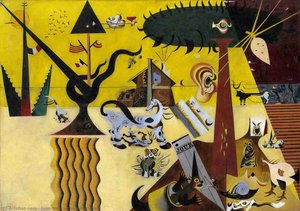
Throughout the 1920s and 30s, Miró developed his signature visual vocabulary—a universe populated by biomorphic shapes, floating forms, and vibrant colors. The Farm (1922) exemplifies this transition. It’s not merely a depiction of rural life but an evocation of Catalan identity and a symbolic representation of the natural world. His collaborative spirit led to innovative techniques like *grattage*, pioneered with Max Ernst in 1926 for designs intended for Sergei Diaghilev's ballet, where textures were revealed by scraping paint across canvas. The Dutch Interiors (1928) series demonstrated his ability to reinterpret the Old Masters through a distinctly modern lens, transforming domestic scenes into dreamlike abstractions. Painting (1933) encapsulates Miró’s exploration of the subconscious and his rejection of conventional artistic boundaries—bold colors and simplified forms conveying a profound emotional resonance. Beyond painting, Miró fearlessly experimented with sculpture, ceramics, and printmaking, expanding his creative horizons and demonstrating a remarkable versatility.Legacy and Enduring Influence
Joan Miró's impact on 20th-century art is undeniable. He wasn’t simply a painter; he was a visionary who challenged the very definition of artistic expression. His work paved the way for abstract expressionism and continues to inspire artists across disciplines. He established two foundations—the Fundació Joan Miró in Barcelona (1975) and the Fundació Pilar i Joan Miró in Palma de Mallorca (1981)—ensuring that his legacy would endure, providing spaces for artistic exploration and education. Throughout his long career, he remained committed to pushing boundaries, questioning conventions, and exploring the depths of human imagination. Miró’s art is a testament to the power of abstraction, symbolism, and poetic expression—a vibrant celebration of life, dreams, and the enduring spirit of Catalan culture. His work continues to resonate with audiences worldwide, inviting us to enter a world where anything is possible and the boundaries between reality and fantasy blur into a captivating dance of color and form.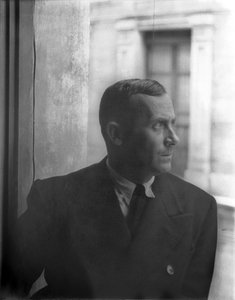
Joan Miró
1893 - 1983 , Hiszpania
Krótka nota
- Artistic Movement Or Style: Surrealizm
- Artists Who Influenced This Artist:
- Pablo Picasso
- Wasilij Kandinskij
- Date Of Birth: 20 kwietnia 1893
- Date Of Death: 25 grudnia 1983
- Full Name: Joan Miró i Ferrà
- Nationality: Hiszpanka
- Notable Artworks:
- Farm
- Dutch Interiors
- Painting
- Place Of Birth: Barcelona, Hiszpania
Powiązane artykuły
Surrealizm w sztuce: 10 arcydzieł, które zmieniły postrzeganie rzeczywistości | OriginalUniqueArt.com
Odkryj 10 arcydzieł surrealizmu! Poznaj historie Dalí, Magritte'a i innych mistrzów tego ruchu. Inspiracje wnętrzarskie i reprodukcje obrazów najwyższej jakości na OriginalUniqueArt.com. Eksploruj pełną kolekcję online!

25 Arcydzieł Kandinskiego: Kolor, Duchowość i Abstrakcja w Twoim Domu | OriginalUniqueArt.com
Odkryj 25 arcydzieł Wassily Kandinskiego – pioniera abstrakcji i ekspresjonizmu! Poznaj historie, techniki i emocje kryjące się za jego kolorowymi kompozycjami. Reprodukcje obrazów najwyższej jakości na OriginalUniqueArt.com. Eksploruj pełną kolekcję online!
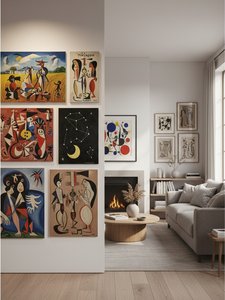
Joan Miró: 25 Najlepszych Dzieł Genialnego Katalońskiego Artysty | OriginalUniqueArt.com
Odkryj 25 arcydzieł Joan Miró – katalońskiego mistrza surrealizmu! Poznaj historie, techniki i inspiracje za jego kolorowymi, abstrakcyjnymi obrazami. Reprodukcje najwyższej jakości na OriginalUniqueArt.com. Eksploruj pełną kolekcję online!

Top 10 arcydzieł ekspresjonizmu abstrakcyjnego – inspiracje dla Twojego wnętrza | OriginalUniqueArt.com
Odkryj 10 arcydzieł ekspresjonizmu abstrakcyjnego – Pollock, Rothko, de Kooning i inni. Poznaj historie artystów, techniki i inspiracje dla Twojego wnętrza. Reprodukcje najwyższej jakości na OriginalUniqueArt.com!

Geometria Sztuki: 10 Arcydzieł Abstrakcji Geometrycznej | OriginalUniqueArt.com
Odkryj 10 arcydzieł abstrakcji geometrycznej! Poznaj historię Mondriana, Kandinskiego i Maleвича. Inspiracje wnętrzarskie z malarstwem abstrakcyjnym – reprodukcje najwyższej jakości na OriginalUniqueArt.com. Eksploruj kolekcję online!