Zobacz w skali 1:1
 Wyślij
 Udostępnij
 Szczegóły
 Przewodnik

 Pobierz plik obrazu
 Podobne obiekty
 RTG
RTG Pokaz slajdów
 Statystyki
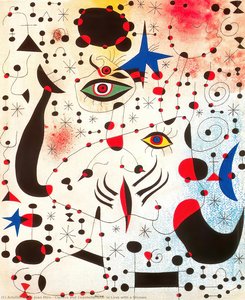
Constellation: Toward the Rainbow
 Acrylic On Paper
- Surrealist Expressionism
 1941
1941- Early Medieval
 46.0 x 38.0 cm
 Czytaj więcej
Dzieło sztuki prezentowane na tej stronie podlega ochronie prawem autorskim, co oznacza, że nie mamy prawa do tworzenia ani sprzedaży jego identycznej reprodukcji. Ochrona ta jest egzekwowana na mocy umów międzynarodowych, takich jak Konwencja berneńska oraz przez przepisy prawa krajowego, w tym te określone w Prawo autorskie USA – Tytuł 17.
Metoda ta jest w pełni zgodna z przepisami prawa autorskiego, ponieważ nie polega na kopiowaniu ani powielaniu chronionego dzieła. Stanowi ona kreatywną reinterpretację – nowy obraz, który czerpie inspirację z oryginału, ale nie jest z nim tożsamy.
Giclée / Wydruk artystyczny
Wydruki giclée lub płótna o jakości muzealnej, szybka realizacja i szeroki wybór opcji wykończenia. ( Kup ręcznie malowany obraz Przełącz na wersję cyfrową)




P118B zł10

P118H zł10

P118W zł10

P438Z zł10

P508JH zł12

P508YH zł12

P805H zł10

P805Z zł10

P919BZ zł10

P919G zł10

P919XJ zł10

P959ZH zł10

P968JZ zł12

W106C zł8

W218G zł10

W218JH zł8

W218Y zł10

W307PJ zł10

W316G zł10

W316PJ zł8

W316Y zł10

W398PJ zł8

W4111J zł10

W500HY zł15

W500JH zł15

W692G zł12

W849H zł8

W940BG zł15

W953PJ zł8




Wybierz spośród naszych standardowych rozmiarów, które zachowują oryginalne proporcje dzieła sztuki.

Możesz wprowadzić własne wymiary, aby dopasować dzieło do konkretnej ramy lub przestrzeni. Jeśli wybrany rozmiar nie będzie odpowiadał proporcjom oryginalnego obrazu, przytniecie dzieło lub rozszerzymy obraz za pomocą odbicia lustrzanego lub jednolitego wypełnienia krawędzi. Przed rozpoczęciem produkcji prześlemy cyfrową wizualizację do Twojej akceptacji.
Prosimy pamiętać, że podgląd na ekranie nie odzwierciedla faktycznego przycinania ani rozszerzania. Tylko wizualizacja dokładnie pokaże końcową kompozycję.
Mimo dostępności niestandardowych rozmiarów, zalecamy wybór wymiaru z listy zdefiniowanej, aby zachować oryginalne proporcje.
Dostawa na cały świat () w ciągu 2 tygodni zamiast standardowych 4/5 tygodni. (14 Październik)

Bezpłatna ekspresowa wysyłka na cały świat

Wysokiej jakości płótno lniane

Pełne ubezpieczenie transportowe

Gwarancja zwrotu należności celnych i podatków importowych

Gwarancja idealnego odwzorowania barw

100-dniowy okres na zwrot dzieła w przypadku wykrycia wad produkcyjnych

Gwarancja 100% zwrotu pieniędzy

Oferta przy zakupie wielu sztuk
 Opcja ze szkłem jest dostępna wyłącznie w rozmiarach poniżej 110 cm

Constellation: Toward the Rainbow
Giclée / Wydruk artystyczny
Rozmiar reprodukcji
-


Suma do zapłaty
zł 301
A Celestial Dance: Exploring Joan Miró’s “Constellation: Toward the Rainbow”
Joan Miró's "Constellation: Toward the Rainbow," painted in 1941, isn’t merely a depiction of stars; it’s an immersion into the artist’s subconscious, a vibrant echo of his escape from the turmoil of World War II. Created during a period of profound personal and historical upheaval, this gouache on paper offers a glimpse into Miró's uniquely poetic vision – one that seamlessly blends dreamscape imagery with a deeply rooted connection to Catalan identity and the rhythms of nature.
The painting immediately captivates with its riotous color palette. Deep blues and greens intertwine with fiery reds and ochres, creating an atmosphere both unsettling and strangely comforting. Miró’s signature style is powerfully evident: a constellation of amorphous shapes – hourglasses, circles, triangles, and crescent moons – dominates the composition. These aren't precise representations but rather intuitive symbols, each imbued with personal meaning for the artist. The thin black lines that connect them evoke the intricate latticework of a wrought-iron screen or perhaps even a fantastical map charting the course through an imagined cosmos.
The Language of Symbols and Surrealism
Miró’s work is inextricably linked to the Surrealist movement, yet he developed a distinct vocabulary that transcended rigid categorization. “Constellation: Toward the Rainbow” exemplifies this – it's less about replicating reality and more about expressing an internal state. The recurring face-like shape in the lower left corner isn’t a literal portrait but rather a primal symbol of recognition, perhaps representing the artist himself or a fragment of memory surfacing from the depths of his imagination. The abundance of eyes scattered throughout the piece suggests a heightened awareness, a constant observation of the unseen and the intuitive.
Interestingly, Miró’s own words shed light on this process. He described how music and the night, coupled with the stars, became crucial elements in shaping his work during this period. This wasn't simply an artistic response to war; it was a deliberate act of self-preservation – a retreat into a realm where logic dissolved and imagination reigned supreme. The painting can be interpreted as a visual manifestation of that inner sanctuary, a testament to the power of art as a means of psychological survival.
Craftsmanship and Context: A Window into Miró’s Process
Each “Constellation” gouache took approximately a month to complete, reflecting the painstaking care with which Miró approached his work. The meticulous layering of color and the deliberate placement of each shape demonstrate a remarkable level of control despite the seemingly chaotic nature of the composition. The choice of gouache – a medium known for its luminous quality and ability to blend seamlessly – further enhances the painting’s ethereal atmosphere.
Painted in Palma de Mallorca after Miró's return from France, “Constellation: Toward the Rainbow” represents a pivotal moment in his artistic evolution. It stands as a bridge between his earlier explorations of Catalan folklore and his later, more abstract works. The piece offers a poignant reminder that even amidst darkness and uncertainty, art can provide solace, inspiration, and a pathway to inner peace – a sentiment powerfully conveyed through Miró’s vibrant and enduring vision.
Bringing the Cosmos Home: Reproduction Details
OriginalUniqueArt is proud to offer meticulously crafted hand-painted reproductions of Joan Miró's “Constellation: Toward the Rainbow.” Our artists replicate the original’s rich colors, intricate details, and evocative atmosphere with exceptional precision. Available in a range of sizes – from 46 x 38 cm to larger formats – this artwork is perfect for collectors, interior designers, or anyone seeking to infuse their space with Miró's distinctive poetic sensibility. Each reproduction is created using archival-quality materials, ensuring its longevity and beauty for generations to come. Explore our collection today and bring a piece of the cosmos into your home.
Pytania i odpowiedzi
Jaki poziom luminancji ma „Constellation: Toward the Rainbow” autorstwa Joan Miró?
Kolory dzieła "Constellation: Toward the Rainbow" wykazują luminancję na poziomie Soft Shadow.
Ile lat miał(a) Joan Miró, tworząc "Constellation: Toward the Rainbow" w 1941 roku?
Gdy w 1941 roku powstało dzieło „Constellation: Toward the Rainbow”, Joan Miró – urodzony/a w 1893 – miał/a 48 lat.
Z jakim etapem kariery Joan Miró odpowiada data 1941 dla dzieła „Constellation: Toward the Rainbow”?
Biorąc pod uwagę datę powstania (1941), dzieło „Constellation: Toward the Rainbow” wpisuje się w Late Period twórczości Joan Miró.
W jaki sposób mogę obejrzeć „Constellation: Toward the Rainbow” autorstwa Joan Miró w formie pokazu slajdów?
Prezentację slajdów dzieła "Constellation: Toward the Rainbow" można obejrzeć na stronie Pokaz slajdów tego utworu.
Do jakiego pomieszczenia polecane jest dzieło „Constellation: Toward the Rainbow” autorstwa Joan Miró?
Zalecaną przestrzenią dla „Constellation: Toward the Rainbow” autorstwa Joan Miró jest Living Room. Sugestia ta może zostać oczywiście dostosowana do Twojego wnętrza.
Kto stworzył "Constellation: Toward the Rainbow" i kiedy?
Dzieło "Constellation: Toward the Rainbow" zostało stworzone przez Joan Miró w 1941 roku.
W jaki sposób "Constellation: Toward the Rainbow" balansuje światło i cień?
„Constellation: Toward the Rainbow” charakteryzuje się ogólną jasnością na poziomie balanced, a jej luminancja wynosi Soft Shadow.
Który kolor najbardziej wyróżnia się w "Constellation: Toward the Rainbow"?
Kolorem, który najbardziej wyróżnia się w "Constellation: Toward the Rainbow", jest Espresso (#3c393b). Dominujący kolor jest pomocny przy dopasowywaniu dzieła sztuki do wnętrza.
Biografia artysty
A Catalan Visionary: The Life and Art of Joan Miró
Joan Miró i Ferrà, born in Barcelona in 1893, stands as one of the most significant figures in 20th-century art. His journey was not merely a progression through styles but an exploration of inner worlds, translating dreams, memories, and Catalan identity onto canvas with a uniquely poetic visual language. From humble beginnings marked by illness and initial parental reservations about his artistic pursuits, Miró persevered, driven by an innate need to express the intangible—the emotions, sensations, and subconscious currents that lie beneath the surface of reality. His early life was steeped in the traditions of Barcelona, a city brimming with architectural marvels thanks to Antoni Gaudí, whose organic forms would subtly influence Miró’s later abstractions. The goldsmithing profession of his father instilled an appreciation for meticulous craftsmanship, while the rugged Catalan landscape became a recurring motif and source of inspiration throughout his career.Early Influences and the Path to Surrealism
Miró's formal artistic training began at La Llotja in Barcelona, where he honed his skills in traditional techniques. However, it was exposure to the avant-garde movements sweeping through Paris that truly ignited his creative evolution. The vibrant colors of Fauvism and the fragmented forms of Cubism resonated deeply, prompting him to move to Paris in 1920. This period proved pivotal as he encountered artists like Pablo Picasso and began experimenting with increasingly abstract compositions. Yet, Miró didn’t simply adopt these styles; he synthesized them, forging a path toward his own distinctive aesthetic. He sought to distill forms to their essence, stripping away representational details in favor of symbolic shapes and evocative colors. This exploration led him to the Surrealist group in 1924, aligning him with artists such as Max Ernst and Salvador Dalí. While embracing the Surrealist interest in the subconscious, Miró maintained a unique sensibility—his work was less about shocking imagery or Freudian symbolism than it was about creating a world of playful forms and poetic suggestion. He famously recounted that he returned to his Parisian studio at Rue Blomet without dinner and began sketching in his notebook, stating: “Those shapes appeared to me on the ceiling.”The Language of Symbols: Key Works and Artistic Innovations
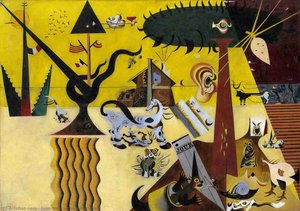
Throughout the 1920s and 30s, Miró developed his signature visual vocabulary—a universe populated by biomorphic shapes, floating forms, and vibrant colors. The Farm (1922) exemplifies this transition. It’s not merely a depiction of rural life but an evocation of Catalan identity and a symbolic representation of the natural world. His collaborative spirit led to innovative techniques like *grattage*, pioneered with Max Ernst in 1926 for designs intended for Sergei Diaghilev's ballet, where textures were revealed by scraping paint across canvas. The Dutch Interiors (1928) series demonstrated his ability to reinterpret the Old Masters through a distinctly modern lens, transforming domestic scenes into dreamlike abstractions. Painting (1933) encapsulates Miró’s exploration of the subconscious and his rejection of conventional artistic boundaries—bold colors and simplified forms conveying a profound emotional resonance. Beyond painting, Miró fearlessly experimented with sculpture, ceramics, and printmaking, expanding his creative horizons and demonstrating a remarkable versatility.Legacy and Enduring Influence
Joan Miró's impact on 20th-century art is undeniable. He wasn’t simply a painter; he was a visionary who challenged the very definition of artistic expression. His work paved the way for abstract expressionism and continues to inspire artists across disciplines. He established two foundations—the Fundació Joan Miró in Barcelona (1975) and the Fundació Pilar i Joan Miró in Palma de Mallorca (1981)—ensuring that his legacy would endure, providing spaces for artistic exploration and education. Throughout his long career, he remained committed to pushing boundaries, questioning conventions, and exploring the depths of human imagination. Miró’s art is a testament to the power of abstraction, symbolism, and poetic expression—a vibrant celebration of life, dreams, and the enduring spirit of Catalan culture. His work continues to resonate with audiences worldwide, inviting us to enter a world where anything is possible and the boundaries between reality and fantasy blur into a captivating dance of color and form.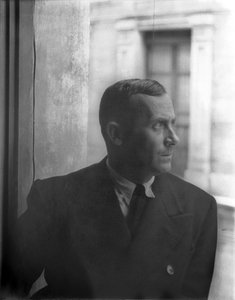
Joan Miró
1893 - 1983 , Hiszpania
Najważniejsze informacje
- Artistic Movement Or Style: Surrealizm
- Artists Who Influenced This Artist:
- Pablo Picasso
- Wasilij Kandinskij
- Date Of Birth: 20 kwietnia 1893
- Date Of Death: 25 grudnia 1983
- Full Name: Joan Miró i Ferrà
- Nationality: Hiszpanka
- Notable Artworks:
- Farm
- Dutch Interiors
- Painting
- Place Of Birth: Barcelona, Hiszpania
Zobacz także powiązane artykuły
Joan Miró: 25 Najlepszych Dzieł Genialnego Katalońskiego Artysty | OriginalUniqueArt.com
Odkryj 25 arcydzieł Joan Miró – katalońskiego mistrza surrealizmu! Poznaj historie, techniki i inspiracje za jego kolorowymi, abstrakcyjnymi obrazami. Reprodukcje najwyższej jakości na OriginalUniqueArt.com. Eksploruj pełną kolekcję online!
Surrealizm w sztuce: 10 arcydzieł, które zmieniły postrzeganie rzeczywistości | OriginalUniqueArt.com
Odkryj 10 arcydzieł surrealizmu! Poznaj historie Dalí, Magritte'a i innych mistrzów tego ruchu. Inspiracje wnętrzarskie i reprodukcje obrazów najwyższej jakości na OriginalUniqueArt.com. Eksploruj pełną kolekcję online!

Złota Era Stylu: Estetyczne Zasady i Trwałe Dziedzictwo Art Deco
Poznaj fascynującą historię Art Deco – od narodzin stylu po współczesne inspiracje. Ekspercka analiza cech, wpływ na architekturę i wzornictwo oraz ikoniczne dzieła tego glamour okresu. Odkryj dziedzictwo Art Deco!
10 Arcydzieł Surrealizmu, które Zdefiniowały Sztukę XX Wieku | OriginalUniqueArt
Odkryj 10 arcydzieł surrealizmu, które zrewolucjonizowały sztukę! Poznaj historie Dalíego, Magritte'a i innych mistrzów. Reprodukcje obrazów najwyższej jakości na OriginalUniqueArt.com – inspiracje dla Twojego wnętrza.

Blask i geometria pragnień: Wpływ Art Deco na współczesną kulturę wizualną
Odkryj fascynujący świat Art Deco! Poznaj historię tego ikonicznego stylu, jego wpływ na architekturę i design oraz dziedzictwo we współczesnej kulturze wizualnej. Ekspercka analiza i inspiracje dla miłośników sztuki.