Zobacz w skali 1:1
 Wyślij
 Udostępnij
 Szczegóły
 Przewodnik

 Pobierz plik obrazu
 Podobne obiekty
 RTG
RTG Pokaz slajdów
 Statystyki
Comedy scene (scene from Molière)


 Czytaj więcej
Giclée / Wydruk artystyczny
Wydruki giclée lub płótna o jakości muzealnej, szybka realizacja i szeroki wybór opcji wykończenia. ( Kup ręcznie malowany obraz Przełącz na wersję cyfrową)




P118B zł10

P118H zł10

P118W zł10

P438Z zł10

P508JH zł12

P508YH zł12

P805H zł10

P805Z zł10

P919BZ zł10

P919G zł10

P919XJ zł10

P959ZH zł10

P968JZ zł12

W106C zł8

W218G zł10

W218JH zł8

W218Y zł10

W307PJ zł10

W316G zł10

W316PJ zł8

W316Y zł10

W398PJ zł8

W4111J zł10

W500HY zł15

W500JH zł15

W692G zł12

W849H zł8

W940BG zł15

W953PJ zł8




Wybierz spośród naszych standardowych rozmiarów, które zachowują oryginalne proporcje dzieła sztuki.

Wpisz wymaganą szerokość i wysokość, aby dopasować grafikę do ramy lub ściany. Wydruk można jedynie przyciąć, nigdy nie powiększając go poza oryginalny obraz, dlatego format o innym proporcji spowoduje utratę części kompozycji. Przed rozpoczęciem druku prześlemy Ci cyfrowy podgląd do zatwierdzenia. Obraz wyświetlany na tej stronie nie pokazuje rzeczywistego przycięcia — jedynie podgląd oddaje ten efekt.
Dostawa na cały świat () w ciągu 2 tygodni zamiast standardowych 4/5 tygodni. (23 Październik)

Bezpłatna ekspresowa wysyłka na cały świat

Wysokiej jakości płótno lniane

Pełne ubezpieczenie transportowe

Gwarancja zwrotu należności celnych i podatków importowych

Gwarancja idealnego odwzorowania barw

100-dniowy okres na zwrot dzieła w przypadku wykrycia wad produkcyjnych

Gwarancja 100% zwrotu pieniędzy

Oferta przy zakupie wielu sztuk
 Opcja ze szkłem jest dostępna wyłącznie w rozmiarach poniżej 110 cm

Comedy scene (scene from Molière)
Giclée / Wydruk artystyczny
Rozmiar reprodukcji
-


Suma do zapłaty
zł 308
A Moment of Contention: Honoré Daumier’s “Comedy Scene (Scene from Molière)”
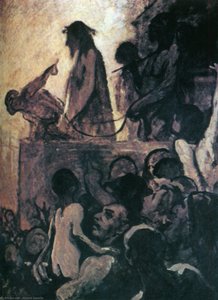
Honoré Daumier's 1862 painting, "Comedy Scene (Scene from Molière)," isn’t merely a depiction of a theatrical moment; it’s a vibrant snapshot of Parisian society grappling with wit, social commentary, and the very nature of performance. The work, rendered in stark black and white – a signature technique for Daumier – immediately draws the viewer into a scene brimming with unspoken tension and subtle gestures. Two men dominate the foreground: one, animatedly gesturing upwards, seemingly addressing an unseen audience; the other, slumped downwards, his gaze fixed on his companion, perhaps lost in thought or responding to the first man’s pronouncements.
Beyond these central figures lies a carefully constructed backdrop of three additional individuals, subtly positioned in the background. Their presence isn't one of active participation but rather serves as a quiet reminder of the broader social context surrounding this private exchange. They are not integrated into the immediate drama, yet their inclusion suggests that this scene unfolds within a larger, more complex world – a world ripe for observation and critique, precisely what Daumier excelled at capturing.
The Artist’s Vision: Realism and Social Satire
Daumier was a pivotal figure in the development of French realism, but his work transcends simple representation. He wasn't interested in idealized beauty or romanticized narratives; instead, he sought to expose the uncomfortable truths of everyday life – particularly the hypocrisy and social inequalities prevalent in 19th-century France. His art became a powerful tool for social commentary, often targeting the aristocracy, the clergy, and the legal system. “Comedy Scene” is no exception, offering a glimpse into a private conversation that hints at underlying tensions and judgments.
The painting’s monochrome palette – predominantly shades of gray and white – contributes significantly to its dramatic effect. This deliberate choice eliminates distractions, forcing the viewer to focus on the figures' expressions and body language. Daumier masterfully employs chiaroscuro—the contrast between light and dark—to sculpt the forms and heighten the sense of drama. The sharp delineation of shadows emphasizes the characters’ postures and gestures, conveying a palpable atmosphere of anticipation and potential conflict.
A Stage Within a Stage: Molière and Parisian Society
The painting's title explicitly references Molière, the renowned French playwright whose comedies satirized societal norms. Daumier wasn’t simply illustrating a scene from one of Molière’s plays; he was capturing the *spirit* of theatrical performance itself – the interplay between performer and audience, the delivery of witty dialogue, and the subtle judgments exchanged during a dramatic moment. The implied setting is likely a Parisian theater, though Daumier deliberately avoids providing specific details, allowing the viewer to project their own interpretations onto the scene.
Furthermore, the painting reflects the vibrant intellectual and artistic life of 19th-century Paris. The Comédie-Française, France’s national theatre, was a central hub for social and political discourse. Daumier's work engages with this dynamic environment, offering a critical perspective on the role of theater in shaping public opinion and exposing societal flaws.
Symbolism and Emotional Resonance
The posture of the two men is particularly revealing. The man gesturing upwards embodies assertiveness and perhaps even arrogance, projecting his thoughts or opinions to an unseen audience. His elevated position suggests a desire for recognition or validation. Conversely, the slumped figure conveys a sense of resignation, doubt, or perhaps quiet disapproval. His downward gaze hints at a critical assessment of the first man’s pronouncements – a subtle challenge to his authority or perspective.
“Comedy Scene” is not a straightforward narrative; it's an invitation to observe and interpret. It evokes a sense of unease, prompting viewers to consider the complexities of human interaction and the often-hidden judgments that shape our perceptions. Daumier’s masterful use of composition, light, and gesture creates a timeless image that continues to resonate with audiences today, reminding us of the enduring power of satire and the importance of critical engagement with the world around us.
Pytania i odpowiedzi
Czy „Comedy scene (scene from Molière)” autorstwa Honoré Daumier to portret, pejzaż czy kompozycja kwadratowa?
Dzieło „Comedy scene (scene from Molière)” autorstwa Honoré Daumier ma format Portrait. Format ten określa proporcje kompozycji.
Jakie emocje wywołuje „Comedy scene (scene from Molière)” autorstwa Honoré Daumier?
Oddany w dziele nastrój „Comedy scene (scene from Molière)” autorstwa Honoré Daumier to Dramatic, a jego ton emocjonalny to Melancholic.
Gdzie mogę pobrać „Comedy scene (scene from Molière)” autorstwa Honoré Daumier?
Obraz „Comedy scene (scene from Molière)” autorstwa Honoré Daumier można pobrać ze strony Pobierz dzieła: wysokiej rozdzielczości cyfrowe zdjęcie do pobrania.
Biografia artysty
Wprowadzenie do Świata Honoré Daumiéra
Honoré-Victorin Daumier, postać niezwykle złożona i fascynująca, to artysta, którego twórczość wciąż wywołuje silne emocje i prowokuje do refleksji. Urodzony w 1808 roku w Marsylii, a zmarły w Valmondois w 1879 roku, Daumier był nie tylko malarzem, grafikiem i rzeźbiarzem, ale przede wszystkim obserwatorem ludzkiej natury – cynicznym, lecz pełnym współczucia. Jego życie, naznaczone trudami i niesprawiedliwością, stało się tłem dla jego niezwykle bogatego i różnorodnego dorobku artystycznego, który zrewolucjonizował świat grafiki i malarstwa.
Daumier, syn szklarza i poety, wyjechał do Paryża wraz z rodziną w 1814 roku. Wkrótce po przybyciu, rozpoczął naukę rysunku, a jego talent szybko stał się widoczny. Jego edukacja, choć nieformalna, była niezwykle wszechstronna – od klasycznych wpływów, przez obserwację życia ulicznego, aż po kontakty z wybitnymi artystami tamtych czasów. To właśnie ta mieszanka doświadczeń i inspiracji pozwoliła mu stworzyć unikalny styl, łączący realizm z ekspresją i satyrą.
Początki Kariery: Caricatura i Satyra
Przełom w karierze Daumiéra nastąpił wraz z rewolucją z 1830 roku. To wydarzenie otworzyło mu drogę do publikacji satyrycznych rysunków, które szybko zdobyły popularność. Zaczynając jako anonimowy ilustrator dla czasopism, szybko stał się znany dzięki swojej pracy w *Le Charivari*, gdzie pod kierownictwem Charlesa Philipona mógł swobodnie rozwijać swój talent. Rysunki Daumiéra nie były jedynie humorystycznymi portretami – to ostre i bezkompromisowe komentarze na temat francuskiego społeczeństwa, polityki i obyczajów. Jego satyra, często brutalna i prowokacyjna, dotykała najwrażliwszych tematów, od korupcji w sądzie po dekadencję arystokracji.
Jego najbardziej znane karykatury, takie jak "Robert Macaire" czy "Typy paryskie", stały się symbolem krytyki społecznej i politycznej. W 1832 roku, za szczególnie ostre rysunki, Daumier został aresztowany i osadzony w więzieniu na sześć miesięcy. Ta sytuacja, zamiast go zniechęcić, tylko wzmocniła jego determinację w dążeniu do prawdy i obnażaniu niesprawiedliwości.
Oprócz Caricatur: Malarstwo i Rzeźba
Mimo że Daumier jest najbardziej znany ze swoich grafik, nie można zapominać o jego twórczości malarskiej i rzeźbiarskiej. Jego obrazy, często przedstawiające sceny z życia codziennego paryskiego proletariatu – łazienników, kucharzy, prawników – charakteryzują się niezwykłą wrażliwością i empatią. Daumier nie malował idealizowanych portretów, lecz wiernie oddawał surowość i trudności życia, wykorzystując do tego celu dynamiczne kompozycje i dramatyczne oświetlenie.
Jego rzeźby, tworzone głównie z gliny (wiele z nich pozostaje niezakończonych), są świadectwem jego niezwykłego talentu modelarskiego. Poprzez gesty i mimikę, Daumier potrafił oddać całe bogactwo emocji i psychologicznych stanów, co czyni jego rzeźby prawdziwymi portretami duszy ludzkiej.
Wpływ i Dziedzictwo
Honoré Daumier był artystą, który zrewolucjonizował świat grafiki. Jego innowacyjne techniki litograficzne, jego bezkompromisowa satyra i jego niezwykła wrażliwość na los ludzki wywarły ogromny wpływ na kolejne pokolenia artystów. Jego twórczość zainspirowała takich mistrzów jak Gustave Courbet i Édouard Manet, a jego prace do dziś są źródłem inspiracji dla artystów i krytyków sztuki.
Daumier nie był tylko artystą – był obserwatorem, komentatorem i świadkiem swojej epoki. Jego dzieła, dostępne w wielu muzeach na całym świecie, wciąż prowokują do refleksji nad kondycją ludzką i wyzwaniami współczesnego świata. Jego legacy jest dowodem na to, że sztuka może być potężnym narzędziem zmiany społecznej i obrony prawdy.

Honoré Daumier
1808 - 1879 , Francja
Najważniejsze informacje
- Artistic Movement Or Style: Realizm, Satyra
- Artists Or Movements Influenced By This Artist:
- Impressionizm
- Nowoczesność
- Artists Who Influenced This Artist:
- Alexandre Lenoir
- Jacques-Louis David
- Date Of Birth: 26 lutego 1808
- Date Of Death: 10 lutego 1879
- Full Name: Honoré-Victorin Daumier
- Nationality: Francuz
- Notable Artworks:
- Rue Transnonain
- Les gens de justice
- Place Of Birth: Marsylia, Francja
Zobacz także powiązane artykuły

Białe arcydzieła: Top 10 słynnych obrazów pełnych światła i emocji | OriginalUniqueArt.pl
Odkryj 10 najsłynniejszych obrazów, w których biel dominuje i tworzy wyjątkową atmosferę. Poznaj historie Moneta, Van Gogha i innych mistrzów! Reprodukcje najwyższej jakości na OriginalUniqueArt.com – inspiracje wnętrzarskie i kolekcjonerstwo sztuki online.

Monochromatyczne Wizje: Estetyka i Historyczne Znaczenie Fotografii Czarno-Białej
Odkryj fascynujący świat fotografii czarno-białej! Poznaj historię, techniki i arcydzieła monochromatycznej sztuki. Inspiracje, porady i analiza wpływu na współczesną estetykę. OriginalUniqueArt.com.

Czarne arcydzieła: Top 10 słynnych obrazów pełnych mroku i ekspresji | OriginalUniqueArt.com
Odkryj 10 słynnych obrazów, w których czerń króluje! Poznaj historie artystów, ekspresjonizm i mroczną paletę barw. Reprodukcje dzieł sztuki najwyższej jakości na OriginalUniqueArt.com – inspiracje do wnętrz i kolekcjonerstwo.
Shadow & Soul: Why Black & White Photography Remains the Ultimate Power Move in Modern Art
Discover why black & white photography remains a powerful force in contemporary art. Explore the impact of light, shadow, and texture through a visual journey of monochrome mastery and learn how to elevate your space with timeless grayscale aesthetics.

Monochrome Edge: The Ultimate Design Flex—Level Up Your Space with Bold Black & White Art
Master the monochrome aesthetic with high-impact Black & White art from OriginalUniqueArt.com. From custom hand-painted oils to iconic pop culture remixes, discover the ultimate design flex for your urban space. Elevate your decor with bold, premium, and timeless monochrome masterpieces.