Menu
BEZPŁATNA KONSULTACJA ARTYSTYCZNA
PreviewPreview Zamów wydruk Zamów wydrukKup cyfrowy obraz Kup cyfrowy obraz UdostępnijUdostępnij
Szczegóły dziełaSzczegóły dzieła Dodaj do ulubionych Dodaj do ulubionych PobierzPobierz Podobne obiektyPodobne obiekty RTGRTG Pokaz slajdówPokaz slajdów

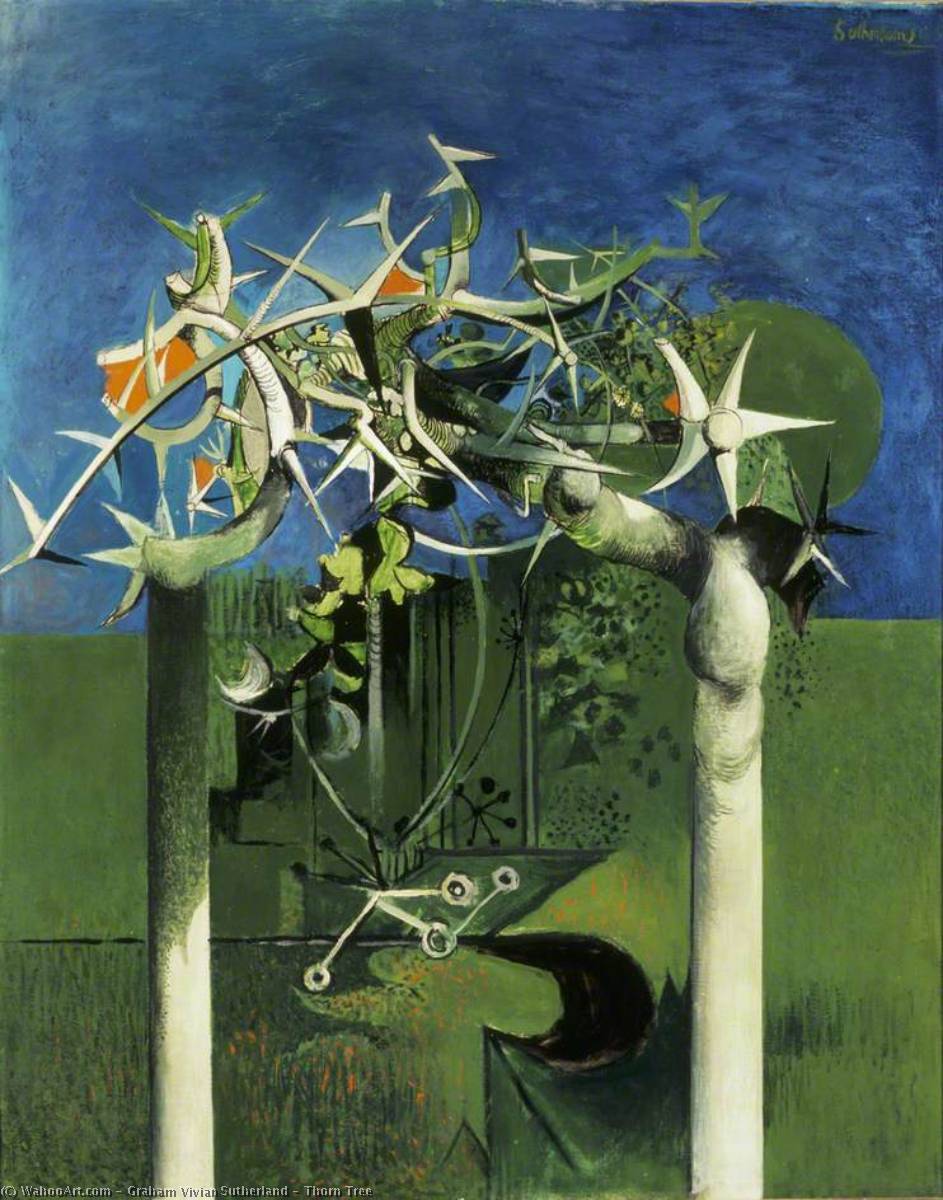
Thorn Tree

Discover 'Thorn Tree' by Graham Sutherland – a captivating oil painting of a windswept tree and birds, showcasing surreal landscapes & evocative nature scenes from 1946.

Graham Vivian Sutherland (1903–1980) był wybitnym angielskim malarzem i grafiką znanym ze swojego charakterystycznego stylu łączącego tradycję angielską obrazowania przy świetle natury z europejskimi ruchami awangardowymi, takimi jak Surrealizm. Jego twórczość obejmowała tkaniny, grafiki oraz portrety, ale przede wszystkim krajobrazy Pembrokeshire, które stały się jego ikoną i symbolem mistycyzmu

Ręcznie malowana reprodukcja olejowa

Ręcznie malowany olej na płótnie w Twoim wymiarze i ramie, tworzony na zamówienie przez naszych artystów.

P118B $10
P118H $10
P118W $10
P438Z $10
P508JH $12
P508YH $12
P805H $10
P805Z $10
P919BZ $10
P919G $10
P919XJ $10
P959ZH $10
P968JZ $12
W106C $8
W218G $10
W218JH $8
W218Y $10
W307PJ $10
W316G $10
W316PJ $8
W316Y $10
W398PJ $8
W4111J $10
W500HY $15
W500JH $15
W692G $12
W849H $8
W940BG $15
W953PJ $8

Standard
custom
CM
INCH

Wybierz spośród naszych predefiniowanych rozmiarów, które zachowują oryginalne proporcje dzieła sztuki.

szerokość
wysokość

Możesz wprowadzić własne wymiary, aby dopasować obraz do konkretnej ramy lub przestrzeni. Jeśli wybrany rozmiar nie będzie odpowiadał proporcjom oryginału, przytniecie dzieło sztuki lub rozszerzymy je o dodatkowe elementy, ręcznie domalowane przez artystę. Przed rozpoczęciem produkcji wyślemy projekt cyfrowy do Twojej akceptacji.
Należy pamiętać, że podgląd na ekranie nie odzwierciedla rzeczywistego przycinania ani rozszerzania obrazu. Tylko projekt dokładnie pokaże ostateczną kompozycję.
Choć oferujemy możliwość zamówienia niestandardowych rozmiarów, zalecamy wybór wymiaru z gotowej listy, aby zachować oryginalne proporcje dzieła.

Przykłady możliwych zmian: Zamień twarz na zdjęcie klienta; Dodaj zwierzę domowe (np. zamień kota na psa); Ukryj wiadomość w tle; Zmień krajobraz lub elementy tła.
Po złożeniu zamówienia zespół OriginalUniqueArt.com skontaktuje się z klientem drogą mailową w celu uzyskania instrukcji i prześle wizualizację projektu

Dostawa na całym świecie () w ciągu 3/4 tygodni zamiast standardowych 5 tygodni. (26 Lipiec). Bez kompromisów w kwestii jakości.

why_choose_icon
Bezpłatna ekspresowa wysyłka na cały świat
why_choose_icon
Wysokiej jakości płótno lniane
why_choose_icon
Pełne ubezpieczenie przesyłki
why_choose_icon
Gwarancja zwrotu należności celnych
why_choose_icon
Gwarancja pełnego zgodności kolorystycznej
why_choose_icon
Polityka 60-dniowego zwrotu (tylko w przypadku wad)
why_choose_icon
Gwarancja 100% zwrotu pieniędzy
why_choose_icon
Zniżka przy większych zamówieniach

Suma całkowita

-

reproduction

Thorn Tree

Technika reprodukcji

Wymiary reprodukcji

-

Cena całkowita

-

Szybkie fakty

  • Artistic style: Landscape painting
  • Year: 1946
  • Dimensions: 127 x 102 cm
  • Location: Albright-Knox Art
  • Influences:
    • Surrealism
    • Expressionism
  • Title: Thorn Tree
  • Artist: Graham Sutherland

Quiz o sztuce

Na każde pytanie istnieje tylko jedna poprawna odpowiedź.

Pytanie 1:
What is the primary subject matter of Graham Vivian Sutherland’s painting, ‘Thorn Tree’?
Pytanie 2:
In what year was ‘Thorn Tree’ painted?
Pytanie 3:
Which artistic movement is most closely associated with Graham Vivian Sutherland’s style as exemplified in ‘Thorn Tree’?
Pytanie 4:
The painting 'Thorn Tree' was created by Graham Vivian Sutherland, who is known for his work in which medium besides painting?
Pytanie 5:
What does the presence of ‘thorns’ in the painting likely symbolize?

Opis dzieła

A Vision of Verdant Mystery: Graham Vivian Sutherland’s “Thorn Tree”

Graham Vivian Sutherland's "Thorn Tree," painted in 1946, isn’t merely a landscape; it’s an immersion into the heart of Pembrokeshire’s rugged beauty, filtered through the uniquely perceptive eye of one of Britain’s most significant modern artists. This oil on canvas work transcends simple representation, offering instead a deeply layered exploration of nature's inherent strangeness and the quiet drama of the natural world. Sutherland, a master of Neo-Romanticism, skillfully blends the traditional English landscape tradition with the subtle influences of Surrealism and Expressionism – a combination that resulted in powerfully evocative and often unsettling images.

The painting immediately draws the viewer into a dense, almost claustrophobic woodland scene. Towering trees dominate the composition, their branches intertwining to create a complex network of shadows and light. The leaves themselves are rendered with meticulous detail, yet they possess an unnerving quality – not quite realistic, but hinting at something beyond the purely botanical. Birds, perched precariously amongst the foliage, add to the sense of unease and suggest a hidden life within this seemingly still landscape. Sutherland’s use of color is particularly striking; predominantly greens—ranging from deep emerald to muted olive—create an atmosphere of both lushness and melancholy. Subtle hints of brown and grey ground the scene, anchoring it in the earth while simultaneously emphasizing its isolation.

The Painter's Process: Technique and Style

Sutherland’s technique is characterized by a remarkable sensitivity to light and texture. He employed a broken brushstroke method, layering thin washes of paint to build up form and create a shimmering effect that captures the dappled sunlight filtering through the trees. The canvas itself appears almost alive with movement – not in a frenetic way, but rather through the careful manipulation of color and tone. The painting’s surface is rich with impasto—thickly applied paint—particularly around the branches and leaves, giving them a tangible presence. This tactile quality invites the viewer to reach out and touch the scene, blurring the line between observation and participation.

Notably, Sutherland's work during this period reflects his deep connection to Pembrokeshire, a region he revisited repeatedly throughout his career. He wasn’t simply documenting the landscape; he was attempting to capture its essence—its mood, its mystery, and its inherent sense of solitude. The painting embodies a shift in artistic focus away from purely representational art towards a more subjective interpretation of reality.

Symbolism and Interpretation

“Thorn Tree” is rich with symbolic potential. The thorns themselves are a potent motif—representing both defense and pain, beauty and danger. They suggest a world where nature isn’t always benevolent, but rather holds its own secrets and challenges. The birds, often associated with freedom and spirituality, seem trapped within the dense foliage, hinting at a longing for escape. The overall composition can be interpreted as an allegory of the human condition—a struggle to find meaning and connection in a world that is both beautiful and unsettling.

Furthermore, the painting’s creation coincided with post-war Britain, a period marked by uncertainty and social upheaval. Sutherland's exploration of nature’s complexities can be seen as a reflection of this broader sense of disorientation—a search for stability and meaning amidst chaos. The painting’s enduring appeal lies in its ability to resonate with viewers on multiple levels, prompting contemplation about the relationship between humanity and the natural world.

A Timeless Masterpiece: Reproduction and Display

"Thorn Tree" is a captivating work that would be an exceptional addition to any art collection or interior space. Reproductions of this painting capture much of its original power, offering a way to bring Sutherland’s vision into your home. When selecting a reproduction, consider the quality of the print and the canvas material—a fine-art giclée on archival canvas will best preserve the artwork's colors and detail. The painting’s evocative atmosphere would complement a variety of interior styles, from modern minimalist spaces to more traditional settings. Its subtle color palette and complex composition create a focal point that invites contemplation and adds a touch of understated elegance to any room.


Biografia artysty

Graham Vivian Sutherland (1903–1980): A Visionary Landscape Painter

Graham Vivian Sutherland OM (24 August 1903 – 17 February 1980) was a prolific English artist, celebrated for his distinctive style that bridged various artistic approaches. He fused the English tradition of painting by the light of nature with European avant-garde movements like Surrealism and Expressionism, establishing himself as one of Britain’s most influential modern artists. Sutherland's oeuvre encompassed printmaking, tapestry design, glass art, and portraiture, yet his landscapes—particularly those depicting the rugged beauty of Pembrokeshire—remain his signature achievement. ### Early Life and Education Graham Sutherland was born in Streatham, London, the eldest child of George Humphrey Vivian Sutherland, a barrister who later served as a civil servant in the Land Registry and the Board of Education, and Elsie Sutherland (née Foster). Both parents possessed artistic inclinations, fostering Graham’s early fascination with drawing. He attended Homefield Preparatory School in Sutton and subsequently Epsom College in Surrey until 1919, gaining a solid grounding in classical education. Recognizing his innate talent for visual arts, Sutherland pursued an apprenticeship at the Midland Railway Locomotive Works in Derby—a decision that defied expectations of his family’s legal profession—before realizing his true passion lay in artistic exploration through technical college studies. This formative period instilled in him a meticulous attention to detail and a disciplined approach to mastering various artistic techniques. ### Artistic Development and Influences Sutherland embarked on his artistic journey with a focus on engraving and etching, honing his skills at Goldsmiths’ School of Art from 1921 to 1926. His exposure to Samuel Palmer’s pastoral landscapes—a connection that profoundly shaped his early aesthetic sensibilities—established a bedrock for his subsequent explorations into tonal harmony and atmospheric perspective. Sutherland's prints reflected the burgeoning Surrealist movement, influenced by artists like René Magritte and Giorgio Morandi, demonstrating a willingness to experiment with unsettling juxtapositions of imagery and challenging conventional perceptions of reality. He embraced abstractionism as a means of conveying emotion and capturing the essence of nature’s complexities—a stylistic choice that would define much of his mature work. Furthermore, Sutherland's artistic vision was nurtured by the writings of writers like Ezra Pound and T.S. Eliot, who championed modernist ideals and encouraged him to push boundaries of creative expression. ### Major Achievements: Landscape Painting and Coventry Cathedral Tapestry Sutherland’s artistic breakthrough arrived in 1938 with his visit to Pembrokeshire, Wales—a transformative experience that ignited his lifelong devotion to the region’s dramatic scenery. Inspired by Paul Nash and Edvard Munch, he produced a series of oil paintings capturing the ethereal beauty of the Welsh coastline, characterized by bold brushstrokes and evocative color palettes. These landscapes became emblematic of Sutherland's artistic vision, reflecting both psychological depth and formal innovation—a testament to his ability to translate subjective experience into compelling visual representations. He meticulously studied geological formations and atmospheric conditions, striving to convey not merely what he saw but also how it felt to inhabit that environment. His dedication culminated in the monumental tapestry commissioned for Coventry Cathedral—a collaborative effort symbolizing reconciliation after the devastation of World War II. This ambitious project showcased Sutherland’s mastery of textile art and cemented his legacy as a cultural icon. ### Portraiture and Later Years Sutherland continued to produce striking portraits throughout his career, notably Winston Churchill—a controversial depiction that sparked considerable debate about artistic interpretation and historical representation. He taught engraving at Chelsea School of Art and Goldsmiths College, nurturing the talents of aspiring artists and disseminating his knowledge of artistic principles. In 1955, Sutherland purchased a villa near Nice, embracing a life abroad that allowed him to reconnect with his artistic inspiration—a period marked by experimentation with color and texture. Despite facing criticism for some of his later works—particularly those exploring religious themes—Sutherland remained steadfast in his commitment to artistic exploration until his death in 1980, leaving behind an enduring body of work celebrated for its originality and emotional resonance. His final paintings reflected a profound contemplation on mortality and the sublime beauty of the natural world.
Graham Vivian Sutherland

Graham Vivian Sutherland

1903 - 1980 , Wielka Brytania

Kluczowe informacje

  • Artistic Movement Or Style: Surrealism
  • Artists Or Movements Influenced By This Artist: ['Paul Nash']
  • Artists Who Influenced This Artist:
    • Samuel Palmer
    • F.L. Griggs
  • Date Of Birth: August 24, 1903
  • Date Of Death: February 17, 1980
  • Full Name: Graham Vivian Sutherland
  • Nationality: British
  • Notable Artworks:
    • Flying Bomb Depot
    • Entrance to a Lane
  • Place Of Birth: London, England
Odkryj dzieła sztuki uporządkowane według tematów, stylów i cech charakterystycznych.