Expressionism
Summer Clouds (Emil Nolde)
Emil Nolde (1867–1956) stworzył Summer Clouds. Należy do nurtu Expressionism. Wykonano w technice Oil.
- Oil

 Podgląd w skali 1:1

 Ręcznie malowany obraz olejny
 Wyślij jako kartkę
 Udostępnij
 Karta informacyjna


 Pobierz obraz
 Podobne obiekty
 RTG
 Pokaz slajdów
 Pytania i odpowiedzi

 Statystyki
Summer Clouds w skrócie
- Tytuł
- Summer Clouds
- Artysta
- Emil Nolde (1867–1956)
- Miejsce urodzenia artysty
- Nolde, Dania
- Technika wykonania
- Oil
- Ruch
- Expressionism
- Epoka
- Modern
- Temat
- ocean, clouds, sky, blue, white
Co przedstawia Summer Clouds?
Identification of the Artwork and Artist
Summer Clouds is an expressionist work by Emil Nolde. Born in 1867 in Nolde, Denmark, the artist developed a visual language centered on intense, personal feeling and the psychological weight of his subjects. His approach moved beyond mere representation to capture the internal pulse of the natural world.
Nolde’s career spanned much of the early twentieth century until his death in 1956. His practice was defined by a search for a visual language capable of holding the intensity of his observations, often utilizing color as the primary substance of form. This work reflects his preoccupation with the immediate sensation of light and atmosphere.
The Composition and Visual Elements
The composition is defined by a horizontal division between a blue ocean and the sky above. Within the celestial expanse, at least thirteen white clouds are scattered across the scene. These forms vary in both size and shape, with some positioned closer to the water's surface while others recede into the distance. The arrangement creates a sense of depth through the varying scale of these atmospheric elements.
The interaction of the blue water and the white clouds establishes a serene and peaceful atmosphere. The work captures the quiet beauty of nature through this simple, direct arrangement of color and form. The visual weight is distributed across the canvas, focusing on the relationship between the sea and the sky.
Zdjęcia w wysokiej rozdzielczości dzieła Summer Clouds

Domena publiczna: artysta zmarł w 1956.
Inne rozmiary, kadrowanie i cytowanie →Emil Nolde, Summer Clouds. Domena publiczna
Odpowiedzi na pytania dotyczące Summer Clouds
W jakiej technice wykonano „Summer Clouds” – Emil Nolde?
Technika wykonania dzieła „Summer Clouds” – Emil Nolde to Oil. Reprodukcje mają na celu wierne oddanie wyglądu tej techniki.
Co przedstawia "Summer Clouds"?
Tematyka obecna w „Summer Clouds” – Emil Nolde obejmuje ocean, clouds, sky, blue, white. Razem stanowią one podsumowanie tematyki dzieła.
Czy „Summer Clouds” – Emil Nolde znajduje się w domenie publicznej?
Jeśli chodzi o prawa autorskie, "Summer Clouds" znajduje się w należy do domeny publicznej – autorskie prawa majątkowe wygasły.
Któremu artyście przypisuje się "Summer Clouds"?
Autorstwo dzieła "Summer Clouds" przypisuje się Emil Nolde.
Do jakiego nurtu należy "Summer Clouds"?
„Summer Clouds” – Emil Nolde należy do nurtu Expressionism. Nurt ten stanowi stylistyczny kontekst dzieła.
Czy dzieło „Summer Clouds” autorstwa Emil Nolde znajduje się w domenie publicznej i dlaczego?
„Summer Clouds” – Emil Nolde jest należy do domeny publicznej – autorskie prawa majątkowe wygasły. Okres ochrony praw autorskich liczony jest od śmierci artysty, która nastąpiła w 1956.
Co łączy "Summer Clouds" z resztą twórczości Emil Nolde?
"Summer Clouds" dzieli z innymi dziełami Emil Nolde styl właściwy dla Expressionism oraz powracające motywy: post-impressionist influences, die brücke group member, expressionist style, focus on color and form, subjective and primal themes.
Czy "Summer Clouds" wpisuje się w typową tematykę twórczości Emil Nolde?
„Summer Clouds” przedstawia ocean, clouds, sky, blue, white, podczas gdy powracające motywy u Emil Nolde to post-impressionist influences, die brücke group member, expressionist style, focus on color and form, subjective and primal themes. Porównanie tych dwóch elementów ukazuje, jak dzieło nawiązuje do typowej dla tego artysty tematyki.
O artyście: Emil Nolde
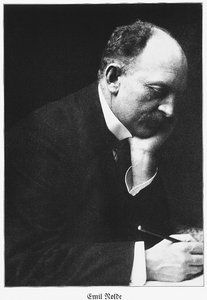
1867–1956, Dania
Emil Nolde
Życie i tożsamość Emila Nolde Urodzony 7 sierpnia 1867 roku jako Hans Emil Hansen, człowiek, który miał stać się znany jako Emil Nolde, dorastał w pobliżu wioski Nolde w Księstwie Szlezwick. Jego wczesne lata zostały ukształtowane przez wiejskie, rolnicze życie jego rodziny. Z czasem jednak odszedł od tej ścieżki, wybierając pracę rzeźbiarza w drewnie i dekoratora mebli. Ten dotykowy, fizyczny trud poprzedził jego zwrot ku malarstwu i grafice.
Inne prace Emil Nolde
 Sunset
 Sea with Red Sky
 Couple on the beach1903
 Masks1911

Eseje o Summer Clouds
 Ethereal Skies: The Curated Collector's Guide to Cloudscape Masterpieces and Atmospheric GrandeurDiscover the sublime beauty of cloudscape masterpieces. From Impressionist light to atmospheric depth, explore a curated journey through fi…
 Expressionism vs. New Objectivity: Emotion vs. Precision in German ArtMaster the tension between Expressionist emotion and New Objectivity precision. Explore the soul of German modern art now.
 Emile Nolde: A Journey into Expressionist Nature & the Primal SelfExplore the powerful Expressionism of Emile Nolde – a pioneer of emotive landscapes & spiritual themes. Discover his journey, influences, a…