Menu
BEZPŁATNA KONSULTACJA ARTYSTYCZNA
Podgląd w skaliPodgląd w skali Podgląd ARPodgląd AR Zamów wydruk Zamów wydrukKup obraz wysokiej rozdzielczości Kup obraz wysokiej rozdzielczości Wyślij jako kartkęWyślij jako kartkę
Szczegóły dziełaSzczegóły dzieła Dodaj do ulubionych Dodaj do ulubionych PobierzPobierz Podobne obiektyPodobne obiekty RTGRTG Pokaz slajdówPokaz slajdów

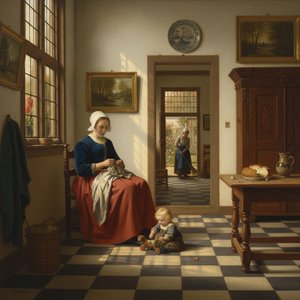
Old Church in Delft

Experience Emanuel de Witte’s atmospheric masterpiece – ‘Interior of the Oude Kerk,’ Delft! Admire its realism & light, capturing Delft's spiritual heritage.

Emanuel de Witte (1617-1692) – holenderski malarz barokowy znany z sugestywnych wnętrz kościelnych i scen rodzajowych. Jego mistrzowskie użycie światła i perspektywy tworzy wciągające wrażenia, kontrastując z precyzyjnym podejściem Saenredama.

Ręcznie malowana reprodukcja olejowa

Ręcznie malowany obraz olejny na płótnie, wykonany na zamówienie przez naszych artystów w wybranym przez Ciebie wymiarze i oprawie. (Zamów wydruk Zamów wydrukKup obraz wysokiej rozdzielczości Kup obraz wysokiej rozdzielczości)

P118B $10
P118H $10
P118W $10
P438Z $10
P508JH $12
P508YH $12
P805H $10
P805Z $10
P919BZ $10
P919G $10
P919XJ $10
P959ZH $10
P968JZ $12
W106C $8
W218G $10
W218JH $8
W218Y $10
W307PJ $10
W316G $10
W316PJ $8
W316Y $10
W398PJ $8
W4111J $10
W500HY $15
W500JH $15
W692G $12
W849H $8
W940BG $15
W953PJ $8

Standard
custom
CM
INCH

Wybierz spośród naszych standardowych rozmiarów, które zachowują oryginalne proporcje dzieła sztuki.

szerokość
wysokość

Możesz wprowadzić własne wymiary, aby dopasować obraz do konkretnej ramy lub przestrzeni. Jeśli wybrany rozmiar nie będzie odpowiadał proporcjom oryginału, przytniecie dzieło sztuki lub rozszerzymy je o dodatkowe elementy, ręcznie domalowane przez artystę. Przed rozpoczęciem produkcji wyślemy projekt cyfrowy do Twojej akceptacji.
Należy pamiętać, że podgląd na ekranie nie odzwierciedla rzeczywistego przycinania ani rozszerzania obrazu. Tylko projekt dokładnie pokaże ostateczną kompozycję.
Choć oferujemy możliwość zamówienia niestandardowych rozmiarów, zalecamy wybór wymiaru z gotowej listy, aby zachować oryginalne proporcje dzieła.

Przykłady możliwych zmian: Zamień twarz na zdjęcie klienta; Dodaj zwierzę domowe (np. zamień kota na psa); Ukryj wiadomość w tle; Zmień krajobraz lub elementy tła.
Po złożeniu zamówienia zespół OriginalUniqueArt.com skontaktuje się z klientem drogą mailową w celu uzyskania instrukcji i prześle wizualizację projektu

Dostawa na całym świecie () w ciągu 3–4 tygodni zamiast standardowych 5 tygodni. (22 Sierpień). Bez kompromisów w kwestii jakości.

why_choose_icon
Bezpłatna ekspresowa wysyłka na cały świat
why_choose_icon
Wysokiej jakości płótno lniane
why_choose_icon
Pełne ubezpieczenie przesyłki
why_choose_icon
Gwarancja zwrotu należności celnych i podatków importowych
why_choose_icon
Gwarancja wiernego odwzorowania kolorów
why_choose_icon
Polityka 60-dniowego zwrotu (tylko w przypadku wad)
why_choose_icon
Gwarancja 100% zwrotu kosztów
why_choose_icon
Zniżka przy zamówieniu wielu produktów

Suma całkowita

$ 300

reproduction

Old Church in Delft

Technika reprodukcji

Wymiary reprodukcji

-

Cena całkowita

$ 300

Szybki podgląd

  • Title: Old Church in Delft
  • Subject or theme: Religious Architecture
  • Artist: Emanuel de Witte
  • Notable elements or techniques: Atmospheric Light; Detailed Interior
  • Medium: Oil on Canvas
  • Influences: Pieter Saenredam
  • Dimensions: 95 x 82 cm

Quiz o sztuce

Do każdego pytania dotyczy tylko jedna poprawna odpowiedź.

Pytanie 1:
What is the primary subject matter of Emanuel de Witte’s “Interior of the Oude Kerk”?
Pytanie 2:
Approximately when was Emanuel de Witte’s “Interior of the Oude Kerk” painted?
Pytanie 3:
What distinguishes Emanuel de Witte’s approach to painting church interiors from Pieter Saenredam’s style?

Opis dzieła

A Breathless Reverie: Emanuel de Witte’s Interior of Delft’s Oude Kerk

Emanuel de Witte stands apart from the towering figures of his contemporaries—Pieter Saenredam, Rembrandt—not in ambition or renown, but in a singular artistic vision. Rather than meticulously documenting architectural grandeur, De Witte sought to distill the very essence of sacred space: its palpable stillness, its luminous grace, and the subtle drama unfolding within its walls. This pursuit distinguishes him as a master of atmosphere, prioritizing feeling over factual precision—a characteristic that resonates powerfully with viewers encountering his paintings today.

Early Delft Training & The Shift Towards Interior Views

Born in Alkmaar in 1617, De Witte’s formative years were spent honing his skills under the tutelage of Johannes Vermeer and Pieter Saenredam—artists who shared a fascination for capturing light and texture. However, unlike Saenredam's dedication to architectural renderings, De Witte embarked on a distinct path in 1650, gravitating towards depictions of church interiors. This pivotal decision reflects a broader trend within Dutch Baroque art: a move away from grand narratives toward contemplative explorations of faith and spirituality.

Technique & The Illusionistic Brilliance of Light

De Witte’s approach to painting was characterized by an unwavering commitment to illusionism—a technique perfected during the Golden Age that aimed to create convincing representations of three-dimensional space. He achieved this remarkable feat through careful observation and masterful manipulation of light, employing chiaroscuro—the dramatic interplay between light and shadow—to sculpt forms and imbue his canvases with emotional depth. As evidenced by ‘Interior of the Oude Kerk,’ De Witte’s brushstrokes are remarkably subtle yet decisive, conveying a profound sense of realism.

Delft's Gothic Legacy & The Painting's Symbolic Resonance

'Interior of the Oude Kerk,' painted in 1650, captures Delft’s architectural heritage—a magnificent Gothic cathedral that had endured centuries of Reformation upheaval. The painting isn’t merely a visual record; it embodies the spiritual fervor of its time, reflecting the fervent piety of the Dutch Reformed Church. Notice the placement of the figures—grouped strategically to emphasize the solemnity of prayer and contemplation—and consider the diffused light filtering through the stained glass windows, symbolizing divine illumination.

A Moment Frozen in Time: Emotional Impact & Artistic Legacy

More than just aesthetically pleasing, De Witte’s ‘Interior of the Oude Kerk’ transcends its formal elements to evoke a powerful emotional response. The painting invites viewers into a realm of quiet reverence—a space where worldly concerns dissolve and spiritual contemplation reigns supreme. It stands as a testament to De Witte's artistic genius—a singular achievement that continues to inspire admiration and provoke discussion among art historians and collectors alike.

  • Artist: Emanuel de Witte
  • Born Year: 1617
  • Death Year: 1692
  • Birth City: Alkmaar
  • Birth Country: Netherlands

Additional Research Links:

Artwork Details:

  • Title: Old Church in Delft
  • Artist: Emanuel de Witte
  • Date: 1642
  • Size: 95 x 82 cm
  • Medium: Oil on Canvas

O artyście

A Life in Perspective: The World of Emanuel de Witte

Emanuel de Witte, a name perhaps less instantly recognizable than some of his Dutch Golden Age contemporaries, nevertheless occupies a significant and fascinating niche within the pantheon of 17th-century masters. Born in Alkmaar in 1617, De Witte’s artistic journey was one marked by both remarkable talent and considerable personal turmoil – a duality that seems to subtly infuse itself into the very atmosphere of his paintings. He wasn't driven by meticulous architectural documentation like Pieter Saenredam; instead, he sought to capture the *feeling* of space, the quality of light, and the subtle drama unfolding within sacred interiors. His canvases aren’t merely representations of churches; they are immersive experiences, inviting viewers into a world of quiet contemplation and spiritual resonance.

From Delft Training to Amsterdam's Embrace

De Witte’s early life provided a solid foundation for his artistic pursuits. His father, a schoolmaster, instilled in him an appreciation for learning and intellectual curiosity – qualities that would later manifest in his careful observation of perspective and light. He formally entered the art world by joining the Guild of St Luke in Alkmaar in 1636, but it was his subsequent apprenticeship with Evert van Aelst in Delft that proved particularly formative. Van Aelst, a renowned still-life painter, imparted to De Witte a keen eye for detail and a masterful command of light and shadow – skills that would become hallmarks of his mature style. Initially, De Witte explored various genres—portraits, mythological scenes, religious narratives—but it was upon relocating to Amsterdam in 1651 that he truly found his calling. The city’s wealth of magnificent churches provided an inexhaustible source of inspiration, and he began to specialize in depicting their awe-inspiring interiors. He didn't simply replicate existing church spaces; rather, he skillfully synthesized elements from different buildings, creating idealized interiors that felt both familiar and subtly otherworldly.

Master of Atmosphere and Imaginary Spaces

Amsterdam proved pivotal for De Witte's artistic development. He didn’t just paint what he saw; he painted *how* it felt to be in those spaces. The Oude Kerk in Amsterdam became a frequent subject, appearing repeatedly on his canvases from various vantage points. But these weren’t straightforward depictions. De Witte manipulated perspective, played with light and shadow, and populated the spaces with carefully arranged figures – often anonymous worshippers – to evoke a specific mood or atmosphere. As Walter Liedtke noted, his primary interest lay not in the architecture itself but in “the space itself – its light, color, sheer extent, and mood.” This emphasis on atmospheric effect distinguishes him from more rigidly topographical painters of the era. He wasn’t concerned with precise accuracy; he was interested in creating a *feeling* of grandeur, reverence, and spiritual depth. His paintings are filled with a sense of quiet solemnity, as if one were stepping into a sacred space themselves.

The Influence of Light and Perspective

De Witte's technique was deceptively simple yet profoundly effective. He often employed a limited palette – predominantly browns, grays, and ochres – to create a sense of muted depth and atmosphere. He meticulously studied the effects of light filtering through stained glass windows, casting dramatic shadows and highlighting architectural details. His use of perspective wasn't always mathematically precise; he sometimes exaggerated certain elements to heighten the emotional impact of the scene. He frequently used *chiaroscuro* – the contrast between light and dark – to draw the viewer’s eye to key figures or focal points within the composition. This masterful manipulation of light and perspective is what truly sets his work apart, transforming ordinary churches into extraordinary realms of spiritual contemplation.

A Life Marked by Shadows

Despite his artistic success, De Witte's personal life was plagued by hardship. The death of his first wife brought profound grief, and subsequent legal troubles involving his second wife and daughter cast a long shadow over his later years. Financial difficulties led him to the humiliating position of indentured servitude to an art dealer, Joris de Wijs, a situation he ultimately breached, leading to further complications. Contemporary accounts paint a picture of a volatile temperament – a man prone to shouting at clients and engaging in disputes. This inner turmoil perhaps contributed to the unevenness of his later work, but it also adds another layer of complexity to our understanding of the artist and his creations. Tragically, De Witte’s life came to a devastating end in 1692 when he reportedly attempted suicide by hanging himself from a canal bridge; the rope broke, and he drowned. It was a grim finale for a man who had dedicated his life to capturing the beauty and serenity of sacred spaces.

Legacy and Enduring Influence

Emanuel de Witte stands as an important figure in the last phase of architectural painting in the Netherlands, bridging the gap between meticulous documentation and atmospheric interpretation. His innovative use of light and perspective influenced subsequent generations of artists, and his paintings continue to offer valuable insights into 17th-century Dutch religious life and social customs. Today, works by De Witte are held in prestigious collections worldwide – at the Metropolitan Museum of Art, the National Gallery of Art, and the Rijksmuseum, among others—testifying to his enduring legacy as a master of perspective, atmosphere, and emotional resonance. He reminds us that art is not merely about what we see but how we *feel* when we look.
Emanuel De Witte

Emanuel De Witte

1617 - 1692 , Holandia

Krótka nota

  • Artistic Movement Or Style: Barok
  • Artists Or Movements Influenced By This Artist: ['Późniejsi artyści']
  • Artists Who Influenced This Artist: ['Evert van Aelst']
  • Date Of Birth: 1617
  • Date Of Death: 1692
  • Full Name: Emanuel de Witte
  • Nationality: Holenderski
  • Notable Artworks:
    • Oude Kerk Amsterdam
    • Wnętrze kościoła
  • Place Of Birth: Alkmaar, Holandia