Romanticism · 1847
Rome (Christopher Pearse Cranch, 1847)
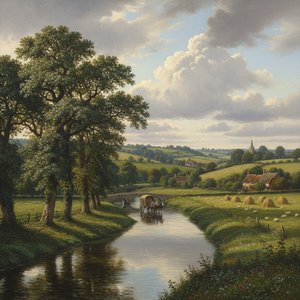
Christopher Pearse Cranch (1813–1892) stworzył Rome. Dzieło pochodzi z 1847. Należy do nurtu Romanticism. Wykonano w technice Oil On Canvas.
- 1847
- Oil On Canvas

 Podgląd w skali 1:1

 Ręcznie malowany obraz olejny
 Wyślij jako kartkę
 Udostępnij
 Karta informacyjna


 Pobierz obraz
 Podobne obiekty
 RTG
 Pokaz slajdów
 Pytania i odpowiedzi

 Statystyki
Rome w skrócie
- Tytuł
- Rome
- Artysta
- Christopher Pearse Cranch (1813–1892)
- Miejsce urodzenia artysty
- Columbia, United States
- Data powstania
- 1847
- Technika wykonania
- Oil On Canvas
- Ruch
- Romanticism
- Epoka
- 19th Century
- Temat
- landscape, rural, trees, building, cloudy sky, pathway
Co przedstawia Rome?
The Depiction of Rome by Christopher Pearse Cranch
In the oil on canvas painting titled Rome, Christopher Pearse Cranch presents a serene landscape scene. The work, dating from about 1847, focuses on a rural setting under a cloudy sky. A central pathway leads the eye toward a building with a partially visible facade, which sits slightly elevated in the background. The scene captures a moment of quiet observation within a naturalistic environment.
The foreground is occupied by a dense cluster of trees. These trees feature varying shades of green and brown, creating a sense of depth through layering. The lighting in the composition appears soft and diffused, suggesting the conditions of an overcast day. The subject matter centers on this quiet, rural landscape, emphasizing the breadth of the terrain through a horizontal composition.
Christopher Pearse Cranch utilizes a style that leans toward realism with an impressionistic touch. The depiction relies on the layering of paint to build up form and color. Visible brushstrokes are particularly evident in the foliage and the sky, providing a tactile quality to the surface of the canvas. The arrangement of organic shapes, such as the trees and clouds, is balanced by the geometric elements of the pathway and the building's structure.
Composition and Visual Elements of the Landscape
The composition is horizontal, emphasizing the breadth of the landscape. In the foreground, a dense cluster of trees occupies the lower portion of the frame, featuring varying shades of green and brown. A central pathway begins near the viewer and leads the eye toward a building situated slightly elevated in the background. This building features a partially visible facade, its structure defined by geometric elements that contrast with the surrounding environment. Perspective is employed to create a sense of distance between the immediate foliage and the distant architecture.
The shapes within the scene are predominantly organic, seen in the forms of the trees, the clouds, and the building’s structure. The sky is filled with clouds, and the lighting appears soft and diffused, suggesting an overcast day. This light provides a consistent illumination across the rural scene, avoiding harsh shadows. The layering of the trees and the receding lines of the pathway establish a sense of depth within the landscape.
Technique and Artistic Style of the Work
The oil painting, created about 1847, exhibits characteristics of Romanticism and Realism. The style leans towards realism while maintaining an impressionistic touch through its handling of light and atmosphere. Loose and expressive lines define the various elements of the landscape, avoiding rigid or sharp boundaries. This approach contributes to the overall impressionistic feel of the composition.
Texture is a prominent feature of the work, made evident through visible brushstrokes. These marks are particularly noticeable in the rendering of the foliage and the sky. The artist utilizes a technique characterized by the layering of paint to build up both form and color. This method creates a sense of depth and physical presence within the scene, particularly where the dense clusters of trees meet the diffused light of the overcast sky.
Zdjęcia w wysokiej rozdzielczości dzieła Rome

Domena publiczna: artysta zmarł w 1892.
Inne rozmiary, kadrowanie i cytowanie →Christopher Pearse Cranch, Rome (1847). Domena publiczna
Odpowiedzi na pytania dotyczące Rome
W którym roku powstało „Rome” – Christopher Pearse Cranch?
Powstanie „Rome” – Christopher Pearse Cranch datuje się na 1847.
W jakiej technice wykonano „Rome” – Christopher Pearse Cranch?
Technika wykonania dzieła „Rome” – Christopher Pearse Cranch to Oil On Canvas. Reprodukcje mają na celu wierne oddanie wyglądu tej techniki.
Co przedstawia „Rome” – Christopher Pearse Cranch?
Tematyka dzieła "Rome" to landscape, rural, trees, building, cloudy sky, pathway, tranquility, nature.
Czy obraz „Rome” – Christopher Pearse Cranch można swobodnie reprodukować?
Jeśli chodzi o prawa autorskie, "Rome" znajduje się w należy do domeny publicznej – autorskie prawa majątkowe wygasły.
Któremu artyście przypisuje się "Rome"?
„Rome” zostało stworzone przez Christopher Pearse Cranch. Informacje na tej stronie dotyczą oryginalnego dzieła autorstwa Christopher Pearse Cranch.
Do jakiego nurtu artystycznego należy „Rome” – Christopher Pearse Cranch?
„Rome” – Christopher Pearse Cranch należy do nurtu Romanticism. Nurt ten stanowi stylistyczny kontekst dzieła.
Do którego okresu twórczości Christopher Pearse Cranch należy dzieło „Rome”?
„Rome” pochodzi z okresu Mature Period w twórczości Christopher Pearse Cranch. Klasyfikacja ta wiąże dzieło z rozwojem artysty.
W jakim wieku Christopher Pearse Cranch stworzył(a) "Rome"?
Gdy w 1847 roku powstało dzieło „Rome”, Christopher Pearse Cranch – urodzony/a w 1813 – miał/a 34 lat.
Z czego wynika obecny status praw autorskich dzieła "Rome"?
Dzieło "Rome" autorstwa Christopher Pearse Cranch znajduje się w należy do domeny publicznej – autorskie prawa majątkowe wygasły. Okres ochrony praw autorskich liczony jest od daty śmierci artysty, a Christopher Pearse Cranch zmarł(a) w 1892.
O artyście: Christopher Pearse Cranch

1813–1892, United States
Christopher Pearse Cranch
The Transcendental Vision of Christopher Pearse Cranch In the rich tapestry of nineteenth-century American culture, few figures embody the era's intellectual and aesthetic synthesis as gracefully as Christopher Pearse Cranch. Born in 1813 in Columbia, Maryland, into a distinguished legal family, Cranch was destined for a life where the boundaries between the spiritual and the material would perpetually blur. While his early path led him toward the pulpit and the rigorous study of theology at Harvard Divinity School, his soul remained deeply tethered to the visual world. This unique duality—the disciplined mind of a Unitarian minister paired with the observant eye of an artist—allowed him to approach the canvas not merely as a surface for depiction, but as a medium for profound philosophical inquiry.
O Christopher Pearse Cranch Najważniejsze dzieła Christopher Pearse Cranch
Inne prace Christopher Pearse Cranch
 River Running between Pastures1850
 Sunset Landscape
 Man with Two Cows1844
 View on the Catskill River1846

Eseje o Rome
 John Constable: Nature, Light & the Romantic Vision of Rural EnglandExplore the life & art of John Constable, the Romantic painter who revolutionized landscape with emotive scenes of rural England. Discover …
 Hubert Robert: Picturing Ruins, Preserving Memory – A Study of Romantic Antiquarianism & Artistic InnovationExplore the captivating world of Hubert Robert, master of Romantic landscape painting & 'capriccio' ruins. Discover his historical context,…
 German Romanticism vs. English Romanticism: A Comparative StudyCompare the spiritual stillness of German Romanticism with the turbulent energy of English masters. Explore the sublime differences now.