Portret Christopher Pearse Cranch

34 najsłynniejszych obrazów artysty Christopher Pearse Cranch, każdy niepowtarzalny

Aktualizacja: Październik 2026 · ranking według naszego wskaźnika popularności (liczba wyszukiwań, wizyt i zamówień dla każdego dzieła) · 34 dzieł Christopher Pearse Cranch w naszym katalogu

W skrócie

River Running between Pastures (1850) to obraz autorstwa Christopher Pearse Cranch, który przyciąga najwięcej spojrzeń. Następnie wzrok kieruje się na Sunset Landscape i View on the Catskill River (1846). Spośród 34 dzieł Christopher Pearse Cranch w naszym katalogu, tych 34 jest najbardziej znanych – każde z nich to unikatowy oryginał, przedstawiony wraz z rokiem powstania, muzeum oraz powodem, dla którego przetrwało próbę czasu.

1813 – 1892, Columbia Hudson river school Najwięcej dzieł: New York Historical Society

10 najlepszych obrazów autorstwa Christopher Pearse Cranch według oka galerii

1
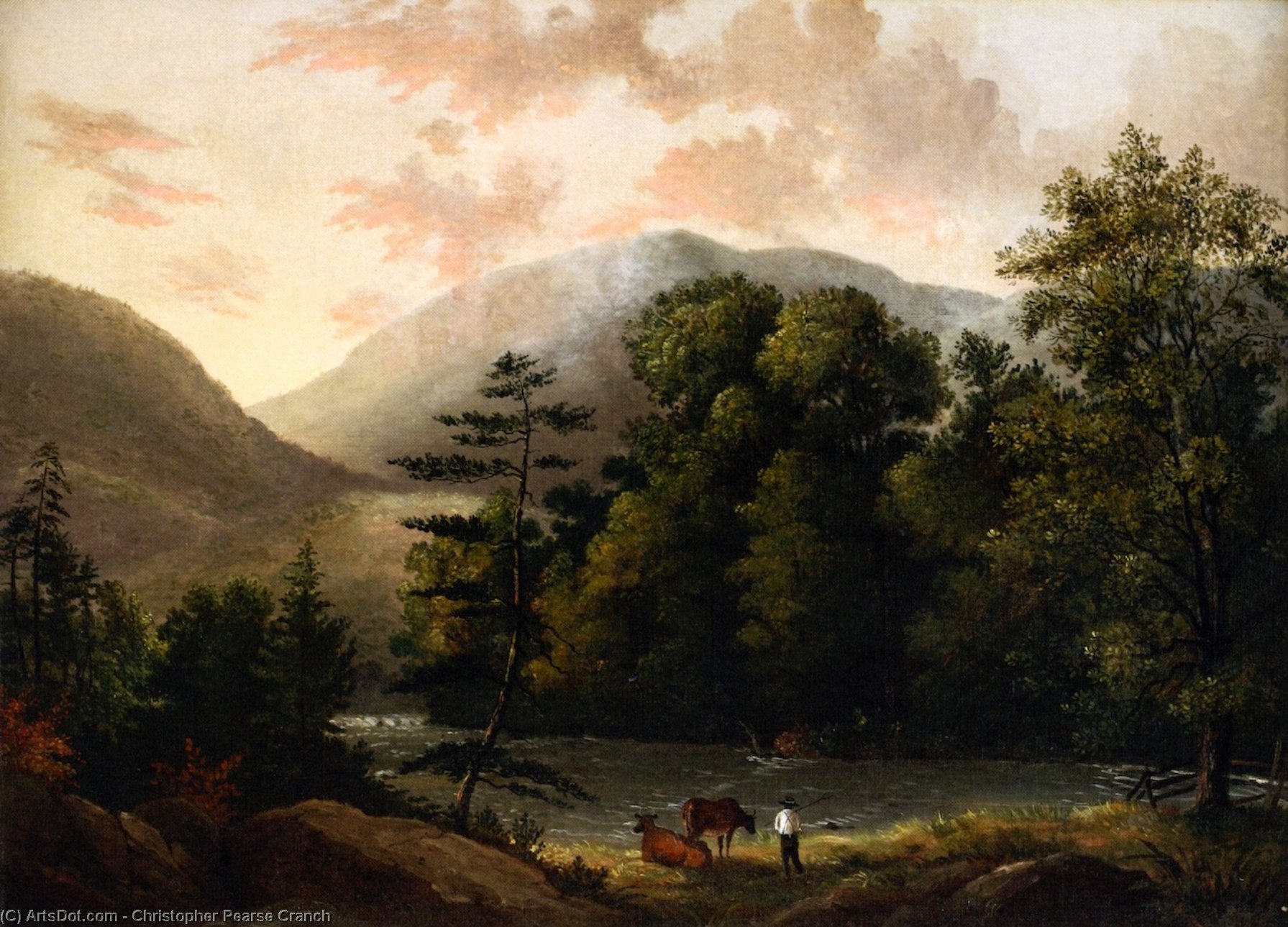
River Running between Pastures (1850) autorstwa Christopher Pearse Cranch

River Running between Pastures

1850 · Oil

A river carves a path through a lush valley, flanked by dense, green foliage. In the distance, mountains rise against the horizon, framing a scene of quiet pastoral life. Along the riverbanks, cows graze peacefully, while horses move through the landscape. A solitary figure stands near the center, observing the movement of the water or tending to the livestock. The composition captures a moment of stillness within the natural world.

Słynne obrazy artysty Christopher Pearse Cranch, od 11 do 34

Tematy, które przyciągnęły wzrok Christopher Pearse Cranch

Cztery motywy najczęściej powracające w tych oryginałach, z których każdy doczekał się swojego najdoskonalszego przykładu.

Muzea przechowujące oryginały Christopher Pearse Cranch

5 muzeów, w których znajduje się najwięcej obrazów z tej strony.

Muzea Miasto Dzieła artysty Christopher Pearse Cranch Obrazy z tej listy
New York Historical Society, Nowy JorkNew York Historical Society Nowy Jork 2 View on the Catskill River, Landscape
Addison Gallery of American Art, MassachusettsAddison Gallery of American Art Massachusetts 1 Sunset Landscape
Fogg Art Museum, CambridgeFogg Art Museum Cambridge 1 View on the Hudson
National Gallery of Art, WaszyngtonNational Gallery of Art Waszyngton 1 Castle Gondolfo, Lake Albano, Italy
Museum of Fine Arts, BostonMuseum of Fine Arts Boston 1 San Pietro in Castello, Venice

Christopher Pearse Cranch na przestrzeni dekad: jeden unikatowy oryginał dla każdego

Dzieła według dekad

Wybierz dekadę, aby zobaczyć dzieło, które ją definiuje.

Obrazy artysty Christopher Pearse Cranch: pytania do galerii

Jakie jest najsłynniejsze dzieło artysty Christopher Pearse Cranch?Odkryj odpowiedź

River Running between Pastures (1850). Następne są Sunset Landscape oraz View on the Catskill River (1846).

W jakim wieku Christopher Pearse Cranch stworzył/a River Running between Pastures?Odkryj odpowiedź

37 lat: River Running between Pastures pochodzi z 1850, a Christopher Pearse Cranch urodził(a) się w 1813.

Które dziesięć obrazów Christopher Pearse Cranch jest najbardziej znanych?Odkryj odpowiedź

River Running between Pastures, Sunset Landscape, View on the Catskill River, Rome, Man with Two Cows, Landscape with Fishermen and Artist Sketching, Tivoli, East of Rome, Mountain Landscape, View on the Hudson i Landscape. Powyższy ranking zawiera rok powstania oraz muzeum dla każdego z nich.

Ile znanych dzieł stworzył Christopher Pearse Cranch?Odkryj odpowiedź

Nasz katalog zawiera 34 dzieł artysty Christopher Pearse Cranch, datowanych od 1844 do 1885.

Gdzie można zobaczyć najsłynniejsze oryginały Christopher Pearse Cranch?Odkryj odpowiedź

W większości znajdują się w New York Historical Society (Nowy Jork), Addison Gallery of American Art (Massachusetts) i Fogg Art Museum (Cambridge). Powyższa tabela muzeów zawiera ich pełną listę.

W jakim okresie Christopher Pearse Cranch stworzył/a swoje najsłynniejsze obrazy?Odkryj odpowiedź

W 1850s: 13 z 34 dzieł na tej stronie powstało w tym czasie, w tym River Running between Pastures.

Który z najsłynniejszych obrazów artysty Christopher Pearse Cranch powstał najwcześniej, a który najpóźniej?Odkryj odpowiedź

Na tej stronie najwcześniejszy to Man with Two Cows (1844), a najpóźniejszy McIntyre Mountain (1885).

Jakie tematy preferował Christopher Pearse Cranch?Odkryj odpowiedź

Landscape (13), Italy (10) i Sunset (4), w ramach 34 dzieł na tej stronie.

Do jakiego nurtu należy twórczość Christopher Pearse Cranch?Odkryj odpowiedź

Hudson river school, sądząc po oryginałach na tej stronie.

Jakie oryginały Christopher Pearse Cranch można zobaczyć w New York Historical Society?Odkryj odpowiedź

View on the Catskill River i Landscape: New York Historical Society, Nowy Jork posiada 2 dzieł widocznych na tej stronie.

Christopher Pearse Cranch: portret artysty

The Transcendental Vision of Christopher Pearse Cranch

In the rich tapestry of nineteenth-century American culture, few figures embody the era's intellectual and aesthetic synthesis as gracefully as Christopher Pearse Cranch. Born in 1813 in Columbia, Maryland, into a distinguished legal family, Cranch was destined for a life where the boundaries between the spiritual and the material would perpetually blur. While his early path led him toward the pulpit and the rigorous study of theology at Harvard Divinity School, his soul remained deeply tethered to the visual world. This unique duality—the disciplined mind of a Unitarian minister paired with the observant eye of an artist—allowed him to approach the canvas not merely as a surface for depiction, but as a medium for profound philosophical inquiry.

Cranch’s creative identity was profoundly shaped by his proximity to the Transcendentalist movement. As a contemporary and participant in Ralph Waldo Emerson’s inner circle, he breathed the same intellectual air that celebrated the divinity found within nature. His involvement with Emerson’s transcendental club provided him with a conceptual framework that would forever inform his landscapes. To Cranch, a waterfall or a morning mist was not just a meteorological event; it was a manifestation of the sublime, a visible sign of the underlying spiritual unity of the universe. This connection to the Hudson River School ethos allowed his work to transcend mere topographical accuracy, reaching instead for an emotional and spiritual resonance that mirrored the era's optimism and reverence for the American wilderness.

A Multifaceted Legacy of Art and Letters

The brilliance of Cranch lay in his refusal to be confined to a single discipline. He was a true Renaissance man of the American nineteenth century, weaving together a legacy that spanned painting, poetry, and prose. His literary contributions were as diverse as they were impactful, ranging from the whimsical charm of his "Huggermugger Books"* for children to the sophisticated, contemplative verses found in publications like Emerson’s Dial. This versatility extended into the realm of visual satire, where his caricatures for Harper's Weekly demonstrated a keen wit and an ability to capture the social nuances of his time.

In his paintings, Cranch achieved a delicate balance between the grandiosity of the landscape tradition and a more intimate, impressionistic sensitivity. His works, such as "Landscape with Waterfall" and his evocative depictions of Venice, reveal an artist capable of capturing both the rugged majesty of the New World and the luminous, atmospheric light of the Old. Through his brush, one can trace the evolution of a man who sought to translate the intangible truths of his faith into the tangible beauty of color and form.

The historical significance of Christopher Pearse Cranch resides in his role as a bridge between eras and ideologies. He stood at the intersection of:

  • Theological Thought: Bringing the moral depth of Unitarianism to the visual arts.
  • Literary Innovation: Contributing to the development of American prose and poetry through both scholarly essays and imaginative children's tales.
  • Artistic Tradition: Enhancing the Hudson River School tradition with a uniquely transcendentalist perspective on the natural world.

Ultimately, Cranch’s life serves as a testament to the power of integrated thought. He did not see art and intellect as opposing forces, but as two halves of a single, harmonious pursuit of truth. His enduring contribution to American art remains a luminous example of how the observation of nature can become an act of profound spiritual devotion.