Portrett av Luis De Morales

De 50 mest kjente Luis De Morales-maleriene, hvert og ett unikt

Oppdatert November 2026 · rangert etter vår popularitetsscore (søk, besøk og bestillinger for hvert verk) · 51 verk av Luis De Morales i vår katalog

Kort fortalt

Virgin and Child with the Infant St John the Baptist (1550) er maleriet av Luis De Morales som vekker mest oppmerksomhet; originalen befinner seg i Museo del Prado, Madrid. Deretter går blikket til The Crucifixion (1566) og The Annuncation (1565). Blant de 51 verkene til Luis De Morales i vår katalog, er disse 50 de mest kjente – hver og en et unikt originalverk presentert med sitt årstall, sitt museum og årsaken til at det består.

1509 – 1586, Badajoz Spanish renaissance Flest verk: Museo del Prado

Topp 10 malerier av Luis De Morales, sett gjennom galleriets øyne

1
Virgin and Child with the Infant St John the Baptist (1550) av Luis De Morales

Virgin and Child with the Infant St John the Baptist

1550 · Oil On Canvas · Museo del Prado, Madrid

In this 1550 portrait, the Virgin Mary holds the infant Jesus in a close, physical embrace. The child is depicted nursing, a detail that grounds the religious scene in a moment of biological necessity and maternal intimacy. To the left and right of the central figures, two winged beings—angels or saints—occupy the periphery of the frame. These figures are positioned against a backdrop of dense trees, which provides a sense…

2
The Crucifixion (1566) av Luis De Morales

The Crucifixion

1566 · Oil On Panel · Museo del Prado, Madrid

The heavy silence of the scene is held within The Crucifixion, a profound work of religious art created by the Spanish painter Luis de Morales. Dating to 1566, this piece captures a moment of intense spiritual weight. The central focus remains fixed upon the Crucifixion of Jesus Christ, a subject that demands the viewer's immediate and solemn attention.

3
The Annuncation (1565) av Luis De Morales

The Annuncation

1565 · Oil On Panel · Museo del Prado, Madrid

The Annunciation by Luis de Morales captures a moment of divine stillness. Painted about 1565, the work presents a quiet encounter between the celestial and the earthly. The Archangel Gabriel and the Virgin Mary occupy a shared, intimate space, separated by a single white lily in a slender vase. A white dove descends through soft light, marking the presence of the Holy Spirit above the figures.

4
The Resurrection of Christ (1566) av Luis De Morales

The Resurrection of Christ

1566 · Oil · Museo del Prado, Madrid

A sudden, vertical force breaks the stillness of the tomb. Christ rises from the heavy stone sarcophagus, his body caught in a moment of divine momentum. The light is not merely a glow; it is a weightless, golden flood that carves the musculature of his torso out of the surrounding shadows. Behind him, a shroud of reddish-pink fabric billows like a sudden flame, tracing the path of his upward movement.…

5
The Birth of the Virgin (1562) av Luis De Morales

The Birth of the Virgin

1562 · Oil · Museo del Prado, Madrid

The air in the room feels heavy, thick with the quiet gravity of a life beginning. Within this shallow, intimate space, four women gather, their forms tightly grouped as if to shield the profound miracle unfolding before them. A woman reclines in the bed, her presence marked by the soft contours of her face and the weight of the linens surrounding her. Nearby, another figure holds a newborn infant, the…

6
The Virgin and Child with a Spindle (1566) av Luis De Morales

The Virgin and Child with a Spindle

1566 · Oil · Museo del Prado, Madrid

The composition is a vertical portrait set against a dark, undifferentiated background. In the center, the Virgin Mary holds the Christ Child. She wears a red gown beneath a heavy blue mantle, while a translucent veil rests upon her head. The skin of both figures appears pale and luminous against the deep shadows. The child holds a wooden spindle, its straight, thin lines cutting through the soft folds of the…

7
Saint John the Baptist (1566) av Luis De Morales

Saint John the Baptist

1566 · Oil On Panel · Museo del Prado, Madrid

The portrait presents a close-up, bust-length view of Saint John the Baptist, positioned slightly off-center. He gazes toward the left with an expression defined by weariness and contemplation. The composition utilizes a chiaroscuro technique, where a strong directional light source illuminates one side of the face, carving out the hollows of the eyes and the texture of the beard against deep, shadowy recesses. This interplay of light and dark creates…

8
Virgin and Child-Morales (1586) av Luis De Morales

Virgin and Child-Morales

1586 · Oil On Canvas · Machado de Castro National Museum, Coimbra

The Virgin gently cradles her son within a space defined by shadow and soft light. A newborn hand tucks through the folds of a red gown, searching for milk. This small gesture anchors the composition, pulling the viewer into a quiet, domestic moment of care. The faces of mother and child lean toward one another, their gazes interlocking with a tender, silent weight. Behind them, a pitch-dark background swallows the…

9
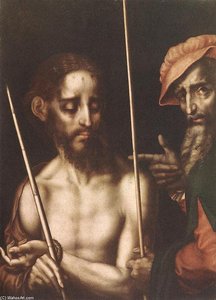
Ecce Homo (1565) av Luis De Morales

Ecce Homo

1565 · Oil On Canvas · Museo del Prado, Madrid

The shadows press closely against the figure, creating a void that seems to swallow everything but the man himself. In this vertical portrait, the upper torso and head of Jesus Christ emerge from a near-black background, caught in a heavy, dramatic chiaroscuro. A soft light descends from the upper left, catching the smooth, porcelain-like texture of his skin and casting gentle shadows across the musculature of his chest and arms.…

10
Pietà av Luis De Morales

Pietà

Oil On Panel · Louvre, Paris

In the quiet, somber depths of Luis de Morales’s Pietà, one encounters more than just a religious scene; one enters a profound meditation on human suffering and divine grace. Executed between 1565 and 1570, this masterpiece serves as a cornerstone of the Spanish Renaissance, capturing the exact moment when the weight of mortality meets the infinite strength of maternal love. The painting depicts the Virgin Mary cradling the lifeless, broken…

Luis De Moraless berømte malerier, nummer 11 til 50

11Christ Justifying his Passion (1565) av Luis De MoralesChrist Justifying his Passion1565 · Museo del Prado 12Christ, Man of Sorrows (1566) av Luis De MoralesChrist, Man of Sorrows1566 · Museo del Prado 13Pietà (1567) av Luis De MoralesPietà1567 · Museo del Prado 14Saint Juan de Ribera (1566) av Luis De MoralesSaint Juan de Ribera1566 · Museo del Prado 15Ecce Homo (1547) av Luis De MoralesEcce Homo1547 · Staatliche Kunstsammlungen Dresden 16The Adoration of the Shepherds (1567) av Luis De MoralesThe Adoration of the Shepherds1567 · Museo del Prado 17Man of Sorrows (1560) av Luis De MoralesMan of Sorrows1560 · Minneapolis Institute of Art 18The Lamentation (1560) av Luis De MoralesThe Lamentation1560 · Metropolitan Museum of Art 19The Purification of the Virgin or The Presentation in the Temple (1562) av Luis De MoralesThe Purification of the Virgin or The Presentation in the Temple1562 · Museo del Prado 20Pietà (1560) av Luis De MoralesPietà1560 · Real Academia de Bellas Artes de San Fernando 21Ecce Homo (1570) av Luis De MoralesEcce Homo1570 · Museu Nacional d’Art de Catalunya 22The Virgin and Child with the Infant Saint John the Baptist (1570) av Luis De MoralesThe Virgin and Child with the Infant Saint John the Baptist1570 · Museo del Prado 23The Virgin Dolorosa (1565) av Luis De MoralesThe Virgin Dolorosa1565 · Museo del Prado 24The Adoration of the Magi (1567) av Luis De MoralesThe Adoration of the Magi1567 · Museo del Prado 25Christ Carrying the Cross (1547) av Luis De MoralesChrist Carrying the Cross1547 · Bavarian State Painting Collections 26Christ Carrying the Cro (1546) av Luis De MoralesChrist Carrying the Cro1546 · Yale University Art Gallery 27Triptych of the Pietà, St John and St Mary Magdalene (1567) av Luis De MoralesTriptych of the Pietà, St John and St Mary Magdalene1567 · Museo del Prado 28Holy Family (1557) av Luis De MoralesHoly Family1557 · Hispanic Society Museum - Library 29Saint Jerome in the Wilderness (1570) av Luis De MoralesSaint Jerome in the Wilderness1570 · National Gallery of Ireland 30Ecce Homo (1565) av Luis De MoralesEcce Homo1565 · Fundación Banco Santander 31Christ before Pilate (1570) av Luis De MoralesChrist before Pilate1570 · Real Academia de Bellas Artes de San Fernando 32Christ Carrying the Cross (1566) av Luis De MoralesChrist Carrying the Cross1566 · Museo del Patriarca 33The Agony in the Garden (1545) av Luis De MoralesThe Agony in the Garden1545 · Museo del Prado 34Madonna and Child av Luis De MoralesMadonna and ChildBowes Museum 35The Virgin and Child (1567) av Luis De MoralesThe Virgin and Child1567 · The Ashmolean Museum of Art And Archaeology 36Virgin and Child (1520) av Luis De MoralesVirgin and Child1520 · Museu do Caramulo 37Virgin and Child with a Spindle (1567) av Luis De MoralesVirgin and Child with a Spindle1567 · Staatliche Museen zu Berlin 38Christ at the Column av Luis De MoralesChrist at the ColumnNational Museum of Fine Arts 39Virgin and Child av Luis De MoralesVirgin and ChildMuseum of Fine Arts 40Madonna and Child av Luis De MoralesMadonna and ChildCampion Hall 41Pietà 1724 av Luis De MoralesPietà 1724 42Christ at the Column av Luis De MoralesChrist at the ColumnKingston Lacy 43Triptych of Bishop Juan de Ribera av Luis De MoralesTriptych of Bishop Juan de RiberaMuseum of Cádiz 44The Virgin and Child av Luis De MoralesThe Virgin and ChildNational Gallery 45Ecce Homo av Luis De MoralesEcce HomoHispanic Society Museum - Library 46Christ as the Man of Sorrows av Luis De MoralesChrist as the Man of Sorrows 47St Stephen av Luis De MoralesSt StephenMuseo del Prado 48Madonna with the Child (1570) av Luis De MoralesMadonna with the Child1570 · Museo del Prado 49Mater Dolorosa (1570) av Luis De MoralesMater Dolorosa1570 · Eremitasjen 50Madonna with the Child (1570) av Luis De MoralesMadonna with the Child1570 · Eremitasjen

Luis De Moraless berømte malerier, periode for periode

Motivene som fanget Luis De Moraless blikk

De fire motivene som går igjen hyppigst i disse originalverkene, hver med sitt fremste eksempel.

Museene som har Luis De Moraless originalverk

De 8 museene som innehar flest av maleriene på denne siden.

Museum By Verker av Luis De Morales Malerier fra denne listen
Museo del Prado, MadridMuseo del Prado Madrid 21 Virgin and Child with the Infant St John the Baptist, The Crucifixion, The Annuncation
Real Academia de Bellas Artes de San Fernando, MadridReal Academia de Bellas Artes de San Fernando Madrid 2 Pietà, Christ before Pilate
Hispanic Society Museum - Library, New YorkHispanic Society Museum - Library New York 2 Holy Family, Ecce Homo
Eremitasjen, St. PetersburgEremitasjen St. Petersburg 2 Mater Dolorosa, Madonna with the Child
Machado de Castro National Museum, CoimbraMachado de Castro National Museum Coimbra 1 Virgin and Child-Morales
Louvre, ParisLouvre Paris 1 Pietà
Staatliche Kunstsammlungen Dresden, DresdenStaatliche Kunstsammlungen Dresden Dresden 1 Ecce Homo
Minneapolis Institute of Art, MinneapolisMinneapolis Institute of Art Minneapolis 1 Man of Sorrows

Luis De Morales gjennom tiårene: ett unikt originalverk for hvert tiår

Verk fordelt på tiår

Velg et tiår for å se originalverket som definerer det.

Luis De Moraless malerier: spørsmål til galleriet

Hva er det mest kjente verket til Luis De Morales?Avslør svaret

Virgin and Child with the Infant St John the Baptist (1550), Museo del Prado, Madrid. Deretter følger The Crucifixion (1566) og The Annuncation (1565).

Hvor gammel var Luis De Morales da Virgin and Child with the Infant St John the Baptist ble skapt?Avslør svaret

41 år gammel: Virgin and Child with the Infant St John the Baptist er fra 1550, og Luis De Morales ble født i 1509.

Hvilke ti malerier av Luis De Morales er de mest kjente?Avslør svaret

Virgin and Child with the Infant St John the Baptist, The Crucifixion, The Annuncation, The Resurrection of Christ, The Birth of the Virgin, The Virgin and Child with a Spindle, Saint John the Baptist, Virgin and Child-Morales, Ecce Homo og Pietà. Rangeringen ovenfor viser årstall og museum for hvert verk.

Hvor mange verk av Luis De Morales er kjent?Avslør svaret

Vår katalog inneholder 51 verk av Luis De Morales, datert fra 1520 til 1586.

Hvor kan de mest kjente originalverkene til Luis De Morales ses?Avslør svaret

Hovedsakelig i Museo del Prado (Madrid), Real Academia de Bellas Artes de San Fernando (Madrid) og Hispanic Society Museum - Library (New York). Museumslisten ovenfor viser alle.

I hvilken periode malte Luis De Morales sine mest kjente malerier?Avslør svaret

I 1560s: 23 av de 50 verkene på denne siden ble laget da, The Crucifixion av dem.

Hvilket kjent maleri av Luis De Morales er det eldste, og hvilket er det nyeste?Avslør svaret

På denne siden er det eldste Virgin and Child (1520) og det nyeste Virgin and Child-Morales (1586).

Hvilke motiver foretrakk Luis De Morales?Avslør svaret

Man (22), Woman (20) og Dark background (18), fordelt på 50 verk på denne siden.

Hvilke materialer brukte Luis De Morales mest av?Avslør svaret

Oil On Panel, for 27 av de 50 verkene på denne siden.

Hvilken kunstretning tilhører verkene til Luis De Morales?Avslør svaret

Spanish renaissance, basert på originalene på denne siden.

Hvilke originalverk av Luis De Morales kan jeg se på Museo del Prado?Avslør svaret

Virgin and Child with the Infant St John the Baptist, The Crucifixion og The Annuncation: Museo del Prado, Madrid har 21 av verkene på denne siden.

Luis De Morales: et portrett av kunstneren

Luis de Morales: Badajoz' guddommelige maler

Luis de Morales (ca. 1509 – 9. mai 1586), kjærlig kjent som «El Divino», står som en av de mest ærede skikkelsene i spansk renessansekunst – en maler hvis dype spiritualitet og forbløffende realisme fengslet publikum gjennom hele livet hans og fortsetter å inspirere beundring århundrer senere. Født i Badajoz, Extremadura, utfoldet Morales’ kunstneriske reise mot bakgrunnen av spirende humanistiske idealer og religiøs iver, noe som formet ham til en uovertruffen mester av from billedkunst og sementerte hans ettermæle som arketypisk kunstner i sin æra.
  • Tidlig liv og påvirkninger: Lite er definitivt kjent om Morales’ formative år utover dokumenterte opptegnelser som indikerer at han ble født i Badajoz rundt 1509. Hans kunstneriske opplæring startet sannsynligvis under veiledning av Hernando Sturmio, en flamsk maler som hadde etablert seg i Badajoz, og muligens Pedro de Campaña, en fremtredende kunstner basert i Sevilla – steder kjent for sine livlige kunsttradisjoner under renessansen.
  • Lombard-skolen og florentinske ekko: Morales’ tidlige verk bærer ubestridelige preg av Leonardo da Vincis lombard-skole – kjennetegnet ved subtilt sfumato (uskarp kontur) og atmosfærisk perspektiv. Samtidig absorberte han påvirkninger fra Michelangelo, hvis monumentale skulpturer ga ham en mesterlig forståelse av anatomi og uttrykksfull gestikk. Disse formative opplevelsene påvirket hans kunstneriske sanselighet dyptgående.

En periode definert av anatomisk presisjon og åndelig dybde

Morales’ kunstneriske produksjon kan grovt deles inn i to distinkte perioder, som gjenspeiler utviklende stilistiske trender og intellektuelle strømninger. Den første fasen, som strakte seg fra omtrent 1539 til 1560, var vitne til en fortsatt forpliktelse til florentinsk estetikk – spesielt Michelangelos anatomiske strenghet – noe som resulterte i malerier fylt med håndgripelig følelse og dramatisk spenning. Verk som *La Virgen del Pajarito* eksemplifiserer denne tidlige stilen, og viser omhyggelig detaljrikdom og formidler dyp åndelig kontemplasjon.
  • Den andre blomstringen: Etter ekteskapet med Leonor de Chaves og den påfølgende flyttingen til Alcántara, opplevde Morales en bemerkelsesverdig kunstnerisk renessanse. Denne perioden så ham produsere mesterverk som presset grensene for renessansteknikken – spesielt når det gjaldt anatomisk nøyaktighet – ved å hente inspirasjon fra tyske og flamske malere som fremmet chiaroscuro (kontrasten mellom lys og mørke) og nøye observasjon av naturen.
  • Merkelige prestasjoner: Blant hans mest berømte malerier er *La Piedad* (1560), som er oppbevart i Badajoz katedral, en betagende fremstilling av Maria som sørger over Jesu død – et vitnesbyrd om Morales’ uovertrufne evne til å formidle sorgfull følelse; *San Juan de Ribera* (1564), som befinner seg i Prado-museet i Madrid; og *Ecce Homo*, utstilt ved Hispanic Society of America. Disse verkene står som varige symboler på renessansens fromhet og kunstneriske ypperlighet.

Ettermæle og anerkjennelse

Luis de Morales’ innflytelse strakte seg langt utover hans egen levetid, noe som etablerte ham som en hjørnestein i spansk renessansekunst og sikret hans plass blant de største malerne i sin generasjon. Hans urokkelige hengivenhet til religiøse temaer – uttrykt med forbløffende realisme og fylt med håndgripelig følelse – resonnerte dypt hos publikum over hele Europa. I dag er hans malerier oppbevart i prestisjetunge institusjoner verden over – inkludert Prado-museet i Madrid og Kingston Lacy House i Dorset – noe som vitner om deres varige kunstneriske verdi og historiske betydning. Morales’ ettermæle fortsetter å inspirere både kunstnere og lærde, og sikrer at «El Divino» forblir et fyrtårn av åndelig kunst for kommende generasjoner.

Utvalgte verk

  • *La Virgen del Pajarito* (*Jomfruen med fuglen*) (1546), oppbevart i San Agustín kirke, i Madrid.
  • *La Piedad*() (1560), oppbevart i Badajoz katedral.
  • *San Juan de Ribera*(1564), i Prado-museet, Madrid.
  • *Ecce Homo*, ved Kingston Lacy House (National Trust), Dorset U.K.
  • *Virgen de la leche* (*Ammettende Jomfru*), i Prado-museet.
  • *St. Jerome in the Wilderness*, i National Gallery of Ireland, Dublin.