Baroque
St. Peter (José de Ribera)
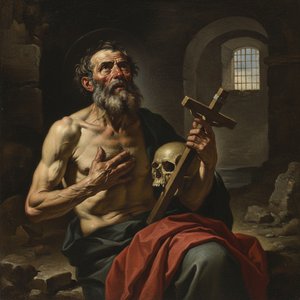
José de Ribera (1591–1652) har laget St. Peter. Det tilhører Baroque-bevegelsen. Den er laget i Oil On Canvas. Verket er bevart ved Museo del Prado i Madrid, Spania.
- Oil On Canvas
- Museo del Prado, Madrid

 Forhåndsvisning

 Håndmalt oljemaleri
 Send
 Del
 Utskriftsvennlig guide


 Last ned bilde
 Liknende objekter
 Røntgenundersøkelse
 Lysbildefremvisning
 Spørsmål og svar

 Statistikk
St. Peter: det viktigste
- Tittel
- St. Peter
- Kunstner
- José de Ribera (1591–1652)
- Kunstner født i
- Xàtiva, Spania
- Medium
- Oil On Canvas
- Hvor det kan ses
- Museo del Prado, Madrid, Spania
- Bevegelse
- Baroque
- Periode
- Early Modern
- Motiv
- man, beard, book, keys, cloak, brown
Hva forestiller St. Peter?
The Portrait of St. Peter by Jusepe de Ribera
In this oil painting on canvas, Jusepe de Ribera presents us with a portrait of St. Peter. The subject, a central figure among the apostles of Jesus and recognized as the first Pope, is rendered with a profound sense of presence. Ribera focuses on the man himself, capturing the weight of his role and the character of his lived experience. There is a quiet intensity in the way the figure is presented, inviting a closer look at the weathered details of his countenance.
The work is a significant example of the Baroque style. Through this approach, the artist emphasizes the spiritual and human dimensions of the apostle. The depiction avoids idealization, opting instead for a directness that feels immediate. By focusing on the specific attributes of the saint, Ribera allows the subject to command the space, presenting a figure that is both a religious icon and a man of flesh and bone.
Composition and Visual Elements of the Portrait
The composition is built upon a stable pyramidal structure, with the head of St. Peter forming the apex of the form. He is presented from the waist up, his body turned slightly toward the viewer's left. In his right hand, he holds a book and a set of keys, objects that anchor the figure within the frame. This arrangement directs the eye upward toward his weathered features, creating a sense of quiet, grounded presence.
A strong light source enters from the left, illuminating his face and upper body while casting the rest of the figure into deep shadow. This light creates a sharp contrast against a background that is nearly black, pushing the subject forward into the viewer's space. The color palette is restrained, dominated by warm earth tones—ochre, brown, and gold—which emphasize the textures of his skin and the heavy folds of his clothing.
Technique and Artistic Style of the Work
The work is defined by a profound use of tenebrism, where the subject emerges from a nearly black background into a sharp, focused light. This dramatic chiaroscuro creates a sense of volume, pulling the figure forward and emphasizing the physical presence of the man. Such a heavy interplay of light and shadow reflects the influence of Caravaggio, grounding the religious subject in a palpable, earthly reality. The light source, positioned to the left, carves out the contours of the face and the weathered texture of the skin, casting deep shadows that heighten the emotional weight of the portrait.
Ribera’s approach to the medium is tactile and deliberate. He employs a technique of layering paint to build up depth, allowing the viewer to sense the physical weight of the drapery and the coarse nature of the beard. Visible brushstrokes are not hidden; instead, they contribute to the overall effect, lending a sense of immediacy to the rendering of the fabric and the aged features. Strong, defined lines delineate the eyes, nose, and mouth, providing a structural clarity that balances the more fluid, organic shapes of the figure. The result is a composition that feels both intensely personal and physically substantial.
Other Works by Jusepe de Ribera
The artist's exploration of this particular subject matter is reflected in several other significant pieces within our collection and major institutions. We hold St. Simeon 1 in our catalog, a work that speaks to the same profound human experience found in this portrait. Another notable piece in our collection is The Repentance of Saint Peter, which is currently housed in the Museum of Fine Arts, Lyon.
Beyond our own holdings, Ribera's preoccupation with the themes of remorse and spiritual weight is evident in other historical examples. The work known as Penitent St. Peter, dated about 1630, is held at the Kunsthistorisches Museum in Vienna. This piece shares a similar intensity in its depiction of the apostle's character. Additionally, The Tears of Saint Peter, which dates to 1612, is part of the collection at the Metropolitan Museum of Art in New York. These works collectively illustrate the artist's ability to capture the complexities of faith and the physical reality of the human condition through his characteristic use of light and shadow.
Hvilket museum har St. Peter?
Museo del Prado
Madrid, Spania
Historien til Museo del Prado Røttene til Museo del Prado er uløselig knyttet til den spanske kongeamlings samlinger, med en historie som strekker seg helt tilbake til det 18. århundre. Det som begynte som en visjon om et naturhistorisk kabinett under Ferdinand VII, utviklet seg etter hvert til et dedikert fristed for maleri og skulptur.


St. Peter i høy oppløsning
José de Ribera, St. Peter, Museo del Prado. Felleseie
En digital ekspert kontrollerer fargene mot originalmaleriet og retusjerer filen, tro mot kunstnerens penselstrøk.
Kjøp bildet i høy oppløsningSpørsmål om St. Peter
Hvor kan "St. Peter" av José de Ribera sees utstilt i dag?
Originalen av "St. Peter" av José de Ribera oppbevares i Museo del Prado, Madrid, Spania. En reproduksjon gjør det mulig å stille ut verket i eget hjem.
Hvilken teknikk er "St. Peter" laget med?
"St. Peter" er utført i Oil On Canvas.
Hva forestiller "St. Peter" av José de Ribera?
Temaene i "St. Peter" av José de Ribera inkluderer man, beard, book, keys, cloak, brown, gold, skin. Sammen oppsummerer de verkets motiv.
Er "St. Peter" av José de Ribera i det frie domene?
Opphavsrettslig status for "St. Peter" av José de Ribera: verket er fritt tilgjengelig – opphavsretten har utløpt. Dette avgjør om det er tillatt å lage frie reproduksjoner av bildet.
Hvem har skapt "St. Peter"?
"St. Peter" ble skapt av José de Ribera. Informasjonen på denne siden beskriver José de Ribera sitt originale verk.
Hvilken kunstretning tilhører "St. Peter" av José de Ribera?
"St. Peter" av José de Ribera tilhører Baroque-retningen. Denne retningen gir det stilistiske kontekstet til verket.
Hvilken fase av José de Ribera sin kunstneriske utvikling representerer "St. Peter"?
I José de Ribera sin karriere tilhører "St. Peter" Mature Period. Denne perioden gjør det mulig å sammenligne verket med kunstnerens øvrige arbeider.
Hva er årsaken til opphavsrettssituasjonen for "St. Peter" av José de Ribera?
Opphavsrettslig status for "St. Peter" – fritt tilgjengelig – opphavsretten har utløpt – følger av kunstnerens dødsår, 1652.
Ble "St. Peter" værende i kunstnerens hjemland?
Ja – kunstverket oppbevares i kunstnerens hjemland. "St. Peter" befinner seg i Spania, mens José de Ribera ble født i Spania.
Om kunstneren, José de Ribera

1591–1652, Spania
José de Ribera
A Life Forged in Shadow and Light Jusepe de Ribera, kjent for mange som Lo Spagnoletto – “den Spanske” – var en fremtredende figur i den barentalære perioden, en kunstner hvis lerret pulserte med dramatisk intensitet og nådeløs realisme. Han ble født i Xàtiva, Spania, i 1591, og hans reise tok ham langt fra sine valencianske røtter, og etablerte ham til slutt som en av de mest betydningsfulle malerne på 1600-tallet i Napoli, en by da under spansk styre. Riberas liv var ikke bare en kronikk over kunstnerisk utvikling; det var en fortelling vevd med vanskeligheter, ambisjoner og en urokkelig forpliktelse til å skildre den menneskelige tilstand i all sin rå kompleksitet. Selv om tidlige biografiske detaljer fortsatt er delvis skjult i mystikk, vet vi at han ankom Italia rundt 1607 og opprinnelig etablerte seg i Roma før han vendte seg mot Napoli i 1616 – en by som skulle bli både hans kunstneriske hjem og smeltedampen for hans unike stil.
Også av José de Ribera
 Magdalena Ventura med sin mann og sønn1631
 Klubbfoten
 St. Onuphrius1637
 The Duel of Women (The Duel of Isabella de Carazzi and Diambra de Pettinella)1636
Essays om St. Peter
 Mastering the Shadows: The Dramatic Power of Chiaroscuro and Tenebrism in Baroque Fine ArtExplore the profound drama of chiaroscuro and tenebrism. Discover how masters like Caravaggio used light and shadow to sculpt emotion and v…
 Masterpieces of Light: The Top 25 Artworks by Duccio di BuoninsegnaJourney through the divine elegance of Duccio di Buoninsegna. Explore 25 iconic Sienese masterpieces, from the Maestà to the Rucellai Madon…
 Jusepe de Ribera: Dramatic Realism & Spiritual Intensity in the Spanish Golden AgeExplore the powerful Baroque paintings of Jusepe de Ribera, master of tenebrism and dramatic realism. Discover his spiritual intensity, inf…