
 Forhåndsvisning
 Send
Send Del med andre
 Vis detaljer

 Last ned bildet
 Liknende objekter
 Røntgenundersøkelse
 Lysbildefremvisning
 Statistikk
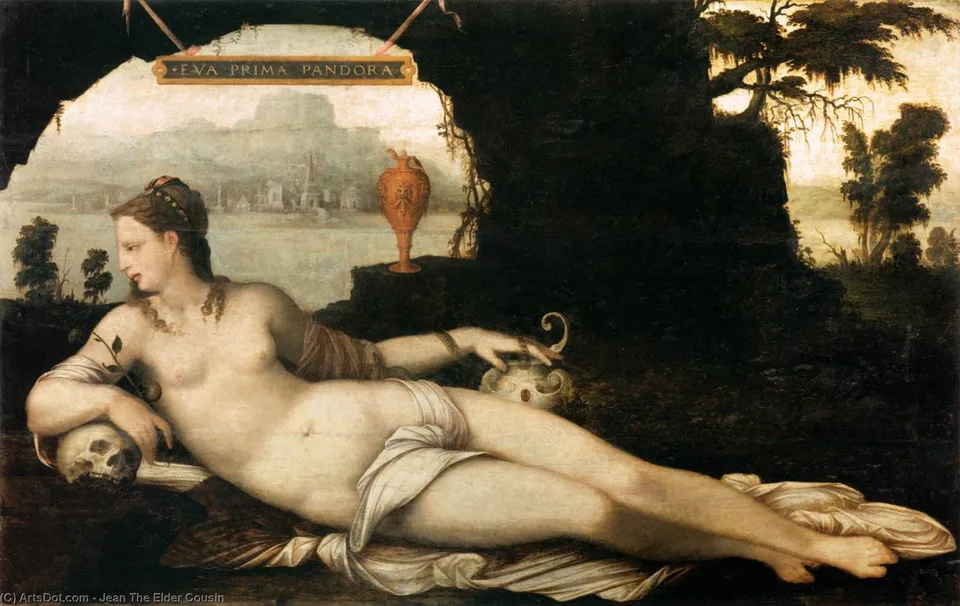
Eva Prima Pandora
 Oil On Canvas
- WallArt
- Renaissance
 1550
1550- Renaissance
 97.0 x 150.0 cm
 Louvre
 Vis hele teksten
Kjøp et høyoppløselig, forbedret digitalt bilde som er langt bedre enn forhåndsvisningen på nettet.
Hver fil er omhyggelig klargjort av våre egne spesialister ved hjelp av avanserte verktøy og profesjonell manuell retusjering. Vi sørger for at hvert bilde har eksepsjonell klarhet, presis fargegjengivelse og fine detaljer.
Den endelige filen leveres via e-post innen 72 timer, optimalisert for umiddelbar bruk i profesjonelle, redaksjonelle og trykte miljøer. Dette er den samme kvaliteten som benyttes av ledende designstudioer, utgivere og gallerier.
Digitalt bilde
Last ned en høyoppløselig fil for personlig bruk, utskrift og kreative prosjekter. ( Bytt til trykk Kjøp håndlaget maleri)
Inkludert i alle bestillinger av digitale bilder
Ekspert digital levering, garantert
Når du velger OriginalUniqueArt.com, får du ikke bare et bilde – du mottar et profesjonelt forbedret digitalt kunstverk, skapt med presisjon og med en garantert tilfredshetsgaranti. Her er alt som automatisk følger med din bestilling:

Rask digital levering
Din høyoppløselige digitale bildefil sendes til din e-post innen 72 timer etter bestilling – klar til umiddelbar bruk.

KI-forbedret digital fil
Ditt kunstverk blir profesjonelt optimalisert ved hjelp av avanserte AI-verktøy og manuell redigering, noe som sikrer maksimal detaljrikdom, klarhet og fargegjengivelse.

Gratis livslang nyutlevering
Har du ved et uhell slettet eller mistet filen din? Ingen bekymring – vi sender den på nytt når som helst, helt gratis.

Ingen importavgifter – noen gang
Nyt ditt kunstverk umiddelbart uten toll, avgifter eller leveringskostnader – digitale nedlastinger er alltid avgiftsfrie.

Garantert fargenøyaktighet
Vi sikrer at ditt digitale bilde gjenspeiler de originale fargene så nøyaktig som mulig ved hjelp av profesjonelle verktøy og fargehåndtering.

100 dagers tilfredshetsgaranti
Hvis du ikke er fornøyd med ditt digitale bilde, vil vi revidere det eller refundere 100% innen 100 dager – uten spørsmål.

100% Penggaranti
Ikke fornøyd? Få full refusjon innen 100 dager etter at du har mottatt din digitale fil – uten spørsmål.

Rabatt ved storkjøp
Kjøp 3 bilder, spar 10% - Kjøp 5, spar 15% - Kjøp 10+, spar 20%. Ideelt for kreative prosjekter, gallerier og byråer.
A Vision of Renaissance Intimacy: Eva Prima Pandora
To gaze upon Eva Prima Pandora is to step directly into the richly textured atmosphere of the French Renaissance. This captivating portrait, executed around 1550 by Jean Cousin the Elder’s circle, transcends a mere depiction of figures; it offers an intimate tableau vivant steeped in classical allegory and human vulnerability. The composition immediately draws the eye to the central grouping: a woman reclined with her head gently supported upon another person's lap. Her apparent nudity speaks not merely of undress, but perhaps of a state of profound contemplation or nascent awakening, themes that resonated deeply within Renaissance humanist thought.
Mastery in Form and Allegory
Jean Cousin the Elder, known for his rigorous study of anatomy and perspective, imbues this work with an undeniable technical brilliance. Observe the delicate rendering of flesh against the implied textures of drapery and skin; it speaks to a mastery of oil paint that allows light to seem almost palpable. Beyond the figures themselves, the surrounding elements elevate the piece from portraiture to complex narrative art. The inclusion of a bird perched delicately upon a vase near the upper register adds a touch of naturalistic grace, while the subtle placement of a skull in the lower left corner serves as a potent memento mori—a timeless reminder of life's fleeting nature juxtaposed against the enduring beauty captured on canvas.
Symbolism and Emotional Resonance
The interplay between these elements suggests a dialogue spanning life, death, knowledge, and repose. The reclining figure, perhaps embodying Pandora herself or an allegorical representation of nascent humanity, rests within a moment suspended between worlds. The presence of the skull anchors the piece in the contemplation of mortality, urging the viewer to consider the preciousness of the present moment. This emotional depth—this quiet confluence of beauty and inevitable decay—is what gives Eva Prima Pandora its enduring power. It invites the collector or decorator not just to admire skill, but to meditate upon existence itself.
A Touch of Renaissance Grandeur for Your Space
For those seeking an artwork that anchors a room with intellectual weight and unparalleled artistic pedigree, this reproduction offers a tangible connection to the golden age of European painting. Its scale (97 x 150 cm) allows it to command attention in a grand salon or library setting, while its subject matter—the beautiful tension between life's bloom and time's decay—provides endless conversation starters. Owning this piece is acquiring not just paint on canvas, but a carefully preserved echo of Renaissance contemplation.
Om kunstneren
Jean Cousin the Elder: A Renaissance Master of Anatomy and Perspective
Jean Cousin the Elder (ca. 1490–ca. 1560) stands as a pivotal figure in French Renaissance art, largely overshadowed by his son Jean Cousin the Younger but nonetheless recognized for his profound contribution to humanist ideals and artistic innovation. Born in Sens, France, he emerged from a family steeped in artistic tradition—his father, Jean Cousin the Elder, was himself a celebrated sculptor and painter who established a lasting connection with Albrecht Dürer, marking him as one of the foremost artists of his time. This familial legacy instilled within Jean Cousin the Younger an unwavering dedication to mastering both disegno (drawing) and geometria (mathematics), disciplines considered essential for achieving artistic excellence during the Renaissance.- Early Life & Training: Cousin’s formative years were spent honing his skills in Sens Cathedral, where he meticulously crafted stained-glass windows embodying biblical narratives—a testament to the burgeoning influence of humanist scholarship and theological contemplation. Simultaneously, he pursued rigorous mathematical studies, preparing for a career as a surveyor and demonstrating an intellectual curiosity that would permeate his artistic endeavors.
- Sens Cathedral Windows: The Sainte-Chapelle windows in Sens represent Cousin’s earliest masterpiece, showcasing his mastery of color and composition while adhering to the principles of linear perspective—a technique championed by Dürer and rapidly disseminated throughout Europe. These works exemplify the humanist impulse to depict religious subjects with anatomical accuracy and emotional depth.
- Parisian Career & Patronage: Moving to Paris around 1530, Cousin secured commissions from influential patrons – including Henry II – furthering his artistic reputation and establishing himself as a prominent figure in the Parisian art scene. He continued his work as a glass painter, creating stunning windows for Vincennes Cathedral, and skillfully blended classical influences with Northern European traditions.
- Notable Achievements: Cousin’s legacy rests primarily on two monumental achievements: “The Last Judgment” (Paris, Louvre) and the “Bible” illuminated by Le Clerc (1566 & 1571). The Last Judgement is considered one of the first French paintings to employ perspective with remarkable sophistication, capturing a dramatic scene with meticulous detail. His illustrations for Ovid’s Metamorphoses and Epistles demonstrated his exceptional draughtsmanship and artistic sensibility.
Jean Cousin the Younger: Continuing Tradition & Artistic Synthesis
Jean Cousin the Younger (ca. 1522–1595) inherited his father's artistic talent and established a workshop that flourished throughout the latter half of the sixteenth century, maintaining a stylistic continuity that captivated contemporaries. Despite scholarly debate regarding attribution—primarily due to the scarcity of surviving artworks—Cousin’s son undeniably absorbed and refined his father’s techniques, producing works characterized by elegance, subtlety, and an unwavering commitment to anatomical realism.- University Education & Artistic Style: Cousin the Younger studied at the University of Paris, reflecting the intellectual climate of the era—a period marked by humanist scholarship and a renewed interest in classical art. His artistic style mirrored his father’s, prioritizing meticulous observation of human anatomy and employing perspective with masterful precision.
- The Last Judgment Revisited: Cousin the Younger's rendition of “The Last Judgement” – rediscovered in 1872—stands as a cornerstone of French Renaissance painting. Its dramatic composition and nuanced portrayal of figures convey profound emotional resonance, cementing Cousin’s reputation as one of the foremost artists of his generation.
- Illustrations & Patronage: Like his father, Cousin the Younger served prominent patrons – including Henry III – undertaking commissions for illuminated manuscripts and decorative panels. His illustrations for Ovid's Metamorphoses exemplify his artistic prowess and underscore his dedication to conveying complex narratives with visual eloquence.
Influence & Legacy: Perspective & Anatomical Illustration
Jean Cousin’s influence extended far beyond his immediate contemporaries, shaping the trajectory of French Renaissance art and establishing him as a pioneer in anatomical illustration—a field that would soon gain prominence thanks to his son's groundbreaking work. His meticulous attention to detail—particularly in depicting human musculature—anticipated developments in scientific observation and artistic representation that would resonate throughout subsequent centuries.- Livre de Pourtraicture: Cousin’s magnum opus, “Livre de Pourtraicture” (1571), represents a seminal contribution to the burgeoning field of anatomical illustration. Published shortly after his death, this book meticulously documented human anatomy with unprecedented accuracy—a testament to Cousin's intellectual curiosity and artistic ambition.
- Rediscovery & Recognition: The rediscovery of “The Last Judgment” in 1872 propelled Cousin’s reputation back into the spotlight, prompting renewed scholarly scrutiny and reaffirming his place among the titans of Renaissance art.
Concluding Remarks: A Harmonious Synthesis
Jean Cousin the Elder and Jean Cousin the Younger's intertwined careers exemplify the harmonious synthesis of disegno and geometria—a hallmark of Renaissance artistic thought. Their collaborative legacy continues to inspire artists today, reminding us that true artistic excellence resides in a profound understanding of both form and substance—a testament to their enduring contribution to European art history.
jean the elder cousin
1522 - 1595