Baroque Landscape
Landscape (Gillis Van Coninxloo)
Gillis Van Coninxloo (1544–1607) har laget Landscape. Det tilhører Baroque Landscape-bevegelsen. Den er laget i Oil On Copper. Verket er bevart ved Museo del Prado i Madrid, Spania. Mål: 24 × 19 cm
- Oil On Copper
- 24 × 19 cm
- Museo del Prado, Madrid

 Forhåndsvisning

 Håndmalt oljemaleri
 Send
 Del
 Faktablad


 Last ned bilde
 Liknende objekter
 Røntgenundersøkelse
 Lysbildefremvisning
 Spørsmål og svar

 Statistikk
Landscape, kort fortalt
- Tittel
- Landscape
- Kunstner
- Gillis Van Coninxloo (1544–1607)
- Kunstner født i
- Antwerpen, Belgia
- Medium
- Oil On Copper
- Dimensjoner
- 24 × 19 cm
- Hvor det kan ses
- Museo del Prado, Madrid, Spania
- Bevegelse
- Baroque Landscape
- Motiv
- landscape, flemish style, baroque art, forest scene, castle architecture, atmospheric perspective
Hva forestiller Landscape?
A Flemish Master’s Woodland Reverie: Gillis van Coninxloo's “Landscape”
Gillis van Coninxloo’s “Landscape,” a captivating oil on copper panel, transports the viewer to a realm of serene contemplation within a meticulously rendered Flemish forest. Painted around 1598, this work stands as a pivotal example of the artist’s mastery in capturing the atmospheric depth and intricate detail characteristic of the early 16th-century Golden Age. More than just a depiction of nature, it's an invitation to lose oneself within a carefully constructed world of light, shadow, and subtle symbolism – a testament to van Coninxloo’s profound understanding of both landscape painting and the human experience.
The scene unfolds before us with remarkable realism. A dense thicket of trees dominates the foreground, their leaves rendered with an almost obsessive attention to detail; each vein, each curl of bark, is painstakingly observed and faithfully reproduced. These trees aren’t merely static elements; they create a palpable sense of depth, drawing the eye into the heart of the forest. Beyond them, a modest collection of buildings – likely farmhouses or small dwellings – nestles amongst the foliage, suggesting a quiet rural existence. The architecture is understated yet solid, reflecting a pragmatic approach to building within this natural setting. In the distance, a formidable castle rises above the horizon, its imposing silhouette anchoring the composition and hinting at notions of power, protection, and perhaps even isolation.
The Alchemy of Light and Shadow: Technique and Style
Van Coninxloo’s technical skill is immediately apparent in his masterful use of oil on copper. This medium allowed for a remarkable level of detail and luminosity – the surface retains a subtle sheen that enhances the richness of the colors and creates an almost three-dimensional effect. The artist employs a technique known as “chiaroscuro,” skillfully manipulating light and shadow to sculpt the forms and create a dramatic sense of depth. Notice how the sunlight filters through the trees, dappling the ground in pools of brightness while simultaneously casting deep shadows beneath the foliage. This interplay of light and dark isn’t merely decorative; it imbues the scene with a palpable atmosphere – a feeling of both tranquility and mystery.
Stylistically, “Landscape” aligns itself with the Flemish tradition of landscape painting, yet van Coninxloo departs from some of the more rigid conventions of the time. While influenced by the Northern Mannerist style—characterized by its emphasis on detail and symbolic imagery—he introduces a greater sense of naturalism and emotional resonance. The composition is carefully balanced, creating a harmonious whole that invites contemplation. The muted color palette – dominated by greens, browns, and grays – contributes to the overall feeling of serenity and timelessness.
A Window into 16th-Century Life and Belief
To fully appreciate “Landscape,” it’s important to consider its historical context. Painted during a period of religious upheaval and political instability in the Netherlands, this work reflects both the anxieties and the enduring values of the era. The castle, for instance, can be interpreted as a symbol of authority – whether representing secular power or divine protection. The humble dwellings nestled within the forest suggest a connection to the land and a reverence for rural life. Furthermore, the dense woodland itself has long been associated with themes of solitude, introspection, and the spiritual realm.
Interestingly, this painting was originally housed in the Museo del Prado in Madrid, Spain, a testament to its enduring appeal across national boundaries. The artist’s biography reveals a fascinating journey – from Antwerp to Germany and eventually Amsterdam—reflecting the shifting political landscape of the time. His work served as a bridge between artistic styles, incorporating elements of Mannerism while embracing the burgeoning realism of the Dutch Golden Age.
A Timeless Masterpiece: Reproduction and Inspiration
Reproductions of “Landscape” capture only a fraction of its original impact. The subtle nuances of light, texture, and atmosphere are difficult to replicate fully, but OriginalUniqueArt’s hand-painted reproductions strive to honor the artist's vision with remarkable fidelity. This piece offers an exceptional opportunity for interior designers seeking to evoke a sense of tranquility and connection to nature – imagine it adorning a study or a living room, providing a focal point that invites contemplation. Collectors will find “Landscape” to be a valuable addition to any art collection, representing a significant moment in the history of Flemish landscape painting.
For further exploration, we encourage you to visit the linked resources:
Hvilket museum har Landscape?
Museo del Prado
Madrid, Spania
Historien til Museo del Prado Røttene til Museo del Prado er uløselig knyttet til den spanske kongeamlings samlinger, med en historie som strekker seg helt tilbake til det 18. århundre. Det som begynte som en visjon om et naturhistorisk kabinett under Ferdinand VII, utviklet seg etter hvert til et dedikert fristed for maleri og skulptur.


Høyoppløselige bilder av Landscape
Fritlig eiendom: kunstneren døde i 1607.
Gillis Van Coninxloo, Landscape, Museo del Prado. Felleseie
Spørsmål om Landscape, besvart
Hvor kan "Landscape" av Gillis Van Coninxloo sees utstilt i dag?
Originalen av "Landscape" av Gillis Van Coninxloo oppbevares i Museo del Prado, Madrid, Spania. En reproduksjon gjør det mulig å stille ut verket i eget hjem.
Hvilken teknikk er brukt i "Landscape" av Gillis Van Coninxloo?
"Landscape" av Gillis Van Coninxloo er utført i Oil On Copper. Reproduksjonene har som mål å gjengi utseendet til denne teknikken.
Hva er målene på det originale verket "Landscape"?
De registrerte målene for "Landscape" av Gillis Van Coninxloo er 24 x 19 cm. Reproduksjoner kan bestilles i andre størrelser med de samme proporsjonene.
Hva forestiller "Landscape" av Gillis Van Coninxloo?
"Landscape" av Gillis Van Coninxloo avbilder: landscape, flemish style, baroque art, forest scene, castle architecture, atmospheric perspective, detailed rendering.
Er "Landscape" fri for opphavsrett?
Opphavsrettslig status for "Landscape" av Gillis Van Coninxloo: verket er fritt tilgjengelig – opphavsretten har utløpt. Dette avgjør om det er tillatt å lage frie reproduksjoner av bildet.
Hvem har skapt "Landscape"?
"Landscape" tilskrives Gillis Van Coninxloo.
Hvilken kunstretning tilhører "Landscape" av Gillis Van Coninxloo?
"Landscape" er et verk innenfor Baroque Landscape. Retningen angir den kunstneriske tradisjonen verket er en del av.
Hvilken periode i Gillis Van Coninxloo sin karriere tilhører "Landscape"?
"Landscape" representerer Gillis Van Coninxloo sin Late Baroque.
Er "Landscape" av Gillis Van Coninxloo i det frie domene (public domain), og hvorfor?
"Landscape" av Gillis Van Coninxloo er fritt tilgjengelig – opphavsretten har utløpt. Opphavsretten beregnes fra kunstnerens dødsår, og Gillis Van Coninxloo døde i 1607.
Om kunstneren, Gillis Van Coninxloo
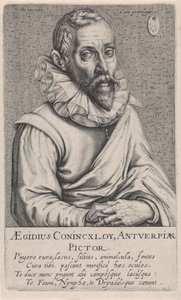
1544–1607, Belgia
Gillis Van Coninxloo
En mester av det grønne riket Gillis Van Coninxloo står som en sentral skikkelse i utviklingen av nordlig landskapskunst, og fungerer som en viktig bro mellom de intrikate manieristiske tradisjonene og den fremvoksende atmosfæriske dybden i den tidlige barokken. Han ble født i Antwerpen i Belgia, og hans liv var dypt sammenvevd med den rike kunstneriske arven i Nederlandene. Som sønn av en maler ble han oppslukt av en verden der håndverk og naturbasert observasjon var av største betydning. Hans tidlige opplæring under mestere som Pieter Coecke van Aelst den yngre og Lenaert Kroes ga ham et rigorøst fundament, men det var tiden i verkstedet til Gillis Mostaert som virkelig lot talentet hans blomstre, noe som gjorde det mulig for ham å bidra til profesjonelle verk samtidig som han foredlet sin unike visjon.
Om Gillis Van Coninxloo Fremtredende verk av Gillis Van Coninxloo
Også av Gillis Van Coninxloo
 Jonah Preaching to the Ninevites1583
 Woodland with Saint Jerome1583
 Landscape with the judgment of Midas1598
 Landscape with the Judgement of Paris1610
Essays om Landscape
 Masterpieces of Jan van Goyen: Top 25 Iconic Dutch LandscapesExplore 25 iconic Jan van Goyen landscapes from the Dutch Golden Age. Discover these tonal masterpieces on OriginalUniqueArt.com.
 Chiaroscuro & Shadows: The High-Impact Power of Moonlight in Masterpiece LandscapesMaster the drama of chiaroscuro and moonlight in classical landscapes. Explore the power of light and shadow now.
 Masterpieces of Nature: The Top 25 Artworks by Jacob van RuisdaelExplore 25 iconic Jacob van Ruisdael landscapes. Discover the soul of Dutch Golden Age art. Explore the full collection online at OriginalU…