Portrett av Denis Van Alsloot

De 28 mest kjente maleriene av Denis Van Alsloot, et gallerivalg

Oppdatert November 2026 · rangert etter vår popularitetsscore (søk, besøk og bestillinger for hvert verk) · 29 verk av Denis Van Alsloot i vår katalog

Kort fortalt

Av alle originalverkene Denis Van Alsloot etterlot seg, er det mest kjente Landscape with Castle and Hunting Scene (1608), som er en del av samlingen til Bonnefanten Museum i Maastricht. Like bak følger Forest Landscape with the Rest on the Return from Egypt (1608) og Diana discovers the pregnancy of Callisto (1610). Vår katalog inneholder 29 verk av Denis Van Alsloot; galleriet har bevart de 28 verkene som verden beundrer mest, hver vist med sin dato, sitt museum og sin historie.

1570 – 1626, Mechelen Flest verk: Museo del Prado

Denis Van Alsloots topp 10 malerier: galleriets utvalg

1
Landscape with Castle and Hunting Scene (1608) av Denis Van Alsloot

Landscape with Castle and Hunting Scene

1608 · Oil On Panel · Bonnefanten Museum, Maastricht

Sunlight breaks through a heavy canopy of leaves, spilling into a central valley where the air feels thick with the scent of damp earth and pine. In this lush, panoramic landscape, the eye is immediately drawn through a dark frame of towering trees, a technique that pulls the viewer deep into the heart of the Flemish wilderness. The scene is alive with a quiet, rhythmic movement; a fox hunt is…

3
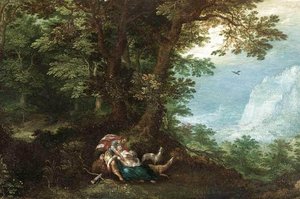
Diana discovers the pregnancy of Callisto (1610) av Denis Van Alsloot

Diana discovers the pregnancy of Callisto

1610 · Oil On Canvas · Staatliche Kunsthalle Karlsruhe, Karlsruhe

In the lush, shadowed depths of a dense forest, a moment of profound revelation unfolds within Diana discovers the pregnancy of Callisto. Painted by Denis van Alsloot between 1614 and 1620, the scene captures the sudden, silent tension of a divine secret being brought to light. The goddess Diana, the huntress, finds herself amidst a gathering of nymphs, her presence marking a shift from the tranquil rhythms of the woods…

4
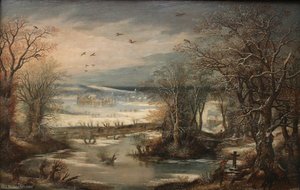
Winter Landscape (1610) av Denis Van Alsloot

Winter Landscape

1610 · Acrylic On Canvas · Louvre, Paris

A Winter’s Embrace: Denijs van Alsloot's Tranquil Landscape Denijs van Alsloot stands as a pivotal figure in the burgeoning artistic landscape of the early 17th century, embodying the delicate transition from Mannerist formalism to the radiant optimism of the Dutch Baroque. Born around 1570 – though precise biographical details remain elusive – his formative years were inextricably linked to the craft of tapestry weaving, a profession that instilled within him…

Utvalget av Denis Van Alsloot fortsetter, fra 11 til 28

Motivene som fanget Denis Van Alsloots blikk

De fire motivene som går igjen hyppigst i disse originalverkene, hver med sitt fremste eksempel.

Museene som har Denis Van Alsloots originalverk

De 8 museene som innehar flest av maleriene på denne siden.

Museum By Verker av Denis Van Alsloot Malerier fra denne listen
Museo del Prado, MadridMuseo del Prado Madrid 3 The Ommegang in Brussels: Part 1: Procession of Guilds, The Festival of the Ommegang in Brussels: the procession of Our Lady of Sablon, Skating during Carnival
Bonnefanten Museum, MaastrichtBonnefanten Museum Maastricht 2 Landscape with Castle and Hunting Scene, Winter masquerade with skaters
Bavarian State Painting Collections, MünchenBavarian State Painting Collections München 2 Winter landscape with masked ice skaters, Winter landscape
Israels Museum, JerusalemIsraels Museum Jerusalem 1 Forest Landscape with the Rest on the Return from Egypt
Staatliche Kunsthalle Karlsruhe, KarlsruheStaatliche Kunsthalle Karlsruhe Karlsruhe 1 Diana discovers the pregnancy of Callisto
Louvre, ParisLouvre Paris 1 Winter Landscape
Royal Museums of Fine Arts of Belgium, BrusselRoyal Museums of Fine Arts of Belgium Brussel 1 Chateau de Mariemont
Koninklijk Museum voor Schone Kunsten Antwerpen, AntwerpenKoninklijk Museum voor Schone Kunsten Antwerpen Antwerpen 1 Garden Festival at Diesdelle

Denis Van Alsloot tiår for tiår: originalverket som definerer hvert av dem

Verk per tiår

Velg et tiår for å se originalverket som definerer det.

Samlere spør om maleriene til Denis Van Alsloot

Hvilket verk er Denis Van Alsloot mest kjent for?Avslør svaret

Landscape with Castle and Hunting Scene (1608), Bonnefanten Museum, Maastricht. Deretter følger Forest Landscape with the Rest on the Return from Egypt (1608) og Diana discovers the pregnancy of Callisto (1610).

Hvor gammel var Denis Van Alsloot da Landscape with Castle and Hunting Scene ble laget?Avslør svaret

38 år gammel: Landscape with Castle and Hunting Scene er fra 1608, og Denis Van Alsloot ble født i 1570.

Hva er de ti mest kjente maleriene til Denis Van Alsloot?Avslør svaret

Landscape with Castle and Hunting Scene, Forest Landscape with the Rest on the Return from Egypt, Diana discovers the pregnancy of Callisto, Winter Landscape, Winter landscape with masked ice skaters, A wooded landscape with an amorous couple seated by a tree and elegant company strolling on a path near a river, A winter carnival with figures on the ice before the Kipdorppoort Bastion in Antwerp, Chateau de Mariemont, The Ommegang in Brussels: Part 1: Procession of Guilds og Winter landscape. Rangeringen ovenfor viser årstall og museum for hvert verk.

Hvor mange malerier etterlot Denis Van Alsloot?Avslør svaret

Vår katalog inneholder 29 verk av Denis Van Alsloot, datert fra 1599 til 1624.

I hvilke museer henger mesterverkene til Denis Van Alsloot?Avslør svaret

Hovedsakelig i Museo del Prado (Madrid), Bonnefanten Museum (Maastricht) og Bavarian State Painting Collections (München). Museumslisten ovenfor viser alle.

I hvilke år malte Denis Van Alsloot sine mest kjente verk?Avslør svaret

I 1610s: 7 av de 28 verkene på denne siden ble laget da, Diana discovers the pregnancy of Callisto av dem.

Hva er de første og de siste kjente originalverkene til Denis Van Alsloot?Avslør svaret

På denne siden er det eldste Winter landscape with masked ice skaters (1599) og det nyeste winter landscape (1624).

Hvilke motiver valgte Denis Van Alsloot oftest?Avslør svaret

Landscape (6), Trees (3) og Forest (3), fordelt på 28 verk på denne siden.

Hvilken teknikk brukte Denis Van Alsloot mest?Avslør svaret

Oil On Panel, for 2 av de 28 verkene på denne siden.

Hvilke verk av Denis Van Alsloot stilles ut på Museo del Prado?Avslør svaret

The Ommegang in Brussels: Part 1: Procession of Guilds, The Festival of the Ommegang in Brussels: the procession of Our Lady of Sablon og Skating during Carnival: Museo del Prado, Madrid har 3 av verkene på denne siden.

Denis Van Alsloot: liv og virke

A Life Woven in Landscape: The World of Denijs van Alsloot

Denijs van Alsloot, a name resonating softly through the annals of Flemish art, occupies a fascinating transitional space between the established traditions of the 16th century and the burgeoning Baroque dynamism of the 17th. Born around 1570 in either Mechelen or Brussels, Belgium, his origins were steeped in the craft of tapestry – his father’s profession providing an early immersion into design and visual composition. Though details surrounding his formal artistic training remain elusive, it's clear that this familial connection to textile arts laid a foundational aesthetic sensibility for the young Alsloot. He entered the Brussels Guild of St Luke in 1599 as a tapestry designer, initially focusing on this craft before gradually shifting towards painting, taking on his first pupil the same year and continuing to mentor apprentices until 1625. This period suggests a deliberate evolution, a honing of skills that would eventually blossom into a distinctive landscape style.

Courtly Commissions and Artistic Flourishing

A pivotal moment arrived around 1606 with Alsloot’s appointment as court painter to Albert and Isabella, the Archdukes who governed the Spanish Netherlands. This prestigious position not only provided financial stability but also thrust him into a world of influential patrons and significant commissions. The court became his canvas, demanding depictions of both grandeur and everyday life. He excelled at capturing scenes of civil processions, local festivals, and ceremonial events – vibrant snapshots of 17th-century Brussels society. Perhaps the most notable commission came from Archduchess Isabella herself: a request to paint eight panels commemorating the Ommegang procession of 1615, for which he was handsomely rewarded with 10,000 guilders. These works weren’t merely decorative; they were historical documents, preserving the spectacle and social fabric of the time. Alsloot's meticulous attention to detail ensured that these panels accurately reflected the costumes, architecture, and atmosphere of the procession – a testament to his commitment to artistic excellence and his understanding of the role of art in documenting history. He skillfully rendered the intricate decorations of St Jacques Square and captured the movement and energy of the participants, creating images that would endure as valuable records of Habsburg rule in Brussels.

The Sonian Forest School and Collaborative Spirit

Van Alsloot is often associated with the Sonian Forest school of landscape painters, a group who found inspiration in the sprawling woodlands surrounding Brussels. This association isn’t merely geographical; it reflects a shared aesthetic preference for depicting scenes from this particular environment – its dense forests, tranquil abbeys, and atmospheric perspectives. His series of views of abbeys within the Sonian Forest exemplifies this connection, showcasing his ability to capture both the natural beauty and spiritual significance of these locations. He frequently collaborated with Hendrick de Clerck, a painter specializing in *staffage* – the figures populating landscapes – creating dynamic compositions that captivated viewers. De Clerck’s vividly colored figures brought life and narrative to Alsloot's meticulously rendered backgrounds, enhancing the overall impact of their combined talents. This partnership demonstrates a willingness to embrace collaborative artistry, elevating his work beyond mere topographical representation.

Influences and a Developing Vision

Tracing Alsloot’s artistic lineage reveals a fascinating synthesis of influences. Early works demonstrate an affinity with 16th-century landscape painting, suggesting he studied the masters who came before him. The style of Gillis van Coninxloo is particularly evident, yet Alsloot's work generally possesses a calmer, more static quality, employing a softer palette and exhibiting greater precision in detail. He also absorbed elements from Jan Brueghel the Elder, skillfully blending these influences into his own distinctive approach. His artistic journey wasn’t simply imitation; it was an evolution. Starting with tapestry design, he gradually expanded his creative scope, embracing independent landscape painting and refining his technique over time. This progression demonstrates a commitment to growth and innovation, solidifying his position as a significant figure in the development of Flemish landscape painting – a precursor to the Baroque style that would soon dominate European art.

Legacy: A Window into 17th-Century Brussels

Though he passed away around 1626, likely before 1628, Denijs van Alsloot’s artistic legacy endures. His paintings are now held in esteemed museums worldwide, including the Museo Nacional del Prado in Madrid and the Victoria and Albert Museum in London, ensuring his work continues to inspire and captivate audiences centuries later. He is remembered not only for his technical skill – his topographical accuracy, atmospheric perspective, and meticulous detail – but also for his ability to document 17th-century life in Brussels. His depictions of festivals, processions, and landscapes offer invaluable insights into the social customs, architectural features, and natural beauty of the era. As a key representative of the Sonian Forest school and a transitional figure bridging earlier landscape traditions with the emerging Baroque style, Van Alsloot remains a significant subject for scholars studying Flemish art history – a testament to his enduring contribution to the visual culture of his time.